The seaside corpse, p.2
The Seaside Corpse, page 2
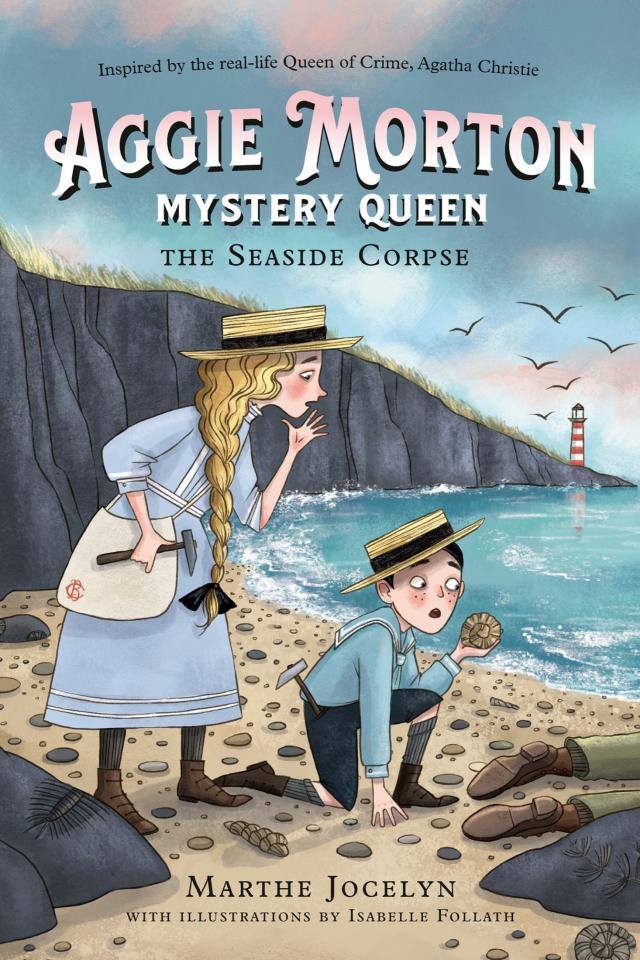


“The one and only Everett Tobie,” said James. Mr. Tobie doffed an imaginary hat and performed a sweeping bow. James put down our luggage, and the men embraced with quick slaps on each other’s backs. Hector bowed in his elegant Belgian way.
I said, “Pleased to meet you, Mr. Tobie,” and began a small curtsy, but was prevented by a firm shake of his head.
“I appreciate the effort,” he said, “but we are very informal, as you will see. Lord Greyson here would be horrified if he knew the truth of it. You’re to call me Everett and we all muck in as a team, right? That works best while camping. Save your fancy manners for the cook, if you know what’s good for you.”
That sounded ominous, but I could see he meant it in jest. We followed him on what he called the short route, winding through the small cemetery. I stopped to look at the stone for Here Lies Eliza Wembley, Beloved Wife, and Timothy Martyn, Not Forgotten, who had carved birds above his name. What better place to linger? Surely those who rested here deserved a few moments of consideration? Their time on earth—and their absence from it—were noted in so few words.
“It is a promising sign that you like graveyards,” said Everett. “A paleontologist must be drawn to the deep, dark past.” He paused beside a weathered stone marker. “Here’s the one you’ll want to notice.”
To the memory of Joseph Anning, it read, who died July the 5th 1849. Aged 53 Years, and then, Also of three Children who died in their Infancy. Also of Mary Anning, sister of the above. Her death date was inscribed as well, March the 9th 1847. Aged 47 Years.
“That’s a crowded grave,” I said.
“Joseph and his sister Mary were the first people to discover an ichthyosaur,” Everett explained. “The very first in the world, so far as anyone knows. She was twelve years old. And here we are, nearly one hundred years later, uncovering another on the very same beach.”
Hector and I, also twelve, lingered to stare at the historic marker.
“Ichthys,” said Hector, “is Greek for fish. And sauros means lizard. That’s where the name came from. Fish lizard.”
Everett’s eyebrows lifted. His first peek at Hector’s superior brain! “A scientist in the making!” he said. “I anticipate exciting days ahead.”
The walk was nearly twenty minutes, but neither James nor Everett complained about carrying our cases such a distance.
“There is a track that comes from the main road directly to camp,” said Everett, “but it’s used by wagons rather than fancy motorcars, and has ruts as deep as ditches.”
We arrived at an encampment of round canvas tents in a small meadow, a tiny village that made me think of Crusaders and jousting. A young woman with rosy cheeks and fluttery yellow hair came out to greet us. This was Helen, daughter of the cook and also his assistant—and now a childminder as well. Not that we needed minding!
“Hallo.” She bobbed her head at James but seemed more curious about Hector and me, examining us with friendly gray eyes. Helen was what my Grannie Jane called pleasingly plump, healthy and bosomy. She wore a flowered dress under her apron, sewn by herself, she told me later. Hector made his adroit little bow, but I only smiled. I’d been taught not to curtsy to servants or helpers.
“And this is Arthur.” Helen introduced the lanky boy lurking behind her. “Arthur Haystead.” He glanced at Hector and attempted his own bow in the direction of Lord Greyson, though he looked rather like a pecking rooster.
“Arthur is the third member of our Young Scientists League,” said Everett. “He lives in the village, but he’ll be staying with us at Camp Crewe for the fortnight. He submitted an informative essay on hagstones when he wrote to request a place with us.”
What was a hagstone? I felt a prickle of shame. Hector and I were here merely because James suggested we come, not for any knowledge about fossils.
“Hector,” Everett was saying, “you’ll be in a tent with Arthur and our other boy when he gets here, if that suits?”
“The pleasure is mine,” Hector lied.
“Oscar Osteda is from America,” said Everett. “He and his father arrive tomorrow.”
“Master Arthur, you’ll show our new friend where he’s to kip, right?” said Helen. “You’re with me, Miss Aggie. Thanks to you being a girl and needing a companion, these next two weeks will be like a holiday for me. I’ll be sleeping a few extra minutes in the mornings, instead of going back and forth to town with my father.” She picked up what she correctly guessed to be my case.
“Go on,” said James, seeing me hesitate. “I’ll take a look about with my governor’s eyes while you put your belongings away.”
* * *
The girls’ tent was circular and made of white canvas, low around the perimeter and high in the middle.
“Leave your shoes out here.” Helen slipped hers off, and obediently I did the same. “Less sand and grit inside that way.”
The tent seemed smaller within than it looked from the outside, and the air was stifling. The dome reached well above our heads, but our cots were set off to the sides where the slope of the roof made us stoop.
“Not to fuss about the heat,” said Helen, with a breathy laugh. “We won’t be in here much during the day, and the warmth is obliging enough to stick around at night. It’s cozy, but it’s nice that we’re only two. The boys are three in the same space.”
I pinned on a smile. I had not shared a bedroom, except with my dog Tony, since Marjorie went away to school five years ago. And here I’d be with a complete stranger!
“I made yours up.” Helen smoothed the dull green blanket that lay over a turned-back sheet and thin pillow. Two folded towels sat on the end of the cot.
“Thank you.”
“It looks worn, but it’s clean,” said Helen. “My mam is the laundress for the camp, and plenty of others in town. I’ll tell you one thing I don’t want to be, and that’s a laundress. Nor a cook, really, either. But I’m seventeen already, so if I’m not promised to be married soon…” Her voice trailed off.
Which of the thousand possible ways had she meant to finish that sentence? If I’m not promised to be married soon, I shall become an old maid with nine cats. If I’m not promised to be married soon, I shall run away to sea…
“Do you have a beau?” I whispered. Not a question one usually asked a stranger, but it seemed to be what she wished for…As if I’d dropped berry sorbet on a tea cloth, her face went pink that quickly.
“I do,” she said, “but you mustn’t say, not ever. My dad…” She wagged her head and widened her eyes. “He expects I’ll be helping him till I’m forty and toothless. I won’t be mentioning my Ned till it’s a sure thing, you hear?”
“I’m good at secrets,” I assured her. If I’m not promised to be married soon, I’ll be chopping onions till my teeth fall out.
Between the beds was a small packing crate in use as a table for a lantern, a speckled tin cup and a notebook with a pencil attached on a ribbon.
“Are you a writer?” I said.
Helen’s cheeks became rosier still. She moved the book from the crate to a place under her nubbly blanket. “That’s my diary,” she said. “Mostly twaddle, my mam would say, not that I’d ever show her.”
I began to pull my own notebook out of the pocket I’d stitched to my skirt especially to hold it, but a voice outside interrupted.
“Helen? Are you there?” It was the boy, Arthur Haystead.
“Lord Greyson wishes to say goodbye to Aggie,” said Hector.
“We’re coming.” Helen hopped up and I followed her into bright daylight. Arthur and Hector were mismatched sentinels: one tall and gangly, the other short and perfectly poised. Arthur’s sandy hair stuck up like summer grass, while Hector’s was as shiny and flat as new paint.
James and Everett were emerging from the biggest tent. The work tent, Helen called it.
“I have been with your hosts,” said James. “You will have an illuminating time of it here.”
“Thanks for the commendation, my lord,” said Everett, not in the least bit respectfully. James laughed and pretended to cuff him. Everett pretended it had been a fierce blow and reeled backward.
But then James turned to me. “Do let us know, won’t you?” he said. “How things are going? Marjorie and your mother will love to hear the news.”
“Yes, James,” I said, “I will write letters. And you needn’t add the bit about being good children and obeying our elders.”
James tugged on my plait. “Consider all instructions left unsaid. Except for the one about taking care not to fall into the sea. Look after each other. Your grandmother will arrive on Friday, for a weekend of sea air, and I shall collect you in a fortnight for another glimpse of the world’s best baby.”
He gave me a hug, and Hector a clap on the shoulder. Even Arthur received a salute. Then he strode off along the footpath toward the church and his lovely motorcar. He turned for a final wave, and I realized it was the first minute of the first week of my life when I would have no family within shouting distance. Hector pressed my hand. He’d been living in a whole other country from his parents and sister for nearly a year! How dare I make the slightest complaint? My mind spun back through the million hours Hector and I had shared during his time in England, a few of them scarily dangerous. For one night full of those hours in particular, he had shouted his throat raw with no one hearing.
I squeezed his hand in return, an optimistic promise that no such calamity would strike during this bright-skied, summery week.
Chapter 3
A New and a Very Old World
Everett directed Arthur to show us around, while Helen went to help her father with making our tea.
“If you please,” said Hector, “the Grand Tour.”
“I’ve been here since yesterday,” said Arthur, “so I know it all.” The Grand Tour meant that we stood on the grass in the center of a circle of tents as Arthur pointed to each in turn, naming its function.
“The biggest is the work tent, but I won’t show you inside right now. They’re still consumed,” he said. “Till the light goes.” He pointed to the next one. “Everett stays in the littlest tent, as he’s alone. Then ours, and the girls’, which you know already. The Blenningham-Crewes have the green one, over there by itself.” There were perhaps a dozen paces between each tent, and the length of a cricket pitch between us and the cliff overlooking the sea.
“Oh,” said Arthur, “and Nina says that repeating ‘Blenningham-Crewe’ fifty times a day is a waste of breathing time, and that we should call her Nina.”
“And monsieur le professeur?” said Hector.
“He’s Mr. B-C, or just B-C. His wife calls him Howard.”
“It is most unsettling,” said Hector. “Such familiarity with strangers.”
“We’ll be thinking of ways to avoid calling them anything,” I said.
Arthur laughed.
“What’s that canopy near the hedgerow?” I asked.
“That’s the shop yard,” said Arthur. “Two men from the quarry were hired on to build things, like crates for packing and tables for the samples. The cook tent is the other big one.” He led us in that direction. “It’s jolly clever.”
Helen leaned against a trestle table, sawing a loaf of bread into slices.
“Hallo again!” She waggled the bread knife and smiled.
“Everett says we eat at the tables under this awning, whether or not it’s raining,” said Arthur. “The cooking fires are on the other side, where the smoke won’t bother anyone. There’s an ice chest indoors and they’ve got stores of food and a place to chop things up.” He might have been giving us the tour of the Royal Armoury, his enthusiasm was so keen.
“The food is good?” said Hector in a low voice.
Arthur hesitated. “Well, there’s lots of it,” he said.
“Oh dear,” said Hector.
Helen had switched to a butter knife and was working her way down the stack of raggedly sliced bread. A large man was visible through the drawn-back flap of the tent behind her. Helen tipped her head toward him. “That’s my dad, Mr. Malone. But everyone calls him Spud.”
Hearing us, Spud came to the doorway to say hello. I could not help but think that his nickname was well chosen. He was shaped like a potato, bulging and lumpy, his head a second little potato precariously balanced up top. Tufts of hair sprouted from behind wizened ears beneath a white cook’s hat. He nodded gravely and returned within.
“He’s not in the best humor,” whispered Helen. She kept up a steady pace of buttering the bread. “The mutton stew is more of a bean soup, thanks to the butcher not showing up today.”
Hector sighed.
“I’ll ring the bell when tea is ready,” said Helen. Her buttering became even more slapdash for the last few slices.
“We’ll go and wash, shall we?” said Arthur.
“Yes!” said Hector. “The journey leaves me…you say in English, grubby?”
Arthur led us to a small rough-hewn shed backed up against a patch of shrubs. To one side was an enormous tank, sitting on a wooden platform. A spigot and a trough below turned it into the camping version of a basin with running water. The loamy aroma told us clearly what purpose the shed itself was meant for. Hector’s cheeks paled.
“It’s a bit primitive,” said Arthur, “but a good sight better than finding a tree to duck behind.”
I turned the tap and wet my hands. Arthur stepped up and quickly shut off the flow.
“The soap is there,” he said, “in the china cup. But you mustn’t let the water run while you’re sudsing. Every drop counts. Fresh water is brought out in these drums, by pony cart. My cousin Gordon loads the carts at the spring, only he’s away this week. Gone with my mum and dad to Cornwall, to visit my sick grandpa.”
“We’ll be careful about conserving water,” I said. “It’s an ingenious setup, isn’t it?”
I hoped that Arthur did not notice Hector’s mortified silence while he washed his hands and shook them dry as I had, there being no towel.
“Hereabouts we call it a backhouse,” Arthur said. “As outdoor lavatories go, this one is not so bad. They’ve dug the pit pretty deep under the bench.”
Hector squeezed his eyes shut. I could almost see his stomach clenching. On our way back to the circle of tents, I noticed that the path was edged with white stones. Would they glow in the moonlight to show the way?
Everett joined us at the tea table. We still had not seen the Blenningham-Crewes.
“Oscar will arrive in the morning,” Everett told Helen as she put down forks and spoons and napkins, “so we’ll have another hungry boy for meals after that.”
“But not the father, right?” said Helen.
“Mr. Alonso Osteda is staying at the Royal Lion,” said Everett. “I don’t imagine that American millionaires are well-suited to camp cots or backhouses.”
“Not only millionaires,” Hector muttered. He stirred his bean soup without bringing the spoon to his mouth.
“Mr. Osteda has an estimable collection of dinosaur bones,” said Everett. “He was thrilled to hear about the ichthyosaur discovery, knowing he’d be here in time to see it. Nothing is settled, but a wealthy collector is never a bad friend to have!”
When we finished eating, we heaped our dishes in a tin tub. Another of Helen’s chores was doing all the washing up.
“I’ll fetch a jersey and meet you lot by the work tent,” Everett said. “The Blenningham-Crewes will be finishing up now that the light is fading. We can say hello and then walk over to the cliff to watch the sun go down.”
“A warning,” whispered Arthur, when Everett had gone. “I expect in Torquay you’ll have met women like Nina, but around here she’s…well, she’s different. She uses bad words, and calls people names. She dresses oddly. My mum thinks…well, my mum says she’s no lady. Not a lunatic exactly…but strange.” He tapped the side of his head. “You’ll see.”
As we neared the work tent, a man’s raised voice made us stop in our tracks.
“Like it or not, if you want your research published, it will be under my name! The Royal Society—”
“The Royal Society,” came a female voice, “is as stuffy and narrow-minded as a priest. If cowards like you accept the rules, and women back down without putting up a fight—”
“You risk being a thorn in their side more than a respected scientist.” It must be Professor Blenningham-Crewe, speaking with his wife.
“The purpose of science,” she said, “is to ask questions and to avoid assumptions. My question is, if women are not excellent scholars, then why are men like you willing to take credit for our work?”
Arthur signaled that we should retreat. Hector and I had begun to inch backward when the tent flap whipped open. Out came a man whose face blazed with fury.
“Who are you?” he snapped. “Lurking about, listening at keyholes.”
We scuttled aside as he barged past. A woman appeared in the opening. Light auburn hair and flashing hazel eyes in a pale face.
“Not a bloody keyhole in sight,” she said. “Come in, please. Don’t be afraid of the wicked wolf. You must be our new Young Scientists. My name is Nina.”
She wore a loose linen tunic the color of toffee. This was not so remarkable, though the garment was more like a gentleman’s nightshirt than anything a lady would normally wear. Over it, she wore a man’s canvas waistcoat, its several pockets bulging with tools of her trade. This seemed wonderfully practical. Her lower half held my attention for a moment longer than was polite. Loose trousers were buttoned below her knees, like a pirate’s knickers. She wore no stockings and, indeed, no shoes! She welcomed us into the tent as if it were a shrine and she the guardian of holy relics.
Two long, low tables stood against the canvas walls, each covered—truly covered—from end to end and from corner to corner with lumps and knobs and rocks and shards, most between the size of a doorknob and that of a dinner plate. The first impression was of strewn rubble more than a valuable contribution to science. A closer look showed that the larger items were each painted with a small white square, while the smaller pieces had white cards tied on with string. A few lines of careful printing in india ink cited the date and location of discovery, the finder’s identity and the name of the species to which the specimen belonged.