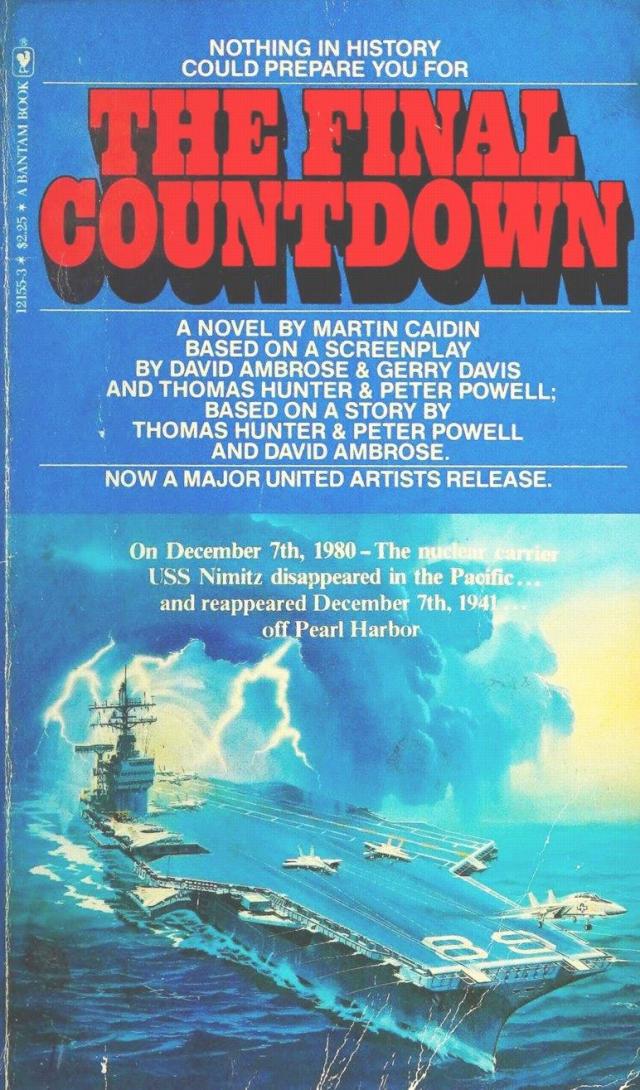
The final countdown, p.1
The Final Countdown, page 1


DECEMBER 7, 1980
There is a storm approaching that your ship’s computer says is impossible … Within a second the bottom of the ocean drops and the hair on your neck stands up as a tunnel of water envelopes you, hurling your ship from front to back and whisking jets along the deck like model planes …
DECEMBER 7, 1941
The sea is calm at once … But the sun is twelve hours further behind you and the only radio you can receive is a public broadcast from the President … Franklin Delano Roosevelt. When the recon planes you’ve sent to base at Pearl Harbor report a fleet of Japanese bombers forming to attack, you face a decision that cannot be made … and the Final Countdown has begun!
THE
FINAL
COUNTDOWN
A novel by Martin Caidin
based on a screenplay by David
Ambrose & Gerry Davis and Thomas
Hunter & Peter Powell; based
on a story by Thomas Hunter &
Peter Powell and David Ambrose.
THE FINAL COUNTDOWN
A Bantam Book / August 1980
All rights reserved.
Copyright © 1980 by Polyc International B.V.
Cover art © 1980 by Polyc International B.V.
This may not be reproduced in whole or in part, by
mimeograph or any other means, without permission.
For information address: Bantam Books, Inc.
ISBN 0-553-12155-3
Published simultaneously in the United States and Canada
Bantam Books are published by Bantam Books, Inc. Its trade-mark,
consisting of the words “Bantam Books” and the portrayal of a
bantam, is Registered in U.S. Patent and Trademark Office
and in other countries. Marca Registrada. Bantam Books, Inc.,
666 Fifth Avenue, New York, New York 10019*
PRINTED IN THE UNITED STATES OF AMERICA
0 9 8 7 6 5 4 3 2 1
This book is for a fellow time traveler
Vern Renaud
THE
FINAL
COUNTDOWN
Contents
THE FINAL COUNTDOWN
1
2
3
4
5
6
7
8
9
10
11
12
13
14
15
16
17
18
19
20
21
ABOUT THE AUTHOR
1
An airfield under the harsh midday sun is like a concrete desert, spliced with lines of asphalt, and spiderwebbing of paint and stenciled numbers and letters, and all manner of buildings bleached in shimmering heat The naval air station at Hawaii might never have been near the island paradise of the island name. A bone-white runway stretched for two miles beneath the pitiless light in the sky, lying on a line that was exactly east-west. At one end of the runway, a great slab-winged metal bird stood locked against its brakes, trembling from the subdued power of mighty engines. Inside the Plexiglas-domed cockpit the crew in brain buckets and pressure suits and hoses and lines enjoyed cold air streaming about their bodies. For the moment they were poised, men and machine a single entity, waiting for release by radioed voice from the control tower. The two crewmen glanced idly to one side where a big helicopter stood on the ramp, great overhead rotors turning, obviously on standby. They saw the reason. A long black limousine driving slowly toward the waiting chopper. The pilot of the powerful Grumman Tomcat fighter turned his attention back to the runway. Brisk winds, scattered clouds at four thousand, some haze on the horizon, and nice bright blue above that. A good day for winging it through the blue. His headset cracked with the voice from the tower.
“Tomcat One Zero One, wind two seven five at fourteen knots, cleared for immediate takeoff, make straight climbout.”
The F-14 pilot nodded imperceptibly to himself. “One Zero One rolling.” His hands moved only slightly, but thunder screamed a dinosaur cry as the engines went to afterburner and spat angry tubes of bright flame behind diem. Flame in one direction, knife-edged fighter in the other, and a breathless rush along concrete, an effortless sigh away from hard surface, and in moments the fighter was a dot and its thunder a fading hoarse whisper.
The helicopter crew had seen plenty of fighters leaving earth behind. They were more interested in two vehicles. That long black limo with darkened windows. You couldn’t see in but the people inside saw out clearly. The limo stopped a hundred yards away and didn’t move. From the other side of the helicopter another vehicle approached. A naval staff car. It slowed to a halt well clear of the rotors. The front right door opened and the chopper crew looked with open curiosity at the civilian who emerged. The copilot nudged the man by his side. “Stranger. Ever see him before?”
The pilot shook his head. “Uh uh. Mystery man. All I know is we’re under priority orders to wait for him, be nice, you know, the kid gloves treatment, and then move out when he’s aboard.” The pilot thumbed another button, called to a crewman. “Higgins, get your butt out there and. give that civie a hand. Bring him aboard pronto.”
“Yes, sir.” Higgins unhooked his communications line from the helicopter and dropped to the ground. By the time he reached the civilian the staff car was gone. The stranger studied him. “I’m Warren Lasky. Apparently you’re my transportation to, uh—”
Higgins threw him a casual salute. “The skipper’s expecting you, sir.” He gestured to Lasky’s side. “Is that your only bag, sir?”
Lasky nodded. “That’s all.” Higgins’s showed the question on his face. It was damned peculiar. A civilian gets dropped off on the flight line all by his lonesome, a large and fast helicopter is waiting for him, they’re on a priority mission, and the man has only this one small bag. Higgins studied the newcomer. Nothing special. Slacks and a sport jacket, open shirt, no hat. A man in his thirties, trim, an air of solid self-confidence. Higgins nodded, then extended the flight helmet he was carrying. “Mr. Lasky, if you’d put on the brain bucket before we get to the chopper? That way we can plug you into the intercom system as soon as you’re aboard.”
Lasky took the helmet, but for the moment he paused, studying the long limousine. He squinted in the sun for a better look at the big car. It didn’t help much. He could make out the outline of a driver behind the wheel, and behind those darkened windows there was a silhouette of some kind. Obviously someone was studying them. Lasky turned to the crewman, the question showing on his face. The man shrugged. “I don’t know a thing about it, sir. We’d better go.”
Lasky gestured impatiently. “Be with you in a minute.” He stared at the parked car. More intrigued than ever he started toward the vehicle. He hadn’t gone a few steps before the front door opened and an enormous man stepped out with a surprisingly lithe, quick movement. Lasky understood immediately; he’d seen enough skilled bodyguards to recognize the signs. The big man stood before him. “Sorry, sir. No closer.”
“Why not?” Lasky demanded. No response came from the other man. He looked impassively at Lasky and his message was implicit: don’t cross the line. The unspoken message even said “please,” and that came through in body language because that walking bludgeon could afford the courtesy. They held the standoff for several moments and then the other front door opened. Lasky looked with renewed interest at the second man approaching him. The walk was easy, the gestures friendly. This was Mr. Smooth, decided Lasky. Gray suit, vest, shoes gleaming in the sun, perfectly groomed and a right touch of a shock of white hair. He had executive written all over him and if his smile wasn’t genuine, it was certainly practiced, polished, and perfect. The businessman stopped directly before Warren Lasky and extended a hand.
“I’m sorry for any seeming discourtesy,” he said in a voice as silken smooth as any old-time radio announcer. “My name is Harold Elliott, and I’m executive assistant to Richard Tideman.” He paused to let the message sink in and Lasky quickly got the message. What the hell—he worked for Tideman, and in the same thought he realized he’d never seen Tideman. Or, for that matter, had he ever seen so much as a picture of the man who alone owned, managed, and directed Tideman Industries with an iron hand. Then he dismissed the thoughts because Elliott’s smile was getting almost as bright as the sun.
“Mr. Tideman is here,” Elliott said as if to confirm Lasky’s own thoughts. “He expressed a personal desire to see you off in the helicopter.’’ The conversation ended there, like punching a tape player to OFF in the middle of a song.
Lasky strained to see better, but the bright sun and dark windows thwarted his effort. “That’s Richard Tideman, himself? In the car? Look, I work for him. I’d like very much just to meet the man.”
Elliott mixed his smile with a slow shake of his head. “I’m sorry, Mr. Lasky. That won’t be possible. Neither is it necessary. Perhaps you didn’t hear me. As I said, he came here to observe your departure.”
The bodyguard hovered near by and Lasky recognized all the signs of futility. Lasky nodded slowly, then shrugged away further attempts. “Well, at least he feels I’m important enough to be sure I made it.” Elliott smiled, said nothing. “Thank him. for his interest ,” Lasky added, turning back toward the waiting helicopter, quite calm about the strange incident, but inwardly seething with questions. Why would the big man himself come down to a naval air station just to see Warren Lasky ge t into that helicopter? He could have gotten all the confirmation he wanted by radio or telephone or personal report. Too much here wasn’t visible. At the helicopter, the whirling rotors hurling wind at him, he slipped on the brain bucket, adjusted the straps with the help of the crewman, and climbed into the capacious cabin. He turned for a final look at the black limousine before the crew slid the door closed. The big car remained where it was, the bodyguard and the aide to Tideman standing where he’d seen them before. Lasky had a definite view of the dark silhouette behind the rear windows, and that was all.
He pushed it aside as the crewman directed him to his assigned seat on the canvas bench running along the helicopter cabin. He strapped in as the crewman hooked him up for intercom. “How do you read, sir?” came into Lasky s earphones. He nodded. “Loud and dear. Thanks.”
“Very good, Mr. Lasky. Well be taking off in a few moments. I think you’ll enjoy the view.”
Lasky looked about him, felt the chopper vibrating as the pilots fed power to the engines and the great rotors above spun ever faster. He heard the tower clear them for a rolling takeoff from their present position. “Ah, Helo Eight One Three, you’re clear for five hundred feet down the harbor.”
“Roger that. Eight One Three is lifting.”
More noise and vibration and the ground beneath Lasky fell away and behind him as the chopper lifted into the wind, tilted for an immediate turn, and soared easily to 500 feet. Lasky had a last glimpse of the black limousine and two small figures standing by the car, and then he turned his attention to the warships and other vessels in the naval harbor. He leaned closer to his window, turning in his seat for a better look at one warship in particular. A memory to time: the memorial to the U.S.S. Arizona, ripped apart by bombs and torpedos on a horrifying Sunday morning. December 7th, 1941. Lasky knew the dead crew had been entombed within the shattered carcass of the great battlewagon. Painted, kept gleaming as a memorial to the nations war dead, it was also packed with tourists.
Then they were across the last beachline beneath them. The crewman stood before Lasky, an embarrassed look on his face. “Sir, I forgot. Your life vest? Would you let me put it on, pleased
Lasky grinned. It was obvious from the look that this was one crewman who’d just gotten chewed out by his pilot for a memory lapse. He released his belt and put on the Mae West. He felt better for it. They had a lot of open water to cover before they’d touch down—at sea.
2
The paper rolled slowly from the curving print tube, extending across a set of mechanical arms that held it away from the machine for instant drying. Several men stood about the relay printout that was picking up signals directly from a meteorological satellite that was at that moment passing within a thousand miles of the great aircraft carrier. The men listened to the mechanical fluting and the gentle rustling of paper. A red light blinked on and a chime sounded, and with those two signals an automatic paper cutter released the sheet for the large roll within the metsat receiver. An officer picked up the printout and glanced at the jetstream pattern, idly noting cumulus buildups and other weather flows. Nothing unusual. He started from the weather center, headed for flight operations, and paused as a bulkhead speaker rattled.
“Attention all hands, attention all hands. There will be a launch test-firing of the Harpoon missile system from turret five at seventeen hundred hours. This will be a live firing. Repeat, this will be a live firing. All hands stand clear of the turret five area. All hands—”
The officer blanked out the announcement; with the weather good he wouldn’t be involved in the missile test. He left the weather center and went down a short passageway to operations. Inside the ops room, he carried the satellite picture to a bulletin board, smoothed it against the self-sticking surface, and closed a clear Plexiglas sheet over the picture. The officer made his first real study of the photograph and frowned at a black smudge over an area free of clouds. He opened the Plexiglas and tried to rub away the smudge. “Damn it,” he muttered quietly. “Got to do something about that facsimile system.” The smudge shouldn’t have been there. The ocean area was clean of any weather disturbances.
Other men joined him to study the picture. “Looks good,” one said. “See that cirrus? It’s high and thin. No sweat”
Another voice agreed. “Yep. No cumulus, no buildups, and the old man will be pleased. They’re calling for full optical track and recording all the way.”
“Good. We stay on schedule.”
A finger tapped the Plexiglas. “What’s that black area over there?”
“Just some crap from the machine, looks like.”
“Uh huh.”
“Okay, mark it off.” Lines from a grease pencil began to cover the Plexiglas overlay as the men marked wind patterns, upper jet streams, cloud movements; it all went down on a list at the side of the chart A weather officer shouldered his way into the group. He stood hulk-wide among the others. The nameplate on his uniform read L/CDR JOHN ARTHUR, but no one used his name. He was a full-blooded American Indian and he was known throughout the great ship as Black Cloud. Not too many men knew whether his name came from his Indian family or because he so often offered up so much stinking weather. Little matter; he’d carried the handle a long time and he enjoyed it.
“Looks neat,” Black Cloud said. “We can confirm in the clear for the next twelve hours.” He tapped the board. “These the latest numbers?”
“Right,” a lieutenant responded. “Severe clear out there. Winds out of the north at four knots.”
“Just like Miami Beach in the posters,” Black Cloud remarked. “I’m going topside with the poop. The old man wants this report in person.”
Black Cloud walked briskly along what appeared to be an endless passageway that was punctuated by oval-shaped watertight hatches—known as knee busters. He could have been in a subterranean chamber of a great city and in one way that’s what it was like aboard a great warship. Some men moved in his direction and a steady stream of men passed in the opposite direction. Black Cloud nodded or gave fast greetings to the ones he knew. He took a narrow, fast-moving escalator to a higher level, stepped off, turned to his left, and began to climb a zigzagging series of metal steps. The higher he went the more he liked it. He liked the sounds. A subdued hum; almost a muted chorus. Not from the machinery that could be heard down in the engine rooms or along the propeller shafts or in the maintenance shops. Up here it was all honey-smooth. Powerful electronic systems, radar shacks, computers. The war center, the place where the head honchos ran the whole works. This is where Black Cloud wanted to belong.
He entered a wide and spacious bridge complex, blinking with the unexpected glare of sunlight streaming through the great angled windows of the ops center, from where the carrier received its commands of life. All about him were men at their stations, some standing, others strapped into seats with helmets on their heads and thin lip mikes by their mouths. The crew was made up of the usual mix found aboard a carrier this size: most of the men were U.S. Navy; there was a contingent of marines on special duty-security, aide to the captain, and top staff officers— and there were a handful of civilians. There was a quite babble up here, the crosscurrents of information and decisions and command. Black Cloud worked his way through to a corner where he saw the captain sitting in an airliner-type seat that was flanked on either side by the great windows. Not only was Captain Matthew Yelland privy to every area within the ship though electronics contact, but from where he sat he enjoyed the satisfying view of watching his ship working. Looking down on the expanse of a magnificent aircraft carrier is both an enormously rewarding and a humbling sight. This carrier had more power in its innards than did most large cities. It carried enough firepower in its aircraft and ordnance systems to match everything turned loose during the Second World War by all combatants. Triple that, mused Black Cloud, or increase it by a factor of a hundred, when you considered some of the really big thermonuclear warheads. The flight deck reared eighty feet above the waterline, and the Nimitz’s huge nuclear turbines deep in her belly provided enough power for her computer-designed hull to outrun even a destroyer. Any time you can get a warship of 140,000 tons in that kind of shape and with that speed, you have in a single package the equal of an entire nation’s fighting arsenal. Nimitz was all that and more. Black Cloud pushed off his sudden mood of introspection and focused his eyes on the captain who was silhouetted against the stark sunlight glare behind him.