

Weird tales 360, p.1
Weird Tales 360, page 1


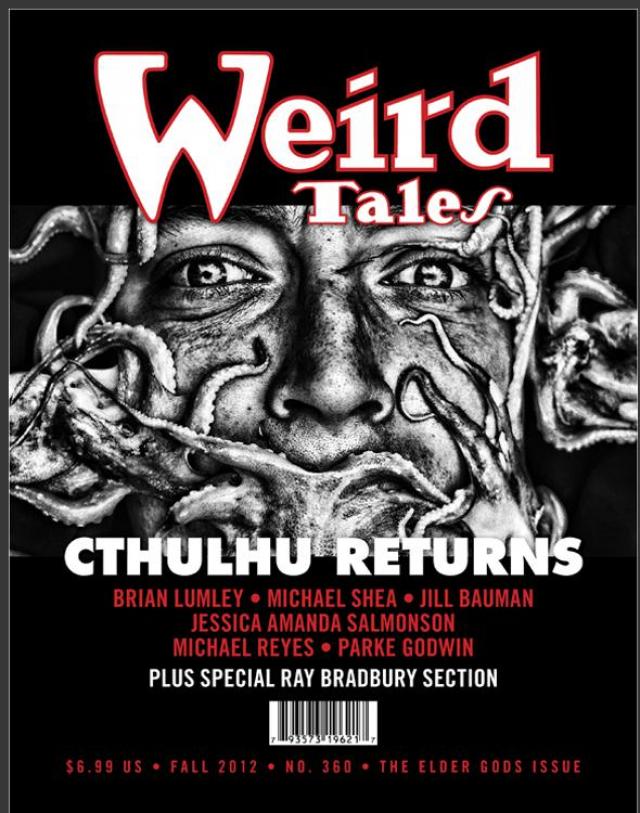
WEIRD TALES
VOL. 66, NO. 4 • ISSUE 360
Weird Tales was the first storytelling magazine devoted explicitly to the realm of the dark and fantastic.
Founded in 1923, Weird Tales provided a literary home for such diverse wielders of the imagination as H. P. Lovecraft (creator of Cthulhu), Robert E. Howard (creator of Conan the Barbarian), Margaret Brundage (artistic godmother of goth fetishism), and Ray Bradbury (author of The Illustrated Man and Something Wicked This Way Comes).
Today, O wondrous reader of the 21st century, we continue to seek out that which is most weird and unsettling, for your own edification and alarm.
Publisher and Creative Director
John Harlacher
Editor
Marvin Kaye
Managing Editor
James Aquilone
Contributing Editor
Kenneth Hite
Design Director
Jeff Wong
Consulting Art Director
Dave Buchwald
Public Relations
Terry Kaye
Editorial Consultant
Eugene D. Goodwin
Contributing Artists
Mark Bilgrey
Fabian
David Hartman
Danielle Tunstall
WEIRD TALES ® is published by Nth Dimension Media, Inc. Postmaster and others: send all changes of address and other subscription matters to 105 West 86th Street, Ste. 307, New York, NY 10024-3412. All rights reserved; reproduction prohibited without prior permission. WEIRD TALES ® is a registered trademark owned by Viacom International Inc.
THE EYRIE
Important Note—As this issue was being readied for press, we were saddened to learn of the death on June 5th of Ray Bradbury, one of America’s greatest fantasists. From 1942 to 1983, he contributed 26 short stories to Weird Tales. While our intent has been to honour the memory of H. P. Lovecraft in this edition of Weird Tales, we believe that it is also appropriate to dedicate this issue to the memory of Ray Bradbury. We have secured, with the permission of his literary agent, three examples of Ray’s writing: a movingly personal poem, a fascinating, little-known essay, and an extremely à propos short story.
—John Harlacher
Publisher
—Marvin Kaye
Editor
Weird Tales is an American trust.
Ever since 1923, for nearly four hundred issues Weird Tales has offered outstanding fantasy, mystery, science fiction, and unclassifiable weird fiction and fact, guided by a series of distinguished editors including (chronologically) Edwin Baird, Farnsworth Wright, Dorothy McIlwraith, Sam Moskowitz, Lin Carter, Gordon M. D. Darb, George H. Scithers, Darrell Schweitzer, John Gregory Betancourt, Stephen H. Segal, Ann VanderMeer, and now genre anthologist-editor-novelist Marvin Kaye, who, with John Harlacher, cofounded Nth Dimension Media, Inc., to continue the Weird Tales legacy.
Over its long life, the style of Weird Tales’s contents and appearance has evolved to reflect the expectations of its readers, as well as the taste and judgment of its editors, especially in the past few years. While some of its long-time readers have perhaps lamented the magazine’s latter evolution, its most recent incarnation has both dramatically increased its readership and won both Hugo nominations and awards.
So what’s next?
We must be Janus-faced. Some of the classic look and content of the 1930s-’40s-and ’50s will be brought back as an important part of the mix, for Weird Tales’s greatest years still capture the imagination of readers of all ages, thanks to the macabre power of such great contributors as Robert Bloch, Ray Bradbury, Robert E. Howard, Fritz Leiber, H. P. Lovecraft, Richard Matheson, etc. But we are also keenly interested in continuing and expanding the splendid work of Stephen Segal and Ann VanderMeer.
When Nth Dimension Media, Inc., purchased Weird Tales from Wildside Press, LLC, it also acquired H. P. Lovecraft’s Magazine of Horror, which ran from 2004 through 2009 in six issues edited by Marvin Kaye.
Weird Tales’s new publisher points out that there are no plans to bring back Lovecraft as a separate magazine, but it will remain an ongoing portion of Weird Tales. In fact, the current issue (# 360) pays special homage to Lovecraft by featuring new stories about the Elder Gods.
The editor, who still has a fairly large inventory of fiction intended for publication in H. P. Lovecraft’s Magazine of Horror, plans to secure rights to as many of these stories and poems as possible for inclusion in future issues of Weird Tales.
The new Weird Tales will be open to nearly all sorts of genre fiction and poetry, including, but not limited to absurdist humor, conte cruelles, fantasy, horror, new riffs on fairy and folk tales, as well as nonsense, terror, surrealism, possibly even theatre. The only kind of story that probably won’t fit would be neo-realism, though even here the editor is willing to be convinced otherwise.
The editorial approach to the Nth Dimension incarnation of Weird Tales will be similar to the way Mr. Kaye balanced content in his thirty-plus anthologies edited for the Science Fiction Book Club and other publishers:
• Stories by well-known authors, some of whom have already expressed interest in appearing (or reappearing) in Weird Tales, among them (though not limited to) Peter S. Beagle, Carole Buggé, Parke Godwin, Ron Goulart, Alan Dean Foster, Tanith Lee, Brian Lumley, William F. Nolan, Roberta Rogow, Jessica Amanda Salmonson, Darrell Schweitzer, Michael Shea, Jay Sheckley, Jane Yolen, and many more.
• Contributions by “midlist authors,” which means excellent writers who deserve to become better known.
• Newer writers culled from online submissions, as well as those discovered and developed by the editor during twenty-plus years of teaching fantasy and science fiction writing at New York University. Among the authors discovered and encouraged by the editor are Carole Buggé, Shannon Cork, Rachel Mann, Jean Paiva, Roberta Rogow, C. H. Sherman, Kathleen Snow, Kathleen C. Szaj, Carolyn Wheat, etc.
• A small number of reprints of classic stories from back issues of Weird Tales, as well as world literature.
Each new issue of Weird Tales will feature a presiding theme, although other stories and poetry will be included along with tales that fit the governing idea.
Our current issue is devoted to the Elder Gods and begins with a new novella by the great British fantasist Brian Lumley, followed by Cthulhu-ish stories from veteran authors Darrell Schweitzer and Michael Shea, and newer author William Blake Smith.
Also in this issue is a non-themed story by renowned fantasist Parke Godwin, who is my personal friend and often collaborator. I am grieved to report that at this writing Parke is convalescent; I am waiting for word from his friend and agent Connor Cochran (“Freff”) as to the condition of Parke’s health.
Our next issue of Weird Tales—# 361—will feature fairy tales/folk tales, with new stories by Dick Baldwin, Marc Bilgrey, Tanith Lee, Jane Yolen and a new tale from the great fantasist Peter S. Beagle.
—THE EDITOR
P. S. I just saw the new movie, The Cabin in the Woods, and highly recommend it. I was fortunate in not knowing anything about it beforehand, except that The Onion gave it an A- … which is an unusually high rating for that publication.
I don’t want to commit a spoiler, but there’s a strong reason why I felt I HAD to mention The Cabin in the Woods in Weird Tales #360!
—mk
Marvin Kaye, author of sixteen novels and editor of over 30 genre fiction anthologies, has had a long personal history with Weird Tales. Fascinated by the “creepy-looking” magazine that his sister Dorothy (now Dot Miller—of Florida) brought into their Philadelphia home, he was an avid fan by the age of nine. He edited two anthologies celebrating the magazine’s distinctive brand of fiction: Weird Tales - the Magazine that Never Dies, in 1988, and The Best of Weird Tales: 1923, in 1997. He also edited H.P. Lovecraft’s Magazine of Horror, which will become integrated into Weird Tales.
No novice to the world of fantasy and horror, publisher John Harlacher is director of “Nightmare,” an interactive theatre experience widely recognized as New York’s most horrifying haunted house. Last year’s motif, a creepy rendition of familiar fairy tales, was described by Fangoria as “entirely spooky and full of nasty, nasty fun … imaginative, and yes, hilarious and repulsive.” Harlacher also wrote, produced and directed the urban horror film, Urchin.
THE DEN
Historical Lovecraft: Tales of Horror Through Time
Edited by Silvia Moreno-Garcia and Paula R. Stiles
Innsmouth Free Press 2011
ISBN: 978-0-9866864-0-5
$14.99 USD/$16.99 CAN
There are many who believe that you cannot teach an Elder God new tricks, and that Mythos fiction has nothing new to offer; this anthology is elegant proof that they are mistaken. Spanning the globe and penetrating layers from the 20th century to the Late Neolithic, Historical Lovecraft is a highly original literary exercise, an archaeological excavation of the Abyss. The collection offers twenty-six tales in a variety of exotic settings, and each story gives the reader a vivid glimpse of cosmic horror through the eyes of a different culture. The cumulative effect is extraordinary, and represents an important leap forward in weird fiction.
What strikes me most about this collection is the way it exposes and probes the greatest weakness of Lovecraft’s literary corpus: the original author’s relentlessly white, middle-class, Anglo-Saxon and male worldview. The contributors to this volume, both male and female, come from many nations and professions; a field archaeologist in
This collection is the first full-length anthology offered by Silvia Moreno-Garcia and Paula R. Stiles, the dynamic editorial team at Innsmouth Magazine. Predictably, the good taste and hard work that they have poured into every issue of their Mythos fiction journal continue to shine through in their first published anthology. Historical Lovecraft stands head and shoulders above many competing publications for the consistent quality of its content. Although this almost completely new material is written by relative unknowns, each story is well-crafted and offers something new in its choice of viewpoint and historical moment. Some tales are translated into English for the first time from Spanish and French, a frequent grace note of Innsmouth publications. Beautifully designed and well-printed on crème paper, the trade paperback as an object also upholds a welcome standard of quality at a reasonable price.
In short, this is one of the most interesting forays into Lovecraft Country of 2011. The international influence of Lovecraft’s work, so easily visible in the Lovecraft film festivals of the last decade, is at last rebounding back to American shores in print. The ideas and images that Lovecraft introduced to the literature of the 20th century were designed to grapple with the existential crisis of the modern age, and that crisis was not confined to the English-speaking west. Lovecraft strikes a chord that rings true around the world, and authors from Europe, Asia and Malaysia, Mexico and South America are all turning to confront a very modern horror of the same eternal, universal and implacable forces: God and Death, the Stars and the Sea.
—Arinn Dembo
The Lovecraft Anthology Volume 1
Edited by Dan Lockwood
I was delighted when Weird Tales editor Marvin Kaye handed me The Lovecraft Anthology, Volume I. I accepted this graphic collection of stories adapted from those by master of the macabre H. P. Lovecraft with eager anticipation. Let’s face it, a graphic novel, or anthology in this case, is nothing but a comic book on steroids. And who doesn’t like reading comics? Of course, I’ve been a fan from way back, avidly absorbing DC and Marvel classics, thrilling to Will Eisner and EC reprints, flirting with Robert Crumb, and assaulting my eyes and funny bone with Mad, Cracked, Plop! and their ilk. I’d ingested years of splendid and varied art, speech balloons and narrative rectangles, and would be able to scrutinize with a practiced eye. Add to that my penchant for the incomparable stories of H. P. Lovecraft, here no doubt whittled down to a few scant lines, and I faced the possibility of being a harsher critic than propriety might dictate. Happily, such was not necessary.
This finely-produced, perfect-bound edition is published by Self Made Hero in London, which has used good quality paper and bold printing to make this trade-size book a real standout, suitable for display on bookshelves and coffee tables. Editor Dan Lockwood has brought together an impressive array of well-established authors and illustrators in the comic/graphic novel genre to bring Lovecraft’s stories to colorful, grisly life. Although, as with all anthologies, I prefer some of the stories to others, the selection makes a good first volume, and a suitable introduction to the unearthly, often gruesome conjurations that define Lovecraft’s writings. A fan of HPL, I am forced to admit that I haven’t read the originals in quite a while, so although familiar with the stories, characters and situations, I was able to view these adaptations as complete new entities, and not just as a comparison to the original author’s works. Any adaptation, virtually by definition, is bound to be diluted to some degree. Sometimes in comparing to the original this degradation is insurmountable. (Isn’t the book almost always said to have been better than the movie?) Taking a several thousand word story and slashing it down to fit in a few pages of boxes and ovals, while still keeping the heart and soul (twisted though they may be) of the story intact has got to be tough. Each of the volume’s six adapters, including Lockwood, who penned three of the seven tales himself, have managed to do just that. Each adaptation manages admirably to retain the flavor and pervasive creepiness of the original, and stands as a compelling narrative in its own right. At times I did find myself rescanning a frame or two, or flipping back a page to see if I might have missed something, but overall the reconstructions are comprehensible and flow well. Common wisdom tells us that “a picture is worth a thousand words”, and in these abridged accounts the contribution of the artwork to that end cannot be denied.
Each of the seven artists who contribute their creative vision have imaginatively rendered the background, and often foreground, for the text. Every story is illustrated in its own distinctive style, often utilizing specific color palletes. The variety of illustration techniques makes for an exciting and visually sumptuous feast for the eyes. Many are detailed and “realistic”, while others are more fanciful. All are slightly disturbing in what they portray, in several cases actually pretty gross, which is as it should be, given the bizarre and disturbing subject matter. Personal preference dictated that some styles appealed to me more than others, but in each case the technique and text were appropriately matched, and represent the finest in genre art. I was particularly impressed in several stories by the illustrator’s ability to create inspired visual images when nothing particularly graphic was suggested by the text, or where the story was left to unfold through pictures alone, rather than words.
Picture book layout is often an overlooked specialty, so vital to the success of a publication of this type, so kudos go to Andy Huckle, who is credited for both the layout and lettering. The layout of the book varies nicely, some stories with boxed panels neatly organized against a white background in the traditional way, some with panels or against full-size illustrations that bleed off the page. Various fonts are used for the easy-to-read lettering, and are boxed in solid white, or sometimes transparent panels which allow the underlying art to show through, or are left unfettered and superimposed directly onto the images in black or white as required.
Considering anything Lovecraftian as a “light read” is perhaps a contradiction in terms, however that is how I would classify this (and possibly any) graphic compendium. I enjoyed reading The Lovecraft Anthology Volume 1, and I think that any fan of macabre, otherworldly scenarios, stunning illustrations, and yes, even the unexpurgated writings of H. P. Lovecraft, will feel the same. I await Volume 2 with anticipation.
—Jon Koons
MUMMIFIED
BY JILL BAUMAN
Dying was the easy part.
Now I lie upon a slab
tightly wrapped,
bound to myself
become so hard and cold.
I am a feast for others.
My organs vandalized
crawling things
ravage me
nourish themselves
as I fall into ruin.
Examining myself
my outer self preserved
permanently
an eternal
monument
to my existence.
I leave my remains behind
my spirit hovers
for a while





