

Before i wake travels ac.., p.1
Before I Wake (Travels Across Time, Book 1), page 1


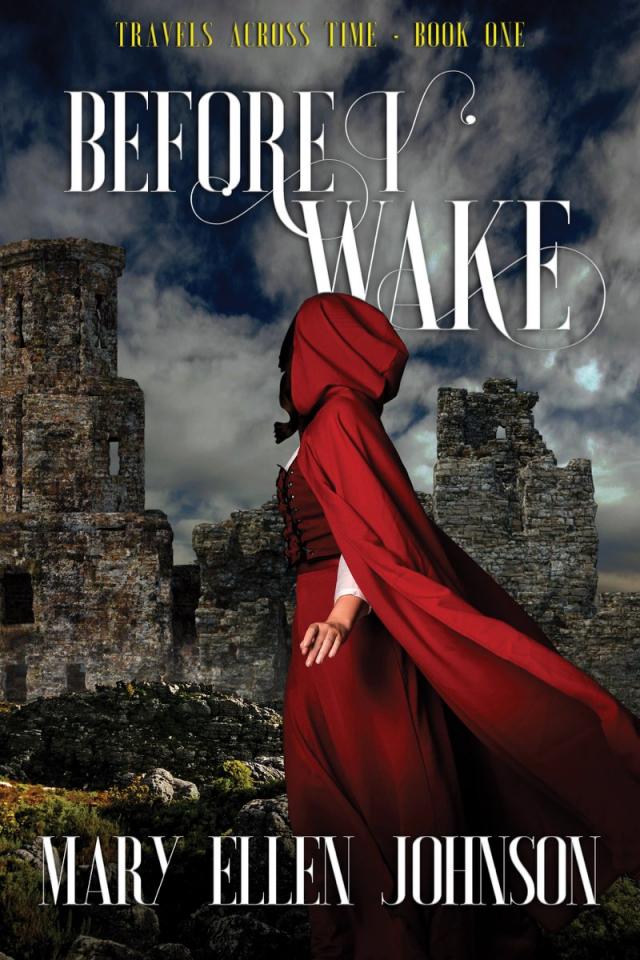
Before I Wake
TRAVELS ACROSS TIME
BOOK ONE
MARY ELLEN JOHNSON
By payment of required fees, you have been granted the non-exclusive, non-transferable right to access and read the text of this eBook. No part of this text may be reproduced, transmitted, downloaded, decompiled, reverse engineered, or stored in or introduced into any information storage and retrieval system, in any form or by any means, whether electronic or mechanical, now known or hereinafter invented without the express written permission of copyright owner.
This is a work of fiction. Names, characters, places, and incidents either are the product of the author's imagination or are used fictitiously, and any resemblance to actual persons, living or dead, business establishments, events or locales is entirely coincidental.
The reverse engineering, uploading, and/or distributing of this eBook via the internet or via any other means without the permission of the copyright owner is illegal and punishable by law. Please purchase only authorized electronic editions, and do not participate in or encourage electronic piracy of copyrighted materials. Your support of the author's rights is appreciated.
Copyright © 2022 by Mary Ellen Johnson. All rights reserved under International and Pan-American Copyright Conventions.
Cover and eBook design by eBook Prep
www.ebookprep.com
Published by ePublishing Works!
www.epublishingworks.com
eBook ISBN: 978-1-64457-328-0
Contents
Author's Note
Part One
Chapter 1
Chapter 2
Chapter 3
Part Two
Chapter 4
Chapter 5
Chapter 6
Chapter 7
Chapter 8
Chapter 9
Part Three
Chapter 10
Chapter 11
Chapter 12
The Haunting
Chapter 13
Chapter 14
Chapter 15
Chapter 16
Part Four
Chapter 17
Chapter 18
Part Five
Chapter 19
Answers
Chapter 20
Ranulf Navarre
Chapter 21
Chapter 22
Chapter 23
Chapter 24
Chapter 25
Chapter 26
Chapter 27
Chapter 28
Chapter 29
Chapter 30
Chapter 31
Chapter 32
Chapter 33
Chapter 34
Chapter 35
Chapter 36
Chapter 37
Chapter 38
Chapter 39
Chapter 40
Chapter 41
Chapter 42
Chapter 43
Chapter 44
Chapter 45
Chapter 46
Chapter 47
Chapter 48
Chapter 49
Chapter 50
Chapter 51
Chapter 52
Chapter 53
Chapter 54
Chapter 55
Chapter 56
Chapter 57
Chapter 58
Chapter 59
Chapter 60
Chapter 61
Reckoning
Chapter 62
Chapter 63
Chapter 64
Chapter 65
Chapter 66
Epilogue
Before You Go…
Eternal Beloved
Also by Mary Ellen Johnson
About the Author
Author's Note
I consider Before I Wake a memoir of the life I should have lived—if I were far more adventuresome and interesting and had actually been transported back to the thirteenth century.
Alas, none of that is true. I have written all the books mentioned, though under the name Mary Ellen Johnson or in the case of The Landlord’s Black-Eyed Daughter, as Mary Ellen Dennis. (Thanks to a good friend and co-author, Deni Dietz, who did all the heavy lifting on publication.)
The core of the story—my regression back to thirteenth century England and Ranulf Navarre—is essentially true and its essence has haunted me since I was a young wife and mother. Beyond that, as my character declares, I have always been more of an observer than a participant in life.
Regarding Tintagel, during the time of Before I Wake it had been deeded to Richard of Cornwall and not Ranulf Navarre. The other facts about Tintagel are as true as I can make them from my research. As is the unfolding of Simon de Montfort’s rebellion and the Battle of Evesham.
I hope you enjoy my fake memoir!
Mary Ellen Johnson
Part One
1969-1972
I have been here before,
But when or how I cannot tell:
I know the grass beyond the door,
The sweet keen smell,
The sighing sound, the lights around the shore.
You have been mine before,—
How long ago I may not know:
But just when at that swallow's soar
Your neck turn'd so,
Some veil did fall,—I knew it all of yore...
“Sudden Light”
DANTE GABRIEL ROSSETTI
One
I married Husband Number One, Dwight Latimer, the year after my high school graduation. Since few people officially dated in our small Colorado town, Dwight and I had kinda, sorta “hung out” for several years.
Dwight wasn’t really handsome—his ears stuck out and he had a cowlick that reminded me of Alfred E. Neumann—but he was charming with an infectious laugh and engaging personality. A natural salesman, Dwight’s goal after graduating college was to become a millionaire selling hearing aids.
“Think about it, Mugwump,” he said, using a pet name which had absolutely nothing in common with my actual name, Magdalena Moore, save for the first letter. “The only people interested in hearing aids are those who need them. Built-in client base.”
Hearing aid salesman wasn’t quite my idea of a proper profession. I came from a blue-collar background; my dad was a plumber, and I was thinking more along the lines of some sort of union apprenticeship.
But, okay, I’m game.
In the late sixties, young men enrolled in college fresh out of high school to evade the draft. Unfortunately, Dwight, who was three years older, had flunked out after one semester and, because of his low draft number, chose to join the Marine Corps. Which meant much of our semi-engagement was long-distance and low-key with phone calls from Camp LeJeune, where he was stationed, and occasional leave home. Until Vietnam escalated and Dwight, plus all the guys in his platoon, knew it was a matter of time before they received their deployment orders.
In the aftermath of the Tet Offensive, fighting had intensified. Five hundred thousand young men and counting, tossed into the maw of America’s war machine. The nightly news was a phantasmagoria of thwomping helicopters swarming like angry wasps across the sky; running or crouching or bivouacked soldiers; bombs dropped from screaming Skyhawks; body counts, body bags and row after row of flag-draped coffins disgorged from the belly of cargo planes. Our generation appeared to be bleeding out before our eyes. Plucked from high school football fields and small towns that displayed the Stars and Stripes all year round, not just on the Fourth of July. From family farms in the heartlands planting and harvesting crops many would not live to see. From sprawling metropolises with stacked high-rises and postage stamp lawns and failing public housing projects. Even a few from the wealthiest zip codes when the sons were particularly patriotic or such screw-ups that Daddy’s money or disapproval couldn’t shield them from the attendant consequences. Vietnam was a miasma hanging over us all.
Life was precious, the clock ticking. It seemed only natural that Dwight and I get married ASAP. Too caught up in being the faithful wife, my husband’s raison d’etre once he was shipped off, I didn’t notice that my fiancé was considerably less excited about being a groom than I was about being a bride.
After a tiny wedding in our tiny Catholic church, Dwight and I drove to California where the Marine Corps Air Station of El Toro was located. On summer weekends, we fled our cramped base housing for Huntington Beach. There we rubbed baby oil on our exposed limbs and alternated between sunbathing and paddling far enough out on the water to ride our Styrofoam boards back to shore.
Huntington Beach teemed with bare-chested young men and bikini-clad women whose wealthy parents purchased their custom-painted VW bugs and vans with surfboards strapped to their roofs; who stayed stoned and attended just enough college so that they, those privileged males, could maintain their draft deferments.
I felt like an outsider—Dwight with his regulation haircut and me with my fears that were universes beyond unwelcome tan lines and whether the Beachboys, Beatles, or the San Francisco sound was “groovier.”
“We’re grappling with matters of life and death here!” I wanted to scream at all those clueless hard bodies.
I just knew that the moment I let down my guard, the moment Dwight and I truly relaxed, he would receive his orders. I’ve always held the admittedly insane belief that if I worried in advance about the possibility of death, heartbreak, betrayal, bankruptcy, or a multiplicity of other disasters, I could prevent th em. Or, if not, at least blunt their pain when they actually occurred.
Ha!
The first time I saw the Pacific Ocean, I felt so inconsequential, as if I were less than a tear dropped upon its seemingly endless expanse. I liked boundaries. Where I could be cocooned by mountains and other landmarks, anchored to Mother Earth rather than cast adrift.
And yet, staring at the horizon, at the blue blanket that gradually faded into a pale smear of cloud and sky, something stirred within me. I’d not seen anything wider than the South Platte River, yet the Pacific seemed familiar. The blending of sea and sky, the immensity of the vista, even the caress of the ocean breeze evoked the oddest feeling. One I couldn’t quite name, as I couldn’t understand my reaction. Like when you can almost remember something, but it remains elusive, tucked away in a neglected corner of your brain.
Yet, much, much later I would look back on that day and realize this was the first of countless clues leading to the man I loved.
And hated…
Inevitably, Dwight’s orders arrived. During our final beach outing, we rode our Styrofoam boards, after which my husband scooped up a couple of beach towels from our blanket.
“Hey, Mugwump,” he said, wrapping a towel around me. “I’m gonna miss you.”
Dwight was largely undemonstrative, so I nestled gratefully in his arms, inhaling the wetness of the skin on his neck and collar bone—a curious combination of clammy and warm. Against my lips, his skin tasted of fish and salt from the sea. I closed my eyes to better savor the moment, only to experience the oddest feeling.
I have been here before.
I thought those words, the first line of Dante Gabriel Rossetti’s “Sudden Light,” a poem that had so profoundly affected me I’d memorized it in its entirety.
I was aware of strong arms around me, of that scent that had triggered a nagging…something. A longing of such fierceness pierced my heart that I gasped against Dwight’s skin. A whirlwind of thoughts and images came and went so swiftly I couldn’t differentiate one from the other.
I opened my eyes expecting…what? Certainly not this chatter of voices, not the pretentious yachts bobbing on the horizon, not the unfamiliar arms looped possessively around my waist or the freckled, sunburned flesh.
Despite the summer heat, I shivered.
What is wrong?
Could I be pregnant? Are my hormones already so unbalanced I’m going crazy?
While we packed up our gear and readied to leave, I still felt unsteady on my feet.
What if I’m not pregnant? What if this is some kind of portent?
A Creedence Clearwater song drifted across the blankets and umbrellas and baking bodies, crying about a bad moon on the rise. “Trouble on the way…Voices of rage and ruin…The end is coming soon…”
Does this mean my husband will die in Vietnam?
As you, dear reader, will soon notice, I pretty much always misread signs and premonitions, as I do the events in my life, both large and small.
Dwight most definitely did not die overseas.
But our marriage did.
On the night before Dwight left, we lay in bed, arms entwined. Both of us cried. My husband would be gone an entire year! At nineteen, that was an eternity. I’d hoped I was pregnant so that should anything happened to Dwight, I could at least carry on the Latimer legacy. I would see Dwight’s eyes in those of the son he would never hold and wept with the devastating beauty of it all. A young war widow. How tragically romantic. I imagined myself atop some high promontory, clutching my babe while the wind snapped my old-fashioned gown around my legs. Gazing out to sea, eyes on the horizon, chin jutting, determinedly facing the future without my spouse, who had somehow been transformed into a sea captain who’d gone down with his vessel somewhere around Cape Horn.
As it turned out, I wasn’t pregnant.
Point of fact: the imagined scene possessed about as much truth as my marriage.
Two
Nineteen seventy ushered in many changes. I landed a job as receptionist at Willow Wand, a small Colorado Springs publishing house, where I decided to become a famous writer. My best friend and maid of honor, Sherralinda Grant, who had become enamored of all things Eastern, struck out for India, determined to follow the Beatles in their quest for Enlightenment.
“Come with,” Sherralinda said, before departing. “We’ll be back way before your hubby’s tour is over.”
“If I’m going to travel, it will be to England,” I said, feeling noble and self-sacrificing. I was certain Dwight carried my photograph inside his wallet and a favorite letter near his heart in the modern-day version of a holy relic. The superstitious part of me feared that my daily correspondence, written regardless of how long my day or how little was actually happening in my mundane life, might be the only thing keeping Dwight alive. Otherwise, he could come down with terminal trench foot or step on some punji stick trap that would blow him to smithereens.
“Someday, we’ll travel,” I said to Sherralinda. “When Dwight is safely home and we’re more settled. Hey, we’ve got a lifetime ahead of us.”
True enough.
Just not a lifetime together.
Three
It’s kind of a trope to say that when America’s young men, who’d been tossing footballs one year and grenades in the jungles of Vietnam the next, returned home, they were all messed up.
Not Dwight. He came back pretty much the same. However, since I didn’t really know him all that well before his departure, I was in for some surprises. Such as the fact that my natural-born salesman husband ditched the hearing aid idea and decided he would make a fortune on pet coffins constructed of the finest corrugated cardboard. When that flopped, he moved on to used cars. Then timeshares on yet-to-be-built Colorado condos.
Increasingly, I was haunted by the feeling that I was marking time, accompanied by such a restlessness as if I were always fidgeting, always pacing, always checking myself lest I break into a run though outwardly I appeared calm enough. Increasingly, I distracted myself with writing. Character sketches, plot ideas related to my research on fourteenth-century England, short stories I hid away in my desk drawer, maudlin poems about sticking pins in the pin cushion of my heart and time bending in upon itself and searching for a lost love who refused to show his face.


