Blade 9, p.1
Blade 9, page 1


FRANK O’HARA
had a treasure. Everybody knew about it but nobody could find it. Or Frank O’Hara.
CHARITY CLAYTON
knew about the treasure and was after it. She was after Joe Blade too—which he didn’t mind.
EDDIE PRENTICE
was town marshal of Cheyenne. He wanted O’Hara, the treasure, and Charity Clayton. He also wanted Joe Blade so he could hang him.
JIMMY WHITTLE
was a pint-sized horse-thief with a giant ego. He’d kill to own a good horse. And frequently did. Which gave the clue to O’Hara’s treasure.
CLEOPATRA VIVALDI
was beautiful, passionate, greedy for men and gold—and claimed to be Mrs. Frank O’Hara. Only Frank didn’t know about it.
They were living out a violent human drama against the massive backdrop of the West. And with a stunning indifference to death, they were out to break the Montana Deadlock.
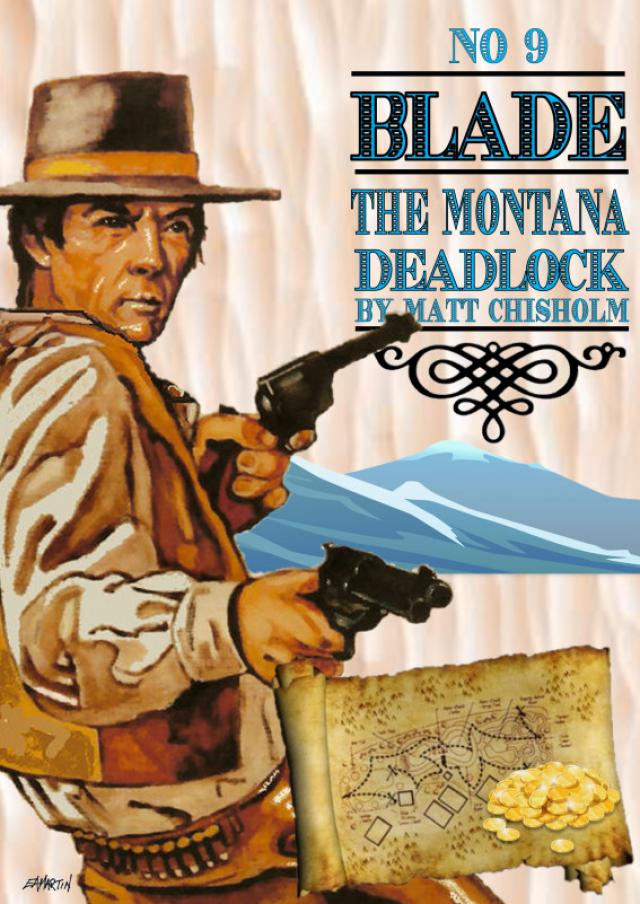
BLADE 9: THE MONTANA DEADLOCK
By Matt Chisholm
First published by Hamlyn Books in 1980
Copyright © 1980, 2019 by Matt Chisholm
First Kindle Edition: May 2019
Names, characters and incidents in this book are fictional, and any resemblance to actual events, locales, organizations, or persons living or dead is purely coincidental.
All rights reserved. No part of this book may be reproduced or transmitted in any form or by any means, electronic or mechanical, including photocopying, recording or by any information or storage and retrieval system, without the written permission of the author, except where permitted by law.
This is a Piccadilly Publishing Book
Cover Art by Edward Martin
Series Editor: Mike Stotter
Text © Piccadilly Publishing
Published by Arrangement with the Author’s Agent.
Chapter One
Joe Blade always hoped that it was not what he saw down the front of the lady’s blouse that made up his mind for him. But he would never have denied that it influenced him. Just as it should have influenced any red-blooded man worth his salt.
Maybe the eyes his gaze next met played their part in his decision too. They were certainly among the loveliest he had ever seen. Their bright clear blue contrasted dramatically with her soft dark hair. Cleo Vivaldi was a dramatic woman.
‘So,’ she said, ‘you will find this man for me? Even though it sounds impossible. I hear you always manage the impossible.’
‘For a thousand dollars,’ he said, ‘I’ll work a miracle.’
She produced a bundle of notes from a drawer in her bureau and handed them to him—‘There’s one hundred dollars advance, Mr Blade. Until you bring this man back to me, you undertake not to deviate from your search for him nor to undertake any other commission from other clients,’
‘That’s the agreement,’ he said.
She sat down and leaned back with a hand behind her head. This showed her figure to advantage, which was something it did not need. Blade reckoned she was playing the voluptuous female pretty heavily, but who was he to grumble? She played the female heavily from habit. It was her way of getting men to carry out her will.
He picked up his hat and turned it slowly in his brown hands—‘This may take a little time. Men sometimes don’t take kindly to coming to heel. He may take a little persuading,’
‘How will you persuade him, Mr Blade?’
‘That’s a professional secret,’ he told her.
He walked to the door and turned. She had not moved. ‘One last question,’ he said.
‘Ask it.’
‘Why do you want this man?’
She smiled. It was the first time he had seen her smile with genuine amusement.
‘He’s my husband,’ she said.
He smiled back at her—‘You must want him awful badly,’
‘Oh, I do,’ she said and he opened the door and left.
Blade walked out on to the Cheyenne, Wyoming, street. He liked Cheyenne. It was still young and raw; it was also impressive because it was young and raw. There were impressive new buildings going up. He walked down the street and turned right at the intersection. The building he entered was not impressive. It was the court-house and jail. Here the town’s chief of police had his office. He had four deputies working for him and that was impressive.
The marshal’s name was Eddie Prentice and he was a nice enough fellow. Nice enough, but not too nice. You can’t afford to be too nice when you police a place like Cheyenne. Blade asked him a few questions.
‘Joe,’ he said, ‘it’s good to see you. But I can’t help you? Honest to God, I can’t.’
Which meant either that he couldn’t help Blade or didn’t want to. You couldn’t tell from his face which it was.
‘Did Miss Vivaldi ask you to investigate his disappearance?’
‘Aw, sure, she asked. They always ask. But it ain’t my job to find men who have stepped out on women—even if it’s a woman like Cleo Vivaldi.’
‘What’s that supposed to mean?’
‘Didn’t you see her?’
They talked some more, but Blade did not learn one single thing about the disappearance of Frank O’Hara beyond the fact that a week or so back Eddie Prentice had taken a drink with him in a saloon called The Lucky Lady,
Eddie said: ‘I wouldn’t presume to tell a man like you his job, Joe. You know that. But you’re purely wastin’ your time, I don’t have to tell you men disappear like this all the time. There ain’t no other way of duckin’ out of a woman’s life.’
‘Who’d want to duck out of life with Cleo Vivaldi?’ Blade asked.
Eddie shrugged with a whimsical look on his face—‘Maybe you got somethin’ there. See you around, Joe.’
Out on the street, Blade stood and mused. The traffic went by without him seeing it. He took Frank O’Hara’s picture from his pocket and had another look at it. O’Hara’s face did not belong to a man who was not man enough for Cleo Vivaldi or any other woman. It was a good face, strong in bone and character. Not handsome, but the kind of rugged face women liked and kids trusted. Blade would bet his bottom dollar, if O’Hara had lit out running there was a perfectly good reason for it. He headed for The Lucky Lady.
There were five men in the large bar. Four were playing cards and the fifth was lying dead drunk in a corner from the night before. The bartender was a middle-aged careworn man with sad brown eyes.
Blade said: ‘Is your beer cold?’
‘Sure it’s cold. Do I look like an hombre who’d sell warm beer?’
‘I’ll have a beer.’
When the beer came, Blade drank down half and started asking his questions.
‘Sure I know Frank O’Hara. There ain’t a man in town who don’t know him. Askin’ me a question like that shows you’re a stranger around here.’
‘You say that like it’s a crime.’
‘Let’s say it don’t endear you to the old-timers,’
‘How long you been in Cheyenne?’
‘A whole year,’ said the barkeep proudly.
‘So where did Frank O’Hara go when he left here the last night he was seen?’
The barkeep looked coy. It was a touching sight.
‘It looks like,’ he said, ‘you’re awful bent on findin’ Frank. Like it means a heap of somethin’ to you. Like you’d put some monetary value on the information.’
‘Ten dollars American,’ said Blade.
‘A man could hurt his conscience lettin’ information like this go for a measly sum like ten dollars.’
‘Would twenty dollars hurt your conscience?’
‘What do you think I am?’
Blade said: ‘I know what you are. Now we’re fixing your price.’
The barkeep looked hurt. One of the card players started to laugh—which showed that at least one of them was eavesdropping the conversation. Blade turned and looked at the speaker. He was a small man with a big head. His eyes were knowing and his mouth was amused by what he knew.
Blade said: ‘Maybe you could tell me where O’Hara went, friend.’
‘You’re doin’ a deal with me,’ said the barkeep.
‘I was,’ said Blade.
The street door opened and the marshal, Eddie Prentice, walked in. His eyes took in everybody there and stopped on Blade. Then they flicked back to the bartender. The marshal looked a little flustered.
‘You won’t find what you want here, Joe,’ he said, but his words did not carry conviction.
Blade said: ‘If you keep to your side of the street, I will, Eddie.’
Prentice said: ‘Every side of the street is mine here, Joe. This is my town.’
The bartender said: ‘This man was askin’ us where Frank O’Hara went, Eddie. I don’t know where he went. Why should I?’
The card player said: ‘Nobody knows where Frank went.’
Blade finished his beer. He nodded pleasantly to the men there and headed for the door. As he went past the marshal, he said: ‘You were right, Eddie. This sure is your town. One of these days somebody’s going to take it plumb away from you.’
To Blade’s departing back, Prentice said: ‘That’ll be the day.’
Blade stood a moment on the sidewalk, thinking. Where was the one place in town where personal secrets were known? Answer—the cat house, of course.
Blade walked across town and came out on the flat between the town and the creek. Here was a large house separated from the rest by a couple of vacant lots. They looked a mess because everybody had thrown their trash here, cans and suchlike. In a nswer to Blade’s knock came a large negro.
To him Blade said: ‘Howdy, Sam. Miss Labutte to home?’
The big black man grinned and said: ‘She is to you, Miz Blade.’
This was the classiest whore house in town and Sam Lloyd played a very fine horn in the small orchestra that played here Friday and Saturday nights.
‘You-all go right along in,’ said Sam. ‘She in her room a-restin’.’
Blade walked into the heavily decorated hall. Here it was all velvet plush and gold paint. To the tired cow-poke and the jaded businessman, this was a kind of earthly heaven where a wife’s nagging and the cares of trade could be momentarily forgotten.
Dora Labutte was an overweight woman from London, England. She was in her late fifties and had a face like that of an ancient Cheyenne squaw. She never drank on duty, but she was off-duty now and she was drinking with the concentration that she reserved for serious things. She looked as prim as a preacher’s wife and her stays were giving her hell, but she would rather have died than appear in public without them.
‘Hello, Joe,’ she said. ‘Have a drink.’
‘I’d rather have some information,’ he said.
Her face cracked in the nearest she could get to a smile.
‘Let’s call it your birthday and give you both.’
He looked at the stiff figure of the woman bolt upright in the straight-backed chair. She looked unbendable and unbreakable. If Dora had any feelings, she kept them well hidden. Though she could turn on the phony variety for the customers without any trouble at all. He reached for the bottle of rye and poured himself a couple of fingers. When he had raised his glass to her, he threw the contents of the glass to the back of his throat. The fact that it was good whiskey did not surprise him. Dora demanded nothing but the best whether she was dealing in liquor or girls.
‘Frank O’Hara,’ Blade began and saw the shadow slide across her hard eyes. The name had warned her of his intentions. That shadow warned him that he was going to meet resistance here. The name obviously means something to you.’
‘Anybody who lived in this town means something to me,’ she said.
‘Did you ever hear where he went when he left town?’
The hard eyes snapped.
‘I stay in business because I mind my own damned business,’ she said. ‘You know that, Joe.’
‘Sure I know it. I’m hired by his wife to find him. She’s getting anxious.’
Dora was surprised. It took a lot to surprise her, but she was surprised.
‘Wife?’ she said. ‘For goodness sake where did you get the idea he had a wife?’ Dora never swore. It was not nice.
‘Cleo Vivaldi.’
‘Did she tell you she was his wife?’
‘Yes.’
Dora snorted. She said: ‘I know what kind that Vivaldi woman is. She’s as much of a whore as one of my girls. But she’s ambitious with it. She’s suckered you, Joe. I could see it a mile off.’
‘Nobody’s suckered anybody—yet.’
‘If she wants O’Hara—you find out why she wants him.’
‘You know where he went, but you ain’t telling,’ he said.
‘I don’t know nothin’,’ she said. ‘That’s gospel. But you watch out. You’re into somethin’ you don’t know about.’
‘Thanks for the whiskey and the warning,’ he said. When he reached the door, she stopped him with his name.
‘Joe, if s the truth. I don’t know a thing. Give me a couple of days.’
He smiled and said: ‘Thanks, Dora,’
He walked back into town again. He thought: a man reaped as he sowed. Years back he had done Dora Labutte a good turn and she had not forgotten. He could not even remember now what he had done.
He was staying at the Planter House, the best hotel in town.' Blade liked die best, though he so often endured the worst. The Planter House was run by two sisters. They were both good for trade, because they both looked good enough to eat. The meals they served were even better than that. How could men resist that combination? Their names were Flavia and Julia. Flavia was at the desk in the lobby. She was a tall stately blonde with grey eyes and a lazy smile that promised heaven.
‘Mr Blade,’ she said, ‘I have a letter for you.’ She reached for it behind her from the rack.
Blade was faintly puzzled. Nobody knew he was here in Cheyenne, well nobody who would want to write him a letter.
When she handed him the letter, their fingers touched for longer than was necessary. She smiled that lazy smile and Blade thought: A few extra days in Cheyenne would not be wasted. She smiled that lazy smile.
‘Excuse me,’ he said and opened the letter.
It was written in pencil. It simply said:
I herd you was alookin for Frank Ohara. For 50 dollars I mite tell you. I will be around Parsons corral around ten tonite.
He frowned and Flavia Planter said: ‘Not bad news, I hope,’
‘No,’ he said, ‘what do you know about Frank O’Hara, Miss Planter?’
She blushed and looked down at the desk top in front of her, Blade thought: So it was like that.
‘I don’t know him all that well, Mr Blade. I mean … my sister and I have met him socially. That’s all. A charming, intelligent and cultivated man.’
‘Married?’
‘Oh, no, not married.’
Five minutes later, in his room Blade took out his gun from his saddlebags, cleaned and loaded it. It was a Colt Frontier, forty-five with simple cedar wood butt. A good gun. When he strapped it on, he put it over his left hip with the butt forward so that it could be drawn more easily from under the skirt of his coat.
Chapter Two
It was night. A clear crescent moon lit thin drifting clouds. The air was crisp and clear, making a man feel pleased to be alive. As Blade walked across town to the livery stable and corral, he wondered if Frank O’Hara was still alive. A man had to be really afraid of something to separate himself from a woman like Cleo Vivaldi.
The traffic was pretty scarce on the streets now. The activities of the day had ceased—the perpetual bang of hammers, the clink of the bricklayer’s trowel as men threw up new buildings for the growing town. Nobody was on the streets except a few drunks and one or two night walkers. The respectable citizens touched their hats to him and wished him goodnight.
When he neared the corral, he saw there was a light in the barn on the far side. That would be Harry Haines, die liveryman. He had a house close by, yet he spent most of his time in the barn. Men said they didn’t blame him, not with a wife like his.
Blade halted by the corral fence and leaned on it. There were a dozen horses in the enclosure. Curious as horses are, a couple of them came over to investigate Blade. He stroked a muzzle and slapped a neck. They wandered off, satisfied.
Voices drifted to him on the still night air from the barn.
‘Mr Blade?’
‘Yes.’
A small man walked out of the shadow of a standing wagon.
‘I see you got my message.’
‘Who’re you?’ Blade demanded.
‘It’s no-never-mind who I am.’ The little man tried to thrust his chin out doggedly. There was not much of the chin, but there was plenty of moustache above it. ‘I hear you’re interested in where Frank O’Hara went.’
‘That’s so.’
‘Maybe I could take you to him. If the price is right.’
‘What sort of price were you thinking of?’
‘Hunnerd dollars.’
Blade thought he heard a faint sound behind him. He started to turn. In the same instant he was aware of quick and violent movement by the little man. Out of the corner of his eye he saw something descending on him from above. He seemed to have a glimpse of a cosh or small billy. He tried to duck under this and, at the same time, his instinct drove his right hand on to the butt of the Colt.
As it slid from leather, something cracked hard against the base of his skull at the back.
The next instant, he was aware of dirt in his mouth and knew that he was lying face downwards on the ground. As he tried to rise, a boot toe caught him agonizingly under the ribs and half-lifted him from the dirt. He heard the bones of his right hand crack as somebody ground a bootheel into it.
He knew the boot would try for him again. Desperately, he tried to flounder away from it, but it found him again and again. He rolled and, with enormous physical effort, he came up on his feet.