Blade 8, p.1
Blade 8, page 1


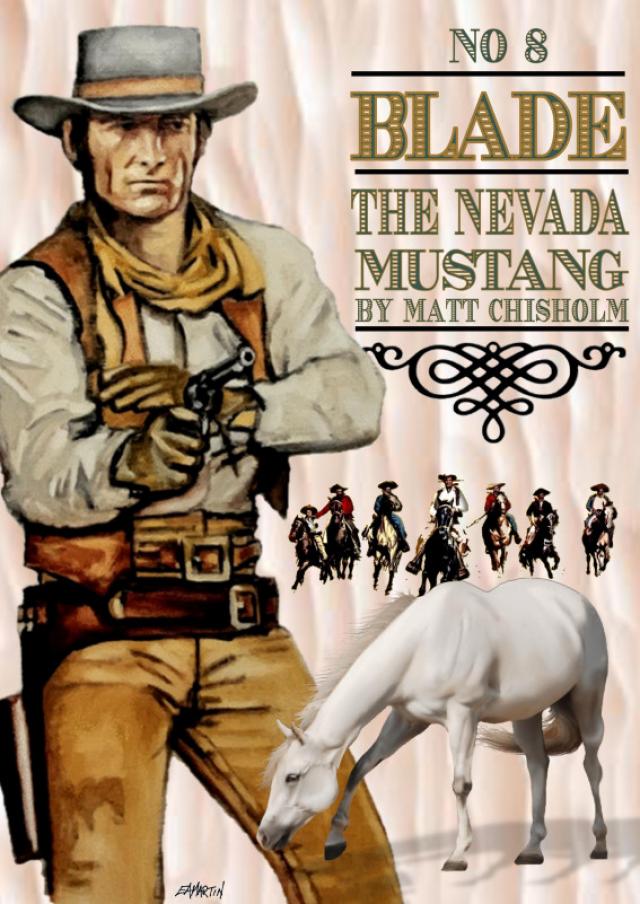
The Nevada mustang was the famous spotted stallion sought after by all men who had horse fever.
Chavez – the Mexican
Little Wolf – the Kiowa
Marty Carr – the gunman
and Joe Blade
They had one thing in common the hope that it would be their rope that snared the great Appaloosa mustang. And they were ready to kill for him. It was one of the greatest horse hunts of all time a hunt which led four men to their fatal destiny.
One
Common sense told him to run. Pride told him to stay.
He lay waiting in the alders with the dark ridges rising to the moon on either side of him. Death waiting for him in the shadows.
He could hear his horse moving uneasily among the trees. There was panic in the animal’s tones when it neighed. The kind that seized him when mountain lions were near. If there were Indians on the ridges, that would explain it. A horse that had been around whitemen all its life was always alarmed by the Indian smell. Just as an Indian horse would fear the smell of a whiteman.
He wondered how long he could stretch the patience of the men up there. If he stayed still, would they sooner or later be forced to rush him? If they rushed him, he knew he would cut some of them down. But were there too many for him? Did they want him so badly that they would sacrifice lives to get to him?
Those questions drifted through his mind as he tried to probe the gloom with his eyes and ears. He wondered if they knew his exact location. He found a small rock and tried the oldest trick in the book on the grounds that it was usually the time-honored ones that worked. He tossed the rock high and far and heard it crash lightly through the foliage. It got no reaction from his attackers whatsoever.
Far to his right along the ridge to the north of him, he heard a turkey-gobbler. But it was no bird that gave voice. Such a signal suggested Indians, but Blade was not going to fall for that one. Whitemen could learn bird and animal sounds as well as any Indian.
He wondered why they had attacked him. Was it a simple matter of theft? Had they shot at him for the sake of a horse and a week’s supplies? Well, he had seen a man with his throat cut for a single dollar. A world that could produce that kind of death could produce anything. A man wore out his capacity for surprise.
A coyote gave voice behind him. The sound was plaintive and prolonged. It sent cold shivers down the spines of experienced men years after they heard their first coyote cry.
As he waited, his common sense started to get the better of his pride, prompting him to belly out of the trees and, keeping to the bottom of the small valley along the edge of the water, make his way out on to the plain away from the ridges. When he thought about it, it didn’t appeal to him. That would mean leaving his horse. And that was no ordinary horse. The two of them had been through much together and come a good many miles in each other’s company.
No, he thought. I’m damned if I go without the horse.
A twig snapped under a human foot.
Blade stood up and stood flat against the trunk of a tree.
Five minutes passed and he heard the deep breathing of a man under stress. A moment later, he could smell the fellow’s sweat and was certain then that it was a whiteman. The man appeared suddenly, soft-footed, tensed.
Blade swung his Winchester carbine and caught the man in the belly. The fellow jack-knifed forward. Blade drove the end of the butt at his head. With nothing more than a grunt the man pitched forward on to his face.
Blade started through the trees towards his horse. He gambled on there being two or at worst, three men. This fellow had come from the north, so the north ridge should be open or not so closely guarded, which was maybe the best chance he should expect.
He reached his horse and thrust the Winchester into the saddleboot. The horse began to quieten down now that Blade was near it.
A man’s voice said: ‘Hold it!’
Without a second’s hesitation, Blade drew and fired. No more than once. The man cried out, ‘Oh, my God!’ and fell backwards into some brush. Blade did not wait. He got into the saddle as fast as he knew how and yelled to the dun. The sturdy animal got its legs under it and ran. It took the small creek in a long stretching jump, hit the grade on the far side and went up it nimble as a goat.
As he topped the ridge, a rifle gave out a flat report below and Blade knew for sure that there were three or more men in this. Then they were going downgrade, the dun sitting on its haunches and keeping its front legs stiff. When it hit the flat, it ran again, stretching for Blade with its best. He ran for a couple of miles before drawing rein and listening.
Just the normal night sounds no pursuit.
Now, Blade was faced with the problem of Chavez. Not much had been attained if he had saved his own skin and failed Chavez. After all, Emilio Chavez was not just another Mexican, he was Espada flesh and blood. A kinsman. Nobody ran off and left a kinsman in trouble. Nobody worth their salt, that is.
He ground-hitched his horse and walked thirty feet from the animal, so that he could concentrate on the sounds of the night without being interrupted by horse noises. At first he heard nothing but the soft soughing of the wind through the grass, but, as he persisted, another sound reached his ears. He could hear a horse running slightly to the north-west of him. The distance was about a mile. He thought he could see a distant shadow flit in the moonlight, but he could not be sure.
The distant hoofbeats stopped suddenly and Blade could picture the rider, much as he was himself, listening intently to the night.
Blade hooted three times with the note of an owl. There was a pause and two hoots came back. Which meant that it was Chavez. Or should be. Blade was never a man to take chances. He ran back to the horse and pulled his Winchester from its saddleboot. Now he could hear the beat of the horse’s approach clearly. Two hoots came clear and Blade replied with his three. Now he could see the dark form of man and horse on the face of the prairie.
When he was closer, the rider halted in caution and called. Blade told him to come ahead. As always when they were alone, they spoke Spanish. A moment later, Chavez was stepping down from the saddle. ‘Por Dios, José circumstances had me very much afraid back there.’
‘You weren’t the only one,’ said Blade. ‘Do you have any idea what it was about?’
‘None.’
Blade asked: ‘Any ideas about what we do now?’
Chavez said: ‘A sane man could only have one idea in a situation like this point the horse in the direction away from those men with guns and keep on going.’
Blade sighed. ‘What about the stud?’
Just by watching Chavez’s face in the moonlight, Blade could see that mention of the stallion had at once changed his cousin’s frame of mind.
‘¡Por Dios!’ exclaimed Chavez, ‘what can be happening to me that I should forget that horse? Jeer at me, primo. I am greatly ashamed.’
As well he might be, thought Blade. For a month now, they had been close on the heels of the Appaloosa stallion. Never before in his life had Blade seen a spotted horse gone back to the wild. Both men were sure that it was not of established mustang stock. Once, they knew, it had carried an Indian saddle. Mostly, the Indians did not geld their horses, for they believed a horse lost his strength with his balls. A good warhorse or a good buffalo-horse was usually a stallion. Now this one was running wild with a band of mares. In that month in which they had followed the horse, they had come three times within rope’s length of the animal. Three times, they had built their nooses to make the final run and take him, but three times the intelligent animal had evaded them. The mares had scattered and left their lord to his fate. And the great-hearted Appaloosa had defied the hunters and defeated them.
Blade knew that it was the old old story that a good horse with a man on its back could not catch another good horse without a man on its back. Added to which, both Blade and Chavez, neither of whom were new to the game of running down mustang, were now convinced that the spotted horse was superior in every way to the horses they rode.
‘Ah, the Appaloosa,’ said Chavez pensively. ‘It is like being spurred to go forward only to find that you have been roped by the feet.’ He sounded angry with Blade. ‘You know I cannot ride off and leave that magnificent horse.’
‘So I know it,’ said Blade, ‘so we can’t ride off. So we go back and we get it.’
‘Go back to our deaths?’ said Chavez in a kind of despair.
‘All we have to do is be a little smart,’ said Blade.
Chavez’s eyes opened wide. Truth had struck.
‘I have it,’ he cried. ‘We are not the only ones who want that horse.’
‘Give the man a dollar,’ said Blade in disgust.
Chavez let the breath run out of him like a man facing an untimely end. ‘So we risk our lives for an accursed horse. As if we do not risk our necks enough when we run him.’
‘There are other ways of catching a wild one than by running him down,’ Blade said.
‘And I know them all.’
‘Right, so we camp and we decide which one we shall use.’
‘That horse will be the death of both of us. You will see,’ said Chavez.
Blade said: ‘Lucky is the man blessed with brave kinsfolk.’ It sounded impressive in Spanish.
Two
They made a cold camp. No fire and no hot coffee. Chavez liked his hot coffee in the chill evenings and in the cold dawn. So they woke cold, chewed on some hard-tack as they saddled, and washed it down with some icy branch water. In the saddle, they huddled against the cold i n their ponchos and headed back the way they had come. They knew what they were going to do. In the cold light of day, neither of them felt too enthusiastic about the plan. But both of them had horse-fever and both knew it. Nobody expected a man so afflicted to behave sanely. They were set on roping that stud and life would not continue for them until their ropes were on him. After that, for all they knew, they would lose interest.
In the month they had been on the animal’s trail, they had covered the whole of his range. They had trailed him from pasture to pasture and waterhole to waterhole. Mustangs are creatures of habit. They stick roughly to the same route and usually come at regular times for water. This simple fact gave the hunter the opportunity of either waiting in ambush or setting a trap. The night before, the two cousins had decided on setting a trap. They had succeeded with that method on more than one occasion in the past. Mustangs were nervous creatures and, however carefully a trap or an ambush was laid, they could spook at a strange scent on the wind or a rabbit on their trail and head off in another direction. The cousins had decided on the use of a trap because by now they had run their saddle horses almost into the ground. They were both animals with plenty of bottom, but neither had enough to run with the stud for anything more than a short distance. And now, to make matters even more difficult, the unknown bushwhackers were in the vicinity.
That being so, Blade and Chavez had decided to intercept the travel pattern of the spotted horse and his harem somewhere in the vicinity of the spot where they had been attacked last night. They hoped by a careful reading of sign to ascertain just what the strength of the opposition was. Chavez thought it could prove a dangerous play, but he had to admit that such action made sense.
When the amount of lead thrown in this vicinity on the previous night is considered, it was not surprising that they approached this area with some caution. Both of them came at it from different directions with their Winchesters in their hands. They met in the small motte of trees where Blade had been attacked and Chavez, being a tracker of the first order, at once dismounted, tied his horse and started to move around with his nose close to the ground. Blade built a small hot fire that would make little smoke and what smoke there was would be dispersed by the foliage of the trees. He cooked them a meal of bacon and beans. Men who went too long without good food were never at their best.
After a while, Chavez came back to say that there had been five men in the attack. One, he thought from a study of the footprints, seemed to be an Indian. The rest were whitemen. Chavez had come back for his horse. He would ride out a ways and see if they had re-formed in a bunch. They had scattered on leaving the shallow basin in which the trees stood. He would also try to find out where they had headed.
Blade said: ‘You lookout for yourself, primo. The only reason they didn’t kill us last night was because they couldn’t see us.’
‘Rest assured,’ Chavez said. ‘You know that I am an accomplished coward.’
A short while after when Blade walked up the nearest ridge and looked at the country, he saw Chavez circling slowly around the basin with his eyes down.
When the bacon was brown and the coffee hot, the Mexican returned and unsaddled.
‘I can’t be hundred per cent sure,’ he said, ‘but it looks to me as if they took off after the cavallada. I found the tracks of the spotted horse and they followed right along it. All of them.’
When they had eaten their bacon and beans and washed them down with scalding hot unsweetened black coffee, Blade drew a map of the stallion’s stamping ground in the dirt with a stick.
Here were the foothills. This trail here was followed by the stud when he was circling to his waterhole here. Chavez nodded. It was his guess that the men who had attacked them last night were headed for there. If they were after the wild ones, it looked as if they were thinking of trapping them thereabouts. A trap near water was the oldest kind of trap known to the hunter. It had been used since man first took out after the wild horse.
All right, said Blade, if that was so, then he and Chavez should make their next try for the stud right here. He indicated a spot which Chavez knew was some twenty miles south of the waterhole where the ambushers were heading.
‘It’s going to take them at least a day to build that trap, Blade said. ‘Maybe they’ll take longer. There’s no great hurry, because the horses won’t be there for a couple of days yet. I reckon right now the stud is about here, west of our friends and starting to circle south. He’ll reach our water-hole, here, around this time tomorrow.’
The Mexican’s eyes were bright. He laughed excitedly.
‘And we shall have him. By God, cousin, I feel it in my water.’
‘Question is, Emilio do we build a trap or do we rope him?’ Blade knew that Chavez loved the riding down and the roping. That was the ultimate excitement the sudden rush over dangerous ground, the split-second decisions, the gamble of risking your neck to neck a horse.
‘You know what my answer is to that,’ Chavez said.
Blade knew the answer before he heard it. The rope was the more difficult way, but, in the case of this quarry, he thought the crafty stud would never allow himself to be lured into a trap. He scrubbed out the rough map in the dirt with the sole of his boot. Would their horses stand up to another hard run? What they needed was a couple of days on good com. Only that would give them enough stamina to run down the stud.
He asked the question ‘Can our horses do it?’ .
Chavez shrugged expressively ‘I do not know. Maybe, maybe not. That is what the game is about.’ He was pensive for a moment. ‘I will catch him with the long rope. You will see.’
The long rope Chavez’s eighty foot rawhide riata. The sensitive tool of the master craftsman. Blade had seen it thrown in California four or five years before. A vaquero had forefooted a longhorn from the back of a fast-running horse. The man had been such a distance from his target that Blade never thought it possible that he could make it. But he had. Using a large noose (the riata larga) he had encircled the whole body of the steer with the noose. The rope had dropped, light as a feather, down the legs, the steer had stepped its hind legs over the noose and then the rider had tightened the rope around the fore ankles. Result: the steer had gone ass over head and been busted well and truly. Maybe Chavez could do it and maybe he could not. They would see.
‘No forefooting,’ said Blade. ‘You bust that horse’s neck and I’ll bust yours.’
Chavez looked scandalized ‘That you could even suggest such a thing! I shall neck him and stop him gentle as a woman. A couple of days and I shall have that stud eating out of my hand. Chavez never ruined a horse in his life. I have seen your Anglo cowboys break a horse, but that is not for these wild ones. You do that to a good mustang and you can watch him shrink to half his size. And I neither joke nor exaggerate.’
‘I believe you,’ Blade said. A couple of years back, hunting wild ones up in Montana, he had dabbed his rope on a black stallion. It took him a week before he could do so and all through that week he had watched the magnificent action of this great horse. Never in all his life, or so he thought, had he ever seen such a horse. But as soon as the rope caught his neck that horse had given up the ghost. He shrank. From being a magnificent black stallion, in minutes he became a small miserable scrub. At that moment, Blade swore he would never go after the wild ones again.
But horse-fever it not a thing to be cured easily. Here he was once again after one.
Chavez was saying: ‘And there is not only that stud in the cavallada, José. There are one or two pretty little mares which might prove useful to breed from. There is a bay there that is a horse of breeding. That stud collected her from a man who knew horses.’
‘Not much good if there’s a brand on her. Unless you propose to turn horse-thief.’
‘Me?’ exclaimed Chavez. ‘A horse-thief? That I should live to hear such—’
‘You mean you never stole a horse in your life?’
Chavez nearly blushed. ‘Ah, you are listening to tales about my boyhood. I was a little wild, that is true. Well, yes, maybe I did once or twice, by accident, drop my rope on another man’s mount. A moment of weakness. Such moments are permitted to every young man.’