

The mohawk showdown, p.1
The Mohawk Showdown, page 1


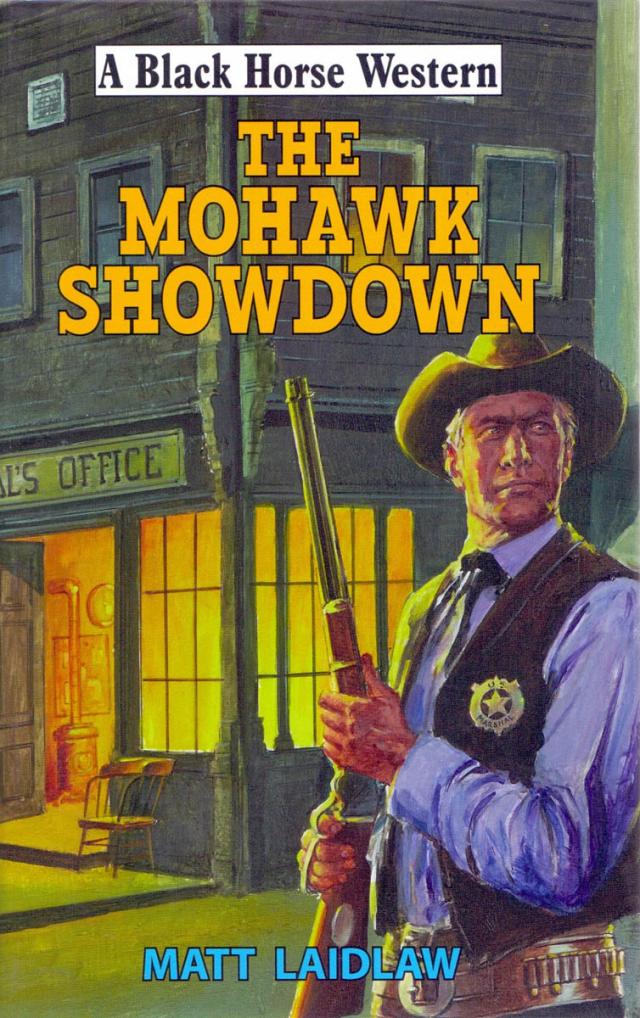
The Mohawk Showdown
Twenty years after being jailed on a trumped-up charge of train robbery, Jack Garrison escapes from Yuma Penitentiary with nothing to his name but an old banjo and the hope of proving his innocence.
Jack is banking on the help of his younger brother, Rick, to wreak revenge on the true villain. But the person who masterminded the robbery is determined to remain undetected, pulling many strings to protect his identity. His influence puts a violent end to Rick’s help, and Jack’s old friend Joe Dublin also pays with his life. Fighting for survival, Jack finds an ally in blacksmith Ed Corcoran, as they go head to head against the true villain in a violent climax.
By the same author
Raiders of Concho Flats
Outlaws of Ryker’s Pool
The Robbery at Boulder Halt
The Deliverance of Judson Cleet
The Four-Way Split
The Night Riders
The Battle for Skillern Tract
The Second Coffeyville Bank Raid
The Bloodstained Crossing
The Mohawk Showdown
Matt Laidlaw
© Matt Laidlaw 2015
First published in Great Britain 2015
ISBN 978-0-7198-2391-6
Robert Hale, an imprint of
The Crowood Press Ltd
The Stable Block
Crowood Lane
Ramsbury
Wiltshire SN8 2HR
www.crowood.com
www.bhwesterns.com
This e-book first published in 2017
The right of Matt Laidlaw to be identified as author of this work has been asserted by him in accordance with the Copyright, Designs and Patents Act 1988
PROLOGUE
Phoenix, Arizona
He was at the roll top desk when she walked into his home office. The room was lit by an oil lamp with a deep red glass bowl, a matching silk shade. He had been sitting there deep in thought, staring at the various pigeonholes stuffed with meaningless papers, documents, the ink pots with their quill pens – and, inevitably, alongside the blotter a bone-handled revolver with an intricately engraved barrel.
He had seen none of that. His eyes had been on inner thoughts, his mind involved with a particular problem to which there seemed no easy solution. It had been the unconscious drumming of his fingers on the desk’s oak top that had drawn her to the room.
She was tall, elegant, with dark hair worn in a chignon, and a plain long dress that might once have been expensive but was now quite old and well worn. She sat down gracefully, crossed slender legs and arranged her skirt modestly as she reclined in the overstuffed easy chair. Her gaze when she looked at him was cynical. Her eyes were ice-blue.
‘I used to believe,’ she said conversationally, ‘that the position of councillor was a reasonable first step on a very tall ladder. But that was a long time ago. How old were we, Jeff?’
He swung his swivel chair to face her. He was a big man with black hair and even blacker eyes. His white shirt showed patches of damp at the armpits. His black trousers were shiny at the knees.
‘I’ve been a town councillor for ten years,’ he said. ‘We were both thirty.’
‘And now we’re forty,’ she said, ‘you’re still on that first rung and I’m bored, and impatient. Jefferson T. Rome. It really does have an imposing ring to it. But a name’s just a name, Jeff, and I’m a woman who needs much more than that.’
‘If what you’re saying is, “I need more than that, or else”, then forget it, Ella. Don’t let impatience overrule those reliable instincts that made you marry me. Your choice was correct; I’ll go so far as to say it was inspired. You see, I’ve looked at exciting possibilities, and reached a decision. Tomorrow I set the wheels in motion.’
‘I’m intrigued. I want you very close to the political summit, but to get there you need influence, or money. My dear, you have neither.’
‘I’ll get the money. Everything else follows.’
‘What are you going to do, steal it?’
‘There’s no other way.’
‘Really? I thought you’d done with that life? I know you had made quite a name for yourself, acquired a reputation as one of the fastest guns in a land where fast guns are as numerous as grains of sand in a desert. But you gave up all that wickedness when you met me. Turned your back on the owlhoot, became a respected member of society.’
‘Nothing has changed.’
‘Yet you are considering furthering your career with stolen money.’ She pouted. ‘I wonder what Tony, our only son, will say when he finds out. A boy of twenty, who’s just become a deputy marshal right here in Phoenix.’
‘He won’t need to find out. I told him of my plans. Our careers will be mutually beneficial. We can help each other, through the good and the bad.’
‘Not just theft, then. You’re quite willing to corrupt my son?’
‘So now he’s your son?’ He smiled. ‘Either you weren’t listening, or heard only what you wanted to hear. I told him my plans, and that’s all. He will not be involved.’
‘My concern is for what might happen to him if you are caught, and his complicity is discovered.’
‘There is no complicity.’
‘But he would be classed as an accessory, either before or after the fact, and for that he could go to prison.’
‘That won’t happen.’
‘If it did,’ she said, ‘you would then have me to deal with.’
For a few moments there was a heavy silence, both of them immersed in deep thought. Rome seemed amused by her threat. She was clearly excited by his startling announcement. Electric tension filled the room. The quiet dragged on for too long, became uncomfortable. It was broken by Ella.
‘I’m quite sure you need an awful lot of money,’ she mused. ‘That suggests a major heist.’ She smiled. ‘If you’re going to be a thief, I suppose I’d better learn the strange language they use in gangster circles.’
He nodded. There was the sheen of sweat on his brow.
‘And when it’s done,’ she went on, ‘your hands need to be lily white. A man in high office in the nation’s capitol doesn’t want skeletons falling out of cupboards.’
‘I may handle the money when it’s been stolen, but I won’t be directly involved in the theft. There was a young man in university who committed a very nasty crime and got away with it. He has that skeleton in his personal cupboard, and I’ve threatened to throw the door wide open.’
‘In official circles I suppose they call that delegating.’ Again she smiled. ‘And you want him to organize some kind of grand theft? Well, if he committed some unspeakable offence then I’m sure he’ll do your bidding to save his skin, but when it’s done there’ll be resentment. You’ll be looking over your shoulder for the rest of your life.’
‘Give me some credit, Ella.’ Rome was shaking his head. ‘It’s all worked out. The skeleton is the lever that gets me money to buy influence and power. I keep my little delegate and his merry band of robbers sweet by bankrolling them for the rest of their lives.’
‘At risk of leaving us short?’
‘Bankroll was the wrong term. They’ll be paid a pittance.’
‘And does this man with a past live here in Phoenix?’
‘No. He’s many miles away, far enough to ensure that there can be no possible connection between us. A place called Sureño, on the Gila River.’
‘My goodness, I know it. So he’s a country boy. And his name?’
‘His name,’ Jefferson Rome said, ‘is Elgan Lloyd.’
PART ONE
ONE
Twenty years later
It was late afternoon when Jack Garrison rode down from the Mohawk Mountains on a stolen horse.
He had left Yuma before dawn, pushed hard into the Gila Mountains, ridden a long loop that took him to the south of Coyote Peak and so into the Mohawks. Now, with the westerly afternoon sun casting long shadows, he let the big blood bay pick its own sure-footed way through boulders littering the more treacherous of the steep, arid slopes. At dusk he was out of the foothills and had ridden north. By the last of the sun’s fading light he found a spot that took his fancy on the green banks of the Gila River, fifty miles to the east of Yuma.
A helluva long ride to end up too close for comfort to the town that was home to the state penitentiary – but no matter. Distance was not his main concern, and there was speculation in his gaze as he looked back at the purple hills.
On the banks of the river the cottonwoods that in the day provided shelter from Arizona’s blistering sun would, at night, retain some of the heat that would otherwise leak away into clear, cloudless skies. The thin blanket rolled behind his stolen mount’s saddle would suffice to keep him warm, and the tinkling music of the river would play its part, lulling him to sleep.
But he was getting ahead of himself.
He dismounted, shrugged off the old open-back banjo that had been strapped across his back since the chill light of dawn, and leaned the instrument carefully against a tree trunk. He stripped the rig off the bay, led the horse down the grassy bank to the water’s edge and let it drink. Then, leaving it to wander and graze, he prepared his own supper.
He built a small, smokeless fire under the trees. The flickering light from the flames lit the overhanging branches and grey-green leaves, creating a comfortable canopy over a campsite encircled by shadows. Bacon and beans taken from a Yuma general store with a flimsy back door that opened to a push sizzled merrily in the blackened pan he’d fou
Ten minutes later he wiped bacon grease from the empty plate with a hunk of dry bread, ate the bread, and was finished. He moved away from the fire. Looking about him, he unbuckled the stolen gunbelt and hung it from the split stub of a broken branch. With the light from the flames barely touching his boots, he sat with his back against a tree trunk and a tin cup of hot coffee on the grass at his side.
Then he reached for the banjo.
While everything he carried with him – and that carried him – had been stolen, the banjo had been his for almost twenty years. A man had been dragged spitting and cursing from a Yuma cell, and hanged at dawn. The cell was still warm when Garrison was tossed in like a bundle of rags and left to rot. Days later, he had found the banjo draped in cobwebs under the dead man’s cot. His playing of the instrument might have driven other prisoners to distraction, but without doubt he knew that over the years the banjo had saved his sanity.
He tapped his fingers lightly on the taut animal skin head scarred by years of use, ran his thumb across the gut strings, tweaked a tuning key and listened to the gentle plinking drift away into the night. Then, banjo in his lap, he leaned back. Down-picking with his middle finger, double thumbing to add a gentle rhythm to old-time, country-style music, he played his own melodic version of Garrison of Alabama, then segued into Oh Susanna, which he always figured was the same older tune been tinkered with. He leisurely finished the coffee. Half a dozen tunes followed, fast, slow, rhythmic, haunting; his eyes felt heavy; sleep was pulling him down when he picked the opening notes of the Arkansas Traveller—
The first bullet sent glowing sticks whirling smokily from the fire like the first wave of Indian arrows. One landed on Jack’s shirt. The cloth began to smoulder. He flapped at it as the second shot punched a hole in the hanging coffee pot. It clanged, swung wildly, brown liquid hissing into the hot embers. The third shot thunked into the tree trunk where Jack Garrison’s head had been resting, but he was already gone. Before the echoes of that first shot had faded he had thrown himself sideways.
Then he lay there. The six-gun in its holster was hanging from a tree yards away, out of his reach. His only weapon was the open-back banjo he clutched to his chest. The coffee had dowsed the fire. It hissed like angry snakes. The campsite was ill lit by moonlight filtering through the canopy of cottonwood leaves. On the river-bank the light was brighter. Jack Garrison watched a man dismount from his horse, leave it to wander away to where the big blood bay was standing alert, then come up the slight slope. He was carrying a rifle. Against the luminous silver gleam of the Gila River, he was little more than a dark shape. Stopping by the dying fire, he looked across at Jack.
‘Careless,’ he said. ‘Or maybe downright stupid. Which is it, Garrison?’
‘You’re calling the tune,’ Jack said.
The man laughed. ‘The tune is what brought me here. I lost you coming down from the hills, was about to give up until daylight when I heard that damn banjo.’
‘So I made a mistake. But what about you? I don’t suppose there’s any need to ask why you’re here?’
‘Maybe there is.’
Garrison thought about, then nodded. ‘So that’s the way it is? I escape from Yuma State Pen. The governor discovers his loss, but doesn’t want me back.’
‘So far, so good.’
‘He doesn’t want me back, but neither does he want me running loose.’
‘Going places. Asking awkward questions.’
‘Questions that might get accusing fingers pointing in his direction? I was one of a gang who robbed a train, stole a lot of money. Innocent guards died. I was caught, and I’ve been paying the penalty.’ Garrison shook his head. ‘Appears clear cut, but that’s not the way it was, not the way it happened. If the truth came out, heads would roll.’
There was no reply, just an unconcerned shrug. ‘You really think I’d get answers, after twenty years in Yuma?’ Garrison said. ‘Turn the clock back, prove my innocence by finding those train robbers?’
‘It’s what you think, not me – but none of that matters. When I leave here, you’ll be a dead man and I’ll have earned my bounty.’
‘You’re that good?’
‘I’m the best. And you’re a long reach from a weapon of any kind.’
Garrison looked down at the old banjo that he’d clutched to him as he threw himself away from the bullets. He sat up, climbed to his feet as the attacker tensed, ran a hand over the banjo’s strings and smiled. He looked up at the bounty hunter.
‘You familiar with banjos?’
‘I know they make a helluva noise. Drove the governor to give you a cell all on your lonesome. Close to twenty years, alone with your thoughts and that banjer,’ he marvelled. ‘No damn wonder you’re loco.’
Garrison grinned. ‘That’s just it,’ he said. ‘Inside, it got me what I wanted, and any banjo man will tell you if the noise gets too much these fine old instruments can be muted.’
There was a metallic snap as the bounty hunter jacked a shell into his rifle’s breech. He was about to earn his money, but it was never easy. His face tightened as he closed his mind.
‘Look,’ Garrison said. He turned the banjo lovingly in his hands so the open back was exposed. ‘This here metal bar’s what’s called the co-ordinator rod. Stuff a sock behind it, a rag, any old bit of cloth’ – he pulled a wadded red bandanna out from behind the pitted metal bar – ‘and the sound’s deadened.’ He shrugged ruefully at the bounty hunter. ‘So that’s what I did when I’d eaten my grub’ – he held up the wadded bandanna – ‘and I figured once I’d done that the sound wouldn’t carry and I’d be safe here for at least the one night.…’
He was holding the man’s gaze as he rattled on, keeping the killer’s mind at a distance from his cocked rifle and trigger finger, at the same time dropping his hands and casually unfolding the bandanna that had been inside the banjo.
He did it neatly, without haste. The tiny Remington .41 pistol hidden in the folds dropped neatly into his hand. Looking into eyes that dilated with shocked awareness, Garrison shot the bounty hunter in the throat, the bullet ripping through the carotid artery.
He watched as the man stayed on his feet for an instant, eyes still wide but swiftly glazing as blood spouted from the terrible wound. Then his knees folded and he fell face down across the fire. The coffee leaking from the bullet-holed pot had killed the flames, but the heat in the embers was intense. The night air was filled with the stink of singeing cloth, of burning flesh.
‘Bragging got you nowhere, because you were never the best, and you were wrong about the other, too,’ Garrison said. ‘I didn’t make a mistake, my friend, it was deliberate. I knew there’d be a man on my tail. A prisoner escaped. The warden liked to keep the lid on lapses in security, and that’s the way he always played his hand: better a dead convict than a man free to boast in some run-down saloon bar. So rather than let you waste energy hunting me down, I played the banjo to draw you in – and, goddammit, didn’t it work a treat?’
TWO
When Jack Garrison had hurled himself recklessly off the top of Yuma State Penitentiary’s high stone wall, hit the ground in a panic, and scuttled like a rat through the undergrowth towards the lights of the nearby sleeping town, he’d possessed nothing but the prison uniform he stood in, and a banjo close to a hundred years old.
At sun-up thirty-six hours later, he set off along the misty banks of the Gila River riding the stolen blood bay and leading the bounty hunter’s fine chestnut mare. The mare’s saddle and saddle-bags lay hidden under dead leaves beneath the cottonwoods: quick thinking had warned Garrison that no man rides into a town leading a saddled horse without inviting awkward questions.
He had two double eagles, more money than he’d seen in twenty years. The gold was in a pocket of the man’s worn leather vest. It was a shade too big for Garrison, but its worn, aged look went a little way towards disguising the newness of the clothing and fine boots he had taken from the Yuma general store’s pegs and hangers. Also, in addition to the new Colt .45 and Remington .41 derringer he had stolen from the general store, he now had a spare gunbelt carrying a Remington Frontier .44 with walnut butts worn from being grasped frequently by the bounty hunter’s calloused palm. The man had used a Winchester ’73 on him when he rode in. That and it’s saddle-boot was another addition to Garrison’s armaments.


