Demon six stories series, p.1
Demon (Six Stories Series), page 1


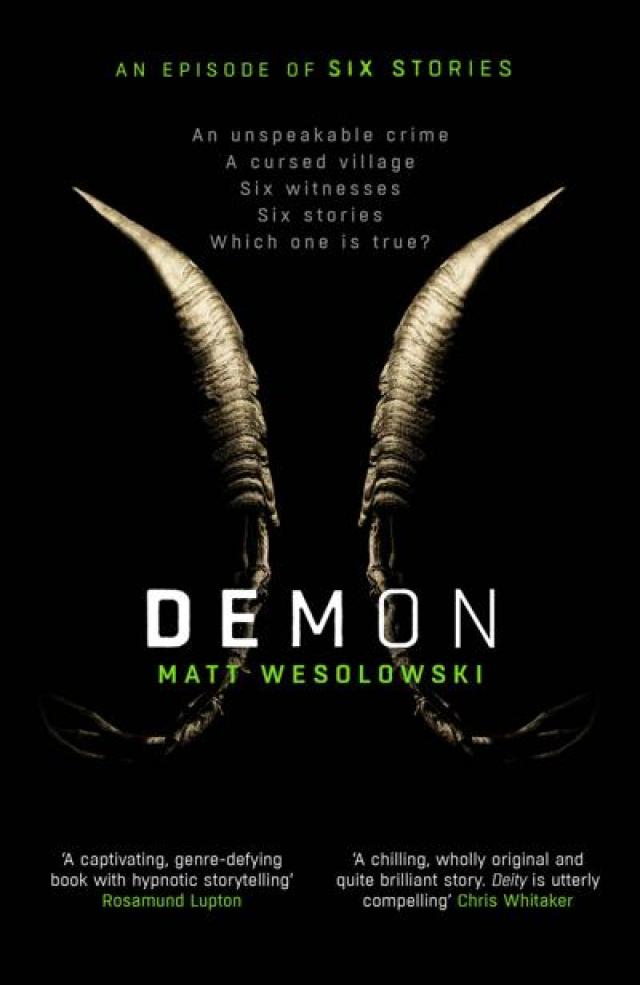
In 1995, the picture-perfect village of Ussalthwaite was the site of one of the most heinous crimes imaginable, in a case that shocked the world.
Twelve-year-old Sidney Parsons was savagely murdered by two boys his own age. No reason was ever given for this terrible crime, and the ‘Demonic Duo’ who killed him were imprisoned until their release in 2002, when they were given new identities and lifetime anonymity.
Elusive online journalist Scott King investigates the lead-up and aftermath of the killing, uncovering dark stories of demonic possession, and encountering a village torn apart by this unspeakable act.
And, as episodes of his Six Stories podcast begin to air, and King himself becomes a target of media scrutiny and the public’s ire, it becomes clear that whatever drove those two boys to kill is still there, lurking, and the campaign of horror has just begun…
Demon
MATT WESOLOWSKI
‘This glen was in very ill repute, and was never traversed, even at noonday, without apprehension. Its wild and savage aspect, its horrent precipices, its shaggy woods, its strangely-shaped rocks and tenebrous depths, where every imperfectly-seen object appeared doubly frightful – all combined to invest it with mystery and terror.
No one willingly lingered here, but hurried on, afraid of the sound of his own footsteps. No one dared to gaze at the rocks, lest he should see some hideous hobgoblin peering out of their fissures.’
—William Harrison Ainsworth
The Lancashire Witches
‘They had engaged in mortal combat with one another, they had cooked strange ingredients over a smoking and reluctant flame with a fine disregard of culinary conventions, they had tracked each other over the countryside with gait and complexions intended to represent those of the aborigines of South America, they had even turned their attention to kidnapping (without any striking success), and these occupations had palled.’
—Richmal Crompton, Just William
Contents
Title Page
Epigraph
Episode 1: The Bad Place
Episode 2: The Witches’ Rede
Episode 3: Claws That Won’t Let Go
Episode 4: Two’s the Charm
Episode 5: You Can’t Fix Evil
Episode 6: Ripples
Acknowledgements
About the Author
The Six Stories Series
Copyright
Please be aware before you proceed that this book contains fictional violence against children and animals that may cause some readers distress or upset.
—Matt Wesolowski
Dear Mum,
You would have hated it today. You would have bent down and whispered in my ear, ‘Look at the fucking state of that.’ I loved it when you used swear words, Mum. You only ever whispered them. Sometimes I whisper them too. I do it in bed, when Dad’s clattering round downstairs or outside having a smoke.
I whisper them and sometimes I cry. But not that much and definitely not when Dad’s there.
It was the village fete today, and it looked properly empty without your stall there. There was all this bunting everywhere with Union Jacks on it. That was new.
It looked shit, Mum, haha!
Everyone stared at me when I walked in, like I had two heads or something. I thought, Look at the fucking state of that, in your voice, and I swear I felt your hand on my shoulder, I smelled your hair, felt it tickle. Heard all the beads in it jangle.
I could almost smell the incense that you used to light and put on your stall. Loads of people bought it as well, Mum, I remember that. I saw one of those little brass Buddhas you used to sell on Nelly Thrunton’s windowsill the other day, so there. To be honest it was really weird – the first fete without you. They had one of those pig roast things where your stall used to be; a whole pig on a spit over this grill thing, and you could see its face and everything. You would have been properly annoyed. I held my breath when I walked past it, just like you would have done.
There wasn’t any of those goldfish in bags as prizes on the whack-the-witch stall, you’ll be pleased to know. I was worried that they’d bring that back, but they must have listened to you for once. There was loads of little kids lined up to have a go. I don’t know why they all go so mad for it – it’s proper lame: the stick is foam, the witch isn’t even scary and if you miss her, Mr Diamond gives you a bag of sweets anyway. What’s the point?
Mrs Bellingham had her jam stall, and all the old biddies were fussing on about it. She had this mad new flavour – gooseberry and lychee, or something, and all these little samples on bits of toast, like in the supermarket. But I didn’t have one.
I’ve still never heard anyone my age say ‘old biddy’ either, Mum; that was totally one of your old-person things. When I walked past, they all turned to look at me with their sad eyes, like sheep. None of them said anything though, none of them asked if I was OK or was I having a good day or anything like that either. I heard them all whisper as well – pss-pss behind my back.
I remember when you got mad once and said that it was full of snakes round here. Now I think I get what you meant. But I think they’re more like sheep: old and white and fluffy and boring. Don’t tell Dad I said that.
Mr and Mrs Hartley were wandering round like they were the bosses of the fete, as usual, and everyone was shaking their hands and saying how lovely it was, and I wanted to say it was fucking shit. Imagine, Mum, if I’d gone up to them and said that. There was nothing to do, really, just boring stalls and food. I wanted to buy a cake, and I joined the queue, but then everyone said I should go to the front and it was proper embarrassing, so I just left because I couldn’t be bothered with them all looking at me and saying they were sorry and all of that. I did go to the book stall, because Mr Womble (remember how you used to call him that?) was the only one who didn’t look at me with stupid sheep eyes. He was too busy with his pipe, and his face was all red, and he was wearing this massive jumper, and he smelled of burned paper. His hair still grows out of his ears and nose too, in those great big clumps. I bought a new Just William, which he said I could have for 5p because the cover was all hanging off. It was William the Fourth, which I’ve not got yet.
I just went home after that.
Dad sent me out after tea to ‘play with my mates’ because he had stuff to do, but he didn’t know I had William the Fourth in my back pocket, so I went to the secret place to read it. I saw the new lad on the way. He was walking over from Stothard’s rec, where they all play football. I bet he’s just like all the rest of them round here, a right wazzock.
No one saw where I went. I was smart: went one way then doubled back on myself up through the dip in the top field and along the ditch. No one was there, they were all playing football. It was peaceful. It’s always peaceful there, Mum, and I sat in the shade and read Just William, and I cried a bit, Mum, but only a little bit, and only because I remembered when you used to read Just William to me. When I read it, I heard it in your voice.
I’m going to start taking a cushion with me, but what if someone stops me and says, What are you doing? I’ll say, I’m taking my cushion for a walk, thank you very much! That’s the sort of thing you would say, and you would laugh and you would have said, That showed the old fuddy-duddies.
Remember when you told me Richmal Crompton was actually a woman, and I didn’t believe you? I didn’t think a lady could write stories like Just William, and you said no one else did either, and no one would have read it back then if she hadn’t changed her name to sound like a man. You told me I need to always look out for that sort of unfairness in the world, because it’s still here, you said, it’s still everywhere.
I waited until I had stopped crying before I went home, but it was dark by then and I was worried that Dad would go mad, but he was snoring on the sofa when I got in, so I read just one more William story, and I remembered that time we made liquorish water and I pretended to like it, and Dad said, ‘What’s this pond water doing in the fridge?’, and we couldn’t stop laughing.
I thought I’d write this just before I go to sleep. School tomorrow, worse luck.
Goodnight, Mum. Xx
http://www.missingpersonsteam.uk
Ussalthwaite
England
North Yorks. Police
[View sensitive images]
Gender: Male
Age Range: 30-50
Ethnicity: White European
Height: 175cm (5 ft 8 ins)
Build: Medium
Body or remains: Body
Circumstances: Deceased male found within cave area of Ussal Bank Kilns, Ussalthwaite
Hair: Brown
Facial hair: Beard
Distinguishing features:
Tattoo – unspecified – left arm – image: ‘Celtic cross’
Tattoo – unspecified – left forearm – image – ‘unspecified tribal design’
Possessions: None.
The Demonic Duo Have Served Their Time in Hell
Leonora Nelson
The men who were once children have served their time. Now has the idea of revenge replaced a need for justice?
A caveat before I even start, before I’m accused of being a hand-wringing Marxist or some kind of war-crime sympathiser: the crime perpetrated by two twelve-year-old boys in Ussalthwaite, North Yorkshire in 1995 was abominable. Some might say unforgivable.
The idea that one or both of the ‘demonic duo’, now men in their thirties, will be named leaves a nasty t
aste. If doing so is not a dog-whistle to provoke some kind of vigilante justice, then what is it? What is the purpose of exposing people who have served their allotted time and have been judged to be successfully rehabilitated into society?
The ‘demonic duo’ have rightly paid for what they did; they are figuratively and literally not the people they used to be, but that may never be enough.
The word flittering though social media is that a member of the public has discovered the identity of one, if not both killers, and is prepared to reveal them for the highest price.
Whoever’s going to do this needs to take a long, hard look at themselves and decide who the demon really is.
Episode 1: The Bad Place
—There was only one remotely bad part of Ussalthwaite, and it wasn’t exactly bad. It’s like anything really, there’s a rotten apple in every batch. .
It’s just outside the village. You have to go over Ussal Top, a big steep hill covered in heather, to find it. Not really Ussalthwaite village I suppose. Well, that’s where they found him the other week, that man.
Have they found out who he is yet?
Dear me, his poor family.
When I was a girl, most of us were happy just messing about on the hill or wandering down to Barrett’s Pond. It’s lovely down that way; there’s a meadow and bluebells on the banks in spring. That’s where we went when there were too many older ones on Ussal Top. There were reeds and you could find frogs or catch sticklebacks in jam jars. We’d take sandwiches and scones that our mams had made. It seems mad now, doesn’t it? Can you imagine parents letting their little ones wander round a pond trying to catch fish with jam jars these days? It would never happen.
Nowadays, they’re just sat inside on their phones, aren’t they?
Back then though, our mams and dads told us to get out the house and be back when it got dark. It was that safe around here. We had all we needed, the sun and the fields and each other. Paradise on earth. That’s Ussalthwaite alright. That’s the real Ussalthwaite.
We weren’t daft, neither was our parents. If I wasn’t home at or before 5.30pm on a Saturday or if they even thought I’d been to the kilns, I was grounded for a month and probably got a whack on the arse with a slipper too. Of course, everyone always went and played at the kilns on Ussal Top. The one place you weren’t allowed to go. The bad place.
That’s kids for you. That’s about as naughty as it got in Ussalthwaite when I was a girl.
Things are very different now.
Welcome to Six Stories.
I’m Scott King.
The voice you’ve just heard is that of long-term resident of the North Yorkshire village of Ussalthwaite, Penny Myers. Penny says she has not and will never live anywhere else.
Ussalthwaite is the epitome of ‘God’s own country’, although, considering what happened there in the seventies and again in 1995, the terms seems ironic.
Now it has seen a suicide. A man, still unidentified. This series, however, is not about him. Not yet. But it was the discovery of his body that brought me here, to this small, picturesque village nestled in the stunning Yorkshire countryside. But this suicide is sadly not the first time tragedy has struck here.
Before we travel to this beautiful village in the middle of nowhere, let me say a few words about what we do here at Six Stories.
We look back at a crime.
We rake over old graves.
I’d just like you all to know that I’m no expert, I have no degrees or PhDs in criminology or psychology. I’m not trying to change laws or challenge beliefs. This podcast is like a discussion group at an old crime scene.
Six perspectives on a crime; one event through six pairs of eyes.
In this series, we’re going to talk to six people who were there at the time of a terrible tragedy; a tragedy that, despite the weight of what occurred, was very swiftly forgotten. It’s inexplicably difficult, even today to find much on the subject of the strange events of more than twenty years ago that sent shock waves through this peaceful, rural Yorkshire community.
Sometimes, looking at the past can have consequences for the present. Sometimes our raking disturbs a plot and sometimes people don’t like old graves disturbed. I can understand that. Some graves should be left well alone. Sometimes we don’t need to pull to pieces things that are better left to rest.
Like, perhaps, this one.
It was here in Ussalthwaite, on a bright morning in September, 1995, halfway along a secluded bridleway, under the shade of some trees, that a local man walking his dog saw what he thought was rubbish bags that had been tossed into a small stream. It took a few moments for the man to realise exactly what he was looking at.
Twelve-year-old Sidney Parsons had endured a severe beating; he suffered broken ribs, cuts and internal bleeding, and his small body had been laid, face down, in running water. A rock was embedded in the back of his skull, it had been thrown with so much force.
I don’t derive any pleasure from giving such gruesome details about the fate of Sidney Parsons, but I think it’s necessary that you know how violent the attack was on a boy who’d simply been sent to the shop by his mother and never returned.
—It’s never been the same round here since then. I would have said that Ussalthwaite was the perfect village. I really would. Then this happened, and no one’ll ever forget it. Not as long as they live.
Ussalthwaite, nestled in the heart of the North Yorkshire Moors National Park, is stunning. It’s a bit of a time warp – cottages nestled along cobbled streets. Walking around, you can almost hear the strains of Dvořák’s Symphony No. 9 on the coal-smoke tinted breeze. Flowers tumble from every window box and spoiled cats loll on windowsills.
The moors themselves were formed in the Ice Age; uplands, lowlands, moors, coasts and cliffs.
Bronze Age and Roman remains have been found across the wider area of the National Park. There are decommissioned nuclear fallout shelters from the cold war era, too. Nature swallows the past swiftly here.
A few remote sheep farms dot these wild uplands, and rivers gurgle through patches of woodland. Time passes here with the flowering of the heather – the cry of the curlew and the golden plover marking the slow turn of the seasons.
But not 150 years ago, this vast landscape of hills and heather hummed with industry. The steam of rail-building met the black smog of the mines; furnaces roared and steam power shunted ore and coal further north and to the coast.
The village of Ussalthwaite itself had a brief flirtation with ironstone mining in the mid-1800s, before the rock went dry. The industry finally left in the 1920s. Just a spatter of the mining cottages remain.
There are remnants scattered in and around Ussalthwaite from its industrial past; the shadows of trams and railways wind past ruined chimneys and monolithic slag piles. Hay meadows now encroach on the remains of pump houses, and the metal grates that seal the ancient pits are grown over.
This land is good at forgetting.
Its people? They wish they were.
—I’m good at this whole Zoom chat rigmarole, you know. You have to be, don’t you? We’re not immune to Covid, even all the way out here. I set up the Ussalthwaite WI Zoom meetings to keep our spirits up. There’s a few of the older ones who are house-bound or frail, and it’s a lifeline for them. It brought light here during that dark. If we hadn’t embraced technology, it would have been the end for a lot of us. Mind over matter, isn’t it? We might be falling apart out here, but our brains are tough as old boots.
I talk to Penny Myers via Zoom. She sits in a comfortable-looking armchair. Like most of Ussalthwaite’s residents, Penny is well off, and her home is neat, polished and cosy. She’s less and less able to move about much these days, but she can still run online bingo like a pro.
Her carer wanders past in the background occasionally. He’s keeping an ear out to hear what I’m asking; he’s making sure Penny doesn’t upset herself.