Echo and the sea, p.1
Echo and the Sea, page 1
part #1 of Echo and the Sea Series


Echo
and the Sea
Matthew Phillion
Echo and the Sea
Lost Continuity Press
Contact:
theindestructiblesbook@gmail.com
www.theindestructiblesbook.com
June 2017
Printed in the United States of America
© 2017 Matthew Phillion
First Edition: © Matthew Phillion / Lost Continuity Press
Cover Design by Sterling Arts and Design:
http://www.sterlingartsanddesign.com
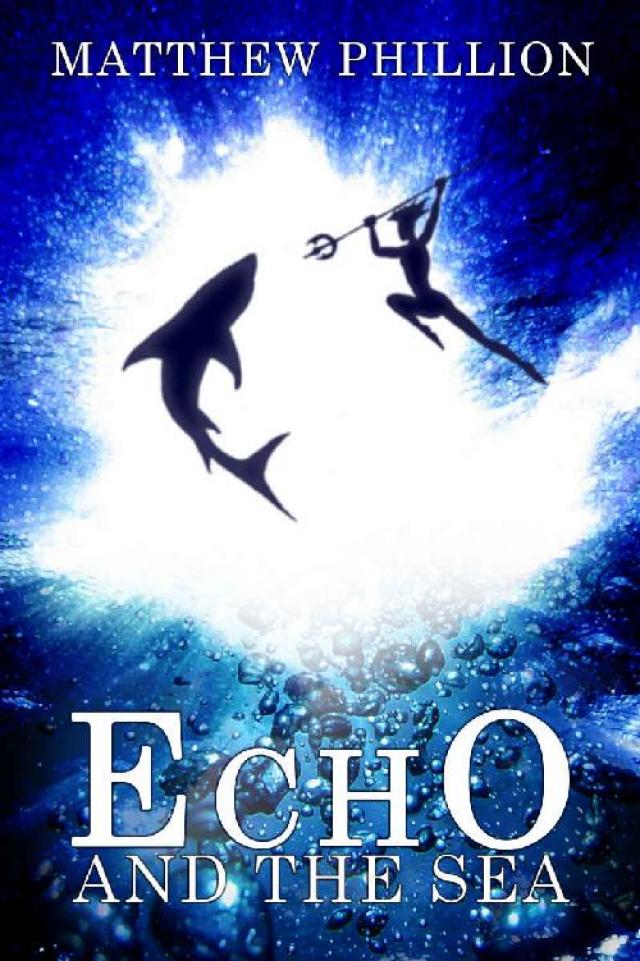
“Echo and the Sea Silhouette” art by Matthew Phillion
To Stephanie
Who keeps this lost ship on course.
Acknowledgments
Prologue: A love story
Chapter 1: The young woman and the sea
Chapter 2: The oil rig
Chapter 3: The icehouse
Chapter 4: The predators
Chapter 5: The heartbeat of the world
Chapter 6: The hunt begins
Chapter 7: The long night
Chapter 8: Derelict
Chapter 9: Who you are
Chapter 10: Failure
Chapter 11: Magic wands and ghost ships
Chapter 12: The Lost Kingdom
Chapter 13: Inclined to impulsivity
Chapter 14: All the greatest mistakes in the world are made out of love
Chapter 15: Not the little mermaid
Chapter 16: Heavy hangs the head
Chapter 17: Viking funeral
Chapter 18: The timetable
Chapter 19: The Island of Unwanted Things
Chapter 20: The hunted
Chapter 21: The life and times of Barnabas Coy
Chapter 22: The Natural
Chapter 23: The pack
Chapter 24: Man-bull-thing
Chapter 25: The Atlantean and the Amazon
Chapter 26: The lair of the serpent
Chapter 27: Wise words
Chapter 28: Who we are now
Chapter 29: The wreck
Chapter 30: The dark council
Chapter 31: Off the record
Chapter 32: The Frenzy
Chapter 33: It didn’t have to be this way
Chapter 34: The Amazon
Chapter 35: Run for your life
Chapter 36: Magic has a cost
Chapter 37: A more aggressive approach
Chapter 38: Stand up and face it
Chapter 39: Don’t get attached
Chapter 40: The coup
Chapter 41: New Tortuga
Chapter 42: The Lady
Chapter 43: A royal prison
Chapter 44: The pirate and the spy
Chapter 45: All for one
Chapter 46: One last look at the sky
Chapter 47: That’s not a submarine
Chapter 48: The dead never answer back
Chapter 49: Eyes on Atlantis
Chapter 50: Bombs will fall
Chapter 51: Gifts
Chapter 52: The resistance
Chapter 53: Chance your arm
Chapter 54: Manta Express
Chapter 55: I thought you’d look more human
Chapter 56: Not my first jailbreak
Chapter 57: Your daughter looks just like you
Chapter 58: The day love died
Chapter 59: The reason I can’t
Chapter 60: Feral
Chapter 61: I leave you alone for one hour
Chapter 62: Unwanted Things
Chapter 63: Poseidon’s Scar
Chapter 64: Breaking news
Chapter 65: Fathers and daughters
Chapter 66: Sort it out yourselves
Chapter 67: Where we go from here
Chapter 68: In every story, you can choose
Chapter 69: Tis not too late to seek a newer world
Epilogue: Once, on a shore
Acknowledgments
It started out as a joke, really, very on while working on the Indestructibles series. The topic came up that it seems like, in every superhero-y world, there’s always an Atlantis. And we talked about how the Atlanteans are always presented as incredibly powerful, but often forgotten (and of course the inevitable “he talks to fish” jokes). It got me thinking: what would Atlantis look like in the Indestructibles universe? Who would their heroes be? Would the rest of the world know about them?
I grew near the ocean. Even had dreams of being a marine biologist as a kid (what kid who grows up around the water doesn’t have that dream at some point though, right?). I have Jaws practically memorized. I have a strong environmentalist slant in my personal beliefs. All of this started coming together to tell a story about an Atlantis, afraid for their own survival, lashing out at the surface world, and trapped in between would be this human/Atlantean young woman who would have to try to stop the two worlds she was a part of from colliding.
And that’s how Echo was born.
From there, I started picking away at the mythic aspect of Atlantis. I was as much a mythology buff as I was a fanatic of whales and sharks as a kid—maybe even more so—and so I knew mythological creatures, from mermaids to minotaurs to sea monsters, would all need to play a part in this. Atlantis, I think, is tied forever to myth and magic, but cannot exist in a modern story without addressing humanity’s impact on the oceans, and where the future lies for all of us.
I hope that Echo’s story, and that of her friends Yuri, Barnabas, and Artem, are a swashbuckling adventure with a heart. They exist in the same universe as the Indestructibles—long-time readers will see some cameos here and there—but they have a very different world to save, one that exists outside human society, on the fringes of the fantastical and mystical parts of the Indestructiverse.
If you’re an Indestructibles reader, thank you for taking a chance on Echo and her crew and allowing me the chance to explore a different part of the Indestructiverse for a while. And if you’re new to this shared universe, have no fear—it’s a story that runs alongside the Indestructibles series but is very much its own tale. Timeline-wise, Echo and the Sea takes place right around the time the first Indestructibles story happens, give or take a few months.
This story couldn’t have happened without the support of those who have helped me all along: Stephanie Buck for being my ever-present lifeline through the process. Fellow writers and test subjects Colin Carlton and Christian Hegg, who let me bounce idea after idea off them all day (sorry guys). Christine Geiger, who has been a life-saver of an editor for this book. (Thank you for spotting the inadvertent Pokémon joke.) Sterling Arts & Design, who as always has done a marvelous job creating the cover. My family, for supporting my weirdness, and the fact that over the past few years more and more of my wardrobe has been made up of comic book tee shirts.
And to you, my fellow explorers of the Indestructiverse. Thanks for taking the plunge into Atlantis with me. Let’s set sail together and see what we find.
Matthew Phillion
Salem, Massachusetts
June 2017
Prologue: A love story
The shoreline was nearly empty at dawn, a barren stretch of pale sand, palm trees swaying just beyond the beach. Meredith bobbed on her surfboard, the sky pink as new skin above her, her feet dangling. Cool Atlantic water lapped at her bare legs, as she waited for the next crest, soaking in the emptiness of it all.
I’ll miss this place, she thought. Hawaii had treated her well in her years here. She was a New England girl at heart, and she knew this, she could not fight it, but the energy here, the warmth, it was addictive. A different kind of beautiful. And to surf in a bikini instead of a heavy wetsuit, to look in to crystal-clear waters and see the soft sand below instead of the impenetrable darkness in the Atlantic—these things made her wish she could stay.
Meredith had always been a woman of the ocean, but this place changed her. The ocean wasn’t always angry here the way it was back home. It wasn’t always cold, it wasn’t always bitter in its beauty. Sometimes, the ocean welcomed you with warm, enfolding arms.
She felt the sea swell below her and she readied herself, caught the incoming wave, planted her feet, and let her limbs fall loose. The world turned slow and languid when she surfed. Time stood still. Just a woman and the ocean, the surface of the board warm where her body had been resting seconds before, cool where the water enveloped it.
The wave wasn’t particularly strong, and the morning approached quickly, so she let herself fall into the water close to shore. She still had work to do, things to see to before she went home for the funeral. So many funerals for the men and women of the sea back home. The ocean always takes its due.
When Meredith surfaced, she saw a man sitting on the beach, peacefully observing the waves. She watched him for a moment, a long-bodied stranger with a mop of curls leaning back on his hands, staring out at the sea. Curiosity overtook her. Meredith paddled in, close enough to feel the sand skim the tips of her fingers, and as she climbed from her board the weight of the world came crashing down on her. Gravity pushed on her shoulders in that strange weight she always felt as she left the ocean.
The man saw her and smiled. He had such perfect white teeth, Meredith thought, the sort of radiant smile that stopped hearts, almost unfair in its beauty. Some people can sway the world with their smiles, she thought.
“Hey,” Meredith said.
“Hello,” the man said.
“You waiting for someone?”
“No,” the man said. He turned pale eyes out across the s
“I think so,” Meredith said. There was a calmness to the man, a quiet contemplation that drew her in. She found herself sitting down beside him almost without intending to, setting her surfboard in the sand.
“You do?”
“I do,” she said. “It’s why I surf at this time of day. For the peace. I feel like it’s just me and the ocean. I’m part of it. It’s part of me.”
“It is,” the man said. “It’s part of all of us. It’s where we all come from.”
“What are you, a philosophy major?” Meredith said.
“A what?”
Meredith laughed. She liked her laugh. She knew it disarmed people. She found herself hoping, vaguely, that it might disarm this beautiful man watching the waves.
“Maybe not, then,” she said. “A poet? An oceanographer? What’s you’re deal?”
The man turned his pale eyes on her. There was a strange serenity there, and an agelessness, as if he were from another time, another world. Meredith felt strangely self-conscious as he looked at her.
“There are days I wish I could stay here forever,” the man said.
“On the beach?”
“So to speak.”
“Me too,” Meredith said. “I have to fly home soon. Funeral for an old friend. He died at sea.”
“Died at sea?”
“Yeah,” Meredith said. “It’s so awful. You’d think, after all this time, we’d find a way, but… the ocean always takes what it wants, doesn’t it?”
“You have no idea,” the man said.
Meredith stared at him. The silver flecked in his beard, his strange eyes, the way his body looked almost serpentine, as if he spent his entire life swimming. He barely looked human, in some ways. In others, he looked perfect.
“I’m Meredith,” she offered.
“Hello, Meredith,” the man said, his eyes looking so intently in hers she felt as if there were no other people in the entire world. “I’m Rhegis.”
I suppose this is what love feels like, Meredith thought. I hope it never ends.
Chapter 1: The young woman and the sea
Echo had always felt at home in the water.
Not simply living near it, which she had, her entire life; but submerged in it, surrounded by it, seeing a darkened world through the light filtered through uneven waves; the cool, distant thrum of noises carried across the depths. The waters off the coast of Massachusetts were not known for their forgiving warmth, but the cool temperatures had never bothered Echo.
Below the surface, she felt at home.
She’d swim laps in the harbor, following the shoreline, an activity that made even the strongest swimmers she knew nervous. The undertow, they’d say, or occasionally “sharks,” though anyone who grew up by the sea knew that the former was far more frequent a threat than the latter. But Echo never worried. She had no fear of the sea.
That scared her mother sometimes.
Meredith had an almost superstitious reverence for the ocean. Not religious, exactly; more what Echo called her mother’s “hippie moments,” when she’d talk about feeling as though the ocean had a spiritual element to it, something that called out to her. Echo always assumed that was just her mother’s inner surfer speaking. She’d been a brilliant surfer in her youth, and still was, when she allowed herself the time away from work at the icehouse their family had owned for generations. Meredith was the only heir from her generation, and Echo was Meredith’s only child, so, she supposed, the icehouse would someday be hers as well.
At least it would keep her by the water.
Echo finished her laps and dragged herself back to shore, her body heavy in that way it always was when she left the ocean’s cool embrace, as though the world wanted to push her back in. She shoved her hair back from her face—hair she’d dyed sea-foam green and kept shaved almost to the scalp along the left side, a look her mother said made Echo look like a broken piece of coral.
She’d left a towel and flip-flops on the shore, confident no one this early in the morning—or ever, really—would care enough to steal them. She dried off, trying in vain to kick the sand from her feet as it stuck to her skin. She found herself staring out across the harbor, watching the near-black ocean meet the near-pink skyline. It’s like it goes on forever, she thought. As if I’m standing at the foot of a colossus.
She felt lost for a moment, cut adrift, as if she were not where she was meant to be. The sensation quickly faded, though, as her reverie was interrupted by a familiar voice.
“Hey! Hey, Echo!”
Yuri Rodriguez came barreling across the beach, sneakers kicking up sand behind him.
Yuri was a lot of things to Echo. Coworker at the icehouse, yes, and housemate, because Yuri had come to live with Echo and her mom when his own mother died six years ago. Best friend, in many ways, because when you live together and work together and when someone shares your mom with you, the options are best friends or worst enemies, and it was hard to not love Yuri. A big, affable guy, with a round face framed by a beard he couldn’t quite fill in properly and a cheap pair of glasses, when Yuri found something funny, everyone found that something funny. And clearly right now he found something very funny. The growing grin on his face right now was infectious.
“Echo, you gotta see this,” Yuri said. His face was flushed from running—he was a strong kid, but sprinting would never be his strong suit. His rested his hands on his knees and wheezed. “You’re not going to believe who’s docked out back.”
“Okay, okay, I’m coming,” Echo said. They did tend to share similar views on comedy.
They shared more than work and home, though, Echo knew, a thought they rarely spoke about but both often had. They’d both lost their fathers to the sea. It was a common theme in this town, and why Yuri’s mom had asked Echo’s to offer Yuri a job at the icehouse when he was old enough. His mother wanted to make sure she wouldn’t lose her son the way she’d lost her husband.
Echo gave up on her flip-flops and ran barefoot for the icehouse, tying her towel around her waist as she jogged. She had to slow her pace a bit to let Yuri keep up. He often teased her about her untapped athletic ability—if he were half as fast as she was, he said, he’d have run track at school or been a running back or something. The fact that she could easily keep up with him hauling ice at work was a long-standing joke, too, given Yuri was nearly twice her size.
Then she saw the man that had Yuri in a lather.
“Okay, you’re right. I don’t believe it,” Echo said.
Her mother stood with a stranger on that stranger’s craft, a long, narrow ship that seemed more like an oversized skiff. The vessel was hard to look at somehow, as if it were designed to deceive the viewer about its size and shape. It had a single mast and an elegant prow. Nothing about the watercraft looked real, though—it seemed like something from an artist’s imagination, something that made for beautiful art but would never survive at sea.
The man himself was even stranger. He wore a salt-stained leather duster, marked all along the edges with symbols Echo had never seen before. They somehow felt familiar, though, she thought, following the patterns along the man’s jacket. More of these symbols dotted the man’s visible skin, the backs of his hands, the side of his neck, even along his scalp, which had been shorn down to a faded stubble. He had a wild, sun-faded beard that looked like something a caveman would grow, and a silly gold hoop in his ear. A decrepit leather satchel was slung over his shoulder and, no joke, he had a sword hanging on his belt.
“Is that a sword?” Echo said out loud involuntarily.
“That is definitely a sword,” Yuri answered. “He looks like Jack Sparrow’s uglier, balder cousin.”
“Who carries a sword?” Echo asked.
“Pirates? Game of Thrones cosplayers?”
The man turned his sunburned gaze on them and stared. Ordinarily it was the sort of long look that would have grossed Echo out, usually reserved for men downtown or sometimes crew on the fishing vessels who docked here for ice, but there was something different about the stare. It wasn’t lascivious. It felt more curious than threatening.