

Romance, p.16
Romance, page 16
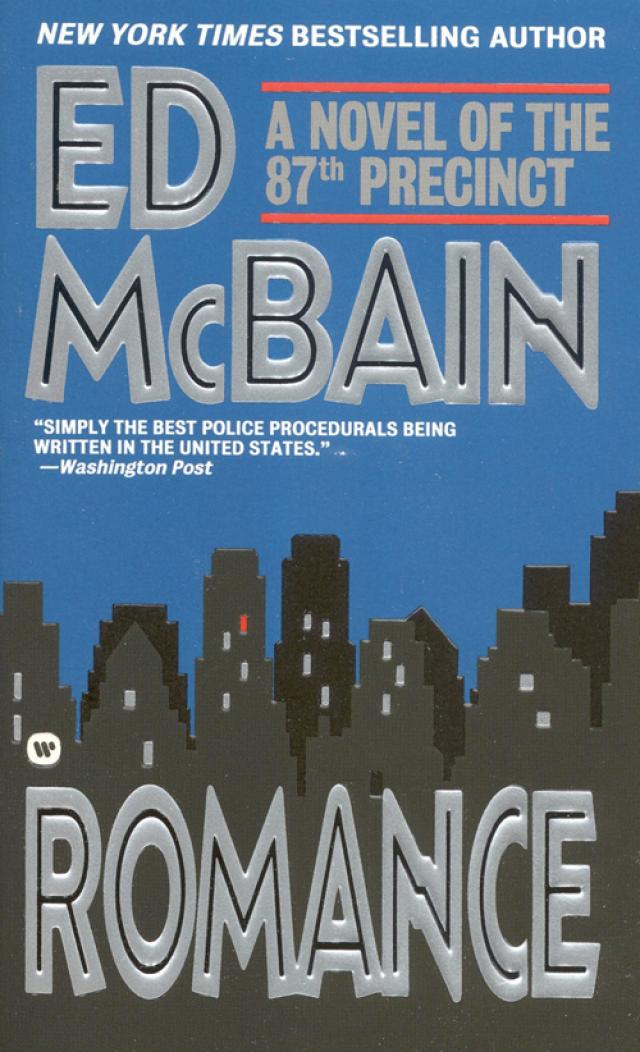


“So let’s dismiss non-fiction as something any child of eleven can do,” he said, “and let’s dismiss most forms of fiction as writing that requires no discipline whatever. The novel, in particular, is by definition a form that defies definition. Moreover, most novelists at work today are writing as poorly as the people writing non-fiction. What it’s come down to, if a person can successfully string together nine or ten plain words to fashion a simple sentence, then he or she may be dubbed ‘author’ and be permitted to go on author’s tours and speak at Book and Author luncheons and generally behave like a writer.“
Carella couldn’t see the distinction.
“An author,” Corbin went on, seemingly reading his mind, “is anyone who’s written a book. The book can be a diet book, or a cookbook, or a book about the sex life of the tsetse fly in Rwanda, or it can be a trashy woman-in-jeopardy mystery, or a high-tech novel about a missing Russian diplomat, or any one of a thousand poorly written screeds or palimpsests. An author doesn’t need to study literature, he doesn’t need to take any courses in the craft of writing, all he needs to do is impulsively and ambitiously sit himself down in front of a computer and write as badly as he knows how to write. In this great big land of the literary jackpot, if he writes badly enough, he may hit it really big, therefore qualifying as a bona fide author entitled to go on book tours and television talk shows. A playwright, on the other hand, ahhh-hah!”
Carella waited.
“A playwright is a writer,” Corbin said.
“I see,” Carella said.
“The living stage is the last bastion of the English language,” Corbin said. “The last arena permitting exploration of character in depth and with perception. It is the final stuttering hope for beauty and meaning, the last stand, the only stand of the word itself. That’s why I write, Mr. Carella. That’s why I wrote Romance.“
Though Carella couldn’t remember having asked him. ”
Now you may ask … ”
I wish I could ask about Michelle, Carella thought.
“… why I’ve chosen to express myself in terms of a mystery. But is my play a mystery? Oh, yes, there is a stabbing in it, an attempted murder, if you will, but the focus of the play is not upon the perp, as you call it, but instead on the vic, as you call it. Unlike the mysteries you deal with every working day of your life … ”
Carella was thinking that in police work there were no mysteries. There were only crimes and the people who committed those crimes. He was here today because someone had committed a most grievous crime against Michelle Cassidy.
“… in a straight play occurs at the end of the story,” Corbin was saying. “And this change, this epiphany, can take many different shapes and forms. It can occur as insight, or simple recognition, or even the realization by a character that he or she will never change, which in itself is a change of sorts. In a mystery, on the other hand, the change takes place at the very beginning of the story. A murder is committed, there is an aberration in the normal orderly flow of events … a change, if you will. And a hero or heroine comes into the story to investigate, ultimately finding the killer and restoring order, correcting the change that took place in the beginning. So you see, there’s a vast difference between a straight play and a mystery play. Romance is not a mystery. I will not think kindly on any critic who treats it as such.”
“There’s a danger of that happening now, don’t you think?” Carella said.
Trying to get Corbin back to the matter at hand. Which was not writing the great American drama, but was instead this investigation into an aberration in the normal orderly flow of events as personified by the body of Michelle Cassidy with its twenty-two stab and slash wounds.
“Do you mean because of the publicity attendant on Michelle’s murder?”
“Yes. Linked with the fact that there’s a stabbing scene in the play itself. Some critics …”
“Fuck the critics,” Corbin said.
Carella blinked.
“I don’t write for critics. I write for myself and for my public. My public will understand that I don’t write cheap mysteries, never have, never will. My public …”
“I understood … ”
“Those were not mysteries. Excuse me, were you about to mention Blue Badge and … ?”
“Actually, I didn’t know the … ”
“Blue Badge and … ”
“… titles of …”
“Street Nocturne, yes. The two novels I wrote about New York City cops. But those weren’t mysteries, they were novels about cops.”
“Right, procedur … ”
“No!” Corbin shrieked. “Not procedurals. Never procedurals. And not mysteries, either. They were simply novels about cops. The men and women in blue and in mufti, their wives, girlfriends, boyfriends, lovers, children, their head colds, stomachaches, menstrual cycles. Novels. Which, of course, I now recognize as a form inferior to that of the spoken word on the stage.”
“How did you feel when Michelle first got stabbed?” ”
“The first time? In the alley?”
“Yes.
“To be honest?”
“Please.”
“I felt good. Because of the publicity the play was attracting. Mind you, Romance is a wonderful play, but it doesn’t hurt to have all this attention focused on it, does it?”
“According to Johnny Milton …”
“That piece of shit.”
“… the idea was originally Michelle’s.”
“I wouldn’t be surprised. Very ambitious girl, very opportunistic.”
“How do you feel about her murder?”
“Terribly saddened.”
Carella waited.
“A regrettable occurrence,” Corbin said. “But I must be honest with you. I still feel good about the publicity we’re getting. Unless it turns against us. Unless it makes my play look like a cheap mystery.”
“How well did you know Michelle?”
“I was the one who held out for hiring her—against Ashley’s wishes and Marvin’s, too—but he has no taste at all. Well, I take that back. He did, after all, decide to produce Romance. But Michelle was hired for the role because I insisted on it.”
It occurred to Carella that his question hadn’t been answered. He tried again.
“How well did you know her, Mr. Corbin?”
“Not at all well, I’m sorry to say. One misses life’s little opportunities, doesn’t one? And then it’s all too often too late.”
“Which of life’s little opportunities do you mean?” Carella asked.
“Why, the opportunity to have known her better.”
“How do you feel about the actress replacing her?”
“Josie? I think she’s wonderful. In fact, I have to admit that I may have made a mistake not hiring her in the first place.”
“Feel better with her in the part, do you?”
“Yes, actually. I think our chances are better. Even without the fuss over Michelle’s death, I think we stand a much better chance with Josie in the role.”
“And, of course, if the play turns out to be a tremendous hit …”
“I would be gratified, of course. But the value of the play is intrinsic to the play itself. Ten years from now, a hundred years from now, whatever the critics say, the play will stand on its own.”
“Still, you would enjoy a hit, wouldn’t you?”
“Oh, yes, certainly.”
“A hit would mean a lot to you moneywise, wouldn’t it?”
“Money’s not the important thing.”
“Six percent of the weekly gross …”
“Yes, but …”
“Capacity gross is estimated at a hundred and eighty-three thousand dollars.”
“If we move downtown.”
“Well, you’ll certainly move downtown if the play is a hit.”
“Yes.”
“So six percent of the gross comes to almost eleven thousand dollars a week.”
“Yes, I know.”
“You’ve calculated it?”
“Many times.”
“Close to six hundred thousand a year.”
“Yes.”
“A play like Romance could run for how long?”
“Who knows? If the reviews are raves, and if we move downtown? Five years, six years, who knows?”
“So there’s quite a bit of money involved here. If it’s a hit.”
“Yes.”
“And with Josie Beaks in the starring role, and with all the publicity Michelle’s murder has generated, the likelihood of a hit becomes … ”
“I feel I should tell you,” Corbin said, “before you ask … I have no alibi whatsoever for the night Michelle got killed.”
Carella looked at him.
“None,” he said. “I was here alone in the apartment, coincidentally working on the scene where the Actress gets stabbed. The scene in the play. So you see … ”
Corbin smiled.
“I’m completely at your mercy.”
They regrouped at three that afternoon.
Carella wasn’t surprised to learn that Andrea’s alibi had checked out. Kling was very surprised to learn that Corbin had no alibi at all.
“Maybe immortal writers don’t need alibis,” Carella said.
Hoping to catch Josie Beales at the theater, they called ahead, but Chuck Madden told them she was already gone for the day.
“You may want to try her at home,” he said. “Though actresses are never home.”
“How do you mean?” Carella asked.
“Auditions, readings, classes, benefits, they’re never home.”
“Did she say she was going to one of those? An audition or …
“I’m just the stage manager,” he said airily, “nobody ever tells me anything.” Carella knew that exactly the opposite was the case. It was part of a stage manager’s job to know where everyone involved with a show could be reached at any given time of the day. “Let me check my book,” he said, “give you her home number, it’s at least worth a shot.” Carella could hear him leafing through pages. “Yeah,” he said at last, “here it is,” and read it off. “Otherwise, you can try the Galloway School later tonight. I see she has a class there on Thursdays.”
“Do you have a number for it?”
“Yeah, right here, it’s on North Loring,” Madden said, and read off the number.
“When’s your next rehearsal?” Carella asked. “In case we miss her.”
“Tomorrow morning at nine.”
They tried Josie at home, and left a message on her answering machine. They called the Galloway School and were told that classes tonight began at eight o’clock and that indeed Josie Beales was enrolled in a class called Advanced Performing Skills.
They’d both been working since eight o’clock this morning.
But they sent out for sandwiches and Cokes, and started typing up their reports, waiting for it to be eight o’clock tonight.
9
THE GALLOWAY SCHOOL—OR MORE ACCURATELY THE GAL-loway School of Theater Arts, as the sign downstairs announced it—was on the third floor of a building that had once been a hat factory. Kling wanted to know how Carella had known this. Carella said there were just some things a good detective knew, kid. A scene was in progress as they slipped into the vast room. Some thirty or so students sat on folding chairs watching Josie Beales and an older man going through an aria intended to break the heart, Carella figured. In it, the old man was telling his daughter he had cancer and had been given thirty days to live. Josie didn’t seem to have much to do in the scene except listen. She did that very well, brown eyes glistening with tears as the old guy told her about all of life’s little missed opportunities. Carella wondered if Freddie Corbin had written the scene. They stood at the back of the room, listening and watching. On the folding chairs, there was a lot of respectful fidgeting.
When the scene ended, a bearded man in the front row personally critiqued it, and then called for reactions and responses from the assembled students on the hard wooden folding chairs. A half hour later, he called a break and Josie and the old guy went out into the corridor together. She was standing by a radiator in front of a very tall window, smoking, when they joined her. The old guy was nowhere in sight. Josie’s strawberry-blond hair was piled on top of her head. She was wearing blue jeans and a white T-shirt, and she looked very young and fresh and innocent. But she was twenty-one years old and an experienced actress. And she had inherited the starring role in Romance from another actress who’d been brutally stabbed to death.
“How’s it coming along?” Kling asked.
“Oh fine. Well, you know, I knew all the lines and stage directions already, I was her understudy, you know, this wasn’t like coming into something cold, taking over cold for somebody. Chuck rehearses all the understudies—Chuck Madden, our stage manager—three, four times a week, so really we’re pretty much up on it.”
She had stubbed out her cigarette and was leaning against the radiator now, arms folded across her chest, a defensive posture, Carella noticed, but nothing else about her seemed guarded. Rail thin in the tight-fitting blue jeans and T-shirt, she appeared almost waif-like. Brown Bambi eyes wide in a pale white face crowned with masses of reddish-blond curly hair, her mouth lipstick-free, a single ruby-red earring in …
She saw where his eyes had wandered.
“This isn’t an affectation,” she said.
Carella looked puzzled.
Her hand went immediately to her right ear, tugged the earlobe there. “I lost the other one,” she said, “I can’t imagine where. I know I had both of them on at rehearsal today.”
“I’m sure things have been pretty frantic,” Carella said.
“Well, yes, but understudies are used to going on at a moment’s notice, you know, if anybody gets sick or anything. So I really do know the part.”
“Must be a strain, though,” Carella suggested.
“A strain? How?”
“I mean replacing a murder victim,” he said softly, and watched her eyes.
“Yes,” she said, “it’s a terrible thing, what happened to Michelle. But this is show business, am I right? The show must go on, isn’t that so?” Eyes clear and bright, eyes unflinching. “And what you said, replacing her, this isn’t really replacing her, it isn’t as if she was fired so I could take the role, it isn’t that at all. I was her understudy and something happened to her, and so I’m going on in her place, but that isn’t replacing her, is it? You don’t really think it’s replacing her, do you?”
“Only in a manner of speaking,” Carella said, and kept watching her eyes.
“Well,” she said, and shrugged. “I feel awful about what happened to Michelle, but I’d be lying if I didn’t say I feel happy for myself, for getting the opportunity to play the leading role in a play that now … well, this’ll sound terrible, too. But, you know, we really do have a shot now. With all the publicity the play’s getting, I mean. I know that’s awful, we wouldn’t be getting the publicity if someone hadn’t killed Michelle, but that’s the simple truth of the matter. She got killed and now there’s a lot of focus on the play. And a lot of focus on me, too—there, I said it before you did,” she said, and smiled.
“I wasn’t about to say it,” Carella said.
“Neither was I,” Kling said.
“No, but you were thinking it, weren’t you? You’ve got to be thinking it. If it wasn’t Johnny who killed her, then it had to’ve been somebody else, am I right? The papers said he admitted stabbing her but not killing her. So, okay, what you’re thinking—the police, I mean, not you two individually, though I’m sure you’re both thinking it, too—what all of you are thinking is that it must’ve been somebody who had a lot to gain from her murder, am I right? So who gains more than her understudy? Who gains more than me? If I go out there and do a good job in this play that everybody’s already talking about weeks before it opens, I’ll get to be a star. Me. Little Josie Beales. So, sure, I can understand why you’re wondering where I was the night she got killed.”
“In fact …” Carella said.
“Sure,” she said, and nodded.
“… where were you, Ms. Beales?”
“I had a feeling you’d ask that right on cue,” she said, and smiled again.
“You understand … ”
“Sure,” she said. “I’m the one who got the part. I’m the one who gets a shot at stardom. So, sure. But did I kill Michelle to get it?”
“No one’s suggesting … ”
“Oh, please, guys, why are you here otherwise?”
“A routine visit,” Kling said.
“Routine, my ass,” she said, and smiled yet again.
Carella wondered if the smile was an actress’s trick. Or even an actress’s tic. He realized all at once that with an actress, you could never tell when she was acting. You could look into her eyes from now till doomsday, and the eyes would relay only what she was performing, the eyes could look limpid and soulful and honest, but the eyes could be acting, the eyes could be lying.
“From what I understand,” she said, and paused dramatically, very serious now, almost solemn now.
“According to the newspapers and television,” she said, and paused again.
He was thinking she was a very good actress.
“Poor Michelle was …” she said.
The word caught in her throat.
“Killed …” she said.
One hell of an actress, he thought.
“… around seven-thirty, eight o’clock on Tuesday night.”
“That’s right.”
“In her apartment on Carter and Stein.”
“Yes.”
“In Diamondback.”
“Yes.”


