Shadowrun, p.16
Shadowrun, page 16
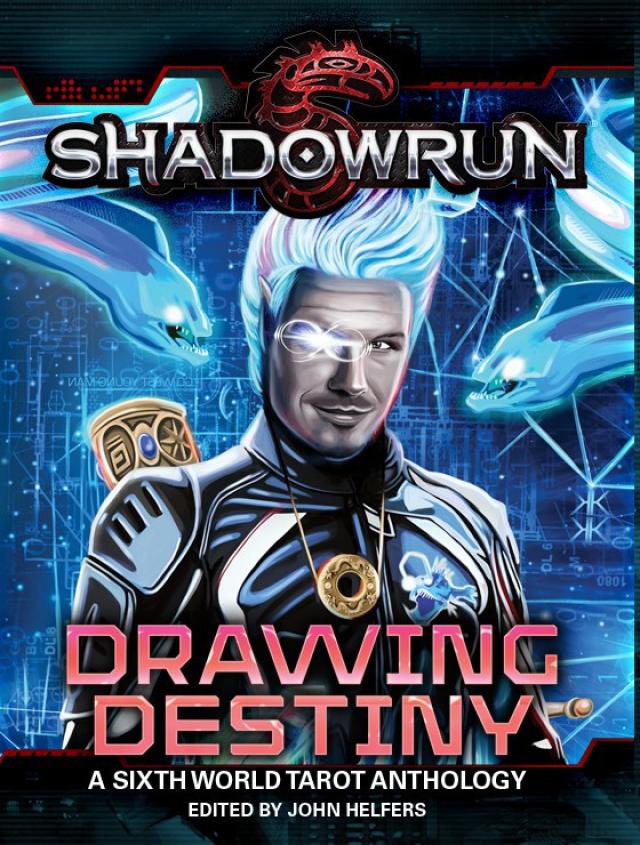


After decrypting the datafile, I stayed up all night to read it, never once suspecting that someone might be hacking into my PAN or watching my every move. The data contained in that file was so hot my circuits almost fried trying to break through its firewalls and security protocols. Once I got in, however, the payoff was totally worth the trouble, for Domenica, Inc.’s biggest sin to date was revealed: biochemical warfare in a peacetime environment.
Creating a weaponized virus wasn’t the worst of it, though, oh no. Those bastardos re-engineered a lesser form of VITAS, stuck a cocktail filled with nanites and chemical inhibitors into it, and tested it on the suspecting masses. Its purpose was to manipulate people’s emotions on a cellular level, in order to control their reactions. Imagine, meeting a total stranger that you normally don’t find attractive and falling head over heels in love with her. Or negotiating with middle management and being so afraid to ask for a raise, your boss demotes you and you’re happy about it—even though, deep down, you know you deserve better.
Reading the file, I could think of a hundred thousand possibilities emotional manipulation could go wrong—even beyond the obvious—but when I realized what the virus was, I almost threw my datajack clear across my apartment.
Domenica, Incorporated called it VITAS-m.
“Belladonna, are you awake?”
After realizing that Domenica, Inc. had not only attempted to bankrupt me, they had also tried to kill me, I wanted revenge, and I didn’t care how much I’d have to pay to get it.
The team I’d assembled for the Prego Job was the best my nuyen could buy. Nikki Sparks was an elven covert ops specialist who stood about six feet tall; she favored a bodysuit made of an imported weave that allowed her to blend in with her surroundings like a chameleon.
Toro Grigio, a dwarvish merc, was short, but what he lacked in height he made up for in ferocity. His signature attack was to charge at his opponents with the titanium, poison-tipped horns attached to his skull. It didn’t matter that he wasn’t the strongest brawler or the most agile; his sharp horns could skewer through anything—even body armor.
Then there was Satin Salvatore, our face, who was obsessed with hidden bioware enhancements that protected and enhanced his senses, but didn’t cover or mar his human appearance. Of course, he wasn’t just “a” face, he was my face. Satin and I dated a few months back, but we wound up falling for each other, so he called it off. I remember him telling me I was too good for him, and one day I’d want to get out of the biz and settle down with a good little Catholic boy and have lots of babies.
Oh, Sal didn’t know me that well—marriage was the last thing on my mind—but that never mattered to me. See, the reason why he was called “Satin” is because his voice was so smooth, he could manipulate the Pope into doing whatever he wanted. Satin had a kind of power over me, though, and we both knew it. It was better for both of us that he called it off. Better, because if he ever truly broke my heart, I would kill him. Twice.
“I can’t tell if she can hear us or not.”
Lastly, there was myself. Belladonna. Decker and drone operator fantastico. For this job I selected one drone in particular, a server I named “Hank the Buffalo,” because I’d painted it brown and stuck a Sioux flag on its underbelly. Hank was a disk-shaped drone the size of a plate of agedashi tofu; it was encased in bulletproof plastic, loaded with sensors, and had a deadly fail-safe. If anyone tried examine Hank or hack into his datafiles, he’d self-destruct, ensuring he would never be traced back to me.
I built Hank to open the door using a trick in a book of cons so old they used to make black-and-white reels about it: I programmed my drone to deliver fresh soyroni pizza. Once inside, Hank would deliver the pizza—which was fake—in order to send me crucial sensory data that Rico’s intel couldn’t provide.
“Maybe we should turn her on her side. That seemed to work for the others.”
Our mission—my vendetta—was to wipe out Domenica, Inc.’s databanks and steal the last remaining vials of VITAS-m so they could never repeat their “grand experiment,” so the citizens of the Italian Federation would be safe. Sure, I could frame the corporation and snatch the proof I needed for the authorities, but after everything I’d been through, I was done playing the long game. I was so angry I wanted to smash their data servers or set the building on fire or kill their CEO, Mateo Forza, with my bare hands. My mind was so filled with rage, I didn’t care about the risks, and that…that’s where I think I went wrong. See, the secret to running well is to think about your team—and their safety was the last thing on my mind.
The night of the raid, we met at a tavern just south of Rome, several kilometers away from our target’s hidden base. It was located in the heart of St. Peter’s Square: below the Sistine Chapel.
I remember how triste the rest of my team was when they found out where we’d be running. It was one thing to be paranoid about a megacorporation, but that night we learned the conclave was still scrambling to name Pio XIII’s successor…that news almost broke Satin. He was of the mind that religion was still a balm for the broken and the weary, and that Vatican City was the salve that soothed our country’s soul. “Those godless Confederates. Pagans and ork-lovers. What do they have that we don’t? Real espresso?” he shouted at the news reporters illuminated on the holo-vids nestled tight against the wall. “Or those fragging UFACS and their tribes? What are they to us?”
“UCAS,” I gently corrected him. I knew he was angry, but I couldn’t help wincing at his imperialist attitude. Orks and dwarfs and elves and magic and foreign gods were not to blame for our country’s ills. Instead of confronting him, I ordered him another birra, and prayed for the best. Satin usually calmed down when he was slightly tipsy, and I needed him to live up to his name. “It’s UCAS, and they’re not as good as us,” I lied. “They can’t be, because we have something they don’t.”
“What’s that, cara mia? Another dead pope? Pio XIII was dead five years ago, you know. The conclave could never make up their damn minds.”
“No, me.” I laughed.
That was when I knew this job meant something to Satin, too. It wasn’t like him to get a single detail wrong, let alone two of them. In his mind everyone and everything had a proper name—human, ork, elf, dwarf, dragon, corporation, country, or otherwise. He should have remembered UFACS was really UCAS, and Pope Pio XIII died just a week ago. The conclave was taking their sweet time to name a new pope, but they’d only been talking about it for seven days, not five years.
Nikki was harder to figure out, partly because she hid her face and ears beneath an oversized hood. She never did feel welcome in Rome, she’d confessed to me earlier, but she took this job for the nuyen anyway. I did agree to pay her extra for the emotional trauma of being called names like “dandelion eater,” “pixie,” and “bony hoop.” It was a shame her bodysuit wouldn’t help her to blend in with the rest of us; if she could, I think she’d up and disappear.
I wish Nikki was just being paranoid, but she had a right to be concerned. The locals, or “sheep” as she liked to call them, secretly believed in their heart of hearts that humans were God’s chosen creatures, and there was no Fall. Not really. In their minds, the Fall was an elaborate hoax designed by the government using that newfangled holotech and hallucinogenic drugs, like Sparklepush and Dreadrunner, that all the clubbers snorted these days.
Funny. How many of those same sheep had the wool pulled over their eyes by the very same corporation that employed them?
Even funnier, I used to work as a terminal operator for Domenica, Inc. Now that I think about it, being their wage slave was probably how I’d gotten sick all those months ago.
“I’m still not feeling a pulse. Ideas?”
Toro Grigio didn’t keep many secrets—which was odd for a merc specializing in wetwork. Of all the runners in my group, I knew I had to keep a closer eye on him because he liked to brag about every little thing. He loved stabbing the Man, repeatedly and with vigor, which is why I hired him right after I found out Domenica, Inc. was a subsidiary of the EVO Corporation. The bigger the target, the more excited he got.
Toro stood out, too, even more than I did, and not just because he dressed like his bullish namesake. To a handful of fans, Toro Grigio was a famous French-Italian DJ who loved tourists and a head-spinning musical genre called “Sixth Fall Grunge Age.” While the other dwarven mercs stuck to back alleys and slums, Toro lived out in the open, as large as he possibly could, broadcasting his every move on the Matrix for his cult of fans.
Thankfully, Toro wasn’t that stupid, just vain. When it came to running, he knew when to keep his mouth shut and when to stop recording. I did worry about his reputation, though, because he was a true merc, and rumored to be loyal only to himself.
I’m not sure he was the one who betrayed me, though. I’m not sure any of my team was responsible for what happened, honestly. I wish I was, so I’d know who to kill.
“We could try to jump start her heart, but that might kill her. The equipment in this infirmary sucks.”
According to the information Rico provided, Domenica, Inc. had built an underground laboratory beneath the Sistine Chapel into the catacombs that most Italians—myself included—thought had collapsed shortly after the Fall. Much to my surprise, while many of the labyrinthine tunnels were inaccessible to the public, other passageways—hidden since the time of Christ—had opened beneath the streets of Rome, exposing finger-shaped fungi and toxic yellow molds, poisonous spiders long thought to be extinct, and glowing, pulsing walls filled with egg-shaped orbs.
I remember messaging Rico about the orbs, because he didn’t paint them as a potential target. He said they were rumored to be the children of Thyrus, a legendary medieval dragon from Umbria, herself.
I don’t know whether Rico was lying to me or not, but my team never made it to those catacombs—or that glowing wall to find out if the orbs were real. We avoided the catacombs altogether by sneaking into Domenica, Inc.’s secret facility the old-fashioned way: through an above-ground sewer grate, thanks to clever scans Hank provided. Then, we crawled through the muck until we reached a locked maintenance door and a chute.
Was Rico on the take from Domenica? That would explain why he’d guided me to set my team up the way I did—and why he gave me that bullshit information about “magical orbs” or “dragon eggs” to scare me off. If I had hired a technomancer—even a green one…. Well, I’m sure the job would’ve gone down very differently than it did.
“Her hair still smells like drek. I wish we could wash it, but I’m afraid to move her.”
While Toro made quick work of the door, Satin Sal encouraged us to clean ourselves as best we could, and Nikki planned our next steps. She and Hank would go on ahead, crawling through the vents, looking for intel to feed back to the rest of the team over our comms. Once they had designated the safest route to our target, Satin Sal would clear a path by distracting the guards so I could run in, smash the vials, and run to the nearest exit.
Toro, on the other hand, was supposed to watch my back and, when the others were at a safe distance, set a series of undetectable timed explosives—short-range EMPs and thermite strips, mostly—at three-foot intervals on his way out.
I remember asking him what kind of grenades he brought along with him. Toro seemed so friendly, so concerned that I knew every pin and timer, he pulled out a trio of small, geometrically-shaped containers and handed them to me. Did he know what was going to happen? Was he trying to warn me?
“Those don’t look like grenades,” I’d told him. “They look like a datastick case for musicians. I think I saw Franzetta selling them at her last concert.”
“Uh, they’re not supposed to. These babies are the reason I’ve lived so long, ’cause they’re undetectable by sensors, and everybody thinks they’re harmless. Something a DJ like myself would carry, right?”
“So you built the grenade inside of your DJ equipment. That’s clever. Which one is which?”
“The blue one, that’s a smoke bomb, and the yellow one’s a concussive soundcrusher, and this white one right here is a mag-frag,” Toro said, opening his palm. “When you pull this pin, you got five seconds, capiche? When the five are up, lay as flat on the ground as you can. Don’t run from the mag-frag. If you do, you’ll die.”
“What does it do?” I was genuinely confused. Normally, grenades were the type of weapon I’d throw at a goon right before I bolted out of the room.
“It’ll hurt. Real bad. It’s a plastic concussive grenade that shoots out bits of motion-sensing magnetic nanites. It’s um, designed to take out bioware and fry ’em on your body like an EMP would. Only the mag-frag is a hell of a lot cheaper, messier, and far less accurate.”
“Hence the motion sensors.”
“Um…yup.” Toro seemed uncomfortable, but now I think he had a crush on me. Either that, or he wanted to make sure I lived long enough so he’d get paid.
“Thanks for the tip.”
“No problemo.”
Toro was right about one thing. Grenades did hurt like hell, and it didn’t matter who threw them.
“We’re running out of time. The boss’ll be here soon, and she still hasn’t woken up.”
“Pupils are dilated. BP is one-ten over seventy.”
“What does that tell me?”
“That she’s still alive. Her back’s pretty messed up, though. Not sure how bad.”
The Prego Job had seemed simple enough, because our plan didn’t involve any magic or tech. It was supposed to be a simple smash-and-grab, the kind of thing dumb-witted Pagliarelli mobsters did for their initiation year after year after year. Our job was to be better than those mooks; to ensure we weren’t stupid enough to get caught, and to make Mr. Johnson happy so he paid us, just like he promised. That was why, Satin Sal suggested, we had to ditch our comms—to prevent the local polizia or security teams from hacking into our channel. No comms, no problem.
Of course, I didn’t listen to Satin Sal. We brought our comms, but they were malfunctioning. At random moments, the feed would cut out, and we would hear nothing but hissing static. I remember Toro saying we’d been cursed by the malocchio, and that we should abort. I told him he was being silly, that the comms would work when we needed them to.
By the time we got into the facility, however, I felt a slight chill running up and down my spine and wondered if Toro was right. Maybe we were cursed. I swallowed my fear, ignored my instincts, and did my part mechanically and beautifully. I didn’t stop for a second, so I never wondered why the security system had already been disabled, why Nikki’s suit wasn’t working, or the real reason why Satin Sal—my so-called friend and former lover—was so insistent on not bringing comms to begin with.
Did they all betray me? Is that why Nikki left us the first chance she got? Or did Rico set me up by trying to hack into Hank’s mainframe, triggering his self-destruct?
“If she’s still alive, then maybe we should kill her now.”
“No! The boss wants her breathing. Said it was important. Something about giving her a choice.”
I remember how pissed I was when I found out no one had been in that building for at least a decade or more. It was a detail Hank would never have been able to figure out on his own; he wasn’t programmed for anything beyond the basics. It was, however, something my fixer would have known, and something the rest of the team would have noticed, too, after a few minutes wandering around in the dark, cobweb-covered halls and abandoned labs.
The other runners didn’t tell me we’d been had. They didn’t need to tell me, because I figured I was being set up before they did. And, if one of them had trapped me, I didn’t want them to know I’d caught on to their bullshit.
I remember the smell of mold and mildew and dust. I remember how my cheeks burned, how I wanted to scream into my broken comms, how I wanted to use those grenades Toro had given me—but I didn’t. I couldn’t. Because just as I was about to fight my way out, I saw the reason I’d been lured underground: a case of vials marked Biohazard.
VITAS-m was real after all.
“Well, we can either sit her up or leave her be. I say we leave her for the boss. He’ll want to be here when she wakes up.”
I didn’t waste any time. I seized one of the vials, stuffed it in my pocket, and then grabbed a grenade—I didn’t care which one—and pulled the pin. I counted to five and sprinted toward the exit, hoping Toro Grigio was right behind me, praying I didn’t trigger the mag-frag.
Just as I put my hand on the door, I remembered a blinding flash and a bang so loud it dropped me to my knees. Then, I heard a terrible noise—a high-pitched whine—and felt tiny knives scraping across my back. I remember staring at my freedom, crawling toward that open door inch by inch with the smell of burning flesh in my nose and the taste of coppery blood in my mouth, and Toro shouting “Sono morto! We’re dead!” at the top of his dwarven lungs—right before I fell unconscious.
“Signore Forzo, I believe you wanted to inspect this woman yourself. We took good care—”
“I take it she is still alive.”
I knew that voice as intimately as I knew all my lovers’.