

The tyrant, p.1
The Tyrant, page 1


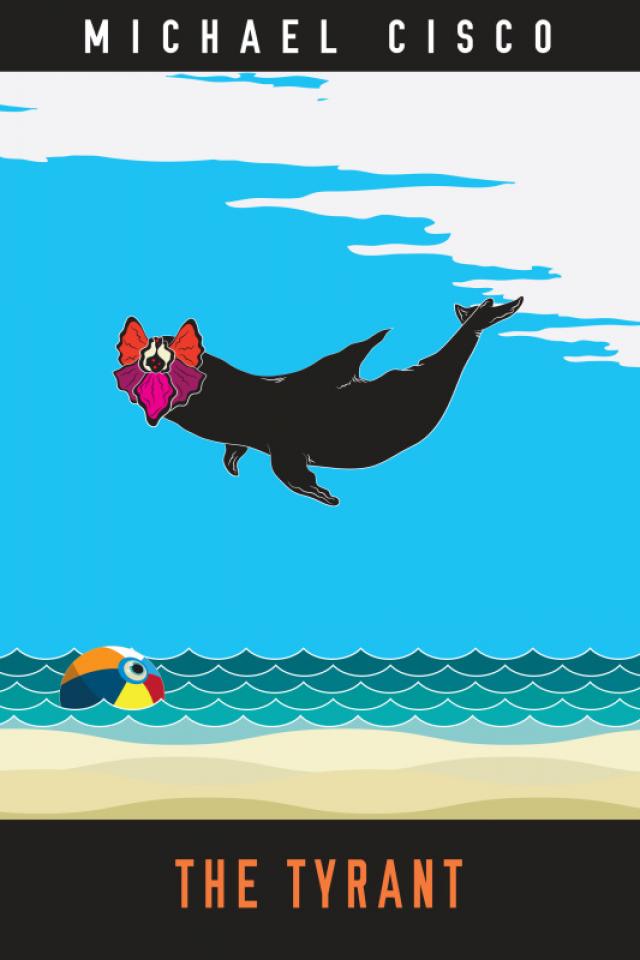
THE TYRANT
MICHAEL CISCO
Cheeky Frawg Books
Tallahassee, Florida
Copyright © 2004 Michael Cisco.
Introduction © 2012 by Rhys Hughes.
Cheeky Frawg logo copyright 2011 by Jeremy Zerfoss.
Ebook design by Neil Clarke.
Cover art copyright © 2013 by Jeremy Zerfoss.
All rights reserved. No portion of this book may be reproduced by any means, mechanical, electronic, or otherwise, without first obtaining the permission of the copyright holder.
Special thanks to Centipede Press for their 2012 limited editions of these novels, from whose preferred text these e-books have been created.
This novel has been re-released as Cheeky Frawg’s 2013 Weird Summer Beach Reading Selections. Cheeky Frawg: We Believe Summer Beach Reading Should Creep You the Hell Out.
Check out the full line of Cheeky Frawg Books at:
www.cheekyfrawg.com
Cheeky Frawg
POB 4248
Tallahassee, FL 32315
vanderworld@hotmail.com
Introduction
Rhys Hughes
I have been struggling for months trying to say something about Michael Cisco that his own prose doesn’t already say about him; and if this gives the impression that Cisco, in his many outlines and guises, is fully framed by the heady clarities and rapturous transparencies of his work, then the error lies in assuming that written words on a page know all the secrets of their authors. In this case they may know only that he is unknowable or at least unable to be defined meaningfully.
I’m not sure how much Cisco’s work really knows about the man who has created it; far more than I do, of course, but surely not the whole story and perhaps not even a basic plot summary. I find it hard or impossible to capture the essence of this brilliant writer in a neat offhand remark. “Oh, Michael Cisco, he’s a fabulist/magic realist/philosophical fantasist/ironic existentialist/dark comedian of our pain.” None of that is adequate, none of it convincing or truly visceral enough.
Because the weird, the odd, the different can often be easily defined, a few words are generally enough to convey an approximate impression of the quality and range of the weirdness, the oddness, the difference. But I have to say that, to me, easily defined weirdness has only ever seemed to be the lowest or first level of the weird. There has always lingered in the back of my mind the question, “What would the weird find weird?” And the answer, whatever it is, is the next level.
Cisco most definitely isn’t one of those eccentric and enigmatic uncles in curious poses and uniforms in sepia photographs on the mantelpieces of certain strange homes. Nobody seems to know much at all about who those uncles were, what they did, why they did it. But Cisco, if anything, is the even more eccentric and enigmatic uncle in the even more curious pose and uniform in the sepia photographs standing on those first uncles’ mantelpieces. Yes, it’s an awkward analogy.
But we mustn’t forget that what the weird finds weird might, at times, be what is “normal” too. Weirds don’t just multiply each other, they can cancel each other out occasionally. There’s always that option. To regard the weird as a value with a fixed positive or negative sign in front of it is a mistake, a mistake made by many or perhaps most writers of the weird. But Cisco never makes this error of eldritch arithmetic; he alters the signs accordingly and thereby juggles his music.
The “normal” generated from the “weird” is the grounding in the now from which Cisco operates, our familiar but deeply unsettling reality that is always there behind the most outré scenes in his brilliantly orchestrated nightmares, mirages and routines, the base that shimmers, almost seems to vanish, a fata morgana on the fictive horizon, but which is firm enough to make devastating raids from, into the heavens and hells of our dreams, and a place to bring captured readers back to.
And that base resembles a maze. There is a Michael Cisco short-story called “Visiting Maze” that can be read, if one chooses to, though it’s not compulsory, as a description of how one might end up transforming into a Cisco devotee. You begin as a normal human reader, a fairly ordinary fan of weird fiction, of the “literature of the imagination”; somehow or other you get to hear about the existence of Cisco; one of his books ends up in your hands. It could be that it seeks you out.
“She showed me the capacious, transparent form, descending from out the clouds of the grayest darkness . . . The great glassy wheel with countless inner compartments impressed itself onto the soft landscape . . . ” And this maze that is more than a maze, that is simply, bizarrely, a visiting maze, follows the one who leads it like a faithful aura across the perfectly but precariously balanced tension of our inner and outer worlds. “It already surrounds you.” Yes, the maze will come to us.
I’m not attempting to be deliberately obscure. With many writers it’s a struggle to insert oneself into the available weirdness, it’s an effort, some sort of task or quest. The story sits meekly inside its book and waits to be jabbed into activity by a reader’s mind. It won’t do anything by itself but sleep in the night of closed covers. One goes to the labyrinth, enters and takes the trouble to get lost inside it. Cisco’s work is never so passive and touristic as that. Rather, it amazes you alive.
This is no exaggeration. I genuinely wonder when reading his work if I’m going to end up trapped in his realities, in his maze, and whether I’ll be ever able to escape at the finish of the experience. Not that there’s any malign trickery going on here. No, the danger is that the same Ariadne who provides the guiding thread of words to lead one along those twisting passages is also the Minotaur in drag, that the currents of prose are the unraveled proteins of the mythical beast.
With specific reference to The Tyrant, I am going to avoid making any suggestion that it might be his best novel. A writer so consistently good doesn’t really have a “best” of anything; nothing can stand out because there is ubiquitous brilliance. I do think, however, that it might be the best book for readers new to Cisco. The arc of plot is more easily digested than the rainbows of structural dynamism that overspread and interthread his later novels. The Tyrant is a maze with clear walls.
I have met hugely experienced connoisseurs of weird fiction who rave about Cisco, who regard him as the Great Mysterious Hope that the genre has badly needed for many years; although sober and cerebral in attitude and demeanor, these connoisseurs burn with a feverish light when asked to discuss Chapter 6 of this novel. It is one of the greatest chapters in the history of weird fiction, a chapter to rival, for instance, Chapter 8 of Italo Calvino’s The Non-Existent Knight for generosity.
By generosity, I mean generosity of the imagination; a willingness, a desire, to give the reader everything, more than was asked for, more than it was realized was available or possible. When you open a Cisco book, you have thrown aside the lid of Pandora’s Box, but in the hands of the Hope that emerges in the wake of all the Troubles, there is a second box, equally deep, no less crammed with new Troubles and Hopes, and so on. There is a transfinite quality to his craft, his mind.
And the lack of false sentiment is refreshing and essential. Ella, with her legs in braces, precocious and inclined to aristocratic disdain, isn’t a standard fifteen-year old fictional heroine but someone closer to reality, with the tenacity necessary to survival in this absurd universe of ours. A reader can empathize and sympathize with her but never pity her, never use her as a strop on which to hone one’s pity before too much existence makes it blunt. She is marvelously flawed and true.
Meet also the man encased in a cube of gelatin to muffle the upsetting frequencies that his tortured body radiates. He is the sick Orpheus who delves into a maze far more intricate than any explored by Theseus, the maze of death itself. Cisco, like Orpheus, has the power to hypnotize his readers through such characters; they sear into the mind in a way that seems risky, hazardous, reckless, unlike so much orthodox weird fiction, unlike the exhausted tropes of the weirdless weird.
For at this moment I must make a confession that won’t endear me to those who believe there is a sacred canon of weird writers and that they all lived in the past and are already dead. The blunt truth is that most of the so-called “masters” of fantastic fiction leave me unmoved and deeply unimpressed. My assumption has always been that the “literature of the imagination” should be exactly what it claims to be, namely original and inventive, overflowing with truly ingenious conceits.
But it so rarely is. The “masters” have made false promises or have had false promises made on their behalf. They were supposed to create work that was imaginative to an extreme degree, that dreamed dreams beyond those I am capable of dreaming by myself. But they didn’t. The “masters” let me down. They just aren’t capable of blowing my mind. None of them make me jump up and ruffle my hair. I’m sorry to say it because I know it’s a dreadful thing to admit, like many disappointments.
Lovecraft, M.R. James, Blackwood, Aickman, Bloch, Stoker, Le Fanu, Machen, Clark Ashton Smith. They aren’t left-field enough. They never catch me out or run rings around me. I can anticipate their answers. But Michael Cisco does give me what I want. He does blow my mind and he does it painfully, beautifully. I find him unpredictable, enthralling. He is what the weird is supposed to be, what I thought it was going to be when I first discovered it. He has fulfilled all the promises.
I am currently in the process of compiling an online glossary of terms and phrases useful in the genre writing world. It’s a variation on Ambrose Bierce’s Devil’s Dictionary
One aspect of Cisco’s work that is often ignored is his playfulness. His playfulness isn’t of a soft teasing kind but a fully dark rumble and tumble through the caverns of inner space. The Tyrant is a commedia, not exactly a comedy, not exactly a tragedy, not even a tragicomedy, but a molecule unseen before, a new style formed from a combination of those elements and others. It is grand and savage and disturbing, curiously uplifting and ecstatically arcane, but never impenetrable or obscure.
Fiction that belongs to the weirdless weird, the vast majority of weird fiction in other words, merely shuffles pre-existing scenarios and clichés into different patterns. But genuinely weird fiction, Ciscoate literature, is an outwards journey at a tangent to itself. There is intense originality, fun with analogies, intellectual ideas with enormous emotional force, twists that are straits, shallows that are deeps, paradoxes that resolve themselves with the aid of other paradoxes into pulsing mandalas.
And the whole is governed by a rigorous logic, but not necessarily the logic of everyday events, orthodox cut-price empirical logic. It might be the logic of ideas (or word) association instead. Why don’t more writers of weird fiction try to learn some of the alternative logics? Not everything that is true has to be in tune with “common sense.” There are deeper truths beyond our everyday assumptions, scholastic formulae that will generate astounding results if we have the courage to test them.
In the final analysis I can only compare Cisco’s courage and daring in pushing and expanding the genre with the composer Conlon Nancarrow, whose love of jazz caused him to wonder why it had to be concurrent and not simultaneous. He punched holes in paper rolls and fed them like wise tongues into player pianos and the result was music impossible for human performers to recreate. On first hearing it might sound like chaos, then it becomes clear that it is a network of interlocked melodies.
So I see Michael Cisco as a piano roll unwinding himself slowly on an instrument somewhere in some invisible city, or perhaps in a salon of hell or heaven, while an audience of eccentric and enigmatic uncles in curious poses and uniforms tap sepia time with their feet. These uncles might be tyrants with breathtakingly extreme aspirations, proto conquerors of the spiritual realms of the universe; or they might simply dance, together and yet alone, describing the paths of a transparent maze.
“ . . . he drew up a line of battle on the shore of the Ocean, arranging his ballistas and other artillery; and when no one knew or could imagine what he was going to do, he suddenly bade them gather shells and fill their helmets and the folds of their clothes, calling them ‘spoils from the Ocean, due to the Capitol and Palatine.’ As a monument of his victory he erected a lofty tower, from which lights were to shine at night to guide the course of ships, as from the Pharos. Then promising the soldiers a gratuity of a hundred denarii each, as if he had shown unprecedented liberality, he said, ‘Go your way happy; go your way rich.’”
—Suetonius, from his “Life of Gaius Caligula”
“So he was comforted and the next day drew up his army in order of battle on the sea-front: archers and slingers in front, then the auxiliary Germans armed with assegais, then the main Roman forces, with the French in the rear. The cavalry were on the wings and the siege-engines, mangonels and catapults, planted on sand-dunes. Nobody knew what on earth was going to happen. He rode forward into the sea as far as Penelope’s knees and cried: ‘Neptune, old enemy, defend yourself. I challenge you to a mortal fight. You treacherously wrecked my father’s fleet, did you? Try your might on me, if you dare.’
“ . . . A little wave came rolling past. He cut at it with his sword and laughed contemptuously. Then he coolly retired and ordered the ‘general engagement’ to be sounded. The archers shot, the slingers slung, the javelin-men threw their javelins; the regular infantry waded into the waters as far as their armpits and hacked at the little waves, the cavalry charged on either flank and swam out some way, slashing with their sabres, the mangonels hurled rocks and the catapults huge javelins and iron-tipped beams.
“ . . . Caligula finally had the rally blown and told his men to wipe the blood off their swords and gather the spoil . . . The shells were then sorted and packed in boxes to be sent to Rome in proof of this unheard-of victory.”
—Robert Graves, I, Claudius
“One might well say that man has at his disposal a capacity for dying that greatly and in a sense infinitely surpasses what he must have to enter into death, and that out of this excess of death he has admirably known how to make for himself a power.”
—Maurice Blanchot
Chapter One
Our Ariadne has brushed by you—in every city. You need only turn aside to see her at your elbow, a plain, dark-haired girl. She sits by the door in a complicated big bundle; the other passengers give her a wider berth and some drop compassionate looks, faint and brief, scarcely aware of the partially unassembled expressions on their own faces and she, with her eyes stubbornly welded to the floor, not at all. She counts the stops.
Without warning, and before the train starts braking, our Ariadne, here called Ella, strongly rises from her seat leaning forward on the stainless crutches that fledge the ends of her two arms, and locks the hinges of her leg braces. When shrieks come from the brakes and you are all precipitated toward the front of the car, she is already braced and leaning into it, and when the doors fly open she sways onto the platform with her eyes still obstinate because this station like all stations on this line has no elevator. The vaccine readily available the disease assumed destroyed, for want of a shot she had lost the use of both of her legs when she was five, from polio. Already a precocious child, the disease passed from her and left her mind hard clear as a diamond terrifying effortless penetrating intelligence, impatient with no wasting time. Utterly defeated and mastered by their remote daughter, her parents could only wave impotent hands when she began taking undergraduate courses as a twelve year old.
Every day, she would stand at the base of the callous stairs in this station, wait a moment for a crazy impulse to spin the wheels in her shoulders bringing the ends of her two crutches up and forward onto the first step. With her crutches’ feet spaced widely apart, she would lever herself off the ground and swing both her legs forward between them, settle them down and then repeat until she stood on the upper platform, all the time the crowd dashing on all sides.
Once, Ella was standing near the top of the stairs when a man in a white trenchcoat dashing for the train raced past her along the handrail buffeting her shoulders as he went, and with a sickening heave she felt her balance swing wildly upright she reached for the rail to her surprise it was already above her someone with dark glasses was coming down the stairs with rapidly tumbling steps above her without noticing her. There was a blow across her shoulders that rammed her chin into her chest—that was the landing, striking her, she had fallen—a crutch tangled with the rail post pried her shoulder from its socket and only then came loose away—her momentum carried her heavy rigid legs unable to bend over her head and she dropped for a moment in a cartwheel onto her heels. With nothing to hand she continued backwards and her heels left the step—she plummeted to the platform and her legs clattered on the lowermost steps in a striped metal V, warm damp spread over the softened back of her head, the man with the dark glasses flashed by and into the closing doors of the car to her left, where her head was turned, her eyes stuck half closed. Persons darkly streaked over. Without understanding but fixed moment by moment in her memory she could see a red trickle escaping across the concrete, gathering into a little bulging pool before pushing further, bearing a cigarette butt. She watched that stream flow into the standing yellow pool at the base of the staircase—she remembers an oblivious kick from the hard point of a woman’s shoe against the soft inside of her forearm stripped of its crutch. Conscious through some of the miscellaneous activity that followed, before her eyes would finally go dim.


