

Billy tabbs, p.35
Billy Tabbs, page 35
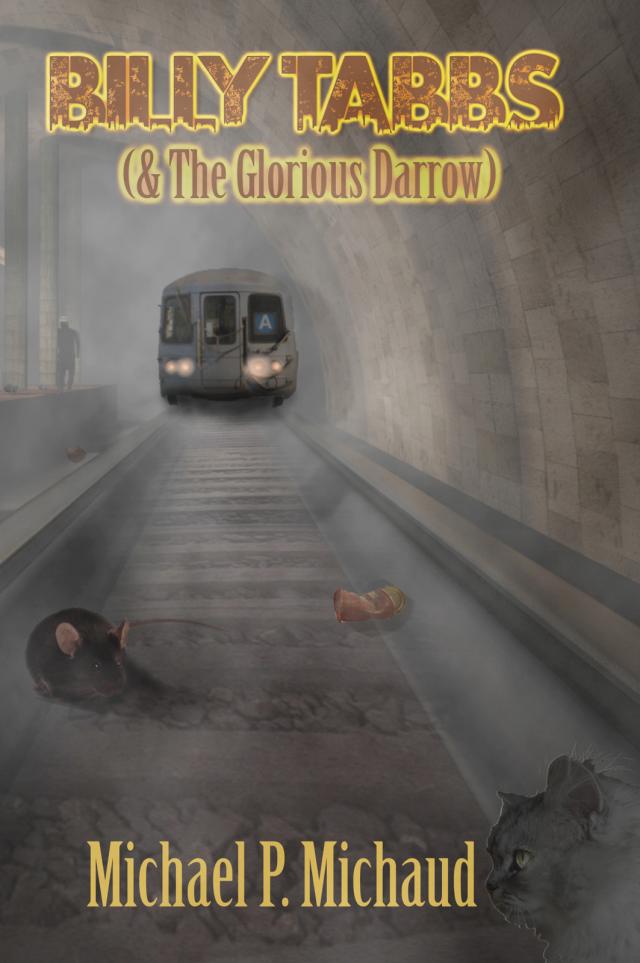


Lambert takes a few more ginger steps on the rocky surface before something catches his attention.
He directs his flashlight to the ground, kneels down for a better look, then digs the half-buried object out from the rocky terrain and pulls it closer to his eyes. He examines the widget from several angles, then slowly makes his way back toward the caboose.
“What did you find?” asks Meyers, now standing on the platform just a few feet away.
Lambert climbs up to join him.
“Nothing, really. Just a rusted bottle cap. I’ve found them abandoned all over the tracks. This one is from an old Nehi bottle. I used to drink this stuff all the time as a kid. Still do, when I can find it.”
“The more things change, I guess…” responds Meyers, his voice trailing off to indifference.
“It’s strange, though.”
“What’s that?”
“I saw some of them in the railcars,” said Lambert. “Some were kept clean and polished on the seats. But then there were others wedged down in the cushions or on the floor.”
“What’s so strange about it?”
“Well, it was as if they collected them. Even valued them a little bit. But then most of them seemed to have been left down in the tracks.”
“Bunch of their own were down there, too, though.”
“True, but if they’d only…”
Meyers clears his throat.
“Dr. Lambert, please tell me you’ve got more for the mayor than bottle caps…”
Lambert nods, somewhat sheepishly, before flicking the bottle cap back down into the tracks. It ticks off a few rocks before disappearing somewhere into the darkness.
“So, Dr. Lambert, we’ve been here for almost an hour…Do you have any preliminary thoughts on what was going on here?”
Lambert doesn’t immediately respond. He was struggling with the same question even before Meyers posed it. Has been thinking of nothing else since the moment he was contacted. He still can’t fathom what might have drawn them all together this way; what could possibly have caused them to shed their reclusive ways and organize themselves in the manner that they did. What catalyst might have set them on this violent path? He’s spent years studying their psychology and living patterns. Nothing fits. Nothing makes sense.
Meyers presses, impatient for some sort of response.
“This wasn’t natural though, was it? I mean, it can’t really be what it looks like?”
An uncomfortable silence settles in before Lambert speaks again. “It’s certainly not like anything I’ve ever seen before, but I’m sure there was a reason behind all of it. It’s a puzzle laid out at our feet. We just have to put the pieces together.”
The non-answer exasperates the detective. “Dr. Lambert, felines are your area of expertise! Are you actually suggesting that they might have been organized? That this colony of ferals and strays actually moved with a purpose?”
Lambert wishes he could tell him more, wishes that he himself fully understood the circumstances that led to what transpired here over the last several months. Their coming together, their seemingly organized and premeditated attacks. “It’s possible…” he responds. “They’re highly intelligent beings. They were obviously upset about something.”
Lambert considers the resourcefulness it would have taken, not only to secure the food that they had, but to locate so much fresh Nepeta here in the city, evidenced by the dried bits scattered thoroughly about the area.
Visibly frustrated, Meyers strikes up a fresh cigarette, inhales deeply, then exhales an impatient cloud of smoke into the chilly darkness. “The people on the platform said it was quite a spectacle. Said it was like a god damned convention.”
Lambert nods, returning his attention to the wall beside the office, yet again trying to decipher the strange scratchings concentrated in that particular area. They appear to be two separate columns of scrawl, careful but nonsensical scratches—at least to the human eye. Lambert can’t help but wonder if there was any meaning behind those claw marks, or if they’d merely turned that particular part of the wall into a surrogate scratching post.
“They said there was a brown-haired tabby front and center,” a quick puff, “said he was really fighting for his life.”
Lambert responds under his breath, “Maybe they all were,” the words falling too softly at his feet for interception.
“Pardon?”
Lambert adjusts his wool cap. “I said maybe they all were,” he repeats.
Meyers nods. Another puff. “Looks like they turned on each other real quick.”
Lambert doesn’t respond.
“Just their nature, I suppose.”
Again Lambert doesn’t respond.
Meyers turns for the exit. “Well, whatever they were up to, it’s gonna be the needle for this lot.”
Lambert responds sharply. “You really think that’s the answer?”
It’s not actually a question, more a shot across the bow; and Meyers doesn’t press, sensing Lambert’s tone. It’s the same smug superiority that Lambert has heard from so many people over the course of his career. The same calcified indifference.
None of them get it.
Many never will.
“We should be going,” says Meyers, tentatively.
Lambert doesn’t budge, his eyes lingering on the tracks.
“They’re just animals, Dr. Lambert.” His voice softer, conciliatory.
Lambert softens his own features in return, curling up a slight smile on his lips, the, “Aren’t we all, though,” left unsaid.
And with that, each man falls into sustained silence, Meyers flicking the remainder of his cigarette to the compound floor and extinguishing it beneath a twist of his heel, Lambert steeling himself for a return trip down the tracks.
It’s just after midnight when they step past the still-leaning flat cap and back into the gravelly tunnel, leaving behind the smell, among others, of stale oil, sulfur, and the promise of better days to come.
Coming (soon?)
The Story of Derek
(Through The Story of Ash)
If it takes a village to raise a child, I believe it takes nearly as many to raise a novel, and a great deal more antacid.
I wish to acknowledge everyone who has supported or inspired me throughout this arduous process, including my family (Robert, Mary, Eric), Michelle Roth—who was supportive beyond words, Meagan Smith, Chris Hanna, Brittany Medeiros, David Dumais, Matthew MacIsaac, The Flying Squirrels—Carolyn Thomas, Sonja Harrison, and Fiona Christie—David D’Iorio, Brian McGuire; all the teachers who believed in and inspired me, specifically Barbara Inman (4th grade, Longfellow Elementary, Portland, Maine), Christine Pittman (10th grade, Chantilly High School, Chantilly, Virginia—where Billy Tabbs was first born), and Naomi Dixon (Grades 10–12, Chantilly High School, Chantilly, Virginia); all those who’ve been invaluable in editing this book, including Sandy Adelson, Allister Thompson, Michael Kenyon, Sylvia McConnell, Karin Lowachee, Susan Folkins, and Susan Foster; to the writers who inspired me throughout and to which this book pays homage, particularly the legendary George Orwell; and finally to Jay Nadeau and the entire team at Bitingduckpress, who perhaps believed in Billy more than he believed in himself.
The phrase “the last, the least, the littlest” comes from a letter by Cardinal Roger Mahony, Archbishop of Los Angeles: “Any society, any nation, is judged on the basis of how it treats its weakest members—the last, the least, the littlest” (November 12, 1998).
An American-Canadian citizen, Michael holds degrees in English, Political Science, and Law.He is employed as a Crown prosecutor in the Greater Toronto Area.
BILLY TABBS (& THE GLORIOUS DARROW) is his debut novel.
Visit darrowknows.com
BOOK CLUB AND DISCUSSION QUESTIONS
1. What are the major themes of the novel, and what message(s) do you feel the author is trying to convey?
2. What creates class divides? What are the benefits of social classes? What are the disadvantages?
3. Some people believe that we cannot have social and economic equality unless we eliminate classes; others believe that class divides may promote social and economic growth, with the possibility of equality for all. Discuss the two points of view.
4. Describe your view of the ideal society and how it is or is not attainable.
5. If you were a member of the House of Darrow, would you have supported Jacob’s or Marlon’s approach, and why?
6. Darrow claimed that “Violent indifference earns indifferent violence.” Do you agree with that statement? Is violence ever acceptable as a means to an end? Discuss.
7. Describe some of the symbolism in the book, particularly as it relates to:
a. Class
b. Animals
c. Religion
8. Who was to blame for the ultimate failure of the House of Darrow? Explain?
9. Describe some of the literary or pop culture allusions in the book.
10. What gender was Sam? Why do you think so?
11. What do the rail cars represent?
12. What does the water damage to the second rail car represent?
13. What do the tracks represent?
14. What do the widgets represent?
15. What does ‘the weed’ represent?
16. What does ‘the needle’ represent?
17. What does Totter represent? What did you make of the theory of Joy Transference? Does it have merit? Why or why not?
18. How old is Darrow? How did you determine his age?
19. What do you think Jacob meant when he told Darrow that “There will always be a man in the tunnels”?
20. Does the revelation strengthen or weaken the novel? If so, how?
21. Does the revelation make the novel more or less satisfying? If so, how?
22. Did your sympathy for the character(s) increase or decrease as a result of the revelation? Why?
23. Did the revelation substantially alter your opinion of any particular event or character, and if so, which one and how?
24. How would you characterize the ending (e.g., happy or sad, hopeful or hopeless)? How does the final scene with Dr. Lambert and Detective Meyers influence your view?
25. At what point in the story (if ever) did you first suspect the true nature of the homeless population? Identify and discuss some of the clues.
26. What, if anything, makes Darrow an admirable character?
27. How did Darrow change throughout the course of the book, and to what do you attribute the changes?
28. What, if anything, makes Billy an admirable character?
29. How would you characterize Darrow? Is he a hero or a villain? Did your view of Darrow change as the story evolved?
30. How would you characterize Billy? Is he a heroic or tragic figure? What could he have done, if anything, to improve the outcome for the community? What prevented him from doing that?
31. Jacob and Tommy came from very different backgrounds, but both were devoted (at least for a time) to Darrow. How did their early years contribute to their characters and their views of nonviolence and equality? Would you describe either of them as naïve? Why or why not?
32. What were Darrow’s last words, and what did you take them to mean?
33. The precise method of Darrow’s death had been foreshadowed. Where?
34. Who was your favorite character, or characters, and why?
35. Who was your least favorite character, or characters, and why?
36. How would you characterize Chester (the town crier)? Was he an innocent pawn or a collaborator? Comment on Chester’s ultimate fate.
37. In what ways, if any, do the downtrodden share responsibility for what became of the House of Darrow?
38. Does Marlon’s explanation for Jacob’s death ring true? Why or why not?
39. Which character(s) were you most rooting for? Did your sympathies change over the course of the story? If so, how?
40. Did your opinion of Rufus change as a result of the revelation, and if so, how?
41. Did you find any part(s) of the book humorous, and if so, which part(s) were most humorous?
42. Ash fails to return to the community after Operation Overpass. Did he die or did he survive? Why do you think so?
43. Billy is hopeful that he was able to save the girl in the blue dress. What suggests that she survived? What suggests that she did not?
44. Which scene or event stood out most in your mind, and why?
45. Which was the most difficult scene to read, and why?
46. Whose death affected you most, and why?
47. What do you think became of Derek? How does it affect the story that his disappearance remains a mystery?
48. A few characters, such as Lyle, Neven, and Hannah make only a brief appearance. What is their relevance, if any, to the story?
49. Do you relate Billy Tabbs to any novels you’ve previously read, and if so, which ones and how?
50. Were Darrow’s unseen achievements (avenging George, defeating the man in the flat cap, razing the facility) apocryphal or real? Does it matter? How?
51. Jacob said, “The fabric of our society needs mending.” Do you agree or disagree? Why? If you agree, what is the best approach?
52. Does this book alter your view on the valuation of life or society? If yes, how?
53. What would a society that values all life equally look like? Is that a desirable goal? Is it possible? Why or why not?
54. Discuss Detective Meyers’ and Dr. Lambert’s comments and reactions during the investigation. Which of their views, if either, is more commendable and why?
Michael Paul Michaud, Billy Tabbs


