

Three apples fell from h.., p.1
Three Apples Fell From Heaven, page 1


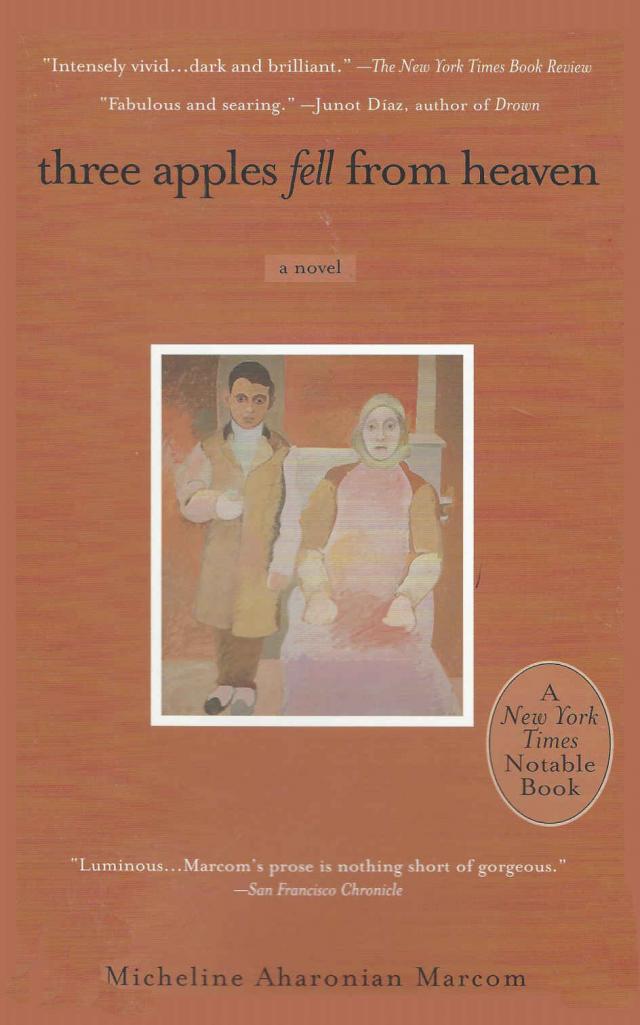
Three Apples Fell from Heaven
Micheline Aharonian Marcom
Three Apples Fell from Heaven, Copyright © 2001 Micheline Aharonian Marcom
No part of this publication may be reproduced in whole or in part, or stored in a retrieval system, or transmitted in any form or by any means, electronic, mechanical, photocopying, recording, or otherwise, without written permission of the publisher. For information regarding permission, write to: Goodreads Press, 454 West 44th Street, New York, NY 10036, or email Susan Schulman at info@goodreadspress.com.
for NANE and DEDE
"Like those who write about the Jewish Holocaust, Marcom faces the well-nigh impossible task of speaking the unspeakable; unlike them, she cannot count on her readers to be familiar with the outlines of the story already. She rises to this double challenge not with a diatribe or a lengthy historical account but by writing a relatively short, intensely vivid, novel. . . . As we turn the pages of this dark and brilliant book, we feel ourselves to be in the presence of a noble act."
—Margot Livesey, The New York Times Book Review
"Chronicles the twentieth century's first genocide with an unnervingly effective blend of imagination, artistry and grisly historical fact. . . . These unsparingly visceral vignettes assume an almost unbearable potency."
—San Francisco Chronicle
"Lyrical . . . from the start you feel as though you are in the presence of an authentic voice, in this case a voice that weeps and wails and growls and shouts and chants and moans and sings about the twentieth century's first— but least-known—ethnic massacre. . . . Marcom is so talented . . . [Three Apples Fell from Heaven] will stay with its readers a good long while."
—Chicago Tribune
"A disturbing, powerful work . . . Marcom's writing is intensely poetic. . . . The effect is surreal, imparting the sense of how it is to continue living when all normal things have gone awry." —The Washington Post Book World
"Reading Three Apples Fell from Heaven, I can believe that poetry can stop war. Micheline Aharonian Marcom's elegy to the Armenian dead—her family, her people, precious individual lives—sings so strong, rings so true that surely the hell of genocide can never happen again. She has written an invaluable work in this age of devastation."
—Maxine Hong Kingston
"[A] heartbreaking, beautiful, painful first novel . . . the highly mannered style manifests a debt to the postmodern novel and the fairy tale, resulting in something between a cry and a reminiscence. This book is not for the faint of heart, but its readers will be well rewarded."
—Publishers Weekly
"Micheline Aharonian Marcom has woven a heartrending tapestry from the lost time, lost places, and lost voices of the Armenian genocide. Spectacularly gifted, tender, wise, and terrible in rage, Marcom has produced a powerful novel that attempts to retrieve one of the most infamous crimes of the twentieth century from the event horizon of history."
—Junot Díaz, author of Drown
"This is an exquisite, vivid, heartbreaking book. It lushly restores one's soul while giving voice to the many silenced souls of the Armenian genocide."
—Cristina Garcia, author of The Aguero Sisters and Dreaming in Cuban
"Micheline Aharonian Marcom has written a poetic and inventive novel set in eastern Turkey, in the epicenter of the Armenian genocide of 1915. With a Joycean affinity for detail, character, and cultural nuance, Marcom opens up a human and historical drama in startling ways. This is an impressive debut."
—Peter Balakian, author of Black Dog of Fate
"[Marcom] has chosen an unusual structure, a tapestry of many vignettes that depict a shattered Armenian culture and way of life through the memories of victims and bystanders, those who hid, those who died, and those who tried vainly to help. . . . Her story has a certain brutal force that stays in the memory."
—Kirkus Reviews
"As a third-generation American-Armenian, Micheline Aharonian Marcom bears the weight of her own family history with extraordinary grace. . . . Marcom doesn't resort to sentiment or shock tactics, but lovingly renders each scene with slow, languorous rhythms."
—The Guardian (London)
"Animated by a resolve that ancestral stories will not be forgotten, and that those who are dead will continue to be cherished."
—The Daily Telegraph (London)
"Powerful."
—Scotland on Sunday
CONTENTS
THIS IS THE STORY RUMOR WRITES
AN OMELETTE FOR MAMA
SARGIS BECOMES A WRITER
HAMAM
RACHEL ESKIJIAN, B. 1900, A CATHOLIC GIRL
MAMOURET-UL-AZIZ (HARPUT), TURKEY
DID IT MAKE YOU ACHE SO, LEAVING ME?
INSIDE, 1917
FILE NO. 820.3, PAGE 3
DICKRAN WHOSE NAME WENT UNRECORDED
THE SMALLEST ANIMALS
SPARE THE ROD
AMERICAN CONSULATE
THRUSHES
DAUGHTER OF SETRAK THE DENTIST AND WIFE TO ELIA, A DRUGSTORE PHARMACIST
MARDIROS
BABA
SWEETNESS ON THE TONGUE
THE LIONHEARTED
I BEGAN WITH SANDALS
OFFICIAL PROCLAMATION
ON WINTER EVENINGS
POETRY
THE HISTORY OF BOZMASHEN AS ITERATED BY THE LOCAL DOGS
AMERICAN CONSULATE
SALE
INSIDE, 1917
ESTIVATION
YOU, YOU ALSO BREAK ME
UN BON GENDARME
AS TO WHERE ARE THE BOOTMAKERS AND THE TOWN OF KHARPHERT
11 FEBRUARY, 1915
I AM NOTHING BUT A GIRL
FIVE GARDEN WORDS
SATURDAY NEWS
ONLY LISTEN, ONLY OBEY
A VERY SAD ENDING
SILK
POSTSCRIPT FOUND
INSIDE, 1917
MR. DAVIS DEPARTS
REMOVED
I WAS MAMA'S ROSE
THE DJINN OF RAS-UL-AIN
THE COMMANDER SAYS I AM HIS FAVORITE
MY FINAL REPORT
INSIDE, 1917
I HAVE SEEN GOD IN THE FACES OF MEN
A SAD ENDING AGAIN
INSIDE, 1917
RACHEL'S LIST IN PART
TODAY IS WEDNESDAY
ARSINEE
MY DARLINGS
GLOSSARY
ACKNOWLEDGMENTS
Not to have seen it yet inheriting it.
–MYUNG MI KIM
At the edge of love, there we stand.
–CLARICE LISPECTOR
THIS IS THE STORY RUMOR WRITES
She writes it late at night, while you are dozing.
Rumor says things like, And so, and so
There was and
There was not
Rumor tells stories, this is the story she writes. Don't believe her, she's a liar of the first order. A mendacious tatterdemalion. A middle of the night whisperer. She follows you and circles your head like stinging bees in late summer. She is disjointed, disorderly, malapropos. She begins in the middle, she stops and starts; she is a wanderer. When you look for her you cannot see her. Rumor says: Noah is my father and Japeth is my father and Haik walked down the slopes of Mount Ararat and squatted under the cypress to build a fire with still green leaves. In 1915. Or in 520 B.C., an inscription in stone of Darius I at Behistun. With breath there is always a beginning. A neonate lies on the sand, she is the founder of the nation. Rumor says, I am the founder of this nation. And so, and so
__________
In a ditch, in a well, on the banks of the Euphrates River, the trajectory of the river has been altered. In the desert, the Mesopotamian beetles drink blood and soup. There is a lake that overflows its bounds, transshapen by flesh. There are limestone houses and burned window frames, piles of manuscript, Gospel and gold buried in the garden. There are manifold dogs who have no need to scavenge. There are muted girls living in the haremlik of the jailmaster's house, in the kitchens and sowing the field. There is a sexton without a face and his brother. There are caravans of invisible grave markers. There are new name places and streets, the heft of empty churches. The printing press is dismantled.
They are not the children of Japeth, the son to Noah, or Haik, who walked down the slopes of Mount Ararat and squatted before the cypress to build a fire with still green leaves. The eaves are empty. The hamam is closed. The bakers and the bootmakers uninvented. The furrier is still lamented in the coldest days of winter. The sweetmaker was spared for a hard candy. Do you miss them? Long for them?
Inside a ditch, in a filled well, up the cupboard staircase, beneath an indifferent oak, in a prison cell, by the Lake, on the stones, on the side of a road, in places that have no roads, by the Lake, the attic, the Wilderness, the hollowed heart that stinks, your mind: here. Their birth was in the time of fire, when God's wrath was immutable and adamantine, in the summer months of that year when all of the stories were destroyed and converged and the new story was preconceived—they were not themselves until then.
And so, and so
There is a surfeit of rumors. A surfeit of surfeit. Indigent rumors. Spiritual rumors. Fucking rumors. Killer rumors. Bodies. Urine. Schools of orphans. Rumor often says, And so and so, if you insist too vehemently on any particular particular. She begins in the middle, she stops and starts; she is a wanderer. Rumor is an evanescent and mendacious tatterdemalion.
Rumor's covenant with her peopl e: I shall not abandon you. A surfeit of surfeit for all time.
Don't believe it, she's a liar of the first order. A mendacious tatterdemalion.
AN OMELETTE FOR MAMA
She walks in the direction of the well now. It lies within plain sight farther down the road. She doesn't look to it or breathe more quickly into the late morning air which is no longer still but bustling, although a bustling of a hollowed tempo. She speaks underneath her breath, pushes the words to the packed and uneven stones in front of her booted feet. She stares at the ground and at the tips of her shoes as they leave no dusty impressions. She whispers, Four eggs only, to no one in particular. She comes to the familiar wooden awning, to the Armenian bakery, and she turns right down a small unpaved street, pushing the words out breathlessly, silently now, so as not to call attention to the idiom which could in these days attract more than a slap to the head or a rough cane blow. She has turned away from the Quarter's well. There are no longer any dogs lingering outside the bakery door, she thinks, as she makes her way to the central market and the egg-seller's stall.
It is then that she begins to count the number of eggs she will purchase more slowly. One. Two. Three. She makes the calculations in her head as a small child would with different combinations of numbers to reach the four: two and two, and two from six. She decides she would rather run than walk down the small alleyway where she has turned; she then imagines herself running, her hair coming loose from its plait, uncovering itself from the black veil that covers her today like a dark shroud. Closely behind this picture of flying braids and cooler air is another picture, quite suddenly, as she knew it would be, as it has been for weeks now, voraciously waiting: the black mole before her, the protruding blanched belly. The potbelly baker and his mole-marked wife are like a sharp stone in her mind.
As she continues walking on the dull marble earth, she sees the hoary mole on Eghis Hanim's left cheek below her lower eyelashes; a protuberance of discolored dark skin rises above the woman's pale flesh, pushing her left eye upward and making it smaller. It was a mole that became offended if you forgot to close the door to the bakery gently.
Children! Eghis Hanim would scream. We are more civilized than those dogs, no? Even if surrounded by them.
It is ugly like sin, Anaguil and her neighborhood friends used to laugh among themselves.
Haigan would say, It's because that "black doo" pulls all the goodness away from her heart.
She's a she-devil! Rachel would say.
A witch.
Anaguil would hunch her back and squint her left eye, pull her mouth and say, Eh, you stupid girls, don't you know how to close doors like Christian ladies? Whereupon all three childhood friends, friends from birth or close to it, would fall onto the garden grasses laughing and rolling and holding their bellies.
Today the mole cannot be pushed out by numbers or calculations. One and the mole appears; two and then Eghis Hanim's big nose like a brass pitcher; three and suddenly her coiled coiffure like a thick skein of dyed black wool. Eghis Hanim screaming at four, her hair (what few patches remained after her own fierce hands had ripped and torn it at the roots) flying like a maddened burning bush—the blood speckles were like field poppies, dull and invisible on the black shawl, in contrast to their flow and relief on her fair skin. Running, Eghis Hanim screamed not about doors or drafts or lazy girls. She clapped her hands and she sang and she danced and she left her unbound locks strewn in the mud and in the vacant doorways.
And in the blue ashes of the vanishing world, she also vanished, Anaguil thinks. The blood from her scalp like the rosebush trickled down, like tears or dew or spittle, like the resin from a fir tree, onto the blue canopy of heaven which no longer is above our covered heads but lies below these booted feet.
Eghis Hanim screamed, I'll stuff my husband's head full of cabbage leaves! That's what you do with an undeliverable parcel.
Then the black mole gives way to the center well and the aged oak trees and the tight red rosebush buds and so Anaguil begins to count again. Quickly. Her feet imitate the beat of the numbers, almost at a run now, One, one, one, one. She does not count beyond one, just one because she understands that in between the numbers her own vile rememberings creep in like ugly desert beetles and that once she sees Eghis Hanim's moled countenance she sees the stamp-seller with a polio limp and then the fat silk merchant Bakrat Gregorian and then the coin-seller, who bought his two gold teeth in America. Then the orchard plums and yellow and red and purple and green grapes and her sweetest uncle, Amo Berj, who said, We did not prepare ourselves adequately. And then and then: Baba. And then one as she comes upon the wooden stall of the egg-seller and slowly dips her hands into the folds of her çarşaf. With her right hand she touches the dull paras in her pocket; she clenches the coins. One.
Some eggs, please, Effendi.
And Eghis Hanim still echoes in the unspeakable noise of her mind, of the bazaar: Cabbage leaves, cabbage leaves—they're so lovely with a severed skullcap! La-di-da. Her mind like a book, she shuts it tightly and looks outside of her eyes to the old Turkish man before her and to the small mound of fresh hen eggs. She drops her gaze to the ground. A goodgirl.
Khalil Agha, the egg-seller, looks at the unchaperoned young girl standing quietly before him, her head bent and her hands tucked into her çarşaf.
How many eggs you need, girly?
Anaguil pulls her left hand from the inside of the floor-length veil and raises four fingers to the egg-seller's eye level.
Four eggs? You want four eggs, eh?
Khalil Agha stares at Anaguil's bent head and knows that since the war began seven months ago even small treasures can bring a profit.
The price is fifteen paras per egg. Prices have gone up today, these are difficult times. He smiles broadly, showing a missing incisor and front tooth edged in black.
Anaguil stares intently at the packed dirt. She shakes her head. Ten par-as, I have only ten.
Khalil Agha smacks his lips together making a sucking sound.
They're not paying you too well, eh?
Anaguil presses the coins she is holding in her right hand into an even tighter fist.
Well, girly, for that I can give you one egg. A bargain for a sweetplum like you.
Anaguil thinks of the word "one"—oneegg—and she wonders if her thoughts have brought this moment into being; her thinking on one making it the only possible number. She removes her clenched hand from the çarşaf and stretches it toward the egg-seller; she opens her right hand revealing a score of indentations left by the coins. The red crescents are relief for the ten paras in her palm.
Khalil Agha reaches across the table to take the currency. As he begins to remove the coins from her hand, he runs his fingers down the center of her palm. He slowly glides his fingers along each of the red moons and when finished reaches to her wrist and then underneath the çarşaf. His hand skims her forearm.
Cacudes, Anaguil thinks, as she glares at the white pebbles lying next to her feet. When Khalil Agha squeezes her elbow through the cloth of the dress she wears beneath the veil, she clenches her hand again.
I do have discounts, cutie.
Anaguil shakes her head three times in the negative and notices in that moment how her hands perspire; she smells the bitter residue of the coins in the sweat of her palms.
No? No? Take your egg then, little-whore, he says, removing the coins from her hand. Even little-whores shouldn't come to the marketplace by themselves.
Anaguil receives the egg he hands her into the linen square she has brought from home. She carefully folds the cloth around the egg and for each fold of fabric she utters one syllable: I-shit-in-your-mouth: cacudes. The egg-seller's gaze is drawn toward her bitten fingers where only small stubs of fingernail remain. Anaguil turns away from the egg-seller's stall and she feels how the back of her dress now sticks to her skin; her hands tremble as she begins walking. It was worth it, she thinks, it was worth going to the market alone and buying from the son of an ass. The boys are at home safe with Mama, and I have done something I never expected. She disregards the burning feeling in her belly as she begins the walk home. She presses her thighs tightly together and ignores the need to relieve herself.
She passes the idle bootmaker's corner and the rows and rows of shuttered storefronts as she winds out of the market; on another corner she passes the knifemakers' stalls. Anaguil smells the horns of goat in the high heat of the Turkish knifemakers' shops. The odors drift onto the morning air and into the mouth like bone, as the knifemakers melt and shape the cartilage and mineral life into handles and blades for cutting and slicing and killing. She hears in the distance the high-pitched call of the muezzin for the midmorning prayer; it is a voice she has heard five times a day since the day of her birth and the sound is familiar, like skin.


