

House moving therapy, p.1
House Moving Therapy, page 1


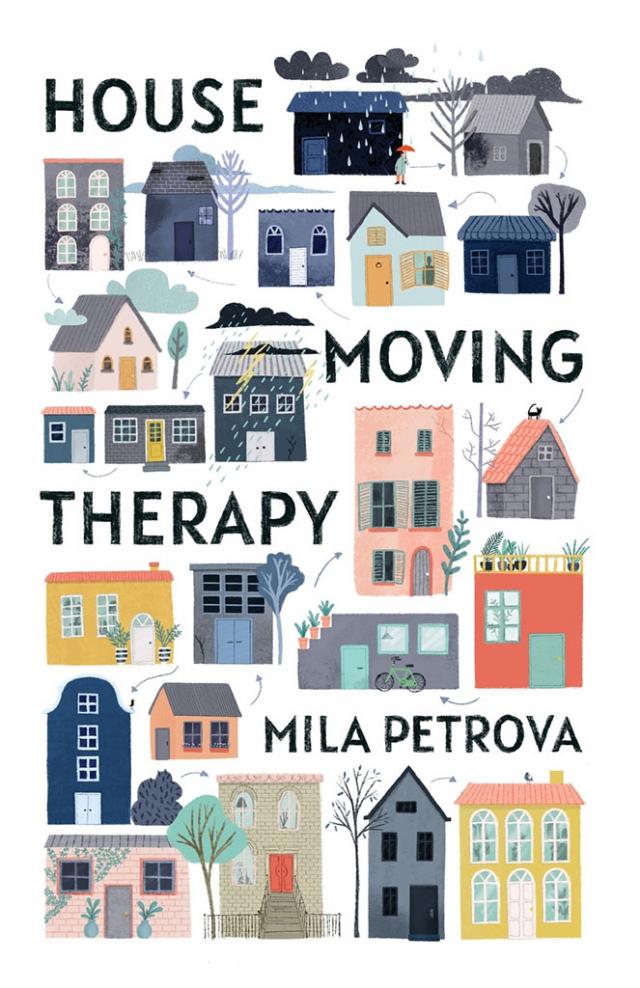
Copyright © Mila Petrova, 2022.
All rights reserved.
No part of this book may be used or reproduced
in any manner whatsoever without written consent from the publisher, except for brief quotations and/or rephrased excerpts acknowledging the source.
For further information, write to Knowmore Publishing, Cornwall, UK mila.p.petrova@proton.me
FIRST EDITION
A CIP catalogue record for this book is available from the British Library.
ISBN paper book: 978-1-7391377-5-5
ISBN e-book: 978-1-7391377-7-9
DEVELOPMENTAL EDITING
Ameesha Green, ameesha@thebookshelf.ltd, thebookshelf.ltd
COPY EDITING
Jessica Powers, jlpowers@evaporites.com, jlpowers.net
COVER DESIGN
Karen Vermeulen, hello@karenvermeulen.com, karenvermeulen.com
DESIGN OF THE INTERIORS
Kathy McInnis, kathy@ivyleafdesigns.net
PROOFREADING
Karen Hamilton, info@karen-hamilton.co.uk, karen-hamilton.co.uk
AUTHOR PHOTO
Thom Axon, thomaxon@gmail.com, thomaxon.com
“All sickness is home sickness”
DIANNE M. CONNELLY
To Arthur—not quite the name, but you’ll know it’s you! Thank you for the times your arms have been my home and for the challenge to find a home that stands even at skyfall.
TABLE OF CONTENTS
INTRODUCTION: Life on the floor
PART I: Beginnings
CHAPTER 1
What makes house moving difficult (1): An explosion of decisions, or how the possessions of a two-bedroom flat can take up the seats of forty-six Boeings
CHAPTER 2
What makes house moving difficult (2): ‘Microprojects’ on roots to uproot, harm to reverse, good to attempt and bullets to bite
CHAPTER 3
What makes house moving difficult (3): Subversive emotions, but rarely the ones you feared
CHAPTER 4
What makes house moving difficult (4): Defaults that are fat slices of our philosophy of life
CHAPTER 5
How to make it easier? Two things to do that don’t need you to lift a finger
CHAPTER 6
Thresholds of pain
CHAPTER 7
Parallel cleaning
PART II: On-Your-Back Things
CHAPTER 8
“When in doubt, wear red” On clothes, the fear of truly shining, and eleven other types of psychological chaos
CHAPTER 9
“Shoes shouldn’t hurt” On shoes, lessons we were confident we have really learnt yet continue to repeat, and nine other types of psychological chaos
CHAPTER 10
“I sing the body electric”: Sports gear and inner coxes On sports equipment, harmful inner conversations, and ten other types of psychological chaos
PART III: House-Bound and Room-Bound Things
CHAPTER 11
Tie yourself to a table. If tables are few, wall colour will do On furniture, moments when our connection to a place (or a thing, or a person) snaps, and seven other types of psychological chaos
CHAPTER 12
House decoration and painted-over soul cracks On decoration and art, and traumas from our childhood homes that mark us for life
CHAPTER 13
Liaisons dangereuses On bedding, towels and other ‘huggables’, and on the self-defeating associations between a physical and an emotional home
CHAPTER 14
Hunger games On food, cooking and eating utensils, and almost any form of psychological chaos you can imagine, including fifteen dysfunctional ‘eating personality’ types
PART IV: Boundary-Crossing Things
CHAPTER 15
Your amazing technicolour dreamhouse and the taken-for-granted On electrics and electronics, the unglamorous essential ingredient of success and happiness they jeopardise, and five other types of psychological chaos
CHAPTER 16
Do It Yourself. Nevermore On DIY equipment, culturally inherited beliefs about what it means to be a true man or woman, and three other types of psychological chaos
CHAPTER 17
You are not just a number On paperwork and the glorious visions we have (had) for our lives v. the lacklustre of the everyday
CHAPTER 18
Home in a bottle of face wash On cosmetics, guilty pleasures and blindingly obvious things that took you decades to see
CHAPTER 19
The books of life On books and lives that need saving
CHAPTER 20
The dark bronze envelope On sentimental items and myths of letting go
PART V: Final Things
CHAPTER 21
Boxing it On boxes, suitcases and bags, and the tinge of dissatisfaction at endings that aren’t a perfect closure
CHAPTER 22
What makes a true home
Acknowledgements
List of Boxes
Disclaimer
I am a book which loves moving houses.
If you’ve read me, please pass me on.
If you’ve truly read me, you won’t need me.
You’ll live me.
LIFE ON THE FLOOR
Have you had your life crash and spill all over the floor, fragments leaking dark red blood and thick black terror, a small puddle for a start but spreading,
spreading
SPREADING?
What is it that got wrecked, disfigured, ripped apart, burnt to the ground?
LOVE? Family? Home?
The humming, sweet routines of the life you’ve long known?
Your vision? Mission? Job?
Health? The time you (vaguely) counted to have left?
MEANING? Purpose?
Truth? TRUST? The stability of the earth’s crust?
The certain answers to the WHO ARE YOU?, what you can and shall and would or would never ever do?
How badly did you break?
Are you whole again, or for the first time ever? The extraordinary gift of some descents into darkness, a gift claimed by so few, yet always there if you refuse to leave without it but refuse to dwell in darkness too? Or, when you undress and touch the seams of truth, are you, rather, superglued?
Have you ever had your life dumped on the floor, this time literally? Drawers pulled out, wardrobe doors flung open
piles of clothes
misshapen hangers
slanting books
scattered papers
bike pump
hammer
smiling sheep
sponges
brushes
cream clean Cif
tangled cables
seaside mug
wrapping paper
filthy rug –
all tripping, slipping hazards,
calling out to you,
calendar declaring your move-out day is tomorrow,
realism demanding it be a week away?
Have you ever felt total disbelief at the amount of possessions you’ve accumulated?
Started sorting from one pile or cupboard only to decide it’s too difficult or undefinable, picked the next, then next, then next, until you returned to the first?
Have you spoken to yourself coolly, rationally that it will all be fine; motivationally, passionately that you wield magic powers and expansive time, while pushing, pushing, pushing back the flood of panic rising in the holes between the words?
Have you made dozens of donation and recycling trips, yet still tied a tight knot around a black bin bag of perfectly usable things?
What did you do with the flowerpots?
The sheets you slept in on your last night?
Oh, you didn’t sleep? You thought you’d be finished by 4 p.m., then midnight, then 3 a.m., then you met the end at sunrise, mopping floors, red capillaries refusing to return home to the white sclera, bed never slept in one last time, a feeling strangely resembling that of separating from a lover without having made love one last time?
I hope you still noticed that that was the most beautiful sunrise you’ve seen in this house. I hope your coffee machine or kettle was not packed, or belonged to the house, and you could have a farewell drink. I hope you laughed (hysterically?) that never-ending night and blazing morning, even if you cried too.
Whether you’ve had your life on the floor one way or the other, or both, welcome.
DOES THIS BOOK BELONG TO YOUR LIBRARY?
This is a book about using the need to sort through physical baggage so as to shift emotional baggage. It is about tolerating material and psychological mess for longer than comfortable so as to move on feeling lighter. It digs deep into my possessions and soul in the hope of showing you new ways to dig deep into yours.
It’s a book for those who want to leave with the rucksack on their back only or need a truck for their possessions. I write of both. I’ve tried both.
It’s a book about house moves which are responsible to the environment, objects and the makers of objects; considerate of the less fortunate; adventurous and cost-efficient. It is about trips to charity shops, recycling facilities and outside of your comfort zone. It is about the lives and happiness of things, our planet and the less well-off. Those make house moving far more difficult than throwing away everything you no longer need. Yet there is nothing easier than living in accordance with your values.
It’s a book about house moves which light up the inner powerhouse of energy. That don’t tire you. Tha
It’s a book which will help you, at moving in, open boxes as if you were decades younger, inner child rummaging through his or her treasures. “Yeeeeey, I’ve been waiting for you to turn up!” “I’d forgotten I had you!”
It is a book about house moves which you begin to miss.
It will give you a lot. It will ask for a lot.
It will ask you to feel what you feel and think what you think about the objects you own. Ideally, every single one of them. This takes time. Focus. Honesty. Sometimes it hurts.
It will ask you to listen to me and completely ignore me, no matter how mad or persuasive I sound. My possessions, life and inner chaos may be both unrecognisably similar to and very different from yours. It takes mental flexibility, being attuned to yourself and courage to know what’s needed.
It will deprive you of the drama and sympathy around “I’m moving house, you know how it is!” No, I don’t. I no longer know how stressful, painful, time-devouring, exhausting, every-room-big-bang-exploding it is. I used to. I turned it on its head. I want to show you my ways so that you can invent yours.
If this is a book that sounds right for you, please make yourself at home. I would love you to read it. If not, thank you for stopping over. Wind in your sails too for your next journey home.
TWENTY-ONE (OR THIRTY-THREE) TIMES, NINETEEN YEARS AND COUNTING
I’ve moved between twenty-one and thirty-three times in the past nineteen years. Twenty-one is for ‘proper’ moves, in which I’ve packed my life in one place and took it over to another, not expecting to return and make home again in the former and expecting to stay for the foreseeable future in the latter. Thirty-three includes moves out of places where I intended to stay and did stay only temporarily. I was still looking for my ‘permanent’ home, waiting for it to be vacated, or hanging in space while my future took a clearer shape. On some of those occasions, I was also ‘home home’. ‘Home home’—I use the phrase often—is the flat where I grew up, left at nineteen, where my mum still lives and where I still ‘return’.
I don’t include the times I’ve moved until I came to England, my most radical house move of all. Most of the decisions and tasks in those times weren’t mine. I was either moved by my parents (only twice actually, aged four and five) or had the broader family and family friends holding my hand (such as an uncle ‘appearing’ in his car when I was moving out of the student residences). If I count that, I will have moved somewhere between twenty-eight and forty times. House moving statistics, like all statistics, is fickle. It shifts up and down depending on one’s assumptions and definitions.
I’ve moved in and out of four countries and nineteen towns, cities, villages and middle-of-nowheres. The biggest city I’ve lived in is London. The smallest place is either a tiny village at the foot of Sierra Nevada in Spain or Dawlish Warren on the coast of Devon, England.
The most impressive accommodation I’ve rented was an eighteen-room manor house, first built in the seventeenth century, still having its original front door and Dutch tiles decoration. I was taking wrong turns in it for weeks. As my only housemate was the owner’s daughter, who had the family home to return to, I was often the sole Queen of the Palace. In my maid-like version, I’ve had a room which could hardly fit an ironing board in the space left by the bed, wardrobe, desk, chair and clothes dryer.
I’ve had sea views from my windows in three houses and from the street right up in another one. In one of the former, on a clear day you could see (or imagine seeing) Africa in the distance. I’ve lived in places overlooking a river, a mountain and a pond. But I’ve also had a room facing the neighbourhood rubbish bins. There are times in life when the very best you can afford, in the timeframe you’ve got to search for it, stinks.
I’ve lived by myself in eight of those places and with a boyfriend in one. The rest I’ve shared with thirty-seven housemates, with some significant margin for memory error (this is the count for a shared kitchen, it’s twenty-nine for a shared bathroom). If you shudder at the thought of so many strangers, which all were originally, the norm in the times I’m not writing of was to have roommates. Including the ever-present boyfriends, the standard level of night-time occupancy was five persons in a three-by-three metres room. Living in shared spaces is a topic for another book. It’s not mine to write.
I’ve lost, moved and created many homes. Until move No 16, I found it hard.
I’ve never wanted to move that much. My studies or work needed it. I’ve been quick to respond to a fluctuating budget, both in its ups and downs. I’ve moved for love. I’ve moved because of love lost. On several occasions, I sought more mental space somewhere far away and secluded. Occasionally, owners needed their properties earlier than I wished to leave. One way or another, I didn’t start my house moving ‘career’ enthusiastically. I connect to things, places and people deeply, often slowly. It took me time to learn to leave with light suitcases. It took fifteen years longer to learn to leave with a light heart.
Most of my house moves are from the times when I was a student or a young academic recovering from a PhD. This meant on a minimal budget.
I’ve never had a car, so they had to be light (though I’ve rented vans too). They grew to be aware. When you carry all your possessions on your back, you are CERTAIN something is worth keeping.
Crucially, they were masterpieces in how not to need, not to ask for, and not to accept any help. My greatest fear in life used to be being a burden.
I hope that none of the above constraints defines your move without an alternative. They no longer define mine, but this book will be extra useful if you are counting every penny, your legs and public services are your only means of transport, and you are a hardy mule who ‘does it’ herself or himself (hello, sister/ brother!).
Apart from having a career in moving, I have a career in analysing. I’m an academic researcher in the health sciences. I have studied psychology, philosophy and literature. I demand rigorous evidence, water-tight argumentation and psychological plausibility. I also talk about death and dying more—and more bluntly—than most people, as much of my recent research has been in palliative and end of life care.
This is not an academic book though. There is no explicit theory in it. There is hardly any research evidence other than that of my own life. When I create an argument, it first needs to persuade the most ignorant, stupid, sceptical and disinterested fragments of me. As I have many ignorant, stupid, sceptical and disinterested fragments, my arguments are as simple as possible, but not simpler. I will still ask you to think hard. I will ask you to admit what you don’t want to admit. It may be more of a hard nut than popcorn of a book.
My experience doesn’t make me a house moving expert. It makes me a house moving expert, an absolute ninja in fact, in my own life. But since our lives, houses, possessions and attachments can be incredibly, even incomprehensibly, different, the direct advice I am willing to offer is minimal. You’ll have to derive most of it yourself. Only then you’ll know it will withstand the storms of your life and inner chaos like nothing I’ll be able to teach you.
WHAT THIS BOOK IS NOT ABOUT
This book is not about rules. I won’t be telling you that if you have not worn something for the last year, or if it belonged to your ex-boyfriend/ ex-girlfriend, or if it has a hole between the legs, you should throw it out (or donate, sell, etc.). I will not prescribe an order in which to pack your possessions. I will not tell you the rough or precise number of things to keep.
I do not ridicule such rules. They simplify decision making. There is clarity and sureness about them. But they don’t work for me. I have to feel that something is good and right to do. This requires adding too much nuance, individual idiosyncrasy and complexity to any rule I could have come up with.
Instead, I tell you about the chaos of my possessions and soul and what I do about them. I share reference points, principles, arguments and examples of making decisions. These can be emotional, pragmatic, ethical, green, psychological, philosophical.... Sometimes they will match your needs, sometimes not. But even if they don’t, they can serve as food for thought. I would be just as happy if your decisions are the exact opposite to mine as long as something I wrote helped you make them.
This is not a book about the sweetness of home either. That sweetness is, of course, the goal and the background. It trickles through. It doesn’t flow.


