The art of the novel, p.1
The Art of the Novel, page 1


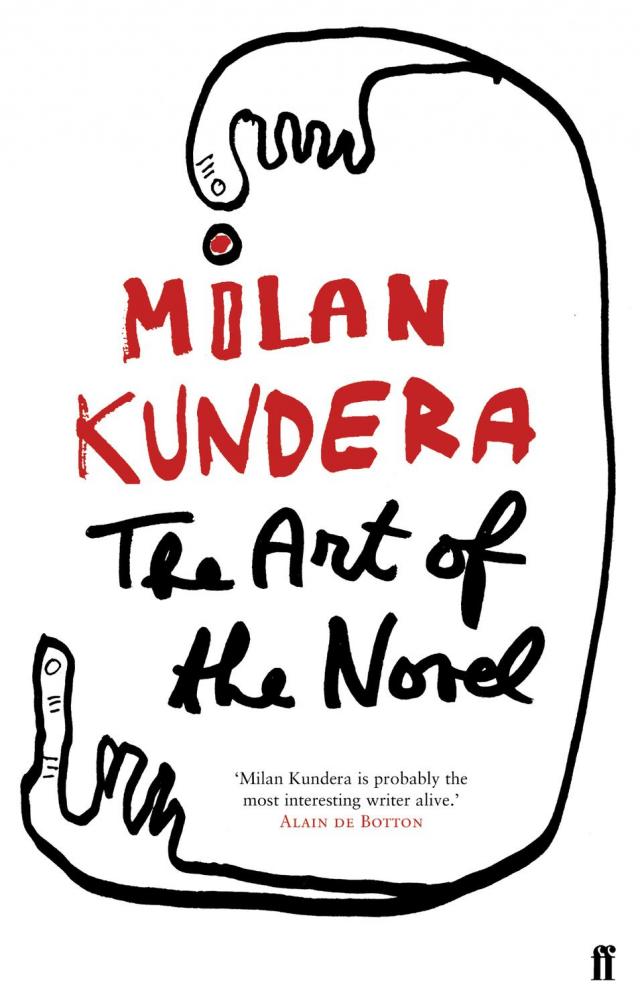
MILAN KUNDERA
The Art
of the Novel
Translated from the French by Linda Asher
CONTENTS
Title Page
Author’s Note
Part One
The Depreciated Legacy of Cervantes
Part Two
Dialogue on the Art of the Novel
Part Three
Notes Inspired by “The Sleepwalkers”
Part Four
Dialogue on the Art of Composition
Part Five
Somewhere Behind
Part Six
Sixty-three Words
Part Seven
Jerusalem Address: The Novel and Europe
About the Author
By the Same Author
Copyright
The world of theories is not my world. These are simply the reflections of a practitioner. Every novelist’s work contains an explicit vision of the history of the novel, an idea of what the novel is. It is the idea of the novel inherent in my novels that I give voice to here.
The seven pieces comprising this book were written, published, or spoken before an audience between 1979 and 1985. Despite their separate births, I conceived them all with the idea of eventually bringing them together. That came about in 1986. Since then, the book has often been reprinted in France, giving me the opportunity to return to it several times in order to better it. The resulting changes, along with a few minor refinements of her translation by the translator, have been incorporated in this printing.
M. K., January 2000
PART ONE
The Depreciated Legacy of Cervantes
1.
In 1935, three years before his death, Edmund Husserl gave his celebrated lectures in Vienna and Prague on the crisis of European humanity. For Husserl, the adjective “European” meant the spiritual identity that extends beyond geographical Europe (to America, for instance) and that was born with ancient Greek philosophy. In his view, this philosophy, for the first time in history, apprehended the world (the world as a whole) as a question to be answered. It interrogated the world not in order to satisfy this or that practical need but because “the passion to know had seized mankind.”
The crisis Husserl spoke of seemed to him so profound that he wondered whether Europe was still able to survive it. The roots of the crisis lay for him at the beginning of the Modern Era, in Galileo and Descartes, in the one-sided nature of the European sciences, which reduced the world to a mere object of technical and mechanical investigation and put the concrete world of life, die Lebenswelt as he called it, beyond their horizon.
The rise of the sciences propelled man into the tunnels of the specialized disciplines. The more he advanced in knowledge, the less clearly could he see either the world as a whole or his own self, and he plunged further into what Husserl’s pupil Heidegger called, in a beautiful and almost magical phrase, “the forgetting of being.”
Once elevated by Descartes to “master and proprietor of nature,” man has now become a mere thing to the forces (of technology, of politics, of history) that bypass him, surpass him, possess him. To those forces, man’s concrete being, his “world of life” (die Lebenswelt), has neither value nor interest: it is eclipsed, forgotten from the start.
2.
Yet I think it would be naive to take the severity of this view of the Modern Era as a mere condemnation. I would say rather that the two great philosophers laid bare the ambiguity of this epoch, which is decline and progress at the same time and which, like all that is human, carries the seed of its end in its beginning. To my mind, this ambiguity does not diminish the last four centuries of European culture, to which I feel all the more attached as I am not a philosopher but a novelist. Indeed, for me, the founder of the Modern Era is not only Descartes but also Cervantes.
Perhaps it is Cervantes whom the two phenomenologists neglected to take into consideration in their judgment of the Modern Era. By that I mean: If it is true that philosophy and science have forgotten about man’s being, it emerges all the more plainly that with Cervantes a great European art took shape that is nothing other than the investigation of this forgotten being.
Indeed, all the great existential themes Heidegger analyzes in Being and Time—considering them to have been neglected by all earlier European philosophy—had been unveiled, displayed, illuminated by four centuries of the European novel. In its own way, through its own logic, the novel discovered the various dimensions of existence one by one: with Cervantes and his contemporaries, it inquires into the nature of adventure; with Richardson, it begins to examine “what happens inside,” to unmask the secret life of the feelings; with Balzac, it discovers man’s rootedness in history; with Flaubert, it explores the terra previously incognita of the everyday; with Tolstoy, it focuses on the intrusion of the irrational into human behavior and decisions. It probes time: the elusive past with Proust, the elusive present with Joyce. With Thomas Mann, it examines the role of the myths from the remote past that control our present actions. Et cetera, et cetera.
The novel has accompanied man uninterruptedly and faithfully since the beginning of the Modern Era. It was then that the “passion to know,” which Husserl considered the essence of European spirituality, seized the novel and led it to scrutinize man’s concrete life and protect it against “the forgetting of being”; to hold “the world of life” under a permanent light. That is the sense in which I understand and share Hermann Broch’s insistence in repeating: The sole raison d’être of a novel is to discover what only the novel can discover. A novel that does not discover a hitherto unknown segment of existence is immoral. Knowledge is the novel’s only morality.
I would also add: The novel is Europe’s creation; its discoveries, though made in various languages, belong to the whole of Europe. The sequence of discoveries (not the sum of what was written) is what constitutes the history of the European novel. It is only in such a supranational context that the value of a work (that is to say, the import of its discovery) can be fully seen and understood.
3.
As God slowly departed from the seat whence he had directed the universe and its order of values, distinguished good from evil, and endowed each thing with meaning, Don Quixote set forth from his house into a world he could no longer recognize. In the absence of the Supreme Judge, the world suddenly appeared in its fearsome ambiguity; the single divine Truth decomposed into myriad relative truths parceled out by men. Thus was born the world of the Modern Era, and with it the novel, the image and model of that world.
To take, with Descartes, the thinking self as the basis of everything, and thus to face the universe alone, is to adopt an attitude that Hegel was right to call heroic.
To take, with Cervantes, the world as ambiguity, to be obliged to face not a single absolute truth but a welter of contradictory truths (truths embodied in imaginary selves called characters), to have as one’s only certainty the wisdom of uncertainty, requires no less courage.
What does Cervantes’s great novel mean? Much has been written on the question. Some see in it a rationalist critique of Don Quixote’s hazy idealism. Others see it as a celebration of that same idealism. Both interpretations are mistaken because they both seek at the novel’s core not an inquiry but a moral position.
Man desires a world where good and evil can be clearly distinguished, for he has an innate and irrepressible desire to judge before he understands. Religions and ideologies are founded on this desire. They can cope with the novel only by translating its language and relativity and ambiguity into their own apodictic and dogmatic discourse. They require that someone be right: either Anna Karenina is the victim of a narrow-minded tyrant, or Karenin is the victim of an immoral woman; either K. is an innocent man crushed by an unjust Court, or the Court represents divine justice and K. is guilty.
This “either-or” encapsulates an inability to tolerate the essential relativity of things human, an inability to look squarely at the absence of the Supreme Judge. This inability makes the novel’s wisdom (the wisdom of uncertainty) hard to accept and understand.
4.
Don Quixote set off into a world that opened wide before him. He could go out freely and come home as he pleased. The early European novels are journeys through an apparently unlimited world. The opening of Jacques le Fataliste comes upon the two heroes in mid-journey; we don’t know where they’ve come from or where they’re going. They exist in a time without beginning or end, in a space without frontiers, in the midst of a Europe whose future will never end.
Half a century after Diderot, in Balzac, the distant horizon has disappeared like a landscape behind those modern structures, the social institutions: the police, the law, the world of money and crime, the army, the State. In Balzac’s world, time no longer idles happily by as it does for Cervantes and Diderot. It has set forth on the train called History. The train is easy to board, hard to leave. But it isn’t at all fearsome yet, it even has its appeal; it promises adventure to every passenger, and with it fame and fortune.
Later still, for Emma Bovary, the horizon shrinks to the point of seeming a barrier. Adventure lies beyond it, and the longing becomes intolerable. Within the monotony of the quotidian, dreams and daydreams take on importance. The lost infinity of the outside world is replaced by the infinity of the soul. The great illusion of the irreplaceable uniqueness of the individual—one of Europe’s finest illusions—blossoms forth.
But the dream of the soul’s infinity loses its magic when His tory (or what remains of it: the suprahuman force of an omnipotent society) takes hold of man. History no longer promises him fame and fortune; it barely promises him a land-surveyor’s job. In the face of the Court or the Castle, what can K. do? Not much. Can’t he at least dream as Emma Bovary used to do? No, the situation’s trap is too terrible, and like a vacuum cleaner it sucks up all his thoughts and feelings: all he can think of is his trial, his surveying job. The infinity of the soul—if it ever existed—has become a nearly useless appendage.
5.
The path of the novel emerges as a parallel history of the Modern Era. As I look back over it, it seems strangely short and limited. Isn’t that Don Quixote himself, after a three-hundred-year journey, returning to the village disguised as a land-surveyor? Once he had set out to seek adventures of his own choosing, but now in the village below the Castle he has no choice, the adventure is imposed on him: a petty squabble with the administration over a mistake in his file. So what, after three centuries, has happened to adventure, the first great theme of the novel? Has it become its own parody? What does that mean? That the path of the novel winds up in a paradox?
Yes, so it would seem. And that is by no means the only paradox. The Good Soldier Schweik is perhaps the last great popular novel. Isn’t it astonishing that this comic novel is also a war novel, whose action unfolds in the army and at the front? What has happened to war and its horrors if they’ve become laughing matters?
In Homer and in Tolstoy, war had a perfectly comprehensible meaning: people fought for Helen or for Russia. Schweik and his companions go to the front without knowing why and, what is even more shocking, without caring to know.
What, then, is the motor of war if not Helen or country? Sheer force that wills to assert itself as force? The “will to will” that Heidegger later wrote about? Yet hasn’t that been behind all wars since the beginning of time? Yes, of course. But this time, in Hasek, it does not try to hide behind even the slightest reasonable argument. No one believes in the drivel of propaganda, not even those who manufacture it. Force is naked here, as naked as in Kafka’s novels. Indeed, the Court has nothing to gain from executing K., nor has the Castle from tormenting the Land-Surveyor. Why did Germany, why does Russia today want to dominate the world? To be richer? Happier? Not at all. The aggressiveness of force is thoroughly disinterested; unmotivated; it wills only its own will; it is pure irrationality.
Kafka and Hasek thus bring us face to face with this enormous paradox: In the course of the Modern Era, Cartesian rationality has corroded, one after the other, all the values inherited from the Middle Ages. But just when reason wins a total victory, pure irrationality (force willing only its will) seizes the world stage, because there is no longer any generally accepted value system to block its path.
This paradox, masterfully illuminated in Hermann Broch’s The Sleepwalkers, is one of those I like to call terminal. There are others. For example: The Modern Era has nurtured a dream in which mankind, divided into its separate civilizations, would someday come together in unity and everlasting peace. Today, the history of the planet has finally become one indivisible whole, but it is war, ambulant and everlasting war, that embodies and guarantees this long-desired unity of mankind. Unity of mankind means: No escape for anyone anywhere.
6.
Husserl’s lectures on the European crisis and on the possible disappearance of European mankind were his philosophical testament. He gave those lectures in two capitals of Central Europe. This coincidence has a deep meaning: for it was in that selfsame Central Europe that, for the first time in its modern history, the West could see the death of the West, or, more exactly, the amputation of a part of itself, when Warsaw, Budapest, and Prague were swallowed up by the Russian empire. This calamity was engendered by the First World War, which, unleashed by the Hapsburg empire, led to the end of that empire and unbalanced forever an enfeebled Europe.
The time was past when man had only the monster of his own soul to grapple with, the peaceful time of Joyce and Proust. In the novels of Kafka, Hasek, Musil, Broch, the monster comes from outside and is called History; it no longer has anything to do with the train the adventurers used to ride; it is impersonal, uncontrollable, incalculable, incomprehensible—and it is inescapable. This was the moment (just after the First World War) when the pleiad of great Central European novelists saw, felt, grasped the terminal paradoxes of the Modern Era.
But it would be wrong to read their novels as social and political prophecies, as if they were anticipations of Orwell! What Orwell tells us could have been said just as well (or even much better) in an essay or pamphlet. On the contrary, these novelists discover “what only the novel can discover”: they demonstrate how, under the conditions of the “terminal paradoxes,” all existential categories suddenly change their meaning: What is adventure if a K.’s freedom of action is completely illusory? What is future if the intellectuals of The Man Without Qualities have not the slightest inkling of the war that will sweep their lives away the next day? What is crime if Broch’s Huguenau not only does not regret but actually forgets the murder he has committed? And if the only great comic novel of the period, Hasek’s Schweik, uses war as its setting, then what has happened to the comic? Where is the difference between public and private if K., even in bed with a woman, is never without the two emissaries of the Castle? And in that case, what is solitude? A burden, a misery, a curse, as some would have us believe, or on the contrary, a supremely precious value in the process of being crushed by the ubiquitous collectivity?
The periods of the novel’s history are very long (they have nothing to do with the hectic shifts of fashion) and are characterized by the particular aspect of being on which the novel concentrates. Thus the potential of Flaubert’s discovery of the quotidian was only fully developed seventy years later, in James Joyce’s gigantic work. The period inaugurated seventy years ago by the pleiad of Central European novelists (the period of terminal paradoxes) seems to me far from finished.
7.
The death of the novel has been much discussed for a long time: notably by the Futurists, by the Surrealists, by nearly all the avant-gardes. They saw the novel dropping off the road of progress, yielding to a radically new future and an art bearing no resemblance to what had existed before. The novel was to be buried in the name of historical justice, like poverty, the ruling classes, obsolete cars, or top hats.
But if Cervantes is the founder of the Modern Era, then the end of his legacy ought to signify more than a mere stage in the history of literary forms; it would herald the end of the Modern Era. That is why the blissful smile that accompanies those obituaries of the novel strikes me as frivolous. Frivolous because I have already seen and lived through the death of the novel, a violent death (inflicted by bans, censorship, and ideological pressure), in the world where I spent much of my life and which is usually called totalitarian. At that time it became utterly clear that the novel was mortal; as mortal as the West of the Modern Era. As a model of this Western world, grounded in the relativity and ambiguity of things human, the novel is incompatible with the totalitarian universe. This incompatibility is deeper than the one that separates a dissident from an apparatchik, or a human-rights campaigner from a torturer, because it is not only political or moral but ontological. By which I mean: The world of one single Truth and the relative, ambiguous world of the novel are molded of entirely different substances. Totalitarian Truth excludes relativity, doubt, questioning; it can never accommodate what I would call the spirit of the novel.
But aren’t there hundreds and thousands of novels published in huge editions and widely read in Communist Russia? Certainly; but these novels add nothing to the conquest of being. They discover no new segment of existence; they only confirm what has already been said, furthermore: in confirming what everyone says (what everyone must say), they fulfill their purpose, their glory, their usefulness to that society. By discovering nothing, they fail to participate in the sequence of discoveries that for me constitutes the history of the novel; they place themselves outside that history, or, if you like: they are novels that come after the history of the novel.