

Hazelnuts and homicide, p.1
Hazelnuts and Homicide, page 1


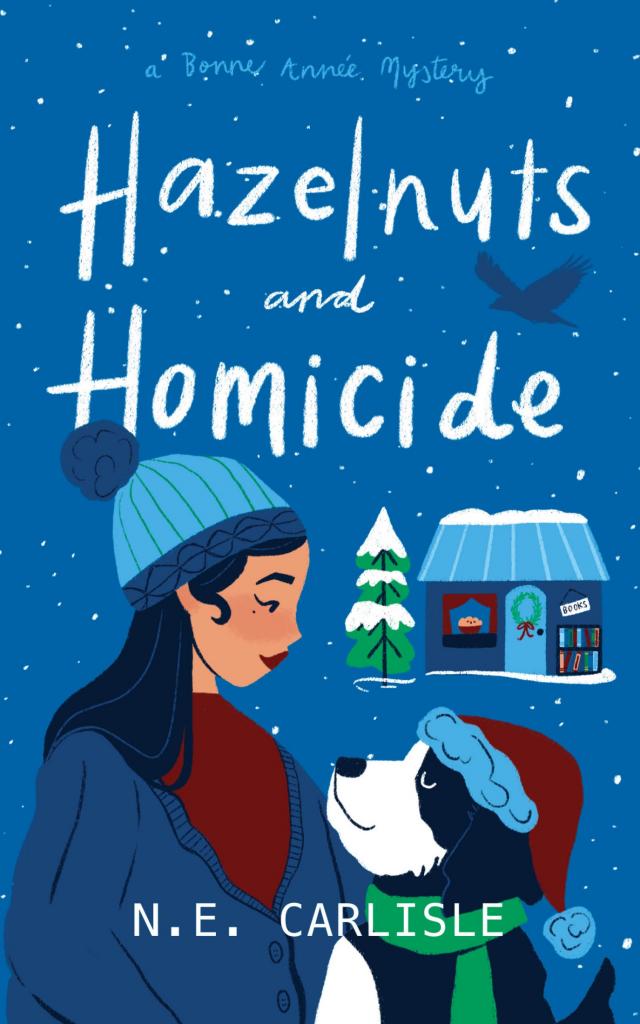
Hazelnuts & Homicide
by N.E. Carlisle
This is a work of fiction. Names, characters, places, and incidents either are the product of the author’s imagination or are used fictitiously. Any resemblance to actual persons, living or dead, events, or locales is entirely coincidental.
Copyright © 2025 by Plot Twist LLC
All rights reserved. No part of this book may be reproduced or used in any manner without written permission of the copyright owner except for the use of quotations in a book review.
Cover design by Janna Steagall
Book design by Jessica Cameron
ISBN: 978-1-956146-70-7 (hardback)
ISBN: 978-1-956146-71-4 (paperback)
ISBN: 978-1-956146-72-1 (ebook)
My heartfelt thanks to my family and friends for their constant encouragement, laughter, and belief in this story from its first spark to the final page. Your support made the writing journey a joy.
I am deeply grateful to Dr. Karen Metheny and the Boston University Gastronomy program for inspiring me to explore the rich connections between food, culture, and storytelling. Their insight and passion for culinary history continue to shape how I see the world — and the mysteries within it.
Contents
Chapter 1
Chapter 2
Chapter 3
Chapter 4
Chapter 5
Chapter 6
Chapter 7
Chapter 8
Chapter 9
Chapter 10
Chapter 11
Chapter 12
Chapter 13
Chapter 14
Chapter 15
Chapter 16
Chapter 17
Chapter 18
Chapter 19
Chapter 20
Chapter 21
Chapter 22
Chapter 23
Chapter 24
Chapter 25
Chapter 26
Chapter 27
Chapter 28
Chapter 29
Chapter 30
Chapter 31
Chapter 32
Chapter 33
Chapter 34
Chapter 35
Chapter 36
Chapter 37
Chapter 1
Arriver Comme un Cheveu sur la Soupe:
To Arrive Like a Hair in the Soup (an uninvited appearance,
or something or someone who disrupts the situation)
I closed the window in the dining room as a chilly breeze slipped inside, unaware that this small act would mark the start of a season I’d never forget—a season filled with murder and secrets. The soft click of the latch brought my attention to the comforting scent of my house—candy canes. With the salty tang of the Oregon coast wafting in all morning, I hadn’t noticed it until now.
I loved candy canes. Their bright, sweet aroma brought more than just peppermint to a room; it was the smell of possibility and of holiday magic waiting just around the corner. It was a scent woven with memories.
My mother—not French, but a trained French pastry chef—approached the holidays like an artist, pies gleaming with egg wash, golden pâte à choux, and tablescapes as precise as her menu. My father, a construction worker, brought the same devotion to carving Nativity figures and crafting the unshakable tree stand that kept our Douglas fir perfectly upright. My parents were opposites, but at Christmas, structure met whimsy and tradition danced with improvisation.
I liked to think I’d inherited the best of both of them. My mother’s elegance showed in my high cheekbones and the soft curly wave of my black bob, which chose a new part daily, no matter how I styled it. My father, a native of Quebec City, gave me French as my first language, my height—nearly five-nine—and a frame balanced between strength and grace. An open box of damaged organic, gluten-free, and allergy-safe candy canes filled the entryway with a festive peppermint scent. I popped a broken piece into my mouth: classic peppermint, of course. None of that sour green apple or mint chocolate nonsense. The crisp flavor cleared my head.
At my feet, Oscar, my fluffy black-and-white Bernedoodle, wagged his tail, his big brown eyes begging. “Not yet, buddy,” I said.
He stared, his big eyes melting my soul.
I caved. “Fine. You win. Again.”
I handed him a nub, and he crunched it happily, the morning light catching in his fur. His usually tragic breath improved a little with the treat, which made his inevitable slobbery kisses more tolerable.
“You’re lucky you’re cute,” I muttered as he licked his lips, already angling for more.
Smiling, I brushed a streak of flour from my sand-colored sweater and tucked a rebellious, gray-streaked curl behind my ear. My loose linen pants were wrinkled, and my favorite sweater was already dusted in flour. My look wasn’t glamorous, but comfortable, and comfort counted.
“Allez, Oscar,” I said, grabbing another piece of candy cane. “It’s going to be a long day. But if we start with candy canes, how bad can it be?”
Oscar had been training to be a service dog when I found him—obedient, kind, and ready to learn. But he wasn’t brave enough for the job, and honestly, I didn’t hold that against him. Bravery, as I’d come to understand, was often overrated. He could cuddle all day and bring me his goofy, lopsided grin when I needed it most, and that was good enough for me.
It was still November—Thanksgiving, to be exact—but my mind had already skipped ahead to Christmas. I’d begun gathering my essentials: cookies, Bûche de Noël, and candy canes. Some people say Christmas is about family, but I’d learned not to count on that. I relied on sugar—serotonin, dopamine, and the rituals that lit up my house.
Most years, I was a Thanksgiving guest, breezing in with my famous pumpkin cheesecake, a gluten-free crowd-pleaser that saved the host from figuring out which dessert is safe for people like me. I let myself roll into Christmas mode without the chaos of hosting the previous holiday.
But this year, I was hosting Thanksgiving, and it was throwing off my rhythm. My tradition of having the house fully decorated by the Friday after Thanksgiving was now threatened by turkey, stuffing, and a soon-to-be-full dining room.
The kitchen door swung open, and Oscar was immediately on his feet, tail wagging like crazy. Alejandro, my old friend who lived in the cottage behind my house, stepped inside, carrying a heavy bushel of apples. His cheeks were flushed from the brisk November air, and he shook his head, clearly amused by Oscar’s enthusiastic greeting.
At six foot three, Alejandro seemed to fill a room just by entering it. He had dark brown hair that curled slightly at the edges, with the faintest hint of premature silver at his temples. He was carrying an extra thirty pounds, but was still fit, looking like a retired linebacker or someone who spent more time chopping wood than sitting at a desk.
“Happy Thanksgiving, Annee,” he said with a grin, setting the apples down on the counter. “Your grandmother’s orchard is as beautiful as ever, but those apples…not light. Hope you appreciate the effort.”
“Happy Thanksgiving, Alejandro.” I smiled as I wiped my hands on a towel. “And I definitely do. You know, her apples are the best. Just that right balance of sour and sweet.”
He glanced over at the countertop where I’d laid out ingredients. “Apple tart, right?”
“Exactly,” I said, pulling out a cutting board. “For ‘Lenore’s Fallen Apples’ tart.”
Alejandro let out a chuckle. “You and your thematic menus.”
“Someone’s gotta keep things interesting,” I replied, slicing the apples. “Plus, Edgar Allan Poe makes for a fun Thanksgiving twist.” I gestured toward the pot simmering on the stove.
“Save me some of the Macabre Caramelized Brussels Sprouts.” Alejandro leaned back against the counter. “You’ve really outdone yourself.”
“By the way, did you catch the Macy’s parade this morning?”
“Nope, missed it,” I said, grabbing some thyme for the stuffing.
“Same old floats, mostly,” Alejandro replied. “And the Broadway numbers this year? Phenomenal. Maybe next year the three amigos—you, me and Mackenzie—will finally make it to New York to catch one of those shows in person.”
I smiled at the idea. Mackenzie was my former high school rival, who just happened to be my best friend now. “That would be amazing, Alejandro. It’s been ages since I’ve traveled anywhere.”
“Same here,” Alejandro admitted, his voice quieter. Then his phone buzzed, cutting through the moment.
I couldn’t help but tease. “Maybe we’ll add a fourth to the group? You’ve been pretty glued to your phone lately.”
Alejandro glanced at the screen, and a shadow crossed his face briefly. “It’s nothing,” he said, sliding his phone into his pocket. “Just some work stuff.”
I frowned slightly. “You sure? You looked—”
“Yeah, I’m fine,” he interrupted gently, his tone a little too light. He cleared his throat and patted Oscar. “Come on, let’s go watch the dog show—the parade’s over.”
“All right,” I replied as the kitchen door swung closed behind them. The smile stayed on my face, but a small flicker of worry lingered as I turned back to the apples. Something was off. Oscar went as far as the backyard between the cottage and the kitchen, but then he came right back into the kitchen to be near all of the smells.
“Traitor,” Alejandro called out after him.
Alejandro had been living with me ever since a bad turn at work sent him looking for a quieter life. For the most part, he seemed better—more grounded, even content helping around the property. But lately he’d been glued to his phone, slipping away to answer calls or brushing off texts a little too casually. I didn’t press; still, I couldn’t shake the sense that something was stirring under the surface.
Even with the comforting smell of baking in the air, my morning routine felt off. Most days, Oscar and I would walk into town, but today I was hosting. Hazelton would be coming to me. I’d already heard from Chief Cora that morning—she was more than our law and order; she was a friend. Still, I couldn’t help inventing little mysteries about her, the way I did with everyone else. Yesterday, I’d noticed she’d dyed her graying hair red. Was it for a date? A fresh start? Or just boredom? Oscar and I had our theories.
Since we had missed our morning walk, Oscar needed to get his energy out, and I needed a break. I turned down the heat to let things simmer, covered what was already done, and decided it was time to survey the front of the house for our guests. I hoped that they might dress up and really take part in the Edgar Allan Poe theme of my literary culinary event, but usually only a few diners ever went the extra mile.
“Come on, Oscar!” I threw open the front door and grabbed another candy cane for a quick sugar boost.
I lived in a sprawling pale blue house with an architectural identity crisis. It was part Gothic Revival, part Victorian. Its steep rooflines, arched windows, and ornate gables give it a church-like feel, softened by my grandfather’s Victorian touches, like gingerbread trim and a wide wraparound porch. During the holidays, I leaned into the whimsy. Twinkle lights traced the roof, wreaths hung from each arched window, and garlands draped the porch railings, turning the house into something out of a storybook.
The house sat far back from the road, so it took some effort to make it to the front door. Along the way, you passed my grandmother’s army of ceramic bunnies and gnomes. As a kid, I found them unsettling, because their painted eyes always seemed to follow me. But to her, they were precious. Each one had a name, a story, and a purpose. My grandfather gave them to her, one by one, over the years. She kept them all. And now that the house was mine, so did I.
Charlie Watson, our postal carrier, town council member, and part-time UPS driver, walked up the driveway with a package tucked under one arm and another balanced precariously in his other hand. He waved, his smile apologetic. “Morning, Annee. Happy Thanksgiving! These should’ve made it to you yesterday, but I ran out of daylight. Better late than never, I always say.”
I met him halfway, taking the box from him. “Thanks, Charlie. Happy Thanksgiving to you, too. Busy day ahead?”
“Always,” he said, shifting the second package under his arm. “Between setting up the Christmas market and getting to your dinner later, I’ve got plenty on the schedule. I might be a few minutes late, but I’ll be there.” He handed me the second package. “This one’s for Alejandro. Mind passing it along?”
“Not at all,” I said, tucking it under my arm.
Charlie’s gaze landed on the house. “By the way, you’ve done a nice job with the place. It’s good to see it stay in the family. Houses like this hold a lot of history.”
I smiled. “Thanks, Charlie. That means a lot.”
He nodded, tipping his cap. “Well, I better get moving.”
“Happy Thanksgiving, Charlie. See you later,” I said as he walked briskly back to his truck, leaving me with the packages and a faint smile.
My family didn’t start in Hazelton. On my mother’s side, my Puerto Rican grandmother and Scottish grandfather met in Boston. She worked in her uncle’s restaurant and he built ships in the Navy Yard. Practical and ambitious, they headed west with their three kids and settled here, where my grandfather built this house room by room with more plans and skill than money.
My grandmother brought the house to life, and even turned it into a bed and breakfast after my grandfather died. For years, it was full of guests, garden blooms, and warm meals. When business slowed, she never complained. She just kept going.
That’s when my cousins and I started coming more. Summers here were loud and chaotic. She’d call us her “little storm” and swear we made the house feel alive again.
When she passed and left me the inn, I gave it new life with my business, The Literary Table. It’s part bookstore, part teahouse, part event space. A place for food, stories, and conversation.
I looked at the bunnies and gnomes by the front path. I couldn’t imagine ever moving them. They had watched over the house for too long. They had seen the people who built it, filled it, and kept it going. They had seen all of us.
Our parents shipped us here every summer, or whenever they needed a break. There were three cousins: Sylvester, whose name origins remained a mystery (we teased him with Tweety and Rocky references), Emerson, named by his poet mother, and me—Bonne Annee Steele. Born on January first to a sentimental French pastry chef, I ended up with two first names. By third grade, I became just Annee.
The boys stopped coming once they hit high school, leaving me the last grandchild standing. By junior year, I’d moved in full-time, right around the time my mother went missing in the Congo. She had thrown herself into environmental activism after my dad died from mesothelioma, convinced that saving the rainforest was her new mission.
I didn’t share her passion. The planet had already taken enough from me. When I went to college and culinary school, I worried about leaving my grandmother behind. But she insisted it was time for her to move into a group home, where, surprisingly, she thrived. Friends, crafts, and for once, someone else taking care of her.
After she moved out, the house went quiet. Mr. Morrison, our caretaker, moved into the cottage to tend the property. College and culinary school felt like my chance to follow in my mother’s footsteps. She was a gifted chef, as was my grandmother, who could cook circles around most professionals. Christmas was their masterpiece; Thanksgiving, a polite truce in between layers of stuffing and cranberry sauce. I wanted to create that kind of magic—the kind that fed both heart and belly.
But I quickly learned I wasn’t destined to be the next Julia Child. Pastry school was a mess—too much precision, too many allergies, and way too many sharp tools for someone as clumsy as me. I left culinary school and found my own path. I might not be a chef, but I could craft a killer menu and host an unforgettable event.
Food and creativity seemed to run in the family. Sylvester built a restaurant empire after ditching investment banking. Emerson critiqued food and everything else, including me. He stayed in contact only via social media. His comments were more barbed than warm, but it was still a connection. Maybe that was his version of caring, or at least, that’s what I told myself.
Even Mr. Morrison, our longtime caretaker, eventually retired. He was ready to enjoy peace and quiet. It felt like the end of an era. Yet the house still hummed with life in its own way. I liked to think my literary culinary treats kept things lively.
When the weather finally cooled this year, I started planning my fall-themed events. My guests voted on the monthly theme—September was Harry Potter and the Half-Blood Prince, October brought Something Wicked This Way Comes, and November became “Poe-vember,” with The Raven and Other Poems as the featured book. Gothic touches mingled with harvest décor, fancy ravens alongside pumpkins and wheat stalks.
Thanksgiving, to me, was like the Olympics of holiday meals. These days, people my age seemed less enthused, favoring “Friendsgiving” or skipping it altogether, but I still loved the challenge of cooking for the season. It’s a day when food, family, and tradition converge—even if the family part was a little unconventional in my world.
This month’s Poe-inspired menu leaned moody: cotton candy macarons, carnival-spiced coffee, and apple cider mimosas with cinnamon-sugar rims. I thought of rebranding them and bringing them back. They were crowd favorites. Though I offered lighter books, the votes skewed dark. I was a little tired of black and purple, but the rotating guests, locals, Portlanders, and coastal travelers made every event feel fresh. I gazed up at the house, contemplating my menu. I had a good feeling this month’s literary event would be the most memorable one yet.


