

Ceo blues, p.1
CEO BLUES, page 1


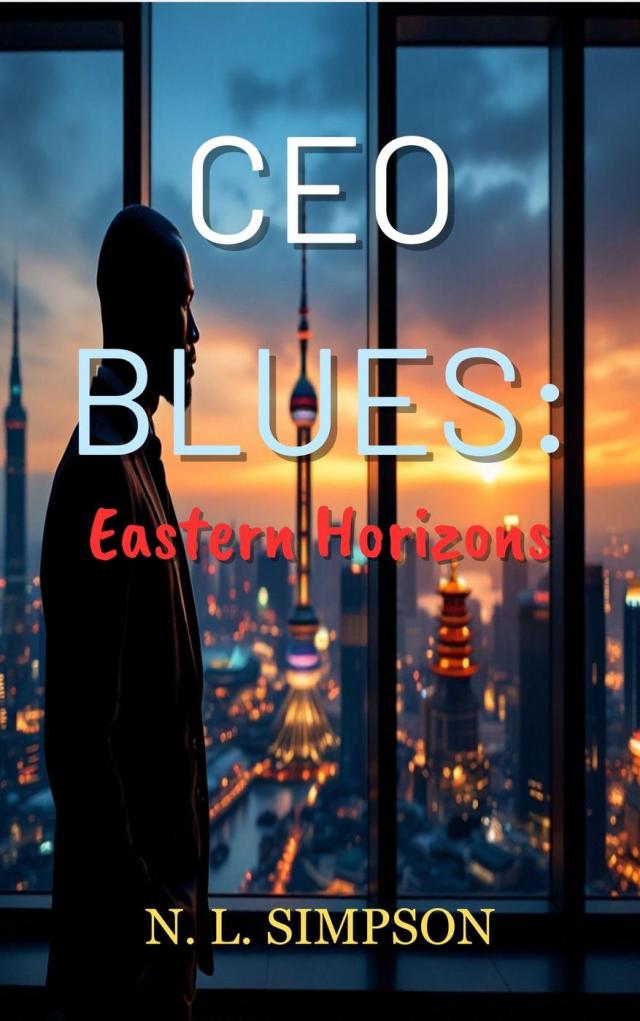
CEO BLUES: Eastern Horizons
CEO BLUES SERIES, Volume 2
N. L. Simpson
Published by Philologia Publishing, 2025.
CEO BLUES: Eastern Horizons
Book Two of the CEO BLUES Trilogy
Copyright © 2025 by N. L. Simpson
All rights reserved.
Published by Philologia Publishing
Michigan, USA
www.nlsimpsonllc.com
No part of this publication may be reproduced, stored in a retrieval system, or transmitted in any form or by any means, electronic, mechanical, photocopying, recording, or otherwise, without written permission of the publisher.
This is a work of fiction. Names, characters, businesses, places, events, locales, and incidents are either the products of the author's imagination or used in a fictitious manner. Any resemblance to actual persons, living or dead, or actual events is purely coincidental.
Library of Congress Cataloging-in-Publication Data
Simpson, Nathaniel Lee
CEO BLUES: Eastern Horizons / Nathaniel Lee Simpson
Cover Design by: Philologia Publishing
Interior Design by: Philologia Publishing
Edited by: Philologia Publishing
First Edition: Fall 2025
Printed in the United States of America
For information about special discounts for bulk purchases, please contact Philologia Publishing at:
Email: philologia@nlsimpsonllc.com
Phone: +1 734-563-3770
“Language Excellence, Global Impact”
DEDICATION
To my children - Nathaniel II, Austen, and Nia -
who taught me that true leadership begins with learning to follow.
To Sarah, my daughter-in-law,
and my grandson Micah -
who show me how our family's story continues to unfold.
To Myralona and Samantha -
who prove that new beginnings hold beautiful promises.
And to all those who find themselves
between who they were
and who they're becoming.
May your horizons always expand.
CEO BLUES: Eastern Horizons
ABOUT THE AUTHOR
Nathaniel Lee Simpson, M.Ed. is an international educator, entrepreneur, and author based in Michigan, USA. With a career spanning multiple industries and continents, he brings a unique perspective to leadership and cultural transformation.
As the founder of N L SIMPSON LLC, he focuses on language excellence and global impact through educational initiatives. His experience includes leading multiple businesses, teaching across cultures, and developing international educational partnerships.
Currently pursuing his Master's in Educational Leadership, Nathaniel combines academic insight with real-world experience to bridge Eastern and Western business philosophies. His writing draws from personal journals documenting his journey from CEO to employee and back again, offering readers an authentic look at leadership transformation.
"CEO BLUES: Eastern Horizons" is the second book in his CEO BLUES trilogy, following the acclaimed first installment "The Fall." The series chronicles the challenging yet rewarding path of personal and professional reinvention.
When not writing or teaching, Nathaniel maintains close connections with his family through regular video calls with his three children - Nathaniel II, Austen, and Nia - and his grandson Micah. He finds balance through cycling, exploring nature, and embracing Eastern cultural experiences. Through N L SIMPSON LLC, established in 2024, he continues to advocate for educational excellence and cross-cultural understanding in both his work and writing.
For more information about Nathaniel's work and upcoming projects, visit:
www.nlsimpsonllc.com
Table of Contents
chapter 1 — "The Landing"
Chapter 2 — A Different View
Chapter 3 — The Space Between
Chapter 4 - Ceremony of Shadows
Chapter 5 - Currents of Power
Chapter 6: Deeper Waters
Chapter 7: Undercurrents
Chapter 8: Shifting Ground
Chapter 9: New Rhythms
Chapter 10: Deeper Currents
Chapter 11: Analog Life
Chapter 12: Undercurrents Rising
Acknowledgments
About the Author
Coming Soon: Book 3
Also by Nathaniel Lee Simpson
Thank You for Reading
| Page
chapter 1 — "The Landing"
The morning sun pierced through Eastbridge's iconic skyscrapers as I stood outside New Dawn Education Center, clutching my teaching materials like a shield. Twenty-three years of being the decision maker, and now I was about to walk through these doors as just another English teacher. The security guard gave me a friendly nod – the kind reserved for regular employees, not executives. I returned it, trying to ignore how foreign it felt to be on this side of authority.
Inside, the hallway buzzed with that particular Monday morning energy unique to Asian schools. Students in crisp uniforms bowed slightly as they passed, their "Good morning, Teacher" echoing in perfect unison. Teacher. Not CEO, not Director, not even Mr. Simpson. Just Teacher. The title simultaneously humbled and haunted me.
Ms. Chen, the center's administrator, appeared from around the corner, her clipboard an extension of her efficient demeanor. "Ah, Mr. Stone," she called out, using my chosen English name. "Your classroom is ready. But first, we need to review some protocols." The way she emphasized 'protocols' made it clear – my previous executive experience meant nothing here. In fact, it might even be a hindrance.
Following her through the winding corridors, I caught glimpses of other foreign teachers through classroom windows. Each one focused intently on their students, seemingly at peace with their role. I wondered if they too had past lives as executives, or if this had always been their path. The thought was interrupted by the sound of Ms. Chen clearing her throat. She had stopped at a door marked '306' and was waiting expectantly.
"Remember, Mr. Stone," she said, her voice carrying both warmth and warning, "in The East, we value harmony above all. Sometimes the best way to lead is to learn how to follow." With that, she pushed open the door to reveal twenty pairs of curious eyes fixed on the newest foreign teacher at New Dawn Education Center.
The classroom felt smaller than it looked from the doorway. Twenty students, aged somewhere between twelve and fourteen, sat in perfect rows, their English textbooks centered precisely on each desk. A boy in the front row – his name tag read "Max" – adjusted his glasses and whispered something to his seatmate that made them both giggle. Ms. Chen shot them a look that could freeze summer humidity.
"Class," she announced, "this is Mr. Stone, your new oral English teacher." She turned to me with an expectant smile that said 'impress us.'
Years of boardroom presentations hadn't prepared me for this moment. The silence stretched like pulled taffy until a girl in the third row raised her hand. "Teacher, why did you come to The East?"
The question caught me off guard. In business, everyone always asked about profits, strategies, market share. No one ever asked why. I found myself smiling genuinely for the first time that morning.
"I came to learn," I answered, surprising myself with the truth of it. "Sometimes to move forward, you need to start from the beginning."
The puzzled looks on their faces told me my attempt at wisdom had either gone over their heads or gotten lost in translation. Ms. Chen stepped in smoothly, translating my words into Mandarin. A collective "Ahh" rippled through the room, followed by knowing nods. These kids understood more about new beginnings than I'd given them credit for.
Learning to Bow
Ms. Chen's departure left a vacuum in the room that needed filling. Twenty pairs of eyes watched expectantly as I moved toward the teacher's desk, muscle memory from countless boardroom presentations taking over. I reached for the piece of chalk – another reminder of how far East I'd come from smart boards and PowerPoint decks.
"Today," I started, writing my name on the board, "we're going to study from Chapter 7 of 'Pierce is Looking for You.'" I held up the novel, watching recognition flash across their faces. The book had been chosen carefully by the school's curriculum director – its mix of workplace dynamics and mystery supposedly perfect for teenage ESL students.
Max's hand shot up again. "Teacher, in America, do people bow like in the story when Pierce meets the CEO?"
Before I could answer, another student chimed in. "My father says Americans just shake hands. Very casual." He demonstrated with an exaggerated handshake motion that drew muffled laughter from his classmates.
I thought about all the times I'd received bows as a CEO in international meetings, how I'd probably done it wrong more times than right. "Actually," I said, setting down the book, "showing respect looks different in different places. In America, we might shake hands. Here in The East, you might bow or nod. The important part isn't how you show respect – it's understanding why you show it."
The class grew quiet, pens poised over notebooks. Even Max had stopped fidgeting with his glasses. I turned to write 'RESPECT' on the board, the chalk clicking against the smooth surface. In that moment, I realized I wasn't just teaching English – I was learning a lesson myself.
"Let's practice," I suggested, moving from behind the desk. "In pairs, I want you to act out meeting someone important. But here's the challenge – you can't use words, and you can' t bow. Show respect another way."
What followed was twenty minutes of the most creative silent greetings I'd ever witnessed. Max and his partner developed an elaborate sequence of gestures that looked part kung fu movie, part interpretive dance. Two girls in the back row demonstrated the most elegant curtsey I'd never seen outside of period dramas. Each pair found their own way to bridge the gap between cultures, teaching me more about adaptation than any business seminar ever had.
Max and his partner's elaborate greeting ceremony ended with what looked suspiciously like a move from a popular K-pop dance. Before I could comment, a quiet girl named Jenny raised her hand.
"Teacher, in our company – I mean, my father's company – they give business cards with two hands." She demonstrated, her small hands presenting an imaginary card with careful precision. "Is this also respect?"
"Excellent example, Jenny." I pulled a business card from my wallet – old habit – and demonstrated the difference between the casual Western flip and the deliberate Eastern presentation. "In America, I used to hand these out like playing cards. My first meeting in Eastbridge, I learned very quickly that was..." I searched for the right word.
"Wrong?" offered Max with his characteristic directness.
"Different," I corrected, drawing knowing smiles from several students. "Cultural differences aren't about right or wrong. They're about understanding."
A boy in the back row – Tom, wearing a Manchester United jersey under his school blazer – raised his hand. "My uncle says in business, you must know face. Save face, give face." He looked at me intently. "Teacher, in America, do you know face?"
The question hit closer to home than Kevincould know. How many times had I mishandled 'face' in my CEO days? How different might things have been if I'd understood then what these students were teaching me now?
"Actually, Tom, that's a perfect transition to our story." I held up 'Pierce is Looking for You.' "In Chapter 7, Pierce learns about face the hard way. Let's see how his experience compares to your uncle's wisdom."
But before we could open our books, Emma – a serious-faced girl who'd been taking meticulous notes – spoke up. "Teacher, you said you came to learn. What is the most important thing you learned about face in The East?"
The classroom grew quiet, all pretense of an English lesson momentarily forgotten. Even Max set down his perpetually fidgeting pencil. Twenty pairs of eyes watched expectantly, waiting to see how their Western teacher would handle this moment of cultural reckoning.
I thought about face – how I'd lost it back home, how I was trying to rebuild it here, how these students were unknowingly helping me understand its true meaning. "The most important thing," I said carefully, "is that face isn't just about appearances. It's about..."
The Sound of Silence
The classroom clock ticked past nine-thirty, each movement echoing in the strange quiet that had settled over Room 306. My students were now deeply focused on their textbooks, occasionally glancing up at the new vocabulary I'd written on the board. The silence felt heavy, different from the tense quiet of boardroom standoffs I was used to. This was a cultural silence – one I was learning had its own meaning in the East.
"Teacher," a soft voice broke through. It belonged to a girl in the second row – Grace, according to her name tag. "In the story, Pierce doesn't speak when he first meets the CEO. Is this..." she paused, searching for the right words, "is this correct in America?"
The question transported me back to countless business meetings where I'd been the CEO on the other side of that silence. How many times had I misread those pauses, rushed to fill them with Western directness?
"In America," I started, then stopped. Was I still qualified to be the authority on American business culture when I was here precisely because that part of my life had crumbled? I adjusted my approach. "Different cultures view silence differently. In the West, we often try to fill silence. Here in the East, I'm learning that silence can be as meaningful as words."
Max, ever eager to contribute, raised his hand again. "My father says Western people talk too much in business." His eyes widened as he realized what he'd said, and he quickly added, "Sorry, Teacher."
A laugh escaped before I could catch it – genuine, unexpected. "Your father might be right, Max. Sometimes the hardest thing for a Western businessman to do is..." I let the sentence hang unfinished, watching as understanding dawned on their young faces.
"Be quiet?" Grace offered.
"Exactly." I picked up 'Pierce is Looking for You' again, turning to Chapter 7. "Now, let's find other moments in the story where silence speaks louder than words."
As the students began flipping through their books, I caught my reflection in the classroom window. Behind me, the Eastbridge skyline stretched toward the clouds, its modern towers a stark contrast to the ancient wisdom I was beginning to grasp. Sometimes the best lessons come when we stop trying to teach them.
The students' pages rustled as they searched through Chapter 7. Max, predictably, found the first example.
"Here, Teacher! When Pierce interrupts Mr. Chen's tea ceremony." He adjusted his glasses, reading carefully. "'Pierce felt the silence grow uncomfortable, so he began explaining his business plan. Mr. Chen's expression remained unchanged as he poured another cup.'"
"Good find, Max. What do you think Mr. Chen was communicating with his silence?"
Emma's hand rose slowly. "Maybe... he was testing Pierce? In my mother's company, sometimes the most important part of a meeting happens before anyone talks business."
The wisdom in her observation struck me. How many times had I failed that same test, rushing to fill silent spaces with PowerPoint slides and profit projections?
"Teacher," Grace ventured, "in the story, Pierce keeps talking until Mr. Chen puts down his tea cup. Is that..." she searched for the word, "...the turning point?"
Before I could answer, Kevinspoke up from the back. "Like a red light in traffic. Stop talking!"
The class erupted in gentle laughter, but there was truth in his simple analogy. I wrote on the board: 'Cultural Traffic Signals' and underneath it: 'Tea Cup = Red Light.'
"Tom's right," I said, letting a deliberate pause fill the room. The students stayed quiet, many nodding in understanding. We were no longer just studying English – we were practicing the very lesson we were discussing.
Through the window, a group of construction workers moved in synchronized silence, each understanding their role without a word spoken. Even the city itself was teaching me about the power of unspoken communication.
"For tomorrow," I said, closing my book, "I want you to observe moments of silence. Not just absence of noise, but silence that says something. Write down what you think is being communicated."
The bell chimed, but nobody moved – a small victory of silence over chaos. I nodded, giving them permission to pack up. As they filed out, Max lingered.
"Teacher," he said, unusually subdued, "my father also says sometimes silence is the best answer to a big mistake."
I looked at him, wondering what wisdom his father had shared around their dinner table. "Your father sounds like a wise man, Max."
He grinned, back to his energetic self. "He talks too much too. Maybe that's how he learned!"
The Weight of Words
The second period brought a different kind of silence. As my students worked on their writing assignment – describing Pierce's cultural missteps without using the word 'mistake' – I found myself drawn to the window again. Three floors below, delivery scooters weaved through traffic with practiced precision, their riders communicating through an elaborate dance of nods and hand signals. Even the chaos had its own quiet language here.
"Teacher." Jenny's voice pulled me back to Room 306. She held up her notebook, neat characters filling half a page. "I wrote that Pierce's words were... heavy." She frowned slightly. "Is this correct?"
I moved to her desk, reading her careful English: 'Pierce's words fell like stones in Mr. Chen's quiet garden.' The metaphor caught me off guard – not just for its elegance, but for how accurately it described my own past missteps in Eastern boardrooms.
"That's... that's very good, Jenny." I turned to the class. "Can anyone tell me why Jenny's description works so well?"


