

Until they sleep, p.1
Until They Sleep, page 1


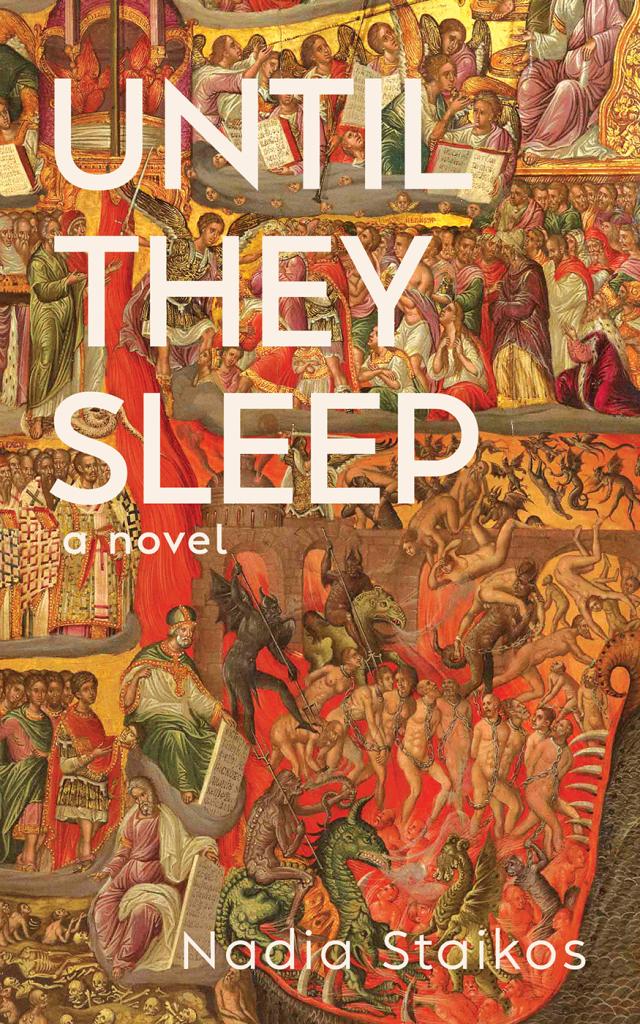
Copyright © 2025, Nadia Staikos and Guernica Editions Inc.
All rights reserved. The use of any part of this publication,
reproduced, transmitted in any form or by any means,
electronic, mechanical, photocopying, recording
or otherwise stored in a retrieval system, without the prior consent
of the publisher is an infringement of the copyright law.
Guernica Founder: Antonio D’Alfonso
Michael Mirolla, general editor
Julie Roorda, editor
David Moratto, Interior and cover design
Rafael Alt, ebook
Guernica Editions Inc.
1241 Marble Rock Rd., Gananoque, ON K7G 2V4
2250 Military Road, Tonawanda, N.Y. 14150-6000 U.S.A.
www.guernicaeditions.com
Distributors:
Independent Publishers Group (IPG)
600 North Pulaski Road, Chicago IL 60624
University of Toronto Press Distribution (UTP)
5201 Dufferin Street, Toronto (ON), Canada M3H 5T8
First edition.
Printed in Canada.
Legal Deposit—Third Quarter
Library of Congress Catalog Card Number: 2024947448
Library and Archives Canada Cataloguing in Publication
Title: Until they sleep / by Nadia Staikos.
Names: Staikos, Nadia, author.
Series: Essential prose series ; 232.
Description: Series statement: Essential prose series ; 232
Identifiers: Canadiana (print) 20240474007 |
Canadiana (ebook) 20240479718 | ISBN 9781771839839 (softcover) |
ISBN 9781771839846 (EPUB)
Subjects: LCGFT: Novels.
Classification: LCC PS8637.T343 U58 2025 | DDC C813/.6—dc23
Contents
Cover
Title page
Copyright
PART ONE
PART TWO
PART THREE
PART FOUR
PART FIVE
Acknowledgements
About The Author
Landmarks
Cover
Half Title Page
Title Page
Copyright Page
Table of Contents
Dedication
Epigraph
Acknowledgments
For Γιαγια
“Though we dream and hardly know it, longing,
like an angel, fosters us, smooths our hair,
and brings us wild strawberries.”
—Marilynne Robinson, Housekeeping
“what did I do but ask
for what I longed for
what sin is this”
—Annick MacAskill, Shadow Blight
The black cat was in the square again. Frona dropped her basket to the ground and pressed a finger to her lips, quieting her little sister. Draped along the top of a low stone wall, the cat drowsily licked its fur, shining eggplant-purple in the sun. Frona was hypnotised by the slow pull of tongue along sleek belly, the spread of delicate paw. The pleasure taken in its own body.
Frona’s mother hadn’t looked up, hadn’t even opened her eyes when she sent the girls out to do the washing that morning. She sat in the rocking chair, shutters thrown open to the breeze, nursing her newest baby—the third boy in a row. Like the cat’s tongue, her mother was methodical, petting and petting the baby’s delicate head. If she had been touched with such tenderness as an infant, Frona had long ago forgotten the sensation.
The cat continued its ritual, and Frona lifted a hand to her own hair. Pulling a lock from behind her ear, tentative, she let it meet the tip of her tongue. Then her arm, her hand, her fingers. The back of her hand swept behind her ear. If she were a cat, she could close her eyes and press her head into an admirer’s hand. Her face, her entire body. She could feel something solid and real pushing back.
Frona stepped forward, hand outstretched, and the animal sprang from reach, streaking across the courtyard toward the village taverna. The girls watched as it slunk beneath the tables, rubbing its length along the legs of chairs and men alike, leaning into them with wanton familiarity.
“Imagine the nerve,” Frona said. What must that be like? The cat knew exactly what it wanted and was asking for it, was allowed to ask for it. Expected, even. Like a baby. But Frona knew better. She was not a baby, not even a little girl anymore. She was ten years old, which was grown, and a grown girl must not desire.
The men shooed the animal away as it circled the tables, begging for scraps. The owner emerged, kicking dust at the creature as it darted out of sight.
“Poor hungry thing,” Hekta said.
“What did it expect, really?” Frona picked up her basket—heavy with wet linens—and led the way home.
Their mother greeted them from the corner of the room, where she was sweeping the hard-packed earth floor. Frona stopped at her brother’s cradle. She ran a finger along the cloud of his cheek, and his eyebrows raised in response before relaxing back into sleep.
“The dough, Frona,” her mother said, pointing with the broom. “If it’s risen, take care of it. You can take the loaves to the ovens.”
As Frona pinched and folded the dough, she dug her fingers in and squeezed big handfuls, letting her fists sink in and running her hands along the surface, savouring the soft skimming of her skin along the floured areas and the gentle stuttering of her fingers along the unfloured. She imagined she was someone else, touching her, and then she imagined she was touching someone else, whoever that might be. Perhaps a cat. Perhaps another girl, just like herself, if she could step outside of her body and find a copy still there. Touching and touched, all at once.
After sliding the pair of loaves into the stone oven in the square, dry heat up against her face, Frona had some time to herself before she’d have to check their progress. Over the wall and through the trees, she knew where to step over the tripping roots and sharpest rocks to safely get to her clearing up behind the church.
Standing alone on the dry earth, tufts of weeds springing up around her, Frona removed her dress and draped it over her basket. The mountainside crackled with insects, greased by waves of heat. She stood, arms wide and face tilted toward the sun, feeling every movement of the air, every lick, every puff. The light filtering through her closed eyelids was a red warmth exploding with yellows and oranges, swirls of blue.
Frona lay back on the dry ground, towers of grasses and vleeta and wild mint stretching toward the sky around her. Her fingertips brushed up and down each arm, soft as spider feet tickling the sides of her face, butterfly wings on her stomach, the gentle scratch of her nails, bitten short, stroking her side from hip to ribs, back and forth, trilling pleasure up the length of her spine.
She was a little girl again, and her mother was pulling a brush through her hair. She was feverish, snuggled into bed between her parents. She was the cat, back on the wall, licking and basking and rubbing against the legs of strangers, seeing everything through twin-coin eyes.
She was Frona again, and plugging her ears, she began to hum. The sound echoed in her head, loud, like all the village, the mountain, all of Greece, all the world, everyone should be able to hear, but the sounds poured into air and drowned. All of that empty space.
* * *
Tasked with shelling peas in the early morning, Frona and Hekta set themselves up in the yard, getting comfortable for the hours of work that lay ahead. Hekta had gone beyond the house to pee, dallying as usual, and ran back shouting Frona’s name.
“What is it? What’s wrong?” Frona was startled to her feet, scattering peas from her skirt. Her little sister was hers to protect—what she imagined it must feel like to be a mother.
“It’s a carriage, coming this way!” Hekta turned, knowing Frona would follow. Sure enough, there was a carriage snaking its way down from the top of the next mountain over. The road dropped into the valley before making its ascent to their village. It was the only route connecting them to other people. Visitors were so rare, Frona wasn’t even upset about the handful of peas sent rolling into the dust, and without having to discuss the arrangements, they hurried back to collect their chore and set it up on a ridge where they could track the visitor’s slow progression.
“A covered carriage. Why do you think it’s covered?”
“They must be rich.”
“Oh,” Hekta said. “Like a prince?”
“No, a prince would have no reason to come here.” Frona placed a pea in her mouth and crushed it between her teeth with an audible pop of sweetness. “But, definitely someone important. Maybe an archbishop.”
“Do you think there are beds in there? With people sleeping in the shade?” The sun was steadily making its way upward, burning so bright it pierced Frona’s skull and hurt her teeth.
“I don’t know, but let’s hurry. I want to finish before it gets here so we can go meet it in town.” Hekta agreed but continued staring into the distance. “Focus. It’s going to cross the Snake soon, and then it’ll be here in no time at all.” They took one more moment to watch as the curious shape approached the river that wound through the valley. Once the carriage crossed the shallows, they would lose sight of it until it came through the trees at the end of the village and approached the main square. Free of the visual distraction, they bowed their heads and worked as fast as their fingers could manage.
When noontime glared from directly overhead, the girls dropped off the peas with their mother, who followed them into town with their brothers in tow. The carriage had arrived. They found their father already there, along with the rest of the villagers.
The wagon was not as opulent as it first appeared. The roof and sides were made of worn canvas pulled over a simple wooden frame, with a large, dark cross of flaking paint in the centre. The horses were mangy, flicking tattered tails at the gathering flies. There was a man at the reins who looked older than anyone Frona had ever seen. The clumps of hair poking out from the bottom of his hat were white gone yellow, and his cheeks, earlobes, and every other fold of skin on his face seemed determined to touch his shoulders. His eyes, as they peeked from beneath drooping lids, scanned the crowd with an incongruent youthful sharpness.
“He must be a hundred,” Frona whispered.
“Maybe two hundred,” Hekta said as they watched him climb down on unsteady legs. He untied the canvas from one side of the frame and unrolled it toward the opposite post, slowly revealing the contents of the wagon. Low murmurs of appreciation made their way through the crowd as what became obvious was a shop-on-wheels displayed its wares. The three remaining sides of the wagon were reinforced with wood and lined with shelves filled with religious icons; flashes of long golden fingers and hundreds of eyes in long golden faces stared out at the villagers from wooden plaques of varying size.
“I will stay for one hour,” the man said in an unexpectedly thunderous voice. His clothing was speckled with gold paint. The girls had never seen such beauty—only the church had elaborate icons, and even then, only a few. They tore their eyes away from the splendor to find their parents in the crowd, but the adults had all abandoned the children, rushing home to find what money they could spare.
“Do you think Baba will buy one?” Hekta said.
“I hope so. But with all of that gold, they must be worth a fortune,” Frona said. She wished more than anything that one of the icons would soon be shining from their own wall.
“Don’t be shy,” the man said. “You’re all good children, aren’t you? You don’t have anything to fear.” Frona and Hekta inched closer, emboldened as the other children pressed in around him. Infant Christs with the faces of men sat in the arms of solemn Marys, and along with different saints and angels, they stared back at the children from their places on the walls. The old man was untying knots to remove the canvas roof. The sun streamed in, igniting the gold accents and bringing the icons to life.
“I am a painter,” he said, the conviction stirring something inside of Frona she couldn’t quite explain. There was no question: he was a painter. She did not doubt that God Himself put him here exactly as he was, with no purpose but what she could see before her. “My hand wields my brush, but it is the Holy Spirit working through me that brings these to life. Do you see them shine, children? If you watch closely, you might even notice them blink.” His gasping laugh searched for air, and Frona reached out to take Hekta’s hand, which was already reaching for her own. Their fingers interlaced as the man slid a low, flat box from the back corner of the wagon-bed. He removed the lid to riffle through a row of scrolls, plucking his choice from its nest. He unfurled the rough canvas and held it out to the children.
“You do know what happens if you’re bad, don’t you? If you misbehave, or even if your thoughts are impure?” Frona added her other hand on top of her sister’s and tightened her grip. What was taking their parents so long?
The man’s smile showed more gap than long tooth as he held the painting open before his audience. Deep reds and blacks and yellows stroked into realism depicted the second coming of Christ in brief flashes of terror and fire, shadowy demons with little horns and wings, snakes and smoke, chains and spears, death and pain. “You don’t need to know my name, or even remember my face, children. I’m but a servant, devoting my life to painting and spreading the message of Christ. But you must prepare yourselves for His return. Be ready to see His glory with pure souls, or suffer these consequences.”
Expressions of terror were painted across the many faces with horrific perfection. Frona’s eyes met with those of a woman tumbling headfirst from a wall, naked and helpless, doomed to the mad abyss. It was pure suffering, and there was no way out. For those people, there would be no end. Who had they been, what had they done to deserve this? Why would anyone choose to be a bad person? When it was a possibility, ending up in a place like that, forever? It was a choice, wasn’t it? The eyes of every icon were on Frona, probing.
“Don’t worry,” the old peddler said. “You can be saved from an eternity of fire. Your parents will bring my icons home. They will hang on your walls and remind you where your thoughts should be if they chance to stray. You can choose to see the light. It’s that simple.”
At once, Frona’s body no longer fit into her own skin; something wasn’t right with her, had never been right. She imagined winged shapes peeking out from behind her teeth and snakes of smoke coiling around her body, gently squeezing. The man looked straight at her, and Frona would never forget his face. He began to hum a vaguely familiar tune as he rolled the scroll back up, placing it in the box just as the adults began to trickle back. Then the bartering began.
The peddler’s visit resulted in brand new icons of all sizes hanging from walls in every home of the village, and a few more in the church. Frona’s parents chose one much larger than the others already in their home; the Virgin Mary in vibrant blue robes held the baby Christ, swaddled in red and gold. Angels watched over them from clouds on a golden background. Frona’s favourite part was the intricate bronze pattern within the luminous haloes surrounding the heads of mother and child. Compared to their other icons, paint faded and crackled with age, this new one shone with a brilliance that drew Frona in.
So, there was more to being good than doing good. Goodness meant everything, every part of her, right down to the nature of her thoughts.
“Do you understand, Frona?” Mary asked.
“Do you, really?” the child said.
* * *
This year, for the first time, Frona was entrusted to dye the kokkina eggs for Easter while Hekta helped her mother to make the tsoureki. Chin held high by the grace of maturity, Frona filled the iron pot with cold water, covering the dozen eggs, and stirred with the large metal spoon to centre the yolks as the water came to a boil over the hearth. Christ watched her from his golden mother’s arms. Oh, the trials that baby had in store. Looking into his eyes, already the eyes of an old man, it wasn’t hard to imagine he had known what was coming all along.
The family had been fasting for over a month. No meat, no eggs, no dairy. No fish, no oil. Frona dreamed of food at night and suffered every bland meal.
“Suffered?” the child asked from his place on the wall.
No, of course not. She should be grateful for any food on her plate.
On Saturday night they would break their fast. She would stay up late and watch fireworks, running barefoot throughout the village while grease from the lamb’s sweetbreads dripped from her fingers and chin. The robust chewiness of meat seemed illusory after weeks of abstaining, a trick of her distant memory.
The smell of mastic and mahleb pulled at Frona from across the room, where Hekta was using the grinder under their mother’s careful supervision. The Easter bread they were preparing would be airy and delicate, flavoured of the divine. After being pulled from the oven, the egg-wash would shine such a golden brown that the loaves would look like polished wood. The voluptuous curving braids would be sprinkled with slivered almonds that would gently crunch between her teeth as the sweet dough melted, butter on her tongue. Frona’s body was radiant with a pleasurable tingling sensation. She squeezed her legs together in answer to a pulsing that beat like a second heart, begging. Touching and touched.
“Prosexay!” her mother shrieked, in a panic. Flour puffed from her mother’s pointing finger, which was directed at the pot of eggs. The water was boiling with unwatched madness; the spoon—which Frona forgot to remove—was clinking and whirling in a frenzy. The metal spoon could bang against the eggs and crack them.


