

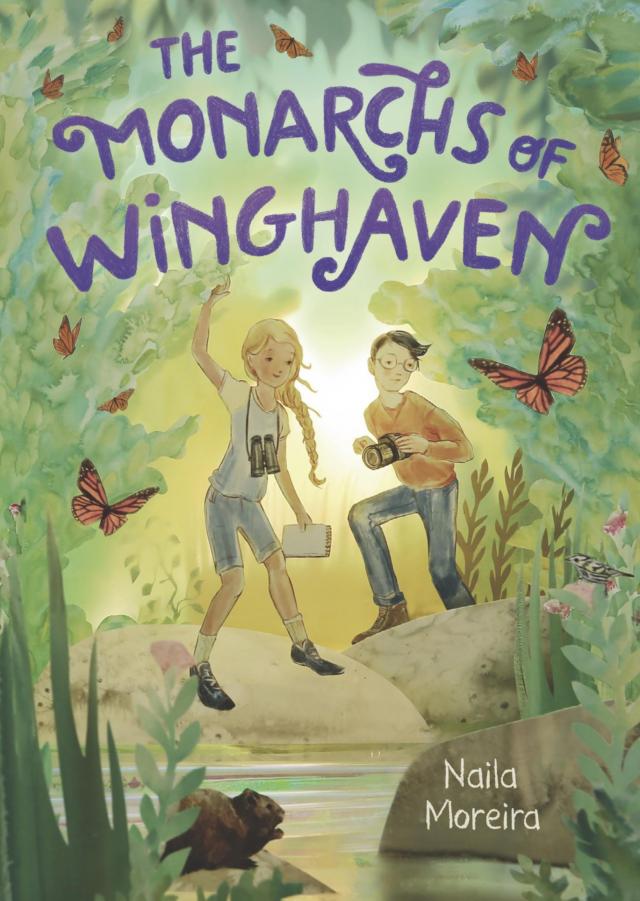
The monarchs of winghave.., p.1
The Monarchs of Winghaven, page 1


CONTENTS
The Secret
The Boy
Fifth Grade and Frog Fights
Bram
Camp
The Muskrat Pond
Painters and Photographers
Better Planning, Better Luck
A Million Tiny Creatures
The Strange Thing in the Woods
The Pact
Pete
Troubles
Taking Risks
Broken Promises
Playground Disasters
The Project
A Sixth Sense for Birds
Courage
Surprises
Antlions
Milkweed
Plans
Hard Work
Changes
The Egg
Robert
Launching
Invitations
The Big Day
Loss
Threat
Camera Difficulties
From Bad to Worse
Discoveries
The Symposium
Bad News
The Dark Night of the Soul
Last Chances
The Hearing
Teamwork
Winghaven
Notes for Young Naturalists
Acknowledgments
About the Author
Samantha Tabitha Smith hiked down to one of her favorite spots in her Field.
Beside the path in the middle of the grassland lay an ancient scatter of trash. A broken-down lawn mower. A few unrecognizable scraps of metal. And most importantly, a wooden door.
It lay flat, weeds tall around it. Like she did most days, she wedged her fingers underneath and lifted. The big board parted from the earth.
Jackpot.
On the furrowed soil lay the usual—earthworms, millipedes, pill bugs. But today, better than all those, a rare and beautiful find: a snake skin—and beside it, the snake itself.
Sammie was used to garter snakes. They were slender and dark green with black patterning and long yellow stripes from head to tail tip. She liked to catch them. They didn’t bite, usually—or if they tried, their toothless mouths closed so weakly around her finger that she always laughed. But if they twisted and rubbed their scales together, they could produce a nasty-smelling whitish cream that made her fingers smell like she’d dipped them in turpentine. She always held the snakes at the base of their head and the end of their tail, straight out, so they couldn’t rub.
But today’s snake was different in color and pattern—not a garter snake at all. She’d never seen one like it. It was pale, milky white, with brick-red markings in big ragged patches. It lay curled up and sleeping. She knew it was alive, because its body seemed to glow, shiny and sleek, not dull like the snake she’d once seen crushed by a car.
She didn’t touch it. She didn’t know if it might bite. Not far off lay the snake skin, coiled, fragile, and transparent. The snake was extra glossy because, she knew, it had just shed its old scales; now it would have space to grow bigger inside its new skin. Reverently, slowly, so as not to disturb the snake, she slid her fingers underneath the old skin and picked it up. It lay like crinkled rice paper in her palm. The whole head, body, and tail were unbroken. A perfect specimen.
She opened her pack and fished out her collecting case, a clear plastic box that wouldn’t break but showed the contents, and tucked the skin inside. It followed her personal rule: she could collect only dead things, never anything alive.
Then she pulled out her notebook, a spiral-bound black one with a hard cover. She recorded the date and the weather.
She sketched the snake, trying to capture every detail. Sammie had taught herself to draw just for this. She wasn’t very good at drawing, but she could at least make a snake look like a snake and a bird look like a bird. Later she would look it up in her field guides at home.
Sammie’s teachers always told her she would grow up to be a writer someday. One of her poems hung in a place of honor on the classroom wall. But Sammie liked bugs and birds and snakes and mammals. She wanted to be a scientist. A biologist, to be exact. Yet no one else besides her seemed to care. Science class was so short. The boys all teased her when she asked question after question.
Worse still, Sammie’s mother didn’t want her to come to the Field alone. The Field was hidden from the rest of the suburb by woodland. It might have been a farm or orchard once, but it had long since been abandoned and returned to nature. Squashed between Sammie’s subdivision and the commercial district of Split Road, it was a big swath of wilderness in this busy town.
“It’s so isolated and hidden, honey,” her mom said. “If anything happens to you, no one will be around to help.”
So every day now when Sammie’s bus dropped her at home and her parents were still at work, she came to the Field in secret.
When they’d lived in their old, more rural town, things had been different. Her mom used to pick her up at school in the afternoons, and they would walk together down the street to a conservation area with a little nature center. Sometimes they strolled the paths together, or her mom would retreat with a novel to a big armchair while Sammie explored. Sammie’s mom didn’t love science the way Sammie did—she mostly thought nature was pretty, like the birds at the feeder she kept just outside the kitchen window. But she’d encouraged Sammie to talk to the staff who worked at Buck Place. “It’s important to have a home base in nature, a place to know deeply,” one of them told her. “That’s how you become a naturalist: someone who understands how all things in nature are connected—from the plants to the animals to the weather and even the dirt.”
Sammie had decided then and there that someday she’d become a naturalist, too. Ever since her family had moved here last year, she’d felt comfortable only in her Field. Like the snake, safe under the door while shedding its skin, here she could hide away while she taught herself to be a scientist.
So Sammie had resolved to come here alone. She felt uncomfortable about it, but she pushed the guilt down. If her parents were never around, it seemed only fair to get to make her own decisions. Besides, it wasn’t like she was here just to have fun: she was learning new things every day. And she wasn’t afraid. If anyone suspicious turned up, she could disappear into the forest like a fawn melting into the underbrush.
And so today, like every day, Sammie had rushed home from the bus stop to her empty house—her parents wouldn’t be home from work until dinner. She’d dumped her schoolbag in the garage, strapped on her pack with her notebook and collection box already inside, and hopped on her bicycle to bike the mile to her secret place.
She’d pedaled to the neighborhood’s end, her blond hair streaming from under her bicycle helmet as she flew past neighbors’ lawns bursting with new grass and daffodils, pretty but tame. Fragrant New England air, warm enough to wear shorts for the first time this spring, washed her legs. After wheeling her bike in a tight circle, she’d dropped it in a hidden place among the bushes. She’d pushed back some branches she’d arranged herself to hike down a short, overgrown path between thick trees. Then the trees opened, and Sammie stood at the top of the Field.
She’d taken a great deep breath and lifted her arms like wings. She was free: of school, mean boys, stressed-out parents, and all the buildings, asphalt, vehicles, and rules that crowded her life.
Almost the only sign of civilization here was this wooden door. Now, still crouched beside it, she carefully closed her collecting box on the snake skin and glanced up through tall grasses waving in the May breeze. All around her she heard birds calling. A common yellowthroat piped a loud witchety-witchety-witchety-witch! And then, to her delight, she heard a bird she didn’t know. She smiled with excitement. She’d heard the call a few times this spring, but the birds lived so high in the trees at the edge of the meadow, she couldn’t spot one. The song rose, a climbing trill of notes like someone running a stick along a musical chain-link fence, welcoming her.
She’d never made a map of this place. Opening to the inside front cover of her notebook, she began to draw again. She sketched the narrow path descending south from the entry woods through a sloping expanse of grassland as big as three or four football fields, patches of shrubbery bunching up among tall grasses. Here where she stood in the very middle, the path turned a slight corner at the wooden door, then continued southward, where it crossed a stone wall into more woods. It took fifteen minutes to hike all the way to busy Split Road beyond. To the west, a shrub-filled decline led down to a pond, then woodland climbed beyond, toward the neighborhoods. To the east rose a steeper hill crested by a long line of pines. The Field was enclosed on all sides.
Only two things interrupted nature in all this space. One was this scrap heap. The other was a dirt track leading from Split Road to the only nearby house, which Sammie called the Junkyard House. Tucked close to the pine woods and half-hidden down the slope toward the pond, its backyard was a mess, full of rusted equipment and broken-down cars and piles of tires. She could sometimes hear a dog barking wildly, but she’d never seen the people who lived there.
Still, the house was way over in the southwest corner, and Sammie could stay away from it just fine.
This was her kingdom, and it made her powerful.
She finished her map by carefully labeling landmarks she cared about: the Hillock, the Pond, the Dead Tree where hawks liked to land. Then she smiled down at the snake still sleeping peacefully after the hard work of shedding its skin. “You’re beau tiful, little snake,” she mouthed soundlessly so she wouldn’t startle it.
With utmost care, she shifted the door from where she’d moved it and placed it back where it belonged, making sure to set it down slowly and exactly as before, so she wouldn’t hurt the snake. Then she got up with a sigh of pleasure. She needed to get home before her mom did at five.
She rounded the bend and looked up the slope. Then she stopped.
She wasn’t alone.
A figure stood at the end of the path, squinting and shading their eyes.
It was a boy.
He was looking at her. Even from this distance, Sammie could see he was about her age. He was wearing ripped jean shorts and a T-shirt, like her. Around his neck hung a black object on a wide strap. Binoculars? thought Sammie in surprise.
She considered slipping away into the forest, like she planned if she ever saw a grown-up here. But the boy raised a tentative hand and waved.
Sammie hesitated. Then, slowly, she walked toward him.
As she approached, she could see that he was tall, taller than her, and lanky, with floppy dark brown hair. Unlike Sammie’s already sun-browned skin, his complexion was milky pale. Now she could see that the object around his neck was a large camera. She felt a sinking disappointment. Not binoculars after all. She stopped in front of him.
He gazed at her through his tortoiseshell-rimmed glasses. “Hi,” he said.
“Hi,” said Sammie.
She wished he’d go away.
“I didn’t think anyone else came here,” said the boy.
“No one else does come here,” said Sammie, clutching her notebook. “Only me.”
“That’s not true,” said the boy. “I come here every day.”
“No,” explained Sammie with deliberate patience, “I come here every day. And you’re never here.”
She felt glad now that her binoculars were hidden in her pack. Nature watching always got her off on the wrong foot with other kids. Sammie stared hard at the boy, as if daring him to say something unkind.
He looked away first and shrugged.
“What’s that?” he said, pointing to her notebook.
She hugged it closer.
“Nothing. Just a notebook.”
“What’s in it?”
Sammie frowned. “That’s private,” she said.
There was a silence. To deflect further prying, she added, “Why do you have that big camera?”
The boy seemed to come to life. He lifted it, giving it a loving look as he turned it carefully in his hands. “This is a Canon Rebel SL-three, one of the best entry-level cameras on the market. It came with an eighteen- to fifty-five-millimeter lens, but I’ve got a twenty-eight- to three-hundred-millimeter telephoto lens on it most of the time.” He twisted the lens, detaching it, then deftly reattached it. The long black cylinder jutted forward like a dog’s nose. “I’m a photographer, see?” He touched a button and turned the digital camera’s screen to her.
Interested in spite of herself, Sammie leaned forward. A wide-angle view of the Field stretched across the screen, broad and golden. In the distance, a small figure anchored the picture.
“That’s me!” she exclaimed with a start.
“Yeah,” said the boy. “Looks good, doesn’t it?” He stroked the black camera frame with his thumb. “I bought this with my own lawn-mowing money.”
Sammie eyed him with new interest. That’s how she’d bought her binoculars—with her dog-walking money. But she wasn’t about to tell him that.
“My dad bought me the extra lens, though,” added the boy. “I took it off for that shot. Here’s one with the lens on.”
The camera gave a few muffled beeps as he pressed buttons. “Lookit.”
A handsome black-and-white bird with a black cap was on the screen. He was taking pictures of birds?
“A black-and-white warbler!” she exclaimed.
“Nuh-uh,” said the boy. “That’s a blackpoll warbler.”
“It is not,” retorted Sammie before she could think better of it.
“It is too. Look, it’s got a solid black cap over its whole head.”
Sammie felt her cheeks flush as she examined the photo. It probably was a blackpoll warbler. She’d never seen one. Why did this boy have to be such a know-it-all? She felt a surge of dislike.
At that moment, she lost her grip on her notebook and it dropped to her feet, falling open.
The boy reached it first and picked it up. “Hey,” he said, examining it. “That’s a pretty good drawing.”
“Give that back!”
“No, wait,” said the boy. He turned a few pages in a leisurely way. “Wow, you take a lot of notes. Look at all this.”
Sammie wanted to snatch it from him. No one, no one ever was allowed to look at her notebook. But if she grabbed it, she might tear the pages. She decided to try to be nice. “Can you give that back, please?”
“You know . . .” The boy pulled a pencil out of his back pocket. “Your birds would come out better if you just—” Lightly and rapidly he began to sketch alongside one of her drawings. “See, the way their legs connect, you’ve got to get the knee up close to the body—”
“Give it back!” Sammie shouted. “I don’t care! I like my birds the way they are.”
“I was just trying to help,” said the boy. He held out her notebook.
“You’re a know-it-all,” said Sammie, snatching it back and hugging it to her chest. She felt ready to cry. He had drawn in her treasured notebook, he had invaded her Field, and she hated boys anyway. “I’m going home.” She ran up the path, but halfway to her bike she paused. “This is my place!” she yelled over her shoulder. “Don’t forget it!”
Sammie sat at her desk under the classroom’s big window. Beyond, the spring day glittered like a fish’s scales, beckoning her. The window seemed close enough to leap out. If only she could. She would run past the fringe of trees at the back of the playground, straight through the web of neighborhood streets until she reached the Field. It couldn’t be more than a mile from here.
She sighed and turned back to the classroom. The voice of her teacher droned on, and a carpeted wasteland stretched from Sammie to the blackboard. Nothing enlivened this view. Not a fish tank, not even a potted plant. Just the scraps of student projects on the walls, and one of her poems, hanging right in the middle.
Emily, who sat at the desk in front of hers, was printing the answers onto the class worksheet. Emily’s notebooks were always covered with doodles of hearts and flowers. As Sammie watched, Emily stopped working and began drawing another flower. Sammie grimaced. As if flowers really looked like that: a circle for the middle and five big cartoon loops for petals.
Flowers, Sammie knew, were made of delicate silk that waved upward from a tucked-in dark center. In that center lay the heart of the flower: pollen-filled stamen stationed like flags around a tall, sticky pistil. Deeper still lay pockets of watery nectar, where bees thrust their long mouthparts as they kicked their feet against the pollen. Kids like Emily only knew how to squeal in terror when a bee flew into the classroom, shrieking, “Kill it! Kill it!” Sammie always hurried to catch every bee and bug that made its way inside before it met that fate and quickly released it back out the window.
On Sammie’s first day at this new school, during recess, Emily had dutifully walked up to where Sammie was eagerly exploring the grassy verge at the playground’s edge. Perhaps she’d been told by the teacher to be nice to the new girl.
“Would you like to hang out with us?” she said. “Adrien’s teaching us how to make fishtail braids.”
Sammie had studied her. That sounded pretty dull, and she was busy. “No, thank you,” she said as politely as possible.
“Are you sure?” said Emily, frowning.
“Yes,” said Sammie. “Perfectly sure. I like being by myself.”
Emily had looked at her like she’d grown an extra head.
“What are you going to do all by yourself?”
Sammie wasn’t sure she wanted to explain. The kids at her old school weren’t interested in nature, and Sammie didn’t like the way they blundered around, scaring off everything she wanted to see. She’d learned it was best to watch nature alone. But she took the plunge anyway.
“I’m looking for insects,” she said, “so I can identify what’s here.”
“Oh.” Emily’s lips wrinkled in an expression of distaste. “Bugs. Gross.” She stalked away.


