

The furrows, p.1
The Furrows, page 1


PRAISE FOR
THE FURROWS
“The furrows of grief, in Namwali Serpell’s telling, are a surreal and hypnotic fantasy. This book reads like a ghost story, a murder mystery, a thriller, a redemptive love story that never loses its knife edge of danger…. A daring and masterful novel about how we respond to the mystery of death.”
—Kiran Desai, author of The Inheritance of Loss
“Namwali Serpell’s deep unity of imagery and voice is at the employ of a wild talent for narrative pivot and surprise; what seems at first a meditation on family trauma unfolds through the urgency of an amnesiac puzzle-thriller, then a violently compelling love story. The final pages take flight with visionary intensity. The Furrows is a genuine tour de force.”
—Jonathan Lethem, author of Motherless Brooklyn
“In Namwali Serpell’s hands, grief is a kind of possession. The Furrows is a piercing, sharply written novel about the conjuring power of loss.”
—Raven Leilani, author of Luster
“Grief is dogged company. It shapeshifts and proliferates, hijacking thoughts and ravaging sleep. But Namwali Serpell’s riveting prose urges me to believe that sometimes the true work of grief is to rupture us so thoroughly, we become capable of telling—and living—another story.”
—Tracy K. Smith, author of Life on Mars
“The Furrows is a triumph, a book that succeeds brilliantly in reconfiguring and retuning itself in pursuit of its essential subject. In this novel of grief, time flows, stretches, collapses, bends, stutters, and echoes, responsive, as it must be, to loss. Namwali Serpell narrates with an acute awareness of what resists and eludes conventional narration, producing a story that is wonderfully unpredictable, arresting, haunting.”
—Jamel Brinkley, author of A Lucky Man
“What makes The Furrows so thrilling is its ability to constantly surprise and keep us on the edge of our seats. But its real brilliance rests in Namwali Serpell’s audacious refusal to allow the complicated layers of guilt and grief to remain unexplored. In this spectacular and genre-bending book, she has permanently shifted the ground beneath us, and where we stand by the end is in a new place where mourning and longing and sensuality not only exist at once, but transform into something revelatory, and perhaps even healing.”
—Maaza Mengiste, author of The Shadow King
“Namwali Serpell’s gift soars…. She takes pain and loss and cooks up a storm. Currents of grief, guilt, and greed are unpicked with ruthless precision. The Furrows establishes her as a literary powerhouse.”
—Jennifer Nansubuga Makumbi, author of Kintu
“A stunning and highly original novel exploring the shadow-life of grief. In Serpell’s hands, longing becomes a story of uncanny repetition, and the logic of dreams feels intensely, compellingly real.”
—Isabella Hammad, author of The Parisian
“Who could have imagined that a novel about loss and long grieving could be so soaring, so sexy, so luminously beautiful and poetic, such a rich and shimmeringly scored piece for three voices?”
—Neel Mukherjee, author of The Lives of Others
“A deeply felt novel that deserves to be read. So eloquent and assured that I easily fell into this sweeping, gut-wrenching tale of loss, grief, and identity.”
—Nicole Dennis-Benn, award-winning author of Patsy and Here Comes the Sun
“Beautifully written…It blew me away.”
—ZoË Wicomb, author of You Can’t Get Lost in Cape Town
“One of the world’s most exciting contemporary novelists…I’m eagerly anticipating this new work from her.”
—Literary Hub
“Lyrical, daring, assured…[an] intricate, genre-bending novel…Serpell disrupts our expectations, over and over [and] blurs the line between our dreams and our waking lives.” —Oprah Daily
“A gorgeous, surreal meditation on identity and mourning, one that squeezes the heartstrings and rarely relaxes its grip.”
—New York
“I’ll jump to read anything Serpell writes, and all the more so with a novel about grief and memory and longing.”
—Electric Lit
The Furrows is a work of fiction. Names, characters, places, and incidents are the products of the author’s imagination or are used fictitiously. Any resemblance to actual events, locales, or persons, living or dead, is entirely coincidental.
Copyright © 2022 by Namwali Serpell
All rights reserved.
Published in the United States by Hogarth, an imprint of the Random House Publishing Group, a division of Penguin Random House LLC, New York.
Hogarth is a trademark of the Random House Group Limited, and the H colophon is a trademark of Penguin Random House LLC.
Portions of this work were originally published as “Take It” in Freeman’s: The California Issue (Fall 2019); and “Will Williams” in Disorder: Amazon Original Stories (June 2019).
Library of Congress Cataloging-in-Publication Data
Names: Serpell, Namwali, 1980– author.
Title: The furrows: an elegy / Namwali Serpell.
Description: First Edition. | London; New York: Hogarth, [2022]
Identifiers: LCCN 2021059855 (print) | LCCN 2021059856 (ebook) | ISBN 9780593448915 (hardcover) | ISBN 9780593448922 (ebook)
Subjects: GSAFD: Mystery fiction.
Classification: LCC PR9405.9.S37 F87 2022 (print) | LCC PR9405.9.S37 (ebook) | DDC 813.6—dc23
LC record available at https://lccn.loc.gov/2021059855
LC ebook record available at https://lccn.loc.gov/2021059856
Ebook ISBN 9780593448922
randomhousebooks.com
Book design by Victoria Wong, adapted for ebook
Cover design: Anna Kochman
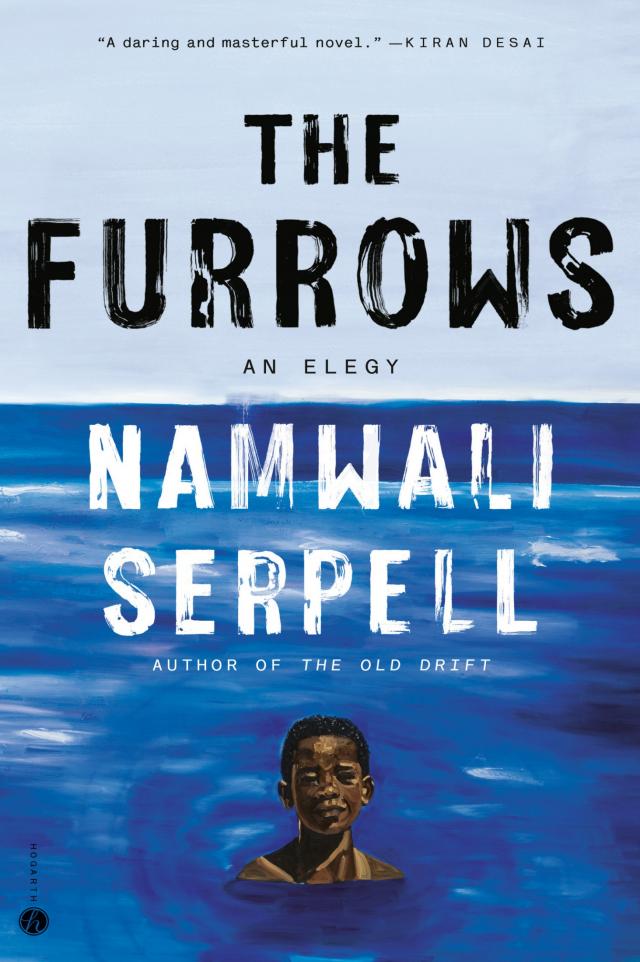
Cover art: © 2021 by Jerrell Gibbs, courtesy of Mariane Ibrahim
ep_prh_6.0_140999378_c0_r0
Contents
Cover
Title Page
Copyright
Epigraph
Part I
Chapter 1
Chapter 2
Chapter 3
Chapter 4
Chapter 5
Chapter 6
Chapter 7
Chapter 8
Chapter 9
Chapter 10
Chapter 11
Chapter 12
Passing
Part II
Chapter 1
Chapter 2
Chapter 3
Chapter 4
Chapter 5
Chapter 6
Chapter 7
Chapter 8
Chapter 9
Chapter 10
Past
Palace
Dedication
Acknowledgments
Also by Namwali Serpell
About the Author
…people do not die for us immediately, but remain bathed in a sort of aura of life which bears no relation to true immortality but through which they continue to occupy our thoughts in the same way as when they were alive. It is as though they were travelling abroad.
—Marcel Proust, In Search of Lost Time: The Fugitive (1925),
trans. C. K. Scott Moncrieff and Terence Kilmartin
1
I don’t want to tell you what happened. I want to tell you how it felt. When I was twelve, my little brother drowned. He was seven. I was with him. I swam him to shore. His arms were wrapped around my neck from behind, his chest on my back, his knees pummeling my thighs. At first, his small heavy head was on my shoulder, and he breathed in my ear, the occasional snort when water came in. His head bounced. My shoulder ached. His hands were knotted at my collarbone and I held them there with my hand, both so that he wouldn’t let go and so that he wouldn’t choke me. With my other hand, I pushed the water away.
We had gone to the beach for the day, just the two of us, alone together. This was allowed. This was our whole summer. Our family lived in Baltimore, or in the suburbs really, a place called Pikesville. When June came and set us free from school, and set my father free from his job teaching chemical engineering at Catonsville Community College—my mother was a painter, so she was always free—we would drive three hours down to Delaware, to a town near Bethany Beach, where every year we rented the same narrow gray house with a skew porch out front.
Every morning, after breakfast and cartoons, my brother and I would leave our father to edit his articles and our mother to dab at her paintings. Wayne and I would change into our still-damp swimsuits and I would pack us Capri Suns and Lunchables from the fridge. We would walk along the roads, cutting through a gap between the fancier houses to reach the beach. My mother had told us that the gap was called No Man’s Land, which Wayne misheard and took to mean it belonged to a man named Norman. We’d sneak quietly through Norman’s Land, then tromp over the boardwalk, our flipflops knocking against it, and find our favorite spot on the shore, which was marked by clumps of sea grass.
Wayne was a nutty brown, a scrawny creature, a good kid. He played so hard, as if play were work. I was too old to play, so I watched him play, and helped sometimes. That day, I buried him for fun’s sake. We dug a shallow trench with cupped hands, like dogs, like gardeners. The topsand was cane sugar, the undersand brown sugar. When the trench was big enough, he tumbled into it and I packed the sand onto his body, patpatting it over his hands and over his bony knees. Under the fluorescent sun, he lay still as a magician’s assistant.
He asked me to cover his head with our straw hat and I said, “No, you’ll suffocate!” He flinched, as if to grab for it himself, then remembered that his hand was buried. Too late: the mound of sand over it had sprouted a crack. He glanced at it, at me. I patpatted the sand back flat. After a moment he said it again, he mouthed, Cover. My. Head. I touched my sandy finger to his sandy cheek. “Close your eyes, Wayne,” I said, and placed the straw hat over his squinching face.
I had stolen that hat from a fruit vendor before Wayne was born, when he was still in the womb. Our mother, pregnant and craving, was buying a pear at a stand at a farmers’ market. The hat was rolling at the fruit vendor’s feet like tumbleweed. It beckoned me and so I picked it up and put it behind my back, switching it quickly to my front when we turned to leave. My mother didn’t notice until a block later. She twisted my earlobe till it stung and hissed, “It’s too late to give it back now, you little twit!”
Although our family had owned the straw hat for many years now, it was still too big for either of us kids to wear. We used it for carrying things instead, its leather chinstrap serving as a handle. We had used it today to bring lunch and a towel. Now it swallowed his head completely.
“You’re a dead Mexican,” I giggled.
“Olé!” he muffled from under the hat.
“I mean cowboy,” I said.
“Ahoy!”
“That’s a sailor.”
There was a pause. “Yeehaw!” he said.
I didn’t answer. I didn’t laugh. I walked away from his buried body, staggered off into the sand pockets toward the greenish sea, bored but deeply satisfied that he would be surprised to find me gone when he lifted that dumb hat off his face. My turn to trick him for once.
My toes were already wet by the time he realized I was gone. He leapt up and tossed the hat and gangled his way toward me. Yelling pellmell, splummeshing past me into the water. I watched his bronze back vanish, then retreated and sat beside the empty trench with my arms around my knees. There was no one else around. It was bright and hot, the end of summer. Then the clouds came and lowered. The wind rose. The waves rose.
* * *
Dear Wayne. You swam into the furrows. At first, you didn’t know it because you were under the surface and you faced down as you swam, staring at the vault of the sea below. Then you felt the sky darken above you, a shadow passing, and when you came up to breathe, you were suddenly inside them, the great grooves in the water, the furrows. On either side of you, those whirring sheets of water, the foam along their edges sharpening like teeth. On either side of you, the furrows chewing, cleaving deeper. They ate you up. You were alone out there and the world took you back in, reclaimed you into its endless folding.
* * *
He was joyful and swimming and then he wasn’t. I ran in. I swam to him. I reached him and we grappled some until he managed to get on my back and wrap his arms around my neck. I held his knuckles in my hand. I turned and swam us to shore. He dragged me back. Halfway to the beach, his small heavy head began to beat against my shoulder in an unreasonable way. That was the word I thought: unreasonable. A word our father would say. I knew to hold my breath and dive through the waves like our mother had taught us. But what about Wayne? Did he remember to dive, to hold his breath? There was no breath in me to ask or remind him.
The wind whipped. I clutched his knuckles like a junk of bones in one hand, pushed the water away with the other. We rocked, his knees bumping the back of me, his head knocking my shoulder in that unreasonable way. It made no sound, but they found bruises later. I felt him soften and something inside him came into me then—ssth, ssth, ssth—came into me in little waves. More and more ripples until it was done and my insides felt full up—his body swept clean of him, mine filled to bursting. I swam like this, doubled, an emptied sack on my back, my fingers raw with clutching.
* * *
—
I woke up on the beach alone, on my back, sputtering, my throat raw. I turned my head and puked, mostly lacy water. Puking didn’t hurt; it was a comfort. Water sucked at my feet, intermittent, insistent. I was confused about exactly how naked I was; my swimsuit was tangled in the crevices of my body. There was seaweed stringing my arms, and the grit of sand and salt disturbed my sense of my skin, its limits, where it began and ended. Exhaustion crowded me, from the top of my head all the way down my back. Pain, the throbbing in my head and my shoulder, made me rise onto my elbows and look around. Everything was blurry until I cleared the coves of my eyes.
I couldn’t figure out where I was. There were black stones studding the shore, a trail of them leading to a bristling cluster of grass. Just past that, maybe twenty yards away, I caught a glimpse of a dark form flung on the sand. It was bent, obscenely bent. The sea tugged at it. I stared at it. Was it my brother? His arm? His leg? All of him? It could’ve been a tree limb. Panic beat inside, for me, for him, for me, for how far apart we were. I watched the bent thing being dragged into the water. I watched it disappear into the sea’s frothing mouths; I saw it bobble up once and then go. I didn’t move, or couldn’t.
I woke up on the beach alone and figured out that I had blacked out again. I was shaking fiercely. I turned to look out at where I had seen my brother but there was nothing but smooth sand now, and those stones dot-dot-dotting over it. I tried to get up but I couldn’t. I curled slowly onto my side, grit grinding grit all over me. Rain came and went, waves came and went, shouting hoarsely at one another.
I don’t know how much time passed but when I opened my eyes, there was a head blocking the gray sky above me: a bizarre alien head, too big. I recognized the shape of our straw hat. Was this man wearing it? For some reason, I thought that if he had found our hat, then my brother, whose body I’d seen rolling in the surf, must truly be dead.
“Where’s Wayne?” I asked the man.
The man turned and pointed to where I’d seen that bent form. Then he shook his alien head and yelled into the wind, which ate the words right out of his mouth. He leaned closer. He was white, in his forties or fifties, wearing a skyblue canvas windbreaker. I remember seeing his lips form the word “home” and how he mimed gestures of politeness—“Can I touch you?” expressed with a pat, a questioning look—before he lifted me up. I remember the steady leverage under my shoulders and knees, then a heavy tottering momentum over the sand, the rain pattering my face, the wind galling my ears.
The man put me in the backseat of a car. My eyes opened briefly when he asked where I lived and I saw the light embedded in the roof, a square. The storm was loud, then quiet—he had shut the door. He drove to the address I’d given. I knew we’d arrived because of the cold and the noise that came in when the car door opened.
Time stuttered again and my father came in through the front door, snapping an umbrella shut with a burst of rain spray. He saw me sitting alone at the bottom of the stairs, wet and sandy, trembling in my swimsuit, my shoulders draped with a stranger’s windbreaker.
“Hey, baby. Rough out there. You get caught in it?” He smiled and frowned at the same time. “Where’s Wayne?”
* * *
Later, he said I told him what had happened. It must have been incoherent, inconsistent, perhaps self-contradictory. I have since pieced together, for example, that in the early days, I didn’t always mention the bent thing I saw being pulled into the water, and what I said about the windbreaker man varied enough with each telling to rouse suspicion. I don’t even remember that first telling.


