

On morrison, p.1
On Morrison, page 1


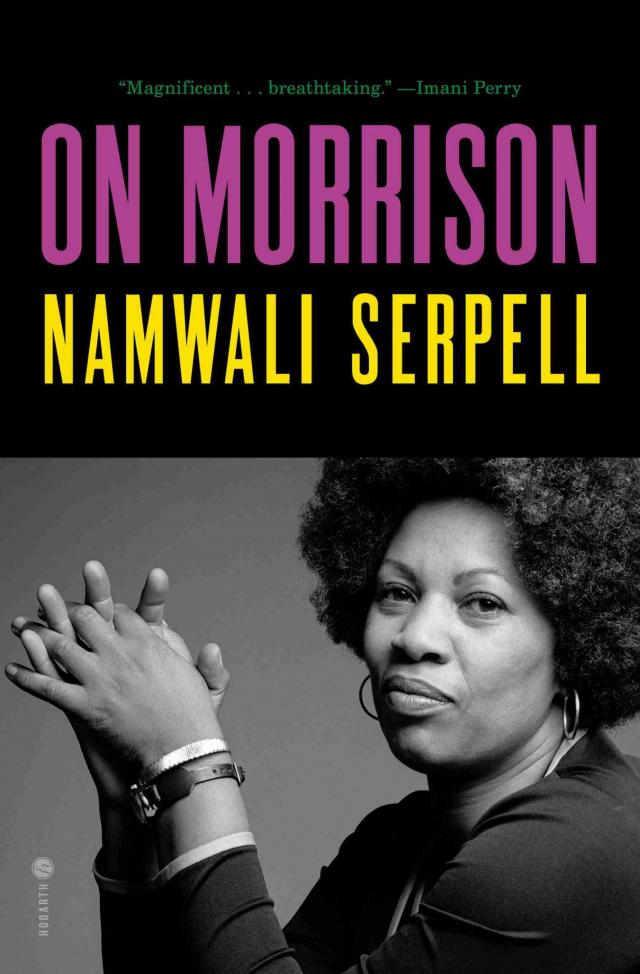
By Namwali Serpell
On Morrison (2026)
The Furrows (2022)
Stranger Faces (2020)
The Old Drift (2019)
Seven Modes of Uncertainty (2014)
Hogarth
An imprint of Random House
A division of Penguin Random House LLC
1745 Broadway, New York, NY 10019
randomhousebooks.com
penguinrandomhouse.com
Copyright © 2026 by Namwali Serpell
Penguin Random House values and supports copyright. Copyright fuels creativity, encourages diverse voices, promotes free speech, and creates a vibrant culture. Thank you for buying an authorized edition of this book and for complying with copyright laws by not reproducing, scanning, or distributing any part of it in any form without permission. You are supporting writers and allowing Penguin Random House to continue to publish books for every reader. Please note that no part of this book may be used or reproduced in any manner for the purpose of training artificial intelligence technologies or systems.
Hogarth is a trademark of the Random House Group Limited, and the H colophon is a trademark of Penguin Random House LLC.
Library of Congress Cataloging-in-Publication Data
Names: Serpell, Namwali, 1980– author
Title: On Morrison / Namwali Serpell.
Description: London; New York, NY: Hogarth, [2026] | Includes bibliographical references and index.
Identifiers: LCCN 2025032668 (print) | LCCN 2025032669 (ebook) | ISBN 9780593732915 hardcover | ISBN 9780593732939 ebook
Subjects: LCSH: Morrison, Toni, 1931–2019—Criticism and interpretation | American literature—Women authors—History and criticism | American literature—African American authors—History and criticism
Classification: LCC PS3563.O8749 Z8545 2026 (print) | LCC PS3563.O8749 (ebook)
LC record available at https://lccn.loc.gov/2025032668
LC ebook record available at https://lccn.loc.gov/2025032669
Ebook ISBN 9780593732939
Book Team: Production editor: Cindy Berman • Managing editor: Rebecca Berlant • Production manager: Jane Sankner • Copy editor: Sue Warga
Book design by Ralph Fowler, adapted for ebook by Arienne Dinh
Cover design: Jaya Miceli
Cover photograph: Dwight Carter
The authorized representative in the EU for product safety and compliance is Penguin Random House Ireland, Morrison Chambers, 32 Nassau Street, Dublin D02 YH68, Ireland. https://eu-contact.penguin.ie.
ep_prh_7.3a_155077259_c0_r0
Contents
Dedication
Epigraph
On Difficulty
1. Nobody Knows The Bluest Eye
2. Naming Sula
3. Signifying on Song of Solomon
4. Tar Baby’s Masks
5. Misreading “Recitatif”
6. Beloved’s Possessions
7. Jazz, Now
8. Reckoning with Paradise
9. Playing in the Shade
10. A Mercy and Other Reprisals
On Monuments
Acknowledgments
Notes
Index
About the Author
Appendix: Image Description
_155077259_
for Jesse
Critics generally don’t associate black people with ideas.
—Toni Morrison
On Difficulty
There are many ways to be difficult in this world. You can be demanding, inconvenient, stubborn, complicated, troublesome, baffling, illegible. Black womanhood is one place where all these forms of difficulty overlap. I have always known this; I have been called difficult more times in my life than I can count. But I only began to understand, to discover the meanings and uses of my own difficulty, because of Toni Morrison.
Morrison has shaped the way we think about everything from literature to politics to criticism to ethics to the responsibilities of making art. But the facts remain: She is difficult to read. She is difficult to teach. Notwithstanding the voluminous train of profiles, reviews, and scholarly analysis that she drags behind her, she is difficult to write about. More to the point, she is our only truly canonical black, female writer—and her work is highly complex. This, it seems, is difficult to swallow.
The very fact of Morrison—a black woman and a genius—has been, to some people, simply an affront. In 1979, she was interviewed for two major profiles, one in The New York Times and one in Vogue. At that point in her career, she was the author of three novels, her most recent, Song of Solomon, having won the National Book Critics Circle Award for 1977.
One might expect an aura of celebration, but the Times profile instead had this oddly truculent tone:
She is, at 48, a big, handsome woman with beginning-to-gray hair. She is often breathless, often running, often (I was to learn) late…. Her defensiveness was palpable. I would soon learn that she is a woman of many moods. Not just ordinary moods: abrupt, seismic shifts, as if the energy within were caught between opposite poles—the need to express and the need to defend. She will often put on an act. In conversation, she might suddenly “get down” and be very chicken-and-ribs, sucking her teeth, poking a finger into her scalp and scratching—a strange, primitive gesture that makes her hairdo rock back and forth on her scalp like a wig. It’s not difficult to get the impression that she’s putting you on, at times, taking pleasure in watching you try to figure her out.
Putting aside the casual racism of the time (and the Times), what strikes me is the interviewer’s palpable resentment about the myriad ways in which Morrison was difficult: late, defensive, moody, abrupt, performative, “strange,” “primitive,” manipulative, implicitly sadistic. What seems to have irked the interviewer most of all was her impression that Morrison actively enjoyed being difficult.
In the other profile, in Vogue, Morrison spoke of a white American reader who had “told her how difficult it was to understand black culture in her books—it was so removed from his experience.” She had responded: “Boy, you must have had a hell of a time with Beowulf!” The Vogue interviewer, missing the wit in this retort, went on to comment: “Morrison has no patience with people who plead ignorance; but then, she does not pride herself on being a patient woman. ‘I find myself being more and more difficult,’ she says. ‘It’s something I really relish.’ ” Even Morrison’s literary difficulty and the pleasure she took in it was translated here into personal difficulty, a moral failing: How dare she be impatient! Well, wouldn’t you be?
One reason for Morrison’s air of pique was surely the strain of trying to balance the demands of multiple careers simultaneously. She was an editor, a professor, a writer, a critic, and a public intellectual. I have worked in these worlds as well, but not for nearly as long and rarely at the same time. To bolster my spirits, I often recite her words about how these professions are really all one thing: “I read books. I teach books. I write books. I think about books. It’s one job.”
But extending many branches is sometimes a way of distracting yourself from the exigency of the core vocation. The commitment to writing over all else is often viewed by detractors as selfish; when gender is factored into the equation, the charge can carry the stigma of illegitimacy. “For a woman to say, ‘I am a writer’ is difficult,” Morrison noted succinctly.
She struggled to accommodate these forms of often underpaid literary labor with the unpaid domestic labor of raising two sons as a single mother: “It was very difficult writing and rearing children because they deserve all your time, and you don’t have it.” This occupational difficulty was exacerbated not only by the fact that she was unique in her fields but also by the fact that she often chose to go it alone.
For example, she didn’t tell anyone at her first job in trade publishing that she was writing a novel until The Bluest Eye came out at another house. And it is notable that not one of Morrison’s sole-authored books has an acknowledgments page.
While autonomy was indispensable to Morrison’s success in her professional life, it was also a source of trouble within it. Her longtime editor, Robert Gottlieb, who is the person who gave her permission to be a writer when she grew up, as she put it, once said: “Toni appears to be such a formidable person, and is such a formidable person, that people assume that working with her could be difficult. It’s exactly the opposite.” But his view seems to have been the exception that proves the rule.
Dana A. Williams’s recent book Toni at Random, a fascinating overview of Morrison’s own editorial work, divulges the clashes Morrison had with her (mostly white) colleagues and her (mostly black) authors over the years. Williams generously refers to some of Morrison’s more cutting remarks as signifying, a black art form of insult that prizes accuracy over tact. But there’s no mistaking Morrison’s arch tone in her correspondence with her authors.
She wrote to one who had accused her of racism: “I will probably always be befuddled about what you imagine this publishing company to be and about your reasons for ascribing sinister motives to a copyediting mistake.” She teased a sculptor venturing into poetry for the first time, noting drily, “This is a commercial house historically unenchanted with 500 slim volumes of profound poetry that languish in stockrooms,” and writing more sharply in a follow-up letter draft: “If you wanted an anonymou s, plain, uneventful recessive jacket you should never have come to this publisher. The only time that works is when the poet is very well known—as a poet. You are not.”
When it came to playing well with others as a critic, we need only consider the series of angry letters to the editor in The New York Times about Morrison’s review in 1971 of an anthology, To Be a Black Woman, which was edited by two men and which she had faulted for its sexism. And when it came to Morrison as a collaborator, there are the various slings and arrows of outrageous misunderstanding between her and the white producers of her play Dreaming Emmett.
As troublesome as it may have been for her professionally, she seemed genuinely to delight in the difficulty of other black women artists such as the black jazz pianist and composer Mary Lou Williams; for Morrison, it was a sign that they had insisted on being taken seriously. Being taken seriously is of course what most artists want, though for obvious reasons, it does not always need such insistence. Part of my project in this book is to show you how to read Morrison with the seriousness that she deserves. To do so requires that we account for the knot—or bind—of gender and race that she and I share.
It is not an easy one to untangle. As Morrison wrote in a 1971 New York Times op-ed, in order to recognize feminism’s elisions and delusions about race, “one must look very closely at the black woman herself—a difficult, inevitably doomed proposition, for if anything is true of black women, it is how consistently they have (deliberately, I suspect) defied classification.”
Let me begin by looking very closely at Morrison herself, at how her own deliberate difficulty—personal, political, and literary—defied classification…and made for brilliance. Difficult, doomed propositions are our forte, after all.
* * *
Morrison’s childhood stories read like photonegatives of the standard American race narratives. She spoke of her black father’s “defensive racism,” which prompted him to throw a predatory white landlord down the stairs. She spoke of her mother’s insistence on integrating every new movie theater in town. She spoke of how when her “pitch-black” great-grandmother had first set eyes on Morrison and her sister, she said the girls had “been tampered with,” which was meant racially: “We were not pure and she was.” And she spoke of growing up in an ethnically mixed, working-class town in the Midwest, which meant that she experienced paper-bag–test colorism for the first time only when she arrived at Howard University in the 1950s. It struck her as “silly.”
I identify with Morrison’s sense of remove about the usual racial logics. The dynamics of my mixed-race family didn’t match the norms, either. My Zambian grandmother, for whom I’m named, initially disapproved of my mother’s decision to marry a white man; my mother's older sister refused to attend the wedding. Our moves to the United Kingdom and then to the United States when I was a kid—followed by a year back in Zambia when I was a teenager—were punctuated by moments of racial absurdity. Everywhere we went, I got the same ridiculous questions: “What are you? Black or white?” (As if I had a choice!) Yet even now, at my grown age, my first response to racism is surprise.
Despite our respective births in disparate times and places (Lorain, Ohio, in 1931; Lusaka, Zambia, in 1980), I think Morrison and I both lucked into the strange privilege of zooming out from or boomeranging around race. This perhaps explains why neither of us, for example, tends to capitalize the word black when referring to people in our writing. It concedes too much; it protests too much.
I would argue that Morrison’s other counterintuitive political takes as a public intellectual arose from what we might call this insider-outsider’s view. Take her famous quote:
The function, the very serious function of racism…is distraction. It keeps you from doing your work. It keeps you explaining, over and over again, your reason for being. Somebody says you have no language and so you spend 20 years proving that you do. Somebody says your head isn’t shaped properly so you have scientists working on the fact that it is. Somebody says that you have no art so you dredge that up. Somebody says that you have no kingdoms and so you dredge that up. None of that is necessary.
Apart from being solid advice about how to save time, this is essentially a description of structural racism—and Morrison was making it in 1975. Racism isn’t a bunch of bad ideas or personal opinions we ought to persuade people to relinquish. It is a political ideology with a function.
Morrison’s way of making us reflect on race was always dialectical, in multiple senses. She often turned questions back on her interviewers, forcing them to interrogate their own premises. When Charlie Rose asked her how she dealt with everyday racism, she responded:
Let me tell you, that’s the wrong question…. How do you feel?…Don’t you understand that the people who do this thing, who practice racism, are bereft, that there’s something distorted about the psyche? It’s a huge waste and it’s a corruption and a distortion. It’s like a profound neurosis that nobody examines for what it is. It feels crazy, it is crazy, and it leaves—it has just as much of a deleterious effect on white people and possibly equal that it does black people. I always knew I had the moral high ground. All my life.
Note the reversals. The question is questioned, as is the questioner; superiority and inferiority are swapped; racism’s neurosis belongs to the racist; the moral high ground is with racism’s victim, who disdains victimhood anyway—“I’m not a victim. I refuse to be one,” Morrison went on to say.
In the same interview, she staged a scathing mock trial of an imagined white racist: “I take your race away, and there you are, all strung out. And all you got is your little self, and what is that? What are you without racism? Are you any good? Are you still strong? Are you still smart? Do you still like yourself?” Here, the self-doubt that is presumed to split the black mind into a pathological double consciousness is redirected to the racist’s “little self.”
And American racism—which ever since W. E. B. Du Bois’s question in 1897, How does it feel to be a problem?, has been presumed to be a black burden—is returned to sender. “If you can only be tall because somebody is on their knees, then you have a serious problem,” Morrison concluded. “And my feeling is that white people have a very, very serious problem and they should start thinking about what they can do about it. Take me out of it.”
Morrison often articulated her political beliefs in this roundabout way—considering things from another angle or from a distance—to powerful rhetorical effect. This is how she argued, for instance, that writers should unionize in her keynote speech at the 1981 American Writers Congress:
We have to stop loving our horror stories. Joyce’s Ulysses was rejected fourteen [sic] times. I don’t like that story; I hate it. Fitzgerald burned out and could not work. Hemingway despaired and could not work. A went mad, B died in penury, C drank herself to death, D was blacklisted, E committed suicide. I hate those stories. Great works are written in prisons and holding camps. So are stupid books. The misery does not validate the work.
Her call for “protection in the form of structure: an accessible organization” came from looking at the “romanticized” individualism of the starving artist in the turret from the other side.
She did strongly believe in one individual right, however: Morrison was a free speech absolutist. She worked for years with PEN to speak out against censorship of all kinds, and she thought it was absurd to ban racist books or cut the word nigger from literary works. She accounted for this view in an unexpected way, too: it was precisely because she was black that she wouldn’t stand for it.
In a 1982 interview for a PEN event, she calmly explained, between drags on her cigarette: “I come from a race of people for whom at one time in this country…it was illegal and punishable by physical punishment and sometime fatal punishment to learn how to read.” She pointed out that those who had made it “a criminal act for black people to read are the ancestors of the same people who are making it a criminal act for their own children to read.”


