

Crossing the bridge, p.1
Crossing the Bridge, page 1


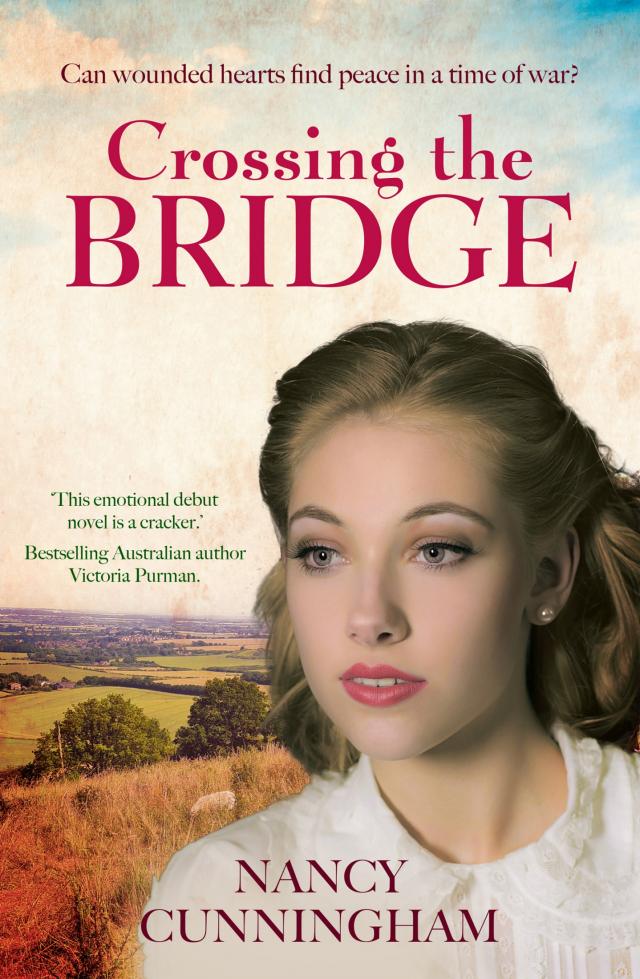
Crossing the Bridge
Nancy Cunningham
www.romance.com.au
Crossing the Bridge
Nancy Cunningham
Can two wounded hearts find peace in a time of war?
1944. Widow Poppy Guilford is fighting to save her farm, the one thing tethering her to her husband—and the legacy promised for their young son. But a devastating secret from her husband’s past threatens to derail her struggle to save the property and keep her son by her side.
Former soldier JB Beaton’s wartime injuries and personal losses have left him with scars, both inside and out. Believing he’s too damaged to be the father his son deserves, he leaves him with his sister and takes on a job as a farmhand, far away from the city and his failures.
Poppy, battling the elements and the heartache caused by her husband’s secret, finds the new farmhand is never far from her thoughts, and JB’s world is thrown into disarray by one of the most beautiful and capable women he has ever met. Neither can fight the surge of attraction they both feel.
In a small town where gossip reigns, will they surrender to duty or follow their hearts?
‘You’ll be cheering for this wartime Australian heroine well before the last page as she fights to find her voice, her feet and love after heartbreak. Nancy Cunningham’s emotional debut novel is a cracker.’ —Bestselling Australian author Victoria Purman.
About the author
NANCY is a writer from Adelaide, South Australia, where she lives with her tech-savvy partner (and real-life hero), her book-obsessed, gorgeous curly-haired daughter, and Molly, the greyhound. When not writing fiction, Nancy works as a research scientist in entomology and specialises in historical insect curation and scientific writing.
Novels, short stories, TV, movies, video games, songs, and poetry have inspired her to write stories in genres from historical to romance to crime and science fiction to short literary fiction. But 20th Century historical fiction and romance is where her writing heart really lies, especially stories involving stoic heroines of the past overcoming adversity and finding love.
Her debut novel, Crossing the Bridge has been a winner and finalist in several awards, including the prestigious Valerie Parv Award and the Romance Writers of America West Houston ‘Emilys’, and was longlisted for the Romance Writers of Australia Emerald Award in 2020 and the Sapphire in 2021. In 2020 it also won the CYA All-Stars Conference Unpublished Adult Manuscript prize.
Find out more about Nancy here:
Website: https://nmcunningham.com/
Facebook: https://facebook.com/NancyMCunningham197
Instagram: https://www.instagram.com/nan_writes/
Acknowledgements
I would like to acknowledge the Kaurna people, custodians of the Adelaide region, on whose lands I lived while writing this book. I respect their spiritual relationship with their country.
The township of Goyders Creek is fictional but is loosely based on the historic town of Burra in South Australia’s mid-north. I would like to acknowledge the Ngadjuri people as the custodians of the land on which this novel is set and pay my respects to their elders past and present.
I’d like to thank American author KT Fawcett, whose encouragement kept me going when I first thought I might make a go of this being an author business and was kind enough to read the first draft of Crossing the Bridge before I knew what I was doing.
To author Victoria Purman, whose Writers SA course I attended in 2017 and who told me to join the Romance Writers of Australia—the best decision for my writing career I have ever made. I’d also like to thank Victoria for her ongoing mentorship and encouragement through the Manuscript Incubator Program Graduates’ group, and to Tanya, Deb, Shannon, Lisa and Elizabeth, for sharing the journey with me. I’d also like to thank Victoria for the awesome and tear-inducing (in a good way!) cover quote for Poppy and JB’s story!
Being a writer is supposedly a solitary pursuit, but I have found a rich community of fellow authors to share the journey with. I couldn’t have done this without the support of the Romance Writers of Australia, Writers SA, South Australian Romance Authors and the Not so Solitary Scribes group.
Shout-outs to:
My first aspiring author buddies Davina Stone and Kristin Silk, and to Dannielle Line for her awesome steerage of the Romance Writers of Australia aspiring group. To my fellow aspiring beta readers for Crossing the Bridge, Renae Black, Vicki Milliken, Simone Abbot, Victoria Brown and Tegan Whalan, you really helped me smooth out all the creases!
To my personal writerly cheer squad and 20th Century Historical fiction writer buddies—the amazing Historical Superstars, Clare Griffin, Ava January and Sarah Fiddelaers. You have made this writing journey a special one—I have laughed, I have cried and I have enjoyed every minute in your company; your support has been extraordinary. A special shout-out to Clare who read the latest draft of Crossing the Bridge, and helped me whip it into its best shape for submission!
To my family: Tony, you are my love and the best ideas man to have by my side, and to my darling Jess, one day you might read my work and think ‘that’s not too bad, Mum’. To Janice, Stuart, Nigel, Deb, Martin, Declan, Renae, Ali, Juliet and Celeste, thank you for loving me and supporting me and my writing.
To my friend Flo (Jo) for encouraging me to keep fit as I spend most of my days glued to my chair at my desk and to the Mother Nurture girls, Sarah, Jay, Michelle, Terrena and Saskia, thanks for the laughs (and the drinks!)
To the HarperCollins Australia Escape Publishing team who gave Crossing the Bridge a chance, especially Suzanne O’Sullivan, Rachael Donovan, Jo Mackay, Pauline O’Carolan and Vicky Struthers.
Finally, to my mum and dad, Jessie and Robert, although you are no longer here, you gifted me dreams and the ability to realise them.
To anyone else who helped along the way and I’ve not mentioned by name—I haven’t forgotten you. Thank you for being part of my writing journey!
For Tony and Jess, my biggest loves.
(Yes, a wombat made it into the final draft!)
Contents
About the Author
Acknowledgements
Chapter One
Chapter Two
Chapter Three
Chapter Four
Chapter Five
Chapter Six
Chapter Seven
Chapter Eight
Chapter Nine
Chapter Ten
Chapter Eleven
Chapter Twelve
Chapter Thirteen
Chapter Fourteen
Chapter Fifteen
Chapter Sixteen
Chapter Seventeen
Chapter Eighteen
Chapter Nineteen
Chapter Twenty
Chapter Twenty-One
Chapter Twenty-Two
Chapter Twenty-Three
Chapter Twenty-Four
Chapter Twenty-Five
Chapter Twenty-Six
Chapter Twenty-Seven
Chapter Twenty-Eight
Chapter Twenty-Nine
Chapter Thirty
Chapter Thirty-One
Chapter Thirty-Two
Chapter Thirty-Three
Chapter Thirty-Four
Chapter Thirty-Five
Chapter Thirty-Six
Chapter One
August 1944, South Australia
To Poppy Guilford, the township and district of Goyders Creek was like a coat—heavy with history and the memories of past lives. She’d worn that coat for the last eleven years and it was no longer discernible from her own skin, one she couldn’t shed and leave hanging on a hook by her front door.
Poppy tapped her watch and gazed along the white acacia-lined street filling with people. The butcher, the general store and the tea room bustled with patrons, in and out their doors like bees visiting a hive. Her eight-year-old son Glenn scraped a stick along the crumbling bluestone kerb, the gutter full of dried mud despite the cloudless sky.
‘I’m bored. How long do we have to wait for Aunt Ronnie?’
‘The bus should be here soon.’ Why hadn’t Ronnie come on the train yesterday like Poppy had asked? She’d been awfully secretive of late. What was so urgent that it had kept her in Melbourne for an extra day? Surely the farm and its business were important to her too.
Her lungs shuddered with a draught of cold air and she recoiled at the sudden waft of pungent pipe tobacco assaulting her nostrils.
‘Morning, Mrs Guilford.’ Paul Jennison, one of the general store owner’s sons said.
She clutched her arms to her chest. ‘Oh, good morning, Paul.’
‘You waiting on someone?’
‘Yes.’
He raised his brow as if expecting her to continue, but she smiled and remained silent.
‘Going to the afternoon tea today?’
‘We’ll be there. Serving tea.’ If she gave short answers, maybe he’d go back into the store and leave her alone. A good Christian shouldn’t have such uncharitable thoughts, but she couldn’t help it, not when it came to Paul Jennison and his brother Alfie.
‘I’ll make sure to stop by at the stall. Nothing like a cuppa from the lovely ladies of the CWA.’ He nodded and walked away.
Poppy shivered and knitted her fingers together. The cracks and the pits in the skin of her hands made by the rough work of many seasons stung in the cool air. How in the last decade had she become someone else? Would unkind thoughts like this have come her way had she remained in Adelaide? Her progression from prim and proper society ingenue to hard-working and hard-done-by farm widow had been a slow and imperceptible change. But in that time she’d grown to love this town and its people—most of them anyway.
The bus finally turned the corner into Market Street and pulled up in front of the post office. Glenn ran towards it and the passengers disembarked. Poppy exhaled. ‘About time.’
Any bus graced with Veronica Guilford’s presence would, of course, be fashionably late. She flowed from the bus steps like a wave in baby blue cotton. Ronnie—for she’d always been Ronnie to Poppy—waved a hand. ‘Dearest!’
Poppy kissed her on both cheeks and forgave Ronnie’s tardiness, relieved to have her here and back in Goyders Creek. With Ronnie’s presence, a lightness ascended through her—reinforcing a connection to family, to her husband Dan and everything the farm meant to her. Their twice-weekly phone calls sometimes weren’t enough.
Ronnie reached forward and grabbed Glenn in an embrace. ‘How is my darling nephew? You look to have grown a foot since I last saw you!’
He pulled away and yanked on the knitted vest already creeping up his body. ‘Mum says I’m four-and-a-half feet now and Uncle Walter says I’m gonna be taller than him!’
‘Is that so?’ Ronnie shot a glance towards Poppy. ‘Been spending a lot of time around Uncle Walter?’
‘Ronnie, please. You’ve only just stepped off the bus.’
‘I can’t help it; I need gossip as much as you country ladies.’
‘There’s no gossip that I haven’t already imparted to you.’ None of which she was aware. Poppy glanced over Ronnie’s immaculate travel clothes. Despite the crowded bus, not a strand of Ronnie’s dark brown hair appeared out of place. Her long lashes, layered with thick mascara, framed her rich brown eyes. She’d even applied a fresh coat of lipstick. Poppy examined her own outfit, an old skirt and matching jacket with the ever-so-slightly frayed pockets. Several wisps of hair tickled her face, and she pulled them back behind her ears.
‘But here I get to live the gossip. Having it all related by phone isn’t the same.’
Poppy couldn’t help but laugh. ‘We’re already late, and I don’t want to delay our meeting with Mr Treloar again. You should be grateful he’d see us on a Saturday.’
‘What can I say? There’s a war going on, and my life is very hectic.’
‘I’m quite aware there’s a war on, Ronnie. Just because it’s quiet here doesn’t mean we’re not affected. The bank—’
‘Oh, the bank, the bank, the bank! Sounds like nonsense to me.’ She handed Glenn her suitcase and put on her sunglasses with a flourish. ‘Are we to walk?’
‘No, Mr Treloar said he’d see us at his house and it’s only a short drive. And it’s not nonsense.’ But this was not the time to argue, and she pushed her berating thoughts aside. ‘Come along.’
They drove from Market Street towards a part of the township near the river; the part filled with the affluence of a previous generation. Big houses on allotments large enough to graze a flock of sheep dazzled with emerald green gardens. And the cars sitting in the driveways were untouched by dust. It was as if this part of town was unaffected by war or the Depression not long past.
Ronnie looked out the window and sighed. ‘What you need is a holiday from this place. Come to Melbourne. I’ll show you a jolly good time.’
‘I’d like that!’ Glenn said.
‘Don’t encourage him, Ronnie.’
‘Why in heavens not?’
‘We just can’t. It’s not a good time. War effort comes first, you know.’ Poppy had never envied her sister-in-law, but lately she’d wanted a different life, one without hardship, without threadbare clothes and callused hands, with music and laughter. She wanted her son at home, not attending school in the city. The war dragged on, and the sameness of every day wore thin at the corners, much like her jacket’s pockets. The boredom was easy to live with if you didn’t spend too much time looking at the horizon for any sign of change.
‘This town needs bringing up to date, doesn’t it? You should see all the development along the Yarra,’ Ronnie said.
‘If you think that would make me say yes to coming to Melbourne, it won’t. A holiday is absolutely out of the question.’
‘Oh, the bloody war.’ Ronnie pulled a compact from her purse and opened it.
Poppy gripped the wheel tight. ‘Please don’t swear.’
Ronnie turned her head from side to side and gazed into the compact mirror. ‘I must admit though, when they’re not fighting, the Americans know how to have a good time.’ She turned and winked at Poppy.
Dan always said Ronnie was only after a good time and frivolous with money. No wonder her quarter of Guilford Farm was left to Dan’s management after their mother’s death. ‘I suppose the stipend helps with all that fun.’
Ronnie snapped her compact shut. ‘Stipend? What on earth are you talking about?’
‘The monthly stipend from Guilford Farm. What else do you think I’m talking about?’
‘I don’t get any money, haven’t for years.’
‘Yes, you do. Five pounds a month is nothing to sniff at.’
‘I get nothing any more. Certainly not five pounds. I decided years ago not to take anything on offer because if I did, Dan would think he had a say in what I did with my life.’ She huffed a laugh. ‘We can talk about Hitler and Mussolini all you want, but if you were ever after railing against domestic tyranny, look no further than your own husband.’
‘Dan was never—’ Poppy bit back her retort. Dan had had a firm grip on everything in their lives, from insisting Glenn go to boarding school in Adelaide after a polio outbreak in the district school, to what Poppy’s activities should be to help the war effort. But now that he was dead, everything lay in Poppy’s lap. They pulled up to the Treloars’ house. ‘Let’s just talk with Mr Treloar.’
‘Do I have to come in?’ Glenn asked.
‘You can stay here in the car. We won’t be long.’ Poppy waggled a finger at him. ‘No mischief.’
They stepped up to the door, twice the size of Guilford farmhouse’s and with ornate fleur-de-lis carvings bordering the top and bottom. Instead of a knocker, there was a doorbell, but its ring was dull and resonant, not shrill like she expected. The Treloars’ maid ushered them into the study. Poppy looked towards the vaulted ceiling where a smoke-like haze glinted with dust motes. A tobacco pipe sat on a silver tray on a desk as large as her dining table. Mr Treloar entered, and Poppy fumbled with her hands to stop them trembling.
‘Mrs Guilford, Miss Guilford. Welcome, please sit.’ Mr Treloar grinned and stood behind the desk. He was tall and lean, and his angled face had a groomed dark moustache peppered with white.
Poppy forced the broadest smile she could manage. ‘Thank you for seeing us on the weekend.’
‘Quite alright. The war keeps us all busy but let’s move this along. In deference to your late husband—’ He paused and nodded towards Ronnie. ‘And brother, and his service as local councillor in the district, we have been very patient.’ He sounded like a schoolteacher reprimanding a pair of errant schoolboys.
Poppy’s lips wobbled when she spoke. ‘I understand, Mr Treloar, but if you can only wait until after the coming harvest, I can make up the difference. I can service the loan. And Ronnie’s stipend ...’
‘I told you,’ Ronnie interrupted. ‘I don’t get a stipend any more. Haven’t in years.’
Mr Treloar sat and glanced between her and Ronnie. He flicked over a paper on the desk. ‘Mrs Guilford, Miss Guilford is correct. The money coming out of your account is not going to her.’
‘See?’ Ronnie said peevishly.
‘It’s not? Well, where’s it going?’
‘Your late husband set up a transaction to be paid into a bank account owned by a—’ He rifled through several more papers in front of him. ‘A Mrs Mary McLaughlin.’
Poppy quizzed Ronnie. ‘Family?’
Ronnie shook her head. ‘I don’t recall a relative named McLaughlin.’
‘Mr Treloar, if the payment isn’t for any services, can we stop it and feed it back into the loan?’


