

Foster dade explores the.., p.1
Foster Dade Explores the Cosmos, page 1


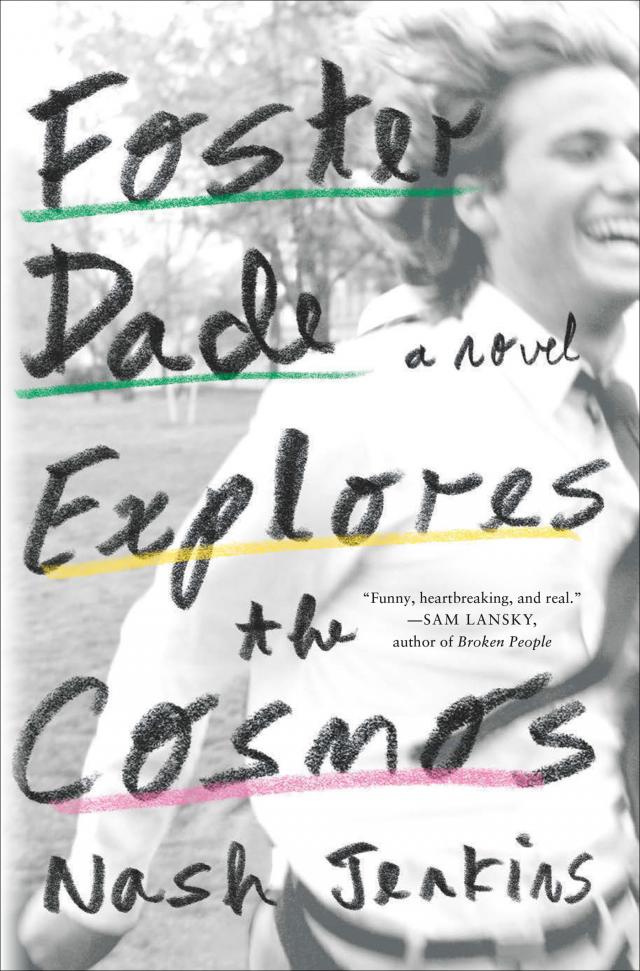
This edition first published in hardcover in 2023 by
The Overlook Press, an imprint of ABRAMS
195 Broadway, 9th floor
New York, NY 10007
Abrams books are available at special discounts when purchased in quantity for premiums and promotions as well as fundraising or educational use. Special editions can also be created to specification. For details, contact specialsales@abramsbooks.com or the address above.
Copyright © 2023 Nash Jenkins
Cover © 2023 Abrams
All rights reserved. No part of this publication may be reproduced or transmitted in any form or by any means, electronic or mechanical, including photocopy, recording, or any information storage and retrieval system now known or to be invented, without permission in writing from the publisher, except by a reviewer who wishes to quote brief passages in connection with a review written for inclusion in a magazine, newspaper, or broadcast.
This is a work of fiction. All of the characters, organizations and events portrayed in this novel are either products solely of the author’s imagination or are used fictitiously. The names of some real people appear, but they are applied to the events of this novel in a fictitious manner.
Library of Congress Control Number: 2022948257
ISBN: 978–1-4197–6476–9
eISBN: 978–1-64700–835–2
ABRAMS The Art of Books
195 Broadway, New York, NY 10007
abramsbooks.com
FOR MOM AND DAD,
FOR SOPHIE, SUSANNA, AND EUGENIA,
AND OF COURSE FOR SLOAN AND JULIE
The boy himself is at once too simple and too complex for us to make any final comment about him or his story. Perhaps the safest thing we can say about Holden is that he was born in the world not just strongly attracted to beauty but, almost, hopelessly impaled on it.
—J. D. Salinger, book jacket synopsis of The Catcher in the Rye (1st edition, Little, Brown and Co., 1951)
And the morning lasted all day
—The Dream Academy
CONTENTS
Preface: September 2019
Part I: August 2008–May 2009
Part II: Summer 2009
Part III: September 2009–March 2010
Part IV: June 2022
Author’s Note
PREFACE
SEPTEMBER 2019
The facts of this case remain disputed. I should start by making that clear, and by emphasizing that the following account will not pretend to resolve certain historical uncertainties. What’s important here—what illuminates and gives shape to the story I am preparing to tell—aren’t the facts but the contours of their dispute. What follows is one topographical survey of these fault lines. In the decade that has passed since the events in question, the loose nebula of half-truths has unfurled under the mythmaking tendencies of time. Clarifying this nebula, I have learned, means only construing its shape; the half-truths are the fibers of its form, and so remain untouched. Acknowledging all of this has helped soothe the unavoidable truth: this is not, nor has it ever been, my story to tell.
They still talk about Foster Dade at Kennedy, though the names of the supporting cast have mostly been forgotten. This is true even of Annabeth Whittaker and Jack Albright. The story as it is told today is less about truth than allegory. I’m sympathetic to these distortions, and will confess that my motivation in pursuing this project is in many respects selfish. It’s probably fair to say that no one else will take the time to curate and organize its pieces, but the simpler truth is that this story has haunted me for the better part of a decade. I suppose I hope that telling it honestly will shake the ghosts off, or at least allow me to understand why they continue to linger. “Honestly,” it should be said, is not the same thing as “accurately.”
The “Adderall ring” had been a misnomer on the media’s part. One lanky towheaded child of divorce does not constitute a ring, no matter how many federal and state lines its distribution network might have crossed. Sheila Baxter, whom Kennedy had poached from Bear Stearns as the school’s communications director in 2005 precisely in anticipation of events like this, had successfully intimidated reporters in the weeks and months thereafter, and the articles that followed were bloated with toothless innuendo and clumsy pseudonyms. There were students who talked to the press on background, against an administrative fiat that carried threat of expulsion.
With no voices on the record to confirm or deny these whispered narrative details, the more principled institutions of the national and New York media—the Times, Vanity Fair—were bound ethically and legally to denature their reporting into broad, colorless parables on adolescent pharmaceutical abuse. Most of these outlets simply dropped the stories and moved on. In September 2010, the Atlantic published a long and strangely glib feature on the role of “study drugs” in these “pressure-cooker country clubs,” but it made only a passing reference to the series of events at Kennedy that had precipitated it. Three months earlier, Gawker had posted direct excerpts of the Facebook chat that would become known across the constellation of northeastern boarding schools as “the Kennedy Thread.” But even Gawker’s editors had the sense to pixelate the names and tiny square profile pictures of the four students who’d written it. Those four, at that point—as their parents’ lawyers made abundantly clear—still enjoyed the legal protection afforded to minors on matters of privacy.
I’ll note here that my own place in this narrative is necessarily peripheral. When I arrived at Kennedy as a new sophomore in the fall of 2010, seven months had passed since Foster Dade had been expelled. The last of the more resolute reporters still sometimes appeared on the porch of Brennan House, where I lived, as if by standing there long enough they might absorb by osmosis the ambient unknowns. I first heard the earliest shards of Foster’s story that October.
There is an untraceable magic to the boarding school ethos, to those hermetic little kingdoms illuminated by the sparkling mythological tendencies of adolescence. This is especially true at night, after 11:00 p.m. lights-out, when boys hustle noiselessly down the hallways into the bedroom of whoever’s been ordained as the nocturnal host. (I was never ballsy or popular enough to be this person; when I showed up, I’d huddle in the corner under the window, enchanted but mostly silent.)
We were still proximate enough to the events surrounding Foster Dade’s expulsion for the truth to be more or less intact, albeit the flexible truth of secondhand accounts. We were Second Years, in Kennedian parlance; my hallmates had been First Years during the events in question, cushioned from direct access to upperclassman politics. The boys a year ahead of us in Brennan tended to regard us with bored disinterest, but every so often a few would join us late at night, and when the conversation turned to the previous spring they seemed to revel in their relative authority. Yet their contributions only seemed to give new dimensional edges to the vastness of the vacancies around it, illuminating the widening chasm between us and this story’s recession into the past.
I would spend my three years at Kennedy in the half-paralysis of my own vague sense of unbelonging, lacking that innate interior alchemy that would allow me to push myself from the ranks of the supporting cast. This was fine, I told myself at the time. I wrote a couple of news stories for the Kennedian and managed to avoid any controversy; I did well enough in my classes to get into a college that has subsequently crept its way into the U.S. News & World Report’s top thirteen. I did go to my five-year reunion this past May, however anxiously, and my classmates told me that I was doing interesting things, albeit with the loosely patronizing surprise reserved for those formerly deemed uninteresting. I am still bitter sometimes, but mostly I covet a wistfulness that was foreclosed to me.
And so I listened that first autumn in silence as mythology found shape in the chasms between and beyond its originating facts, and I began to privately curate what truths I could. The characters in question were at that point just two years above us, but I was wide-eyed enough to see them as somehow older and more transcendent than seventeen: their sex more profound; their travails cast in a certain unintelligible luster of romance. Whether the grim sadness that trailed over them was only the imagined consequence of the stories shared late at night seemed beside the point. I would watch that winter as Annabeth Whittaker and Porter Roth and Sofi Cohen wordlessly made their way into Vito’s, the pizza parlor across the village main street beyond the campus gates, stepping into the yellow light from the cold Wednesday night. I looked for secrets in their faces, chapped and pink from the February wind. I looked for sadness in the way they unzipped their Canada Goose parkas and felt—or at least chose to feel—the wordless friction in the crowded restaurant shift slightly but palpably as they parted it.
As far as mythologies go, the broad strokes of this one aren’t all that unique: Foster Dade had come from Baltimore to arrive on that green campus in the final days of the summer of 2008 and vanished in the same fashion eighteen months later. Jacqueline Franck, a very pretty girl from Greenwich the year above me, would later claim to others that he’d been back on campus the night before his class’s graduation, the year after he was expelled; she suggested that this had been an attempt to see Annabeth Whittaker. More than a few others claimed on supposedly good authority that at that point he was living eight thousand miles away in Hong Kong with Jae-hyun An, possibly operating pseudonymously, the two of them expanding their commercial enterprise with the financial backing of a South Korean crime
With practice, I’ve managed to refine how I explain my project’s motivating logic to those who ask. In October 2018, I got an email from Caren Haas at New York. I was working as a freelancer, and she wanted to see if I’d be interested in contributing to a forthcoming retrospective issue on the previous two decades’ noteworthy prep school scandals. “You went to Kennedy, right—wasn’t something there?” she’d written. Two weeks after I’d replied with the links to the Gawker and Atlantic pieces, the Democrats retook the House, and Caren informed me apologetically that the feature had been upended by a twelve-page profile of a vivacious young progressive from the Bronx who’d ousted the ten-term incumbent in the primary. “Plus,” she wrote, “your story seemed juicy, but we’d never get it past legal—too much there that’s unproveable.”
In this version of things, it was my effort to prove her wrong in the pages of another publication that led to this project’s untenable metastasis. I tell this version because it is preferable to the truth, which is that my earliest notes on Foster’s story predate this assignment by several years. (Two different therapists have politely but unnervingly raised their eyebrows when I’ve disclosed the magnitude of my investment, and from a clinical perspective I can’t blame them, though it’s worth noting that both therapeutic relationships ended shortly thereafter.) I first attempted to write some primordial draft of this story for an undergraduate nonfiction workshop, where I produced what was basically a tortured piece of postmodern memoir, lyricizing rumor and stylizing my own experiences at Kennedy as a proxy for Foster’s.
But the real truth is that I set out on this project long before even then. I would return to my room in Brennan House late at night in my first months at Kennedy and watch the smear of headlights push down Eastminster Road beyond the Meadow, feeling the darkness for solidarity with the faceless lives who populated the whispered folklore. I’d been assigned to a small bedroom by the back stairs on Brennan’s second floor, which looked out onto the House Master’s parking space. The closet by the door was narrow but deep, and one night that winter, I noticed the small door at the base of its rear wall. It resisted my pull at first, its wood swollen by a century of humidity. Inside was a small space, as high and deep as a shoebox and maybe slightly wider, bisected by a shelflike pine plank. On it sat a purple and green SpaceMaker pencil box, similar to the one I’d had in elementary school. I picked it up, and in my BlackBerry’s flashlight I saw its owner’s name written in Sharpie along its edge. Time and friction had smeared and faded the ink, but I could discern the contoured shadows of the words FOSTER DADE.
Except for a broken stick of lead from a mechanical pencil, the plastic case was empty. Over the course of that year, though, other little pieces of flotsam would present themselves from the room’s liminal niches: a Post-it note stuck to the back of a desk drawer with the blue ballpoint-ink words PRIDE AND PREJUDICE PAPER DUE FRI.—FOOTNOTES! bloated and smeared across the blotch of a water stain, the forgotten opaque cap to a tube of Old Spice deodorant along the dusty wall behind the bed; once, beneath the dresser, a Ziploc containing what looked like the chalky eggshell detritus of crumbled pills.
I find credence in the metaphor that avails itself here, however cute. Adolescence is an exercise in coveting what exists just beyond our grasp; it is this inaccessibility that sustains its magic. At sixteen, I saw in the mosaic of these arbitrary artifacts the spectral contours of a life that shimmered precisely in this evasiveness, gesturing to something I could ascertain only in voyeurism. It is here that the story I am about to tell finds both its motive and determining shape: in the collation of relics from forgotten edges; in the exclusion of things left behind. Explaining the account that follows as an overdue piece of journalism on a scandal—as an attempt to report the story that Sheila Baxter so meticulously rendered unreportable in 2010—forgives the basic peculiarity of its endeavor, and at times I’ve believed it myself. Sometimes, late at night, when I find myself clicking through photos of the alumni events I didn’t attend, I’ll pull out my old coffee-stained copy of Still Life with Woodpecker and blink at the last line: It’s never too late to have a happy childhood. And perhaps safer if it isn’t your own.
I will say that I have done my damndest to treat the facts at hand with as much fidelity as possible. I remain somewhat shocked by the availability of many of the relevant primary sources. PDF files of the Kennedian and even the so-called Kennedy thread can be found in unlikely corners of the internet, if you know where to look, or whom to ask. An equally surprising number of secondary characters were eager to testify; that nostalgia may have warped or prejudiced their recollections is itself instructive. Most critically, Foster Dade had deleted his Blogspot that fateful night in March 2010, but a cached version can be found in the annals of the Internet Archive’s Wayback Machine. From these disparate pieces of evidence, I have patched the narrative holes in this story with my own theorizations. I can only tell you that I utilized this license as responsibly as I could.
This is the certainty with which I tell this story: the confident, fabricated truth we retroactively assign to the filmstrips of our youths. The earliest repositories of Annabeth Whittaker’s now-quiet Facebook page exist today as they did almost a decade ago, when I first visited them late one October night in the darkness of my room at school. After Foster’s expulsion, she spent the summer in digital self-exile, but was back online as she entered her last year at Kennedy. Under the earliest pull of the spell that would follow me through nearly ten years of twilights, I arrived at an album of photos she’d uploaded a year and a half earlier. There are times when I’ve returned to these pictures in adulthood, usually after midnight, when the watery May dawn in 2009 they capture seems to pause for a moment in its recession into history. Manhattan is still Manhattan, of course, purple and gilded and ethereal in the spill of spring mornings; the Brooklyn Bridge still rises up over the East River. It’s against these colors of permanence that we find the three teenagers standing there upon the bridge’s pedestrian promenade, their faces lilac with the first light of day. There is Jack Albright, the dark-headed boy, looking back to the camera with the solemnity he’d learned for photographs, and beyond him on the bridge is Annabeth Whittaker, tall and ponytailed, the indecipherable magic that certain boys at Kennedy would still describe years later palpable even in suspended animation.
And there, between them both, is the wheat-haired boy with wide eyes, standing in the clarity of the morning.
If there is a truth to be found in my reconstructions, it is in a fidelity to these images, I think. They deny us certitude in any literal sense, but in its absence we are left to regard the plays of light that dance in the space of what we cannot know. The expressions of those who populate the image betray no absolute confidences. What we have instead is the spill of magmatic silver that bled across the sky of a forgotten May morning, and the way Foster Dade looked up at it.
This is what I do know: Foster’s story is still told at Kennedy, in the dark hours after midnight when adolescence is given a quality of magic and stories like his feel almost religious. Art Tierney is set to retire next year; they’re renaming the tennis courts after him. A childless middle-aged couple lives in the house on Overland Road in Baltimore now, the wife a psychologist and the husband a professor of English at Johns Hopkins. Foster Dade’s old bedroom is the husband’s study. Annabeth Whittaker is engaged to be married.
And the last time I was in New York, on a blustery day two weeks before Christmas, I was sitting in J.G. Melon and saw Jack Albright walking by outside. On his arm was an upright blond Episcopal-looking girl in a quilted Barbour. He did not see me, and I watched him as he continued down Third Avenue. I briefly considered following him down the block. But I stayed put, and he disappeared into the ebbing tide of the crowd. There were questions—so many questions—but I knew already that he would not answer them. In the interest of preserving the mythological luster of this story, I feel they must remain unanswered. There is enough there otherwise.


