

Interface, p.1
Enshittification, page 1


Begin Reading
Table of Contents
About the Author
Copyright Page
Thank you for buying this
Farrar, Straus and Giroux ebook.
To receive special offers, bonus content,
and info on new releases and other great reads,
sign up for our newsletters.
Or visit us online at
us.macmillan.com/newslettersignup
For email updates on the author, click here.
The author and publisher have provided this e-book to you for your personal use only. You may not make this e-book publicly available in any way. Copyright infringement is against the law. If you believe the copy of this e-book you are reading infringes on the author’s copyright, please notify the publisher at: us.macmillanusa.com/piracy.
To my comrades, past, present, and future. It has been an honor.
I will never forgive them for what they did to the computer.
—ED ZITRON
Introduction
It’s not just you. The internet is getting worse, fast. The services we rely on, that we once loved? They’re all turning into piles of shit, all at once. Worse, the digital is merging with the physical, which means that the same forces that are wrecking our platforms are also wrecking our homes and our cars, the places where we work and shop. The world is increasingly made up of computers we put our bodies into, and computers we put into our bodies. And these computers suck.
This is infuriating. It’s frustrating. And, depending on how important those services are to you, it’s terrifying.
I’ve been an internet activist for a quarter of a century, working with the Electronic Frontier Foundation, a digital human rights group that more or less invented the whole idea of digital human rights. I’ve been a United Nations observer and helped draft internet treaties; I’ve lobbied legislatures and agencies in the United States, Canada, Europe, and the United Kingdom. I’ve been through street protests and virtual blackouts.
I’ve never seen anything like this.
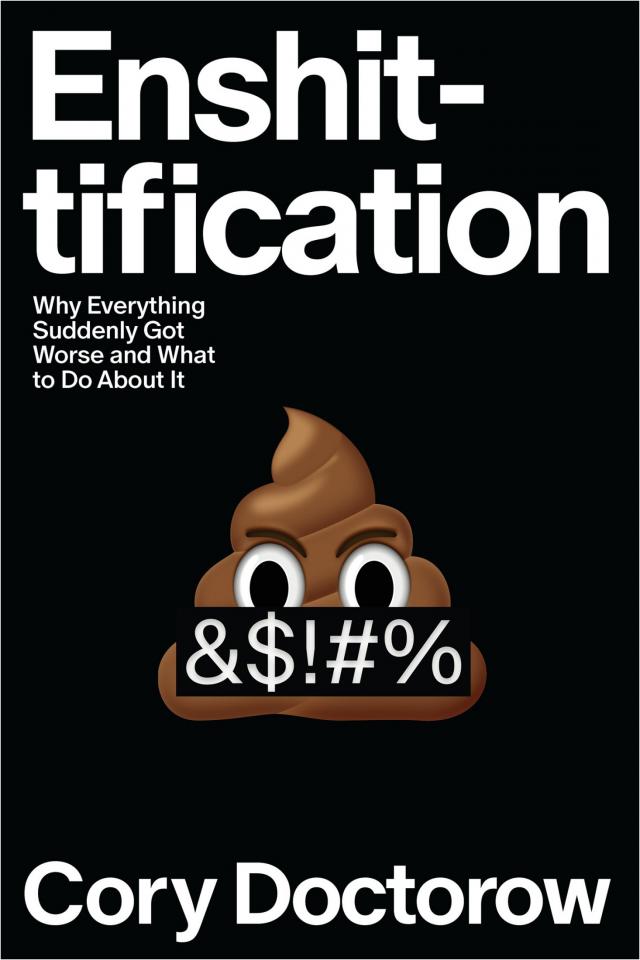
In 2022, after decades of striving to get people fired up about the esoteric world of internet policy, I coined a term to describe the sudden-onset platform collapse going on all around us: enshittification. To my bittersweet satisfaction, that word is doing big numbers. In fact, it has achieved escape velocity.
It’s a funny, naughty word, and it’s funny and naughty to say, and I’m proud of that. But that’s not why the American Dialect Society named it its word of the year in 2023, nor why Australia’s Macquarie Dictionary named it its word of the year for 2024, nor why millions of people have used it to describe the inescapable online dumpster fire that’s roasting them alive.
The reason for enshittification’s popularity is that it embodies a theory that explains the accelerating decay of the things that matter to us, explaining why this is happening and what we should do about it.
Because enshittification isn’t just a way to say “Something got worse.”1 It’s an analysis that explains the way an online service gets worse, how that worsening unfolds, and the contagion that’s causing everything to get worse, all at once.
You see, this moment we’re living through, this Great Enshittening? It’s not a mystery. It’s not the Great Forces of History bearing down on our moment, decreeing that we must all suffer through the end of services that once met our needs. It’s a material phenomenon, much like a disease.
Like a disease, it has symptoms, a mechanism, and an epidemiology. The first part of this book will explain these components of enshittification.
But the point of this analysis isn’t to merely give you a more technically informed way to feel demoralized and furious about the state of the digital world—I wrote this book to propose a cure. That’s the second part of the book.
This era, the Enshittocene, is the result of specific policy decisions, made by named individuals. Once we identify those decisions and those individuals, we can act. We can reverse the decisions. We can name the individuals. We can even estimate what size pitchfork they wear. Or at the very least, we can make sure that they are never again trusted with the power to make policy decisions for the rest of us.
We can make a new, good internet, one that’s fit for human thriving. We can create the digital nervous system we need to connect and coordinate us through a twenty-first century haunted by climate collapse, genocide, authoritarianism, and economic chaos.
We can create enshittification-resistant infrastructure for a new, good world.
Part One
The Natural History
Enshittification infects a specific kind of digital business: platforms.
The term platform gets thrown about a lot. Formally, a platform is a business that operates a two-sided market, that is, a system that connects business customers and end users.
In its purest form, a platform’s value comes from the people and companies that use it, not from anything it brings to the table. The more people there are selling things on an e-commerce platform, the more value that platform holds for shoppers. Likewise, the more buyers there are on a platform, the more value it holds for sellers.
Think of eBay and Amazon, which connect buyers and sellers. Or Uber and Thumbtack, which connect workers and customers. Or Google, which connects publishers and advertisers to searchers. Or Facebook, which does the same but for people who want to socialize rather than search.
The platform has emerged as the endemic form of online enterprise, which is weird, because another word for platform is middleman.
If you’re old enough to remember the early excitement about the coming digital age, you’ll recall how enthusiastic we were about the prospect of disintermediation—that is, cutting out the middleman.
It’s not that middlemen (also called intermediaries, which is where we get disintermediation from) are intrinsically evil. Take books (like this one!): I have worked in printing, bookselling, publishing, and pre-press, and obviously, I also write books. Even though I am knowledgeable and skilled in many of the arts needed to bring this book to you, I voluntarily and enthusiastically work with publishers like Farrar, Straus and Giroux, because they can accomplish this work better than I can, because they offer a fair deal, and because doing so lets me prioritize writing books, which I enjoy much more than doing that other stuff.
Intermediaries are part of the solution to the age-old problem of connecting people with one another—but they become part of the problem when they grow so powerful that they can act as gatekeepers who can usurp the relationship between the two sides of their markets.1
That’s why the early days of the internet were so concerned with disintermediation. We had a sense that our intermediaries had gotten too big for their britches: we were tired of a few big retailers deciding what we could buy, a dozen big publishers and studios deciding what we could read and watch, and half a dozen big labels deciding what music we heard. We’d heard the horror stories of how these big intermediaries treated their suppliers—be they small businesses, creative workers, or manufacturers—and we yearned for a way to cut out the middleman and do business directly with the people who made and did the things we loved, or at least the things we needed.
There was a time when disintermediation seemed to be living up to its promise. Small businesses popped up to supply us with online goods and services, and while some of them were founded explicitly as fast-growing startups with global ambitions, some of the most successful disintermediators—like Craigslist—were basically hobbies that accidentally turned into hugely disruptive businesses, serving as a vessel that people with something to offer and people seeking out those offers could fill up.
But the internet’s early blush of disintermediation faded quickly. Waves of mergers and acquisitions consolidated the internet into “five giant websites, each filled with screenshots of the other four.”2 Meanwhile, the non-tech intermediaries were also consolidating: most of the key sectors of the global economy shrank to five or fewer firms, and the most pronounced consolidation took place with intermediary sectors like shipping and finance. The entertainment industry, too. Remember the early-2000s dream of disrupting the dozen major publishers? Today, there are five major publishers, four major studios, three major labels, two companies that dominate apps, and a single company that dominates ebooks and audiobooks.
We’re a quarter century into the digital-forward, internet-fueled twenty-first century, and the power of intermediaries has never been greater. The internet could disintermediate our world, enable person-to-person relations, and relegate intermediaries to helping buyers and sellers, rather than exploiting them.
But it hasn’t.
But it’s worse: this isn’t merely the age of the abusive outsized platform; it’s the age of the sick, collapsing abusive outsized platform.
It’s the Enshittocene.
When doctors observe patients who are sick with a novel pathogen, their first order of business is creating a natural history of the disease. This natural history is an ordered catalog of the disease’s progress: What symptoms do patients exhibit, and in which order?
Here’s the natural history of enshittification:
First, platforms are good to their users.
Then they abuse their users to make things better for their business customers.
Next, they abuse those business customers to claw back all the value for themselves.
Finally, they have become a giant pile of shit.
This pattern is everywhere. Once you learn about it,
These case studies are not intended to be exhaustive; rather, they’re a representative sample. You could fill several more books with breakdowns of companies like Uber, Valve, and Fitbit, but it would get repetitive!
Case Study: Facebook
Stage One: Good to Users
Facebook is the perfect place to start. Facebook is a service that Mark Zuckerberg started in his dorm room so that he and his creepy pals could nonconsensually rate the fuckability of their fellow Harvard undergrads.1
It was Zuck’s users who figured out how to make something great out of this inauspicious beginning. They filled up the vessel with themselves and with connections to one another, forging bonds. It was a compelling experience, so much so that many people called it addictive.
But Zuck was determined to bring Facebook back to its origins: a service that treated people as means, not ends—as something for the platform’s managers to toy with and, ultimately, abuse.
When Facebook started, it was available only to American college kids. They loved it, and investors saw potential: with all these users piling it, there would be innumerable opportunities to sell things to them. Hell, you could sell users to one another. Investors poured money into the business. In 2006, Facebook decided to spend some of its investors’ cash to expand to the general population, so it dropped the requirement for users to sign up with the .edu email addresses that only American college students, faculty, and personnel can get.
Back in 2006, Facebook made a simple and compelling pitch to those new users it was hoping to lure onto the platform:
Sure, we understand that most of you already have a social media service that you enjoy using called MySpace. But has it occurred to you that MySpace is owned by an evil, crapulent, senescent Australian billionaire named Rupert Murdoch, and he spies on you with every hour that God sends?
Come to Facebook, where we will never spy on you.2
All we ask of you is that you create a Facebook account and then “articulate your social graph” by telling us which other users you want to connect to you. Then, we will create an automated custom feed, consisting solely of the things that the people you follow have posted for consumption by their followers.3
This is a pretty good deal. You aren’t imagining it: Facebook was fun and useful and valuable, once upon a time.
That was stage one: Facebook had a surplus (its investors’ cash), and it allocated that surplus to its end users by subsidizing a feed of things that users wanted to see, rather than things that businesses would pay to show them.
To sweeten the deal, Facebook gave MySpace refugees a way to eat their cake and have it, too: a bot. Once you joined Facebook, you could give that bot your MySpace login and password, and then, several times a day, the bot would log in to MySpace on your behalf, scraping all the messages your friends there had left for you and pasting them into your Facebook inbox. You could reply to those, and the bot would push them back out to MySpace on your behalf. That way, you didn’t have to choose between Facebook’s superior user experience and the friends you left behind on MySpace.4
So users piled in, and they proceeded to lock themselves into Facebook’s platform. There are lots of ways for digital businesses to lock in their users, but with social media, they don’t even have to try.
Most online businesses enjoy high network effects. This is the economist’s term for a product or service that gets more valuable as it attracts more users. You joined Facebook because the people who were already there made it valuable to you, and once you were there, you made Facebook more valuable to the people who wanted to hang out with you.
But Facebook doesn’t just benefit from large network effects; it also relies on high switching costs.
Switching costs is another useful piece of economics jargon. Switching costs are everything you have to give up when you switch from one product or service to another.
In the case of Facebook, the switching costs of leaving Facebook include the company of everyone you hang out with there, because they’ll still be on Facebook and you won’t be.
Now, hypothetically, you can avoid this switching cost. If you can convince all the people you like on Facebook to quit at the same time as you and transition to a new social network where you can all reestablish your links, you can leave Facebook and keep your friends.
Here’s where the collective action problem comes in. That’s our third and final piece of economics jargon: the collective action problem is the incredibly difficult business of getting other people to do what you want them to do, when you want them to do it.
You experience the collective action problem on a small scale all the time. You know that group chat with half a dozen friends in it? Remember how hard it was to decide what movie or bar to go to, or which board game you should all play? Even when you all agree that you want to do something together, it’s hard to agree what to do and when to do it. That’s the collective action problem.
Adding people to the group makes the collective action problem exponentially more problematic. Once you’re established in a Facebook community with a couple hundred friends, you have to convince them all to leave at the same time as you, and go to the same place as you.
But all those friends have their own groups of people they can’t afford to leave. Maybe they’re in a support group for people with a rare disease. Maybe they use Facebook to organize their kid’s Little League carpool with the other parents. Or maybe that’s how they stay in touch with the people they left behind when they emigrated. Maybe it’s where their customers are.
To get your friends to switch away from Facebook, you not only must convince them that it’s time to go and that you’ve got the right place for them to go next—you also have to convince them to talk all those other people into leaving, too; or you have to convince them to endure the switching costs of leaving their own groups behind.
So Facebook users can’t help but take one another hostage, and Facebook grew progressively more cognizant of this fact. Once it sensed that a critical mass of its users were locked in to its platform, it was time for stage two.
Stage Two: Good to Business Customers
Facebook understood that it could make money from two groups of business customers: advertisers and publishers. There was only one problem: to make the service valuable to them, Facebook would have to reduce the value enjoyed by its users.
So Facebook started to claw back the surplus from those end users and began doling it out to advertisers and publishers. Facebook approached its advertisers and made a pitch: “Hey, do you remember when we told these rubes that we wouldn’t ever spy on them? We were lying. We spy on them from asshole to appetite. If you give us a remarkably reasonable sum of money, we will use that surveillance data to do extraordinarily precisely targeted advertising on your behalf. What’s more, we are such upright, good-natured slobs that we have filled a whole building with engineers who labor day and night to fight ad fraud. If you give us a dollar to show an ad to a specific kind of person, you can be sure that ad is going to be shown to the right person.”5
Then, Facebook approached publishers and made a different pitch: “Hey, do you remember when we told these rubes that we would only show them the things they asked to see? That was a total lie. If you post short excerpts from your own website content to your Facebook account, complete with a link back to that website, we will nonconsensually cram those excerpts into the eyeballs of users who never asked to see them. You will get a free traffic funnel that you can monetize as you see fit.”6
So the publishers and the advertisers piled in, too, and they became dependent on the users—the users who were sticking around because they were dependent on one another, the users who took one another hostage—which meant the publishers and advertisers were now held hostage, too.
Now it was time for stage three of enshittification: putting the screws to the business customers.


