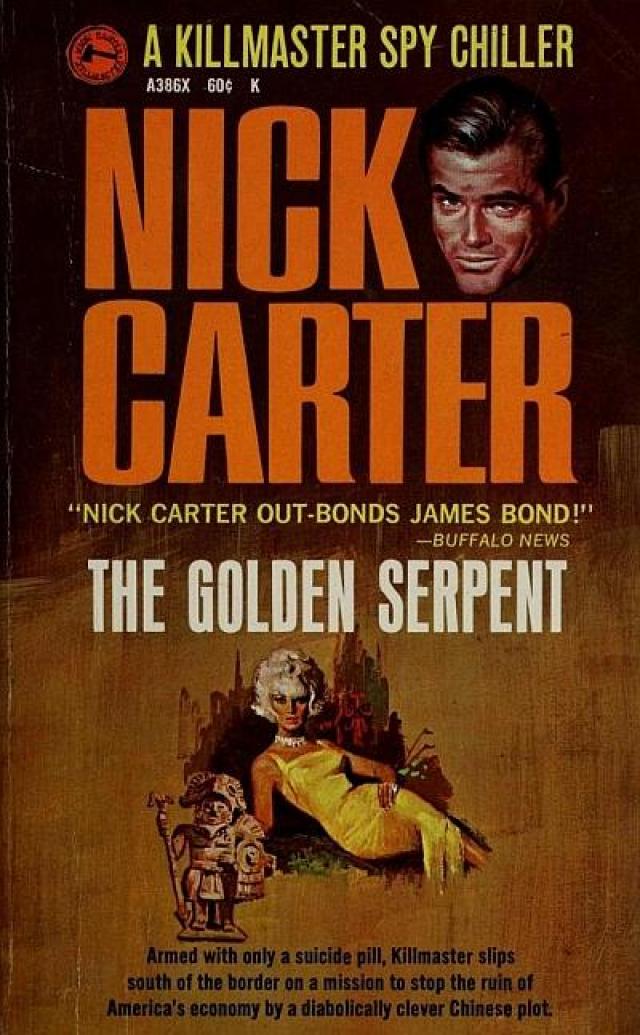
The golden serpent, p.1
The Golden Serpent, page 1
part #20 of Killmaster Series


Annotation
Take a Mexican political party that demands the territorial return of Texas... and New Mexico... and Arizona... and California.
Add a Chinese paper exporting operation that exports a fine engraver's surface for the familiar five-dollar portrait of Lincoln.
Stir with a Countess who has made a fortune in cosmetics and runsa private little kingdom at her castle deep in the Mexican jungle.
Mix in the CIA and AXE, prickling each other's sensitivities while the nation and the highest men in government are stumped to stop the ruin of America's economy...
And suddenly, in the meeting between Hawk and the CIA man, the ingredients have blended into a little pill they hand Nick Carter. His instructions are: straighten things out-or swallow your defeat in L pills!
* * *
Nick CarterChapter 1
Chapter 2
Chapter 3
Chapter 4
Chapter 5
Chapter 6
Chapter 7
Chapter 8
Chapter 9
Chapter 10
Chapter 11
Chapter 12
Chapter 13
* * *
Nick Carter
The Golden Serpent
Dedicated to The Men of the Secret Services of the United States of America
Chapter 1
The Green Plague
Like a green plague, the counterfeit five-dollar bills flowed over the United States. They inundated the country like a vast and secret horde of locusts — each one had to be sought out in its hiding place and killed. And, even when at last the alarm was out, there was no stopping them. Still they came. Not only in the United States, but the world over. Anywhere, everywhere, where the U.S. dollar was in demand, be the demand covert or open, there that same dollar was now suspect. They were exquisite forgeries, so nearly perfect only an expert could tell they were not real. And many of the experts had been fooled.
Finally, in desperation that was near panic, the Treasury had to warn the country at large. Local and regional measures could not cope. The large and efficient body of T-men were powerless. In an admission of near defeat the Secretary of the Treasury went on the air, on all networks, radio and TV, and spoke to the public. Accept no fives, give none, keep what you have until further notice. There was no indication of when that notice would come. Secrecy descended. Washington was sitting on the matter.
In the confines of that Potomac city, in the secret places where policies are made and decisions rendered, the cauldron of apprehension boiled and bubbled.
It was a seething day in Washington. The city was living up to its name of Hell on The Potomac. Normally well-groomed men went about in shirtsleeves and women wore as little as decency required — at times not that — and everywhere the asphalt ran in black rivers and people had faces like wilted lettuce. But in a certain secret room in the Treasury Building it was cool and comfortable, the air-conditioners hummed, and more than a score of worried men sat around a huge U-shaped table and turned the air blue with tobacco smoke and subdued profanity. In a figurative anteroom a great many types of hats and caps would have been represented.
Nick Carter's boss, the dour Hawk, with his inevitable unlit cigar drooping from thin lips, was watching and listening and saying nothing. About his sparse figure, encased now in a rumpled seersucker suit, there was an attitude of waiting. This meeting, he knew, was only one of many. There had been others, there would be more. It would be a little time yet, Hawk thought now, but in the end he knew what it would come to. There was a certain smell about it Hawk's mouth, cracked and parched from the heat, tightened about his cigar. It was going to be a shame to call Nick Carter back from Acapulco. For a second Hawk let his attention wander from the matter at hand — he wondered what Nick was doing at the moment. Then he brushed the idle thought away — he was too old, and too busy, to think of such matters. He brought his mind back to the affair at hand.
On the table before each man there was a five-dollar bill. Now one of the men picked up the bill in front of him and examined it again with a glass. There was a battery of small lamps mounted on the table beside him — ultras and infras of various types — and he passed the bill under the lights as he studied it. His mouth was pursed, his forehead creased, as he continued his agonized perusal. There had been a little mosquito buzz of talk around the table, now it gradually ceased and the silence grew as the man still studied the bill. All eyes were on him.
Finally the man took the glass from his eye and flung the bill down on the table. He looked around at the waiting faces. "I say again," he told them. "My final decision — this bill was made from genuine United States Treasury plates. It is absolutely flawless. Only the paper betrays it — and the paper is very, very good."
Across the table another man looked at the speaker. He said, "You know that is impossible, Joe. You know our security measures. Anyway it's such an old plate — a serial of 1941. As a matter of fact it was destroyed just after Pearl Harbor. No, Joe, you've just got to be wrong. Nobody, nothing, could steal a set of plates from the Treasury. Anyway we've checked all that a dozen times — the plates were destroyed. All the people involved, both in making and destroying those plates, are dead now. But we've gone into the records so thoroughly that there can't be any doubt about the matter. Those plates were destroyed!"
The man who had last examined the bill picked it up again. He gazed from it to the man across the table. "In that case there's a genius somewhere in the world. An engraver who has copied the genuine to absolute perfection."
Down the table another man spoke up. "That's impossible. A set of plates is a work of art — it can never be perfectly duplicated again."
The expert let the five-dollar bill flutter to the table. He looked up and down the table for a moment, then said, "In that case, gentlemen, we are dealing with black magic!"
There was a long silence. Then some wag spoke up. "If they're so damned good why don't we just accept them? Funnel billions into the economy."
His sally did not bring much of a laugh.
The weary looking man, who was chairing the conference from a raised desk in the slot of the U-shaped table, rapped a gavel. "This is not a matter for levity, gentlemen. Unless we can find the source of these bills and destroy those plates, and very soon, we are in serious trouble. We are, indeed, already in very serious trouble. Millions of our citizens have been bilked, more will be, and that is only in this country."
The man sitting next to Hawk asked, "What's the latest figure, sir?"
The chairman picked up a piece of paper from his desk and glanced at it. He sighed. "By computer, and this includes extrapolation, there is now, or soon will be, more than a billion dollars' worth of these bad bills in circulation." He took off his old-fashioned pince-nez and rubbed at the red marks on his nose. "You can understand, gentlemen, the enormity of the task ahead of us. Even if we could stop the flow of these bad bills this afternoon, we would still have the gigantic job of rooting them all out and destroying them."
"We might," someone said, "make do without five-dollar bills for the next ten years or so."
The chairman gave the speaker a hard look. "I will not dignify that with a reply, sir. Our first, our foremost and most urgent task, is to find the source of these bills and wipe it out. But that is not our province. Not at all. I am sure that the agencies involved are already taking steps. Meeting adjourned, gentlemen." He rapped his gavel.
As he filed out of the room Hawk thought: I knew it. I knew it in these brittle old bones. It's going to turn out to be an AXE job yet. This is too big for even the CIA — they haven't got Nick Carter.
As he stepped into the blazing July day and donned his brown straw hat he was thinking: Nearly a billion bucks already. My God! What an operation! No wonder the T boys and the Secret Service can't handle it.
He made his way down Pennsylvania Avenue, his heels sinking into asphalt that had the quality of hot mud. His keen, old-fashioned razor of a mind was macerating the problem from every angle. He was enjoying himself. This was the sort of challenge he liked and understood. As he avoided a group of teen-age girls in shorts and bras that would not have been permitted on a beach, he thought: there are only two counterfeiters in the world big enough to rig a deal like this. I wonder which one it is — the Bear or the Dragon?
Hawk decided not to call Nick back yet. Let Number One Boy frolic a bit longer on the Acapulco beach. Killmaster had earned this vacation a thousand times over. Hawk rounded into Dupont Circle and headed for his office hidden in the labyrinth of the Amalgamated Press and Wire Service. It wouldn't do any harm, he told himself, to put a few wheels in motion. AXE hadn't been called in yet. Not yet. But it would be. For a moment, as he waited for an elevator, he resembled an old forester sizing-up the tree.
* * *
Tony Vargas, renegade and drunk, and late of the Mexican Air Force from which he had been cashiered for cheating at cards, listened to the comfortable drone of the little Beechcraft with an expert ear. His eyes, slightly bleary, scanned the instrument panel for signs of trouble. None. The gas was holding up well. Tony grinned and reached for the pint bottle beside the pilot's seat. This was one time he didn't have to worry about the point of no return. There wasn't going to be any return! Not unless he — Tony grinned again and drew a finger across his throat. Ugh! What they would do to him! But they would never catch him. Never.
Tony reached back to pat one of the large suitcases behind him. Mother of God! What a haul. And he —
He broke off to bank left and take a quick look at the terrain below. His instructions were to cross the Rio Grande well west of Presidio, but east of Ruidosa. Tony grimaced and took another drink. It was like threading a needle, yes, but he could do it. He had flown border patrol many times when he had been Lt. Antonio Vargas, before they — well, no point thinking of that. Soon he would be a millionaire — well, half a millionaire. It was close enough.
Timing was important, too. He must cross the Rio Grande just before dusk, low, and keeping careful watch for Ranger or Immigration planes and choppers. They were hell on wetbacks these days, the Americans. But what was most important, very important indeed, was that he reach the appointed rendezvous just before dark. He must have light enough to land. There would be no flares. Tony Vargas grinned. Flares. Hah! American gangsters did not put out flares. Tony reached back to stroke the suitcase again. How many millions of the bad stuff, the so beautiful bad stuff, had he packed into that bag in his rush? He could not guess. But plenty. And another bagful as well. For which he was going to receive a half-million good, fine, lovely and authentic American dollars!
It had been carefully explained to him, again and again, at the meetings in Mexico City. If he could get the stuff, and if he could get to the arranged rendezvous, then he would be paid the half-million. At the last meeting Tony had asked a question. The phony five-dollar bills could not be passed now — they had been interdicted, yes? Any fool who could read the newspapers or listen to the radio knew that. So what could the Syndicate do with the counterfeit after they had it?
He had gotten a pitying look and a harsh answer. The men who were buying the money could afford to wait. Twenty years if they must. The bad stuff would keep until time to start easing it into circulation again. And this time it would be done properly, professionally, not dumped on the market all at once. Tony had read the contempt in the gringo's voice for such amateurs. But then the gringo did not know everything. Tony could have told him a few things that went on — but that was none of his business. Politics bored Tony.
He glanced at the map strapped to his knee. At the same time he saw the sun sparking on the silver snake of the Rio Grande below and to his left Carambal He was too early. Then he remembered, glanced at his altimeter. 10,000. That was much too high, of course, but it explained the bright sun. Dusk would be gathering on the ground as the sun went behind the peaks. Nevertheless he banked around in a circle and flew south for a time — losing altitude as he did so — just in case he had been spotted, or had popped onto a radar screen somewhere. Tony grinned and took another drink.
He got down to a thousand, banked around again, and began to skim back toward the Rio Grande. Get it over with. Through the narrow slot and into the wastes of Big Bend National Park. On his map there was traced a rough triangle bounded by Chinati Peak, Santiago Peak, and Cathedral Mountain to the north. In the center of that triangle there was a high mesa where he could land. Twenty miles to the northeast ran a main road, U.S. 90. The men who were to meet him, and pay him, had been waiting a week now. Playing at being campers. They would wait one more week, then they would leave, and the deal would be off.
The wide, shallow Rio Grande — really nothing but mud banks and trickles this time of year — glinted beneath the little plane. He was over. A bit low. He pulled her up and banked around to the northeast. Still a bit early, too. Dusk was just beginning to fall. Tony reached for the pint bottle. What matter? Soon he would be a rich man. He took a drink and put the bottle down.
"Perdition!" This was tricky flying. Nothing but gorges and canyons and peaks. Staying down on the deck was not easy. Tony grinned once more. His last grin. He never saw the jutting crag, like a great fang, that caught the wing of the little Beechcraft.
* * *
Jim Yantis, Texas Ranger, had just loaded his horse Yorick into the little van and was sliding behind the wheel of the Ranger car when he saw the Beechcraft go in.
"Goddamn it!" Jim spoke aloud — You get that way alone a lot. "Crap!"
He waited for the blossom of flame. It did not come. So the poor bastard wouldn't be cremated, anyway. There would be something to identify. He got out of the car — Christ, he was tired — and went back to open the van. He led Yorick back down the little ramp and started saddling up. The big roan whinnied and side-stepped in protest and Yantis soothed him with a few strokes.
"I hate it, too," he told the horse. "I know it's time to eat, old buddy, but that's the way the ball bounces. We got to go back in there and find out the name and identity of the clown who just killed himself." He patted Yorick on the nose. "Besides he might not be dead, you know. You don't like jobs like this? You shouldn't have joined the Rangers, pal. Now git!"
It took Jim Yantis nearly an hour to reach the crashed plane. By the time he did it was dark, but a full moon was beginning to hang in the sky over Santiago to the east. From this height he could see the occasional tiny prongs of a solitary car's headlights on Route 90.
The Ranger went through the wreckage with a powerful flashlight The pilot was dead. There was a pint bottle of whiskey, half full, not broken. Jim Yantis whistled softly. The things some crazy bastards did...
Then he saw the money. One of the large suitcases had broken open and a slight, clean-smelling mountain breeze was riffling the packets of green bills. The Ranger picked up one of the bills and inspected it. A fiver. They were all fivers. He knelt and opened the other suitcase. Full of fivers. Realization dawned as he got up and dusted off his knees.
"Goddamn almighty," he told the horse. "We've stumbled into something this time, boy. We better get back and radio in. And no use complaining about it, because we're going to be sent right back again to stand guard until they get here."
Jim Yantis thucked to the horse and started back over the same tortuous trail by which he had come in. Thank God for that big moon! As he rode he thought vaguely of the reason he had been in that part of the country at all. Six men — odd types to find around here, he'd been told — had sort of disappeared into thin air from the Tall Pine Inn. District Headquarters had told Jim to sort of mosey around and see what had happened to them. Well, that would have to wait now. This was bigger than six disappearing strangers!
* * *
A phone tinkled in an expensive suite at one of Mexico City's posh hotels. The man at the huge picture window did not turn. He had opened the heavy velvet drapes and stood gazing down onto the Plaza, watching traffic weave golden arabesques around the Cuauhtemoc Statue. It had just turned dusk and a light rain was falling, greasing the busy streets and turning them to black mirrors. Mirrors that reflected a thousand car lights. Won't be long, the man thought with an odd petulance, before the goddamn traffic is as bad here as it is in Los Angeles. Why didn't that stupid prostitute hurry up! He was paying her enough!
The phone rang again. The man cursed softly and turned from the window, crossed the luxurious carpeting and picked up the instrument. As he did so he noticed the tremor of his fingers. Damned nerves, he thought. When this last job was over he was getting out. Running and hiding.
He spoke cautiously into the phone. "Yes?"
There was a metallic gabble. As he listened, his pink, well-fed face began to sag. The well-barbered jowls quivered as he shook his head violently.
"No! Don't come here, you idiot. No names. Listen and then hang up immediately. Half an hour, Alameda Park in front of San Juan de Dos. Got it? Good. Goodbye!"
As he put down the phone there was a light tap on the door. The man cursed and went into the foyer. The stupid puta would come now! Just when he had to leave.