The chinese paymaster km.., p.1
The Chinese Paymaster (KM 024), page 1
part #24 of Killmaster Series


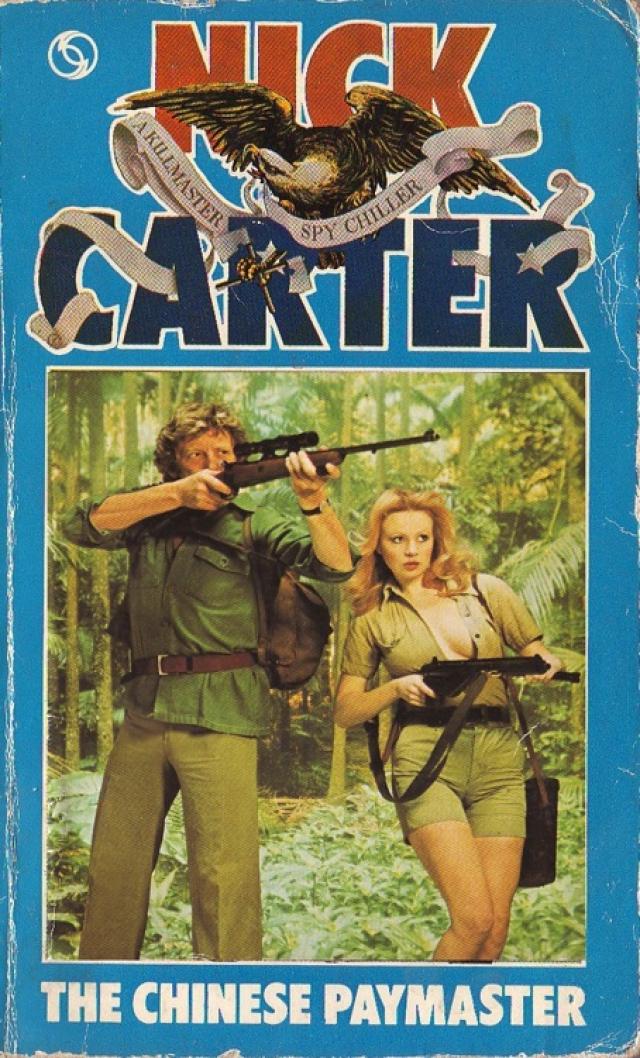
The Chinese Paymaster (1967)
(Book 24 in the Killmaster series)
Version 0.9
Dedicated to The Men of the Secret Services of the United States of America
Chapter 1
THREE THINGS happened, separated in space and time by considerable distances. They were all violent and had far-reaching effects on governments, and men, especially United States foreign policy. Although many newspapers picked up these stories, none ever had the full or correct account behind these events.
The first occurred in a small town in the Kiangsi Province of the People’s Republic of China. There the Fusien River bends in its slow descent to the ocean through what is left of the vast estates of noblemen who have owned these lands since the days of the Emperor Kien-lung. At the twilight hour when the willows blend with the mist that rises from the placid Fusien, it was the habit of one Doctor Chien to sit on the bank in. front of his summer house, now vermin infested and thirty years in decay. He’d contemplate the infinitesimal slice of the ancestral estates which the State in its goodness had permitted him to keep as a reward for his international reputation as a classicist and humanitarian.
As he sat, the doctor observed a figure, neat, formal and precisely correct in the uniform of a high-ranking army officer, stepping carefully through the overgrown gardens out of concern for the high gloss of his polished boots. The man was well known to the good doctor and repugnant enough to make Doctor Chien wonder if Men-cius could have foreseen the arrival on earth of General Tsung when the sage formulated his concept of the innate goodness of man. Doctor Chien, however, permitted none of his distaste and gathering fear to show on his courteously welcoming face.
“It is very good of you, General Tsung,” he said when the figure had drawn within earshot, “to come so far from the capital to visit such an insignificant scholar and servant of the State. What could have torn you from your arduous labors in defense of our nation?”
“Business, of course,” the military man replied. “I am never off duty.”
“You are indeed commendable, Comrade General,” the scholar replied. “But what in our tiny village could be of interest to such an illustrious personage as yourself?”
“I come to stamp on the head of a sneaking revisionist snake,” the general growled. “A traitor whom the Republic had clasped to its bosom for much too long.”
Dr. Chien met the general’s stare with a thumping heart. At the same time Chien was intrigued by the idea of a politically minded reptile. The general unsnapped the flap of his polished leather holster and withdrew his revolver.
“Your little essay in treason is at an end, Doctor Chien,” the general said. “Kneel, dog.”
The scholar never moved.
“I said kneel down!”
“If you are to slay me without benefit of trial or appeal,” the scholar quavered, “perhaps we could walk a little way from this bank. You see, General, there is a heron nesting nearby this season. The heron has, alas, been too long gone from China. The gunshot… .”
General Tsung’s answer was to seize the old man by his thin beard and wrench him to his knees.
“You should, have thought of herons, Doctor, before you learned to meddle with high-speed radio transmitters and the seduction of-youth to treason. Our D-fing units have finally succeeded in locating your transmitters. Your followers are now in jail.”
“Am I not to be tried? To face my accusers?” the old man asked from his knees. The general chuckled briefly and placed the muzzle of his revolver against the old man’s forehead.
“You are facing your accuser now, Doctor. For you a public trial is out of the question. Your suicide will be announced. A letter regretting your treachery will be discovered.”
“You must understand, the world must understand that it is not China that I love the less,” the scholar said, trying to climb to his feet. “That is a yery important point….”
The muzzle of the general’s revolver suddenly spat flame and the angry crack of the report shattered the twilight stillness. A small hole, so red that it was. almost black, appeared between the old man’s eyes and he slowly crumpled to the bank.
In the bushes there was a great thumping and whirling. The general saw a great gray bird, its’ long legs making silver splashes in the river, beat heavily for altitude, then fly directly over General Tsung and the motionless old man at his feet in the grass.
The death, by his own hand, of the eminent and respected Doctor Chien was reported briefly in Peking newspapers and by the New China News Agency and picked up on radio broadcasts monitored by American agents in Hong Kong and Manila. It was not in any way related to the swift trial and execution of bad elements and saboteurs whose crimes, like Dr. Chien’s, were not specified publicly.
The second important event seemed to be nothing more than an obscure violation of air space by Chinese fighter bombers over the northern Laotian Jungles.
Tie only reliable witness to this significant event was Colonel Chuck Tarleton of the U.S. Army, who made a damn smart guess but too late. On the afternoon in question, the famous “Mountain Colonel,” clad only in a pair of shorts and a battered Stetson hat, stared with satisfaction across the jungle clearing to where the leaders of a dozen different tribes, usually fiercely hostile to each other, congregated in what seemed to be the best of good fellowship. Tarleton had taught them a lot—how to resolve their differences and unite against their old enemy, the Chinese; how to use their knowledge of terrain and modern equipment to forbid the mountains to the Chinese troops. Tarleton had only one task left. In two days there was to be a meeting of the remaining tribal leaders, the ones who were still unconvinced of the practicality of this military alliance of tribes. But the Mountain Colonel was sanguine. The tribesmen whom he had trained would make convincing salesmen. No one in the camp doubted that once the pow-wow was over, Tarleton would have formed an effective guerrilla force that would get word about Chinese activities on the border back to Luangprabang with lightning speed, as well as being able to close the border to as many as two full Chicom divisions.
His number one aide-de-camp, Wan Thwin, a youth of nineteen, hunkered down beside the colonel and expressed the general optimism in pidgin French-English.
“… et nous sommes fini? Boku whiskey damn Luangprabang… make much fun?”
Tarleton looked affectionately at the youth who had been through so much with him and punched him lightly on his muscular arm.
“Prabang, hell, Wan,” he said with a trace of Kentucky accent. “We’ll go the hell to New York City and I’ll show you some real living. Wait’ll you see that town all lit up at night from the St. Regis roof.”
The colonel was interrupted. The flame and the noise came at the same time, for jets fly a little ahead of their noise. One second the clearing was drowsing in the afternoon sun, the next moment it was. like being inside the sun. The world was made of flame and heat, even the trees were burning as the tenacious napalm clung to the damp, vegetation. The noise of the attacking jets made commands impossible. Screams of horror mingled with shouts of baffled rage as the tribal leaders tried to run from the liquid, flaming death that rained from the sky. Weapons were discharged skyward as the three jets came around for their second pass. Machine gun bullets ripped long furrows in the soft earth. Tarleton shouted at one of the running chiefs and told him to order the men not to fight back. Those left alive were to scatter into the jungle. At that moment the chief burst into flames and became a human torch in front of the colonel’s eyes.
Before Tarleton could regroup his forces something hit him high in the back, harder than a sledge hammer, and he pitched face down in the grass. The pain made thought impossible.
He lay there for some time before the noise and the flame died away. The afternoon became evening and still Tarleton did not move. In the long night, animals made strange noises in the jungle around him but avoided contact with the blasted clearing and the charred carrion that lay there. The next day the kites attacked him but he managed to move back to his shelter and fire off his pistol when the scavenger birds became too bold. He lived for two days on a half canteen of water, his wounds festering.
Early on the third day he heard the sound of a helicopter dropping into the clearing but was too weak to look up and find out who it was. Then he heard an American voice:
“Colonel, we hauled tail the second we got the word, I don’t know what to tell you….”
The voice belonged to his CIA contact. Tarleton used his last ounce of energy to force a weary smile to his stubble-rimmed lips.
“That’s the way the old ball bounces sometimes. Too bad they couldn’t have held off for a couple of days more, though. This border would have been secure till Doomsday. Looks as if someone back at the palace is playing footsy with the Communists.”
“Take it easy, Colonel,” the CIA man said. “Don’t try to talk now. It can wait until we get back to Prabang.”
It didn’t wait, though. The wounded man died halfWay there. The fabulous Mountain Colonel was dead and a costly military intelligence effort by the United States had been nullified by a seemingly “accidental” air space “violation on what the Chicoms later described as a “routine training mission.”
The third incident took place in New York’s famous Eagle’s Nest Restaurant, a thousand feet above the teeming city at that time of night when all the barmen in town are going mad trying to keep up with the demands of a populace freed from a hard day’s work
At the bar in the Eagle’s Nest there was a double line of well-dressed men, balancing martinis and waiting for tables. Among these prosperous men watching the twilight fall over the city skyline was Prince Sarit-Nu of Thailand, an outspoken friend of the United States and an enemy of China. He was waiting for his table in the company of his nation’s U.N. Delegation and a legman for a noted Washington columnist. The party was discussing a modification of the SEATO Pact which would come to a vote on the floor of the U.N. the following week. Prince Sarit did not take part in the discussion. He had already persuaded his delegation to vote with the United States on this touchy issue but that was still a secret and he didn’t want the vote anticipated in the columnist’s paper.
No one who was there was ever quite sure what happened next. Prince Sarit was jostled as they all had been many times that evening and turned with his usual pleasant smile to accept the apologies of the man who had bumped him. As he did so, he gasped and then the silver-haired, handsome prince fell forward. His gold-rimmed glasses dropped to the rug. The Washington reporter bent to pick them up and in so doing heard the prince’s last Words.
“He… he… shot,” Sarit gasped. Then he slumped on top of the newspaperman.
Even the most lurid New York tabloids found little interest in the story of a minor diplomat dying of a heart attack in a fashionable restaurant and they buried the story far to the rear of their papers. Had they read the report of the doctor who performed the autopsy, however, the editors would have run the story on the front page. As it was, no one but a handful of men at the top of the government knew that the doctor’s report said Prince Sarit had died of inhalation of concentrated cyanide gas, probably sprayed , at close range into the prince’s face. Nor would the public ever know that a strange-looking “water pistol” had been found at the bar .of the Eagle’s Nest by a cleaning man.
The following week the Thai delegation, leaderless and badly divided on the SEATO issue, voted against the United States after many lengthy and acrimonious debates among themselves.
The reports of these events were studied in Washington, then broken down into Fortran, which is the language of computers. They were then fed—together with such diverse information as the latest wheat production figures from the Ukraine and the amount of choler shown by the latest Red Chinese official reports—into a sort of supercomputer in Langley, Virginia, to become electronic impulses. From the computer’s cogitations came a print-out document called the National Security Estimate. This report, as the name indicates, is a result of all the American intelligence efforts and is a summation designed to keep the President, the Joint Chiefs, and a few other officials on the very top level, abreast of what is going on in this large and infinitely complicated world. The report is marked “eyes only” and has a very exclusive circulation. One pair of eyes which fell on it was far from pleased.
Although he occupied an office with one of the most imposing views in Washington, the slim old man who sat in the publisher’s office on the top floor of the Amalgamated Press and Wire Service Building, was not one to be distracted by the loveliness of the Capitol at dusk. His mind was engaged with different scenery. His gray head was bent over a copy of the National Security Estimate and he apparently did not approve of what he read. As he turned the pages a frown deepened across his forehead.
“Bosh,” he said quite clearly at one point. This was followed a few pages later by, “Nonsense!”
It would be easy enough to take the man for a newspaperman, perhaps one of those vigorous, homespun intellectuals with faces that appear to have been hewn from the granite of the local quarry. He looked like a man you might find behind ‘the publisher’s desk of a small town weekly paper of the type that wins journalistic awards. But, despite the name of the building, the man was not a journalist. And the building was not a newspaper office. It was the cover name for the AXE group, the United States Government’s highest and most secret intelligence agency. The old man’s name was Hawk, and Hawk was chief of AXE. Through the corridors of the building roamed a small army of technicians, ex-college professors, ex-policemen and newsmen. All day long wires hummed, TWX messages arrived, bells rang on cable machines and occasionally the President’s office called. But in the office of the old man all was quiet as a cemetery at midnight.
Then his buzzer sounded.
“Yes?” Hawk snapped.
“N3 is outside,” a female voice almost as dry as his own informed him. “Are you ready to see him?”
“Of course. At once,” Hawk said.
The man who came in and greeted the old man pleasantly was tall, handsome and surprisingly young looking. He wore an expensively tailored silk suit, hand-lasted shoes and a tie from Liberty of London. But it was his bearing and face that were worthy of attention. The face in particular. It was made up of strengths common to the age but rarely found in a single head—fortitude, quick intelligence and a lazy humor that inclined to the cynical. It was a face that would have been recognized along the Oregon Trail or perhaps among the Crusaders of old. Its counterpart was to be found often leading a brigade among the foreign legions of the world.
Hawk lit a cigar and studied the face wordlessly for some moments. Then he said, “I think someone’s been putting Spanish fly in General Tsung’s egg roll, Nick.”
The man called Killmaster crossed one perfectly tailored leg over the other and smiled sympathetically.
“We’ve been taking a beating, sir, that’s for sure.”
“Beating? We’re getting raped. But then how would you know? Taking that social ramble in Jamaica. Late nights, booze, rhumbaing on the beach until dawn. Not to mention more debilitating activities with that woman….”
“Grand Cayman Island, sir,” Nick said. “And Zi-Zi happens to be a clean-cut, fun-loving Hungarian movie star with a couple of million dollars… .”
“Very well, Carter, we’ll dispense v/ith the snappy dialogue for now. Look at that map.” Hawk indicated a large wall map covered with red and green pins. Nick looked and raised his eyebrows. The red pins signified areas where United States intelligence efforts were having questionable success or none at all, and they outnumbered by far the green pins which indicated operations proceeding according to plan and schedule.
“One,” Hawk said, jabbing his fist into his palm. “Our network in Peking under Professor Chien. Possibly the best thing I’ve set up in their government service. Annihilated. And that doesn’t include the smaller stuff which-is only relatively less important.” He reeled off the list of Chicom intelligence victories, finishing up by saying, “General Tsung is a fair intelligence officer but he shouldn’t beat us like this.”
Nick took out a pack of expensive foreign cigarettes and fit one with a gold Dunhill butane lighter, while considering his reply.
“Maybe they have a new gimmick in their moths operandi, sir. We both know that if you go to the expense and trouble of changing everything around you’ll score a few wins until the opposition catches on. Usually it just isn’t worth the trouble….”
Hawk grunted and shook his head.
“Good guess but uh-uh. It’s the same old network, same old techniques. But they’ve increased their efficiency and are doing better. We know this. One of our sources in Budapest tipped us off.”
“Then the Chicoms must be paying off more money,” Nick said.
“Now you’re talking, son,” Hawk said. He. settled back and puffed his cigar. “They must have found a paymaster and a damn good one. He’s getting heavy dough to the people near the top, the important ones whose incomes are watched. Making it worthwhile for cabinet ministers and generals to turn traitor. I don’t have to tell you that just a few such trusted people around the world can play hell with Western security. Also he’s managing to get these large sums into the various countries.”
“Why don’t we arrest some of the jokers taking the payoff?” Nick asked promptly.
“Because we don’t know who they are,” the old man answered just as promptly. “But,” he added, “we have a bit of an idea how they’re doing it.”
“Color me baffled,” Nick said.
“All right, listen,” Hawk said, and his eyes had the glint that always appeared when he pulled off an intelligence coup. “Our Budapest station informs us that the paymaster is flying in and out on commercial airlines at regular intervals. His payoffs are in pounds or dollars— swift and discreet. We’ve got dates of past performances, see? We get more actual dates by pulling a worldwide intelligence alert. That pinpoints his movements pretty well. While you’re jiving around’ on Grand Cayman I’m spending days and nights with the slide-rule boys. We check the schedule of every airline through the Langley computer and match it with our ‘leak area’ chart. What do you think we come up with?”