The peruvian exchange ja.., p.1
The Peruvian Exchange (Jack Barr Thrillers Book 2), page 1


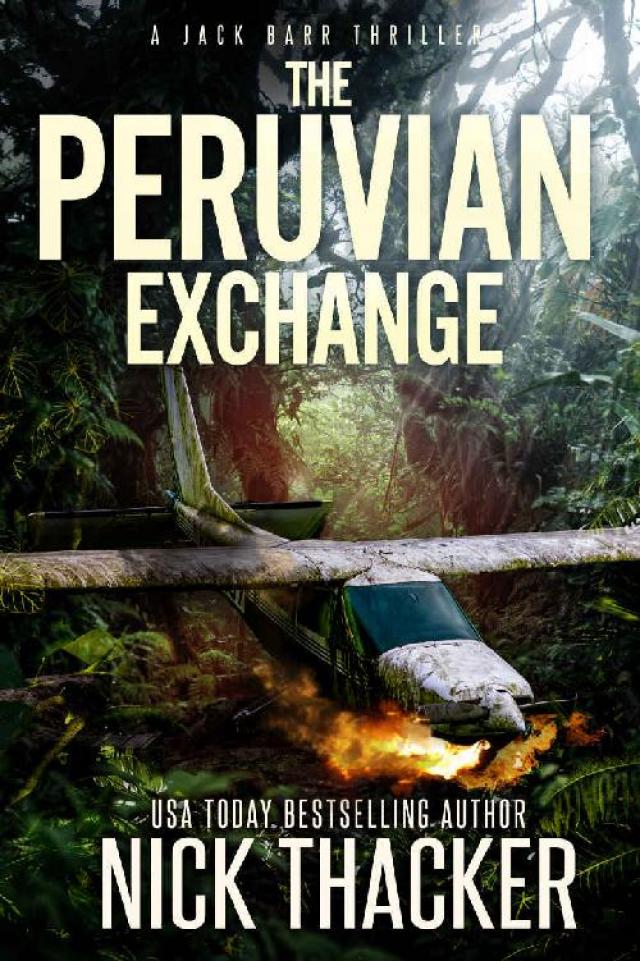
THE PERUVIAN EXCHANGE
JACK BARR THRILLERS
BOOK 2
NICK THACKER
THE PERUVIAN EXCHANGE: Jack Barr Thrillers #2
Copyright © 2022 by Nick Thacker
Published by Conundrum Publishing
This is a work of fiction. Names, characters, places, and incidents either are the product of the author’s imagination or are used fictitiously, and any resemblance of fictional characters to actual persons living or dead, business establishments, events, or locales is entirely coincidental.
All right reserved. No part of this publication can be reproduced, stored in a retrieval system, or transmitted in any form or by any means—electronic, photocopying, mechanical, or otherwise—without prior permission of the publisher and author except in the case of brief quotations embodied in critical articles or reviews.
CONTENTS
Want free books?
1. Sanchez
2. Jack
3. Jack
4. Jack
5. Jack
6. Wyman
7. Jack
8. Jack
9. Jack
10. Wyman
11. Jack
12. Wyman
13. Jack
14. Jack
15. Jack
16. Jack
17. Jack
18. Jack
19. Jack
20. Jack
21. Jack
22. Jack
23. Jack
24. Jack
25. Jack
26. Jack
27. Jack
28. Victor
29. Jack
30. Heavens
31. Jack
32. Heavens
33. Jack
34. Jack
35. Victor
36. Jack
37. Heavens
38. Jack
39. Jack
40. Jack
41. Jack
42. Jack
43. Jack
44. Heavens
45. Jack
46. Jack
47. Jack
48. Jack
49. Jack
50. Jack
51. Jack
52. Jack
53. Jack
54. Jack
55. Jack
56. Jack
57. Jack
58. Heavens
59. Jack
60. Wyman
61. Jack
62. Jack
63. Jack
64. Jack
65. Jack
66. Jack
67. Jack
68. Jack
69. Jack
70. Jack
71. Jack
72. Jack
73. Heavens
74. Jack
Afterword
Books by Nick Thacker
About the Author
WANT FREE BOOKS?
Head over to nickthacker.com/free-books to download three full-length thriller novels!
ONE
SANCHEZ
The plane was going down, and the pilot knew it.
Getulio Sanchez’ Cessna had been traveling at approximately 120 knots when the rocket-propelled grenade slammed into its right wing. The explosive charge glanced off the wing before exploding slightly behind and above below the plane.
But it had been enough to do catastrophic damage to the aircraft. The plane rocked to the side, rising a dozen feet in an instant from the explosion, but losing it just as quickly. Pieces of the flaps and spoiler on the port side of the aircraft disintegrated, falling down to the jungle below.
The pressure wave of the detonation knocked control cables inside the wing loose as well, no longer allowing the pilot to control the plane’s position in the sky.
Three of the port-side windows blew inward from the impact, the frontmost window shattering and sending shards of glass into the side of the pilot's face. The pilot screamed and fell to the side, but recovered an instant later, only to find his plane beginning to spin wildly out of control. He grabbed the yoke and yanked it hard to the right, trying to compensate for the loss of control on the left side.
He checked the altimeter, seeing that they were losing altitude far too quickly for a safe landing attempt.
Not that there was any place for a landing to be attempted. The man looked out the side window, watching the jungle stretch by in all directions. There was not even so much as a plane-sized gap in the thick green canopy.
In an instant, Sanchez knew what was going to happen.
The well-trained pilot ran through a mental checklist, his training kicking in immediately. He had flown for the Colombian Air Force, had trained for everything. He knew how to force the small single prop plane into a stall and then recover, accidental barrel rolls, and even flying upside down.
But Sanchez had never tried to fly with a single wing.
Heat throbbed on the side of his face where he knew the shards of glass from the blown-out window had landed and were still stuck. There was blood oozing from many of the cuts, dripping onto his left knee. The cold air whipping in from the high altitude did little to ease the pain, and as he tried to look to the left to inspect the damage on the wing he realized his left eye was unable to move. Sharp pains shot up his optic nerve and around his occipital lobe as he tried to wiggle it.
He groaned in agony once more, his hands still clamped tightly around the yoke handles. He tried to force the plane to maintain its lift and heading.
To let go now would be suicide — it would immediately launch the plane into an unrecoverable barrel roll, sending it hurtling down toward the jungle canopy.
And yet… there was no other option. The pilot finally forced his head all the way to the left, his neck cracking with the exertion, and saw a large chunk of wing missing. Smoke ran in a straight line from behind it, the smoldering and charred pieces of fuselage that had caught aflame adding to the mix.
Sanchez knew it — the plane was definitely going down. He had trained for controlled crashes, not-so-gentle landings, hitting the ground with no landing gear.
But he was not sure what hitting the treetops at near-full-speed, head-on, would feel like.
He was not going to live through it, that much he could be sure of. Would it hurt? Would he simply black out, or would he feel every moment, as if hitting in slow motion?
He was about to find out.
The best Sanchez could do now was try to somehow hit the canopy at an angle — and speed — that kept his two passengers alive.
He heard shouts from behind him, where one of his two passengers sat. The passenger was either injured or scared, or both. But whatever the shouting was intended to accomplish — the pilot could not respond.
There was nothing to say. Nothing left to do but hope for the best. He began to pray.
The man to his right was staring at him, wide-eyed. He was another passenger, another delivery.
And the pilot knew he would not be making his delivery successfully today.
TWO
JACK
Jackson Barr, Jr. tossed the half-eaten protein bar to the floor and gripped the small handle above his head. It was mounted between the front windshield and the starboard side-panel glass in the cockpit of the small Cessna, but it felt as though it would rattle away and disappear.
Like the rest of the plane.
The engine was howling, the whine of it louder now than it had been at any moment during the journey.
He watched the pilot toiling against the pull of the craft, knowing that he would not be able to hold much longer. The wing was going to eventually give way, and the crumpled carcass of the rest of the aircraft would plunge straight down to the jungle.
Jack felt his stomach rising, and he tried to ignore the feeling of wanting to hurl by forcing himself to think of something else.
They had left from the tri-border region in southern Columbia, flying west-southwest on a heading that would take them directly to Iquitos, Peru. Their destination was a small strip of runway on farming land, well out of sight from the local authorities and cartel members.
But apparently they had not remanned out of sight of the other hostile faction in the region. The Shining Path — or Sendero Luminoso — had been Peru's most infamous terrorist group about three decades ago, rising to power and calling themselves the Maoist Communist Party of Peru. They had taken over villages, claiming them for their own, generally horrifying and terrifying locals with atrocious acts of violence.
And someone had armed them, as well. Rumor was it had been the Peruvian government itself. Some assumed there was a faction who was not excited about Peru’s leadership at the time, wanting a new party in power. Jack tended to believe the answer was much simpler: guns had been easy to come by in this corner of the world at that time. It wouldn’t take much to outfit a terrorist organization down here with enough firepower to fight an army.
Over the past 20 years, however, the Shining Path organization had dwindled to almost nonexistent status, after the capture of its leader, Abimael Guzmán. It had only been in the past five years that rumors resurfaced about another group of radicalized communists with the same name — seemingly rising from the ashes of the once-powerful organization.
They were claiming to be the original Shining Path, and they had marked this entire corner of Peru as their own.
The Amazon tributaries flowed freely th
A drifting sensation snapped Jack back to the present. He wished he knew what to do. He had seen the pilot play with the oxygen settings before, pushing it in and out as they rose in altitude, listening to the engine.
The explosion had rocked everyone, and Jack had smacked the side of his head against the glass. It wasn't hard enough to be painful, and he had recovered quickly. Rudy, in the backseat, had been fine as well. The man had immediately jumped into action, pulling his pack over the front of his body and onto his shoulders, then looping the backpack with the chute inside over his back. He had shouted something, but Jack could not make sense of the words.
He was scared shitless. He had no idea what to do, so he mindlessly copied Rudy's actions and reached for his own bag. It was sitting directly behind him in the back seat, and it would be impossible get at it and successfully pull it to him. He would have to move into the back of the fuselage to put it on.
As the pilot yanked hard to the right, he noticed that Rudy was holding out Jack's chute.
"Give me the pilot’s, too!” Jack shouted.
Rudy frowned, then shook his head. Jack couldn't see his eyes from behind the man's dark sunglasses, but he understood the confusion on the man's face.
"Just give it to me!” Jack yelled, his voice louder.
The pilot continued fighting the plane.
Rudy shook his head again, still not agreeing with Jack's decision. Nevertheless, he handed him the third pack.
Rudy reached for the handle that would open the port-side hatch. Jack barely heard his words over the roar of the engine and the wine of the plane as it fought to stay afloat in the air. "Time to go, Jack!" Rudy shouted. "Get back here, now!"
Jack did as he was told, tossing the third chute onto his seat while throwing his own over one of his shoulders. He jumped over the navigation clipboard seated next to the pilot and landed in the backseat of the large Cessna.
Only then did he reach back to the other seat and grabbed his personal duffel — his lifeline. He wore both the chute and his pack now, putting the straps of the parachute on his back and the strap of his pack on his front side, over his chest.
He had just gained a hundred pounds, but it was worth it. The heavy bag on his back would save his life now, while the pack on his front would save his life over the course of the next few days.
Rudy already had the hatch open a bit, and Jack heard the louder rush as air flew by the inch-wide gap.
"Are you ready?" Rudy shouted.
Jack swallowed. No, I'm not ready to jump out of an airplane.
He was new to fieldwork, a brand-new operative working side-by-side with a seasoned veteran. Jack had been under the Directorate of Intelligence for twenty years, but he had never left the comfort of his own desk when working for the CIA. Now he was under the Directorate of Operations, and his cozy desk was nowhere in sight.
Jack shook his head.
“Now or never, Jack,” Rudy shouted.
Jack ignored the man, turning to the pilot. He could see sweat falling from the man’s forehead, mixing with the blood and perspiration already covering his face. He looked as though he had been through a battle, even though the entire incident had happened over the course of only thirty seconds.
Jack reached over and pulled on the pilot’s shoulder. He leaned forward and spoke directly into the man's ear. “You let go, we start spiraling, yeah?”
The man nodded, leaning his entire body toward the center of the plane, as if trying to counterbalance the weight of the damaged wing himself.
“Let go and climb back here. I've got your chute ready."
The man stared straight ahead as the nose of the plane dipped below the horizon. They were picking up speed. He shook his head. "You go. I'll hold her steady."
"Jack, Now!" Rudy shouted from Jack’s side.
Jack ignored the veteran operative.
He pulled harder on the pilot’s shoulder, almost yanking the man's hand free. It was exactly what Jack was trying to do, and the man fought against it.
"Let's go now, or else we all die," Jack said. "This is our only chance to get out of here alive. You have to leave!"
The pilot seemed to consider this for a long moment — seconds Jack knew they didn't have. Suddenly he released the yoke and it jammed to the opposite side, the plane launching into a downward spiral.
And immediately sending Rudy out the open hatch.
He heard the man's shout, then a relatively ominous quiet.
And then the roar of the engine and the whine of the plane and the rush of the air all came back and pummeled Jack's senses at once. The kerosene-like smell of fuel and ozone, and the almost ocean-like thick air of the jungle atmosphere slammed into his nostrils.
The pilot was crawling back in the plane, Jack helping him along. As the plane tipped forward into the spiral, the man had to work a bit harder, how climbing upward. Jack helped him to his knees once in the back of the plane, tossing the man's chute over his back.
Jack got a glimpse of canopy once again as he was thrown off balance. The plane bucked, hopping over a bubble of hot air.
The trees were much larger than they had been the last time he’d seen them.
Jack practically flung the pilot out the hatch now, holding onto the plane’s wing strut as he did. Once the man was free, Jack jumped out as well, not even giving himself enough time to consider what was he was doing.
He had skydived exactly twice before: once in the Army, when a team of PJs came for a special training session… and once at a bachelor party, fifteen years ago.
Jack had hated it both times. The sheer terror he had felt as he had stepped close to an open door while fumbling through the air in 150 mph had caused him to nearly vomit all over the jump deck and the other passengers.
Thankfully, both times he had been tandem jumping, with an instructor strapped onto his back, and both times the instructor had pushed him forward and out of the craft before he could hurl his lunch everywhere.
But there was no one strapped to him today.
THREE
JACK
Jack couldn't even scream. His body was in shock. He blinked a few times, his mouth working opened and closed, but no sound came out.
All he heard was air, cannon fire into his ears as if trying to blast them off of his head. And it was cold. His body felt like he had just tossed it into a frozen pond. He tried to get his arms and legs to work, but couldn’t help but notice they were just flailing uselessly around him.
The earth was spinning around him, the horizon the seconds hand on a clock, ticking on fast forward.
His mental training kicked in then. It was not an automatic muscular response — there was no muscle memory to pull from in this situation — but he was finally able to convince his legs to stop whipping wildly. He forced his hands rigid, to his sides like tiny, mostly useless wings.