The winter garden, p.1
The Winter Garden, page 1


Select praise for the novels of Nicola Cornick
The Last Daughter of York
“What a fascinating story. I enjoyed every moment of it.”
—Barbara Erskine, Sunday Times bestselling author
“Well researched and stylish, full of emotion from past and present, this is an engrossing mystery to keep the reader turning the pages.”
—Anne O’Brien, author of The Queen’s Rival
“An engaging, beautifully crafted romance that weaves together several intriguing mysteries, both ancient and modern.”
—Alison Weir, author of the Six Tudor Queens series
The Forgotten Sister
“Fascinating... Cornick’s rich mystery will serve readers well on a rainy day.”
—Publishers Weekly
“A gorgeous novel, so fresh and original. And the tension! I was on the edge of my seat.”
—Jenny Ashcroft
The Woman in the Lake
“I was hooked from the first pages.”
—Gill Paul
“You just can’t put it down. Brilliant!”
—Katie Fforde
The Phantom Tree
“There is much to enjoy in this sumptuous novel.”
—Sunday Mirror
“A brilliant time-slip novel with a great twist in the tail!”
—Woman magazine
House of Shadows
“Fans of Kate Morton will enjoy this gripping tale.”
—Candis
“A gripping read.”
—BBC Radio
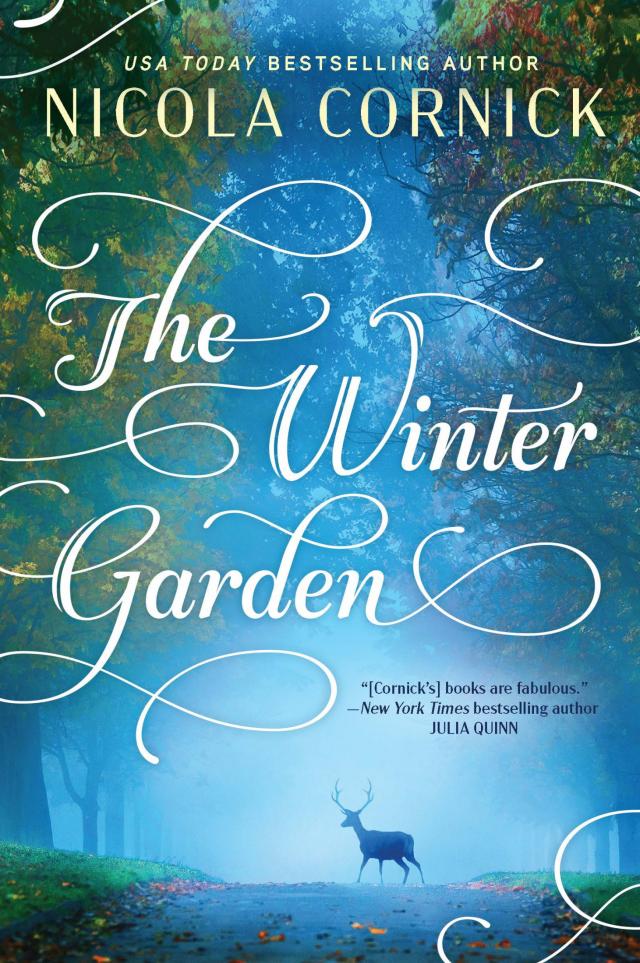
The Winter Garden
Nicola Cornick
In memory of Ashurst Sky Angus MacLeod.
Contents
Prologue
Chapter One
Chapter Two
Chapter Three
Chapter Four
Chapter Five
Chapter Six
Chapter Seven
Chapter Eight
Chapter Nine
Chapter Ten
Chapter Eleven
Chapter Twelve
Chapter Thirteen
Chapter Fourteen
Chapter Fifteen
Chapter Sixteen
Chapter Seventeen
Chapter Eighteen
Chapter Nineteen
Chapter Twenty
Chapter Twenty-One
Chapter Twenty-Two
Chapter Twenty-Three
Chapter Twenty-Four
Chapter Twenty-Five
Epilogue
Author Note
Acknowledgments
“Winter Garden
The moon thinned to a thread.”
Matsuo Basho
Prologue
Catherine
Knightstone Manor
Winter, 1598
They awoke that morning to snow. The garden was cloaked in it. It fell in huge flakes the size of rose petals from a sky as soft and white as down. Catherine, who had mourned the loss of the summer shapes and colors, who had disliked the bare bones of the garden in winter, was enchanted. Here was her creation transformed into something magical and new.
The children were desperate to play outside. The nurses wrapped them in winter flannels and thick woolens; it was astonishing that they could move, let alone run. Robert went with them as they shrieked and tumbled in the snow of the labyrinth, their excited cries echoing in the crisp winter air.
Everywhere she walked, the garden beckoned her on. The clipped hedges of the knot garden were stiff with tiny spikes of frost bristling on each twig. The pebbles of the path glittered with ice. The lake was lost beneath a covering of snow like a flat, blank mirror. The summerhouse—a winter house now—had icicles hanging from the eaves. She wandered along the bank, wondering whether when the snow had cleared there might still be ice for skating. The boys would love that. She was sure there was an old pair of wooden skates in a chest somewhere. Robert would know; the house had been his grandmother’s before his.
She had to be careful climbing the path back to the terrace. The ground was slippery, iced fronds of fern hanging over the stream where the water ran between banks piled with snow. It sounded like music in her ears but then everything was bewitching to her this morning. From the top of the spiral mound she could see for miles across the vale. The snow had cleared away now and the sky was the palest blue of a bird’s egg.
She scrambled down the hillside to join her family in the labyrinth. The hem of her gown was soaking now and her feet felt wet and cold, but happiness bubbled up inside her, banishing the discomfort. This was how she had imagined it, only far, far better; her garden a place where joy and laughter dwelled.
Robert threw a snowball at her and it melted down the neck of her cloak. She pretended to be angry but all she wanted to do was kiss him, to whirl around in his arms. So she did, and their sons ran alongside; or William did—Robbie was still barely able to stand. The nurses laughed and everyone’s faces were rosy, and when they could no longer feel their fingers or toes they went inside to sit before the fire and drink spiced ale to warm up.
Later, when she finally realized that the key was missing from the chain about her neck, she knew she would never find it again. She had explored every corner of the garden earlier that morning. She had no idea which snowdrift might hold it.
They searched; of course they did. They retraced her steps, she and Robert and the servants, digging, huffing and puffing until the snow was trampled and the garden no longer looked enchanted. There was no sign of it.
“I will have a new key made,” Robert promised, as they lay beneath the tester together that night, burrowed in and warm in each other’s arms. “Or buy you a new box for your treasures. Do not fear, my love. Perhaps we shall find it anyway, when the spring comes.”
But the melting of the snow did not reveal the key and although Robert had gone to London and promised a new box for her as a gift, it would have meant breaking open the old one, splintering the highly polished wood she loved, so she was glad when he forgot.
Eventually, as the summer came, she decided she must put aside any sentimentality and break into the box so she could see the pictures again. She missed them and already the boys had grown and changed almost out of all recognition. But the summer brought with it nothing but trouble and soon the key was forgotten beneath matters much weightier than snow, and it was to be more than three hundred years before it was found again.
One
Lucy
The Present
Late July
The house looked exactly as she remembered it.
Immediately ahead of her was a low wall of chalk and sarsen stone, overgrown with a tangle of white and gold honeysuckle, pink wild rose and white star jasmine. Tall pink-colored hollyhocks bent confidingly close toward one another, almost blocking the little wooden gate. Beyond that, a path of irregular flagstones cut across a wide lawn—almost a meadow because the grass was so long and dotted with wildflowers—up to the pale green-painted door, which nestled beneath a flat porch. The windows were irregular too, two of them set on each side of the entrance, their Georgian casements reflecting a gleam of lamplight within.
Gunpowder Cottage. The pale cream of the chalkstone walls, burnished honey gold in the late, low sun, gave the house a timeless, ethereal appearance, as though it had been settled in the landscape forever. Lucy could almost hear the centuries whispering to her.
It was a beautiful place, but she’d rather be almost anywhere else in the world right now.
“It’s the perfect place for you to have a break,” her sister, Cleo, had said warmly, when she had rung to tell Lucy that she had arranged it all. “I’ve spoken to Aunt Verity and cleared it with the lettings agency. They’re not taking bookings at the moment because there’s some major work being done in the gardens. Aunty Verity did mention she might be heading back from Australia in a few weeks, but for now the place is all yours.”
Lucy hadn’t replied because there were tears crowding her throat, tears of combined guilt, gratitude and frustration. When she failed to speak, Cleo had continued breezily: “You don’t need to worry about a thing, Luce. All you have to do is rest.”
“Right,” Lucy had said. Then, thinking this sounded ungrateful, “Thank you, Cleo. You’re a star.”
“I know you’re not used to taking it easy,” Cleo said, a hint of reproach in her voice, “but this time you really are going to have to stop, Lucy.”
“Yeah,” Lucy said. Admitting the truth was hard, even to Cleo, especially to Cleo, perhaps, since normally Lucy was the organizer and her little sister was swept along in her wake. She could hear the subtext in Cleo’s words, the echoes of friends and family:
“Poor Lucy, she’s such a workaholic, so driven... No life outside of her music... What will she do now?”
It was a good question. Lucy didn’t know the answer. Not yet. She hadn’t even really accepted the reality of it yet, how a month of pneumonia and the complications that had followed it had ended her musical career so brutally. Her entire life plan had been derailed by a jumped-up flu virus.
“New talent Lucy Brown lights up the Barbican concert hall,” one review had said, a week after she had been hospitalized. “The new Benedetti!” another raved. “Full of promise. We can’t wait to hear more from the London Gala Or
But there would be no more violin solos and the critics would forget her soon enough because there was always someone else coming up through the ranks. Meanwhile she had to get over it and get on with her life.
Lucy set her hand to the latch of the gate. The now-familiar twinge of pain shot up her arm, and she gritted her teeth against it. The illness had left her with a legacy of fatigue, aching joints and muscles, breathlessness, a whole shopping list of problems that were unfamiliar and exhausting. To start with she had tried to return to rehearsals but the excruciating pain had changed music from being a sublime pleasure to a painful trial. In the end she’d been forced to admit defeat and had cried with fury and frustration.
Her consultant had been matter-of-fact:
“Post-viral fatigue,” he had said briskly. “We see a lot of it after the flu, or viral pneumonia like yours...” He shrugged. “It’s similar to long COVID, that tail of symptoms that carry on after the initial infection has gone. I’ll prescribe you some steroid treatment, but you need to rest.”
Whilst she was still feeling bewildered and scared he had glanced toward the door as though hoping or expecting an interruption, and Lucy had realized that it wasn’t that he had not cared, simply that this was all new and frightening to her but for him it was a daily occurrence and he needed to move on to the next patient.
Lucy dropped the latch, the ache faded and the gate swung open smoothly and silently. She had been expecting the squeak of rusty hinges to match the neglected garden. Then she reminded herself that the cottage was usually let for holidays and longer periods; of course it would be kept in good working order even if the grass needed a cut.
Her wheeled suitcase bumped and stuck fast on the rough path and she pushed the handle down with an impatient snap. Ancient charm and uneven flagstones were all very well but the case was heavy and she was very tired. She’d declined Cleo’s offer to give her lift from London for no reason other than pure pride. She’d wanted to do something for herself, to prove that she was still capable. It was annoying that she now felt exhausted. The train journey from Paddington to Swindon had seemed interminable. From the station she had taken a taxi to Knightstone, watching the golden twilight settle over the Berkshire Downs to the south as the car had eased out of the Swindon traffic and taken the twisting route through the Ridgeway villages. Down in the Vale of the White Horse, the ripening corn had glowed in a perfect sunset. Beside the road, the ancient hedgerows faded into dusk, the gnarled old trees bent eastward with the prevailing westerly wind.
It was almost fifteen years since she had been in this part of England, the forgotten corner of Wiltshire, Oxfordshire and Berkshire that nestled between the Downs and the Vale. As the taxi turned off the road to Wantage and headed downhill on the tiny lane overhung with arching beeches, she acknowledged how beautiful it was and how little she wanted to be there. Instead of this quiet she ached for the buzz of a concert hall packed with people and anticipation, the gleam of chandeliers on the rich old wood of the violin as it came to life beneath her hands...
She picked up the suitcase to heave it over the final few flagstones. The muscles in her arm cramped and the case bumped heavily against her leg for the remaining few steps to the door. She ducked into the cover of the porch and was immediately struck by an unexpected memory of childhood summers spent at Gunpowder Cottage. Perhaps it was the poignant scent of the jasmine, heavy in the evening air, that transported her. She felt helpless, an unfamiliar sensation, as though the past had reached out completely unexpectedly and snared her. In a flash she remembered that the spot where the grass grew less thickly at the base of the ancient apple tree was where she had sat reading in the summer evenings, her back pressed against the warm, rough bark. The lichened staddle stone by the wall, which as a child she had thought was a giant mushroom, cast an elongated shadow across the grass. She remembered that it had once supported the old granary at the back of the cottage, keeping the corn off the ground and safe from the rats. It was one of the many stories that her aunt Verity had told her about Gunpowder Cottage. Verity’s tales of queens, knights and dragons had enchanted her on every visit and she had been caught up in the magic of it all.
“I want adventure!”
It was almost as though she could hear her own voice, high and excited, carried to her by the winds of time. What an eager, happy child she had been. And Verity had been a role model—a woman whose entire life seemed one big adventure, who, after a long army service commitment, had set up her own highly successful explosives and demolitions business. Even now that she was semiretired, Verity was still much in demand for her expertise, hence her current trip to Australia, where she was consulting on a mining operation in New South Wales.
Lucy took a deep, bracing breath. She had promised herself that she wouldn’t give in to self-pity. She had achieved her own adventure in her own way and it had been brilliant even if that journey had now been cut short. Like Verity she would move on to something new. Except that it felt too soon; she didn’t want to think about that now, about the blankness of the future. But she did know that she wasn’t going to stay here too long. She’d find a fresh purpose. She didn’t want to become one of Cleo’s lost causes, like a rescue kitten in need of rehoming or a dead cactus that her sister would insist was only wilting. This was a strictly temporary stay.
A cool breath of breeze from the Downs tiptoed along her spine. In contrast to the now-chilly garden, the lamplit room inside the cottage looked warm and inviting. It had been thoughtful of Verity to arrange for someone to leave some lights on to welcome her. Evidently someone was keeping an eye on the cottage whilst it was empty.
Lucy dug in her bag, her fingers closing around the front door key. It should have been a big iron antique to fit the appearance of the cottage, but Verity wasn’t old-fashioned when it came to security. There were two keys, a mortice and a latch. Lucy took them out with a jingle of metal.
The door opened before she could insert either key into a lock. Light spilled across the step, mingling with the dusk of the garden. A black Labrador rushed past Lucy and cocked his leg against the apple tree. Lucy dropped the keys with a clatter on the step. The dog turned his head at the sound and stared at her, his eyes shadowed and dark in the night garden. He wasn’t young; gray hairs were beginning to show around his muzzle, but he was very handsome all the same.
The dog gave a little yelp of excitement to see her and dashed back across the garden, wagging his tail madly, beating it against Lucy’s leg in an orgy of delight.
“Hello,” she said weakly, crouching down to pat him whilst he stared at her with his big soulful brown eyes. “You’re very friendly, but what are you doing here?”
The dog pressed closer to her, his big body warm and reassuring. He smelled of a familiar dog smell, which gave her a pang of longing. It was years since she had had any sort of pet—her lifestyle hadn’t allowed for it—but when she and Cleo had been children there had been a succession of dogs of many shapes and sizes. Their parents currently owned a Welsh terrier called Tal, short for Taliesin. This dog, she saw from the tag glinting in the faint light, was named Geoffrey.
A shadow fell across them. Geoffrey looked up, panting, his whole body wagging now. A man stood framed in the doorway, a disheveled tawny-haired giant wearing nothing more than a bath towel about the waist. His hair was wet and droplets clung to his broad shoulders. His narrowed hazel gaze scanned Lucy with incredulity before moving to the bag and violin case at her side. He frowned ferociously.
“Who are you?” he said.
It was not the warmest of welcomes and it was not what Lucy needed right now. She kept her gaze firmly fixed on his face despite an instinct to look lower.
“Lucy Brown.” She considered extending a hand to shake and decided against it. Who knew what would happen to that towel if he took it? “My aunt Verity owns Gunpowder Cottage and has leased it to me for a few weeks—this cottage,” she added in case he was particularly dense, or didn’t know the name of the house he was squatting in. “So perhaps I should be asking who you are?”