

One of our kind, p.1
One of Our Kind, page 1


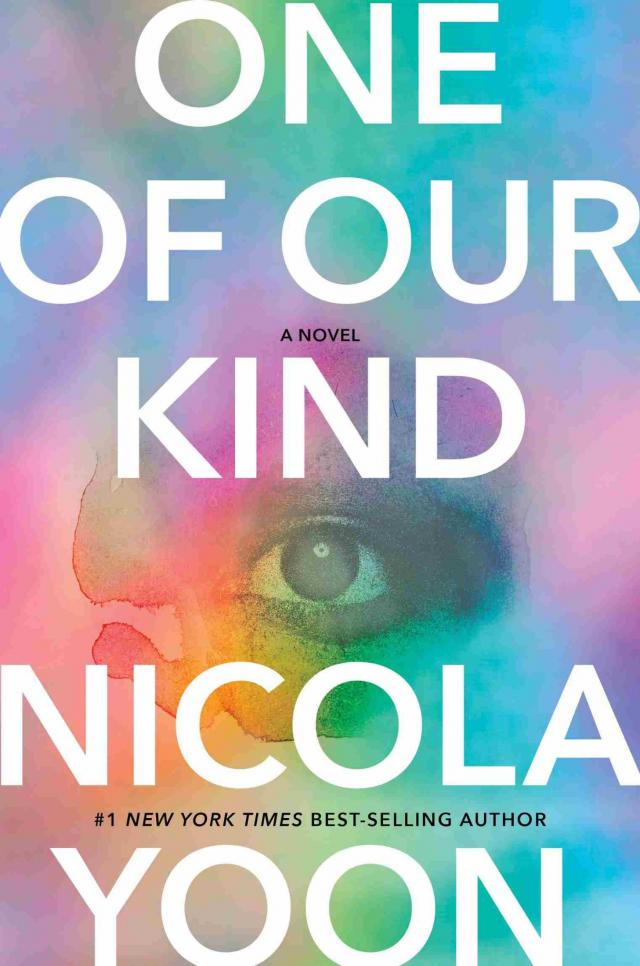
This is a Borzoi Book
Published by Alfred A. Knopf
Copyright © 2024 by Nicola Yoon
All rights reserved. Published in the United States by Alfred A. Knopf, a division of Penguin Random House LLC, New York, and distributed in Canada by Penguin Random House Canada Limited, Toronto.
www.aaknopf.com
Knopf, Borzoi Books, and the colophon are registered trademarks of Penguin Random House LLC.
Library of Congress Cataloging-in-Publication Data
Name: Yoon, Nicola, author.
Title: One of our kind : a novel / Nicola Yoon.
Description: New York | Alfred A. Knopf, 2024.
Identifiers: LCCN 2023031557 (print) | LCCN 2023031558 (ebook) | ISBN 9780593688434 (open market) | ISBN 9780593470671 (hardcover) | ISBN 9780593470695 (ebook)
Subjects: LCSH: African American families—Fiction. | LCGFT: Novels.
Classification: LCC PS3625.O5375 O54 2024 (print) | LCC PS3625.O5375 (ebook) | DDC 813/.6—dc23/eng/20231023
LC record available at https://lccn.loc.gov/2023031557
LC ebook record available at https://lccn.loc.gov/2023031558
Ebook ISBN 9780593470695
This is a work of fiction. Names, characters, places, and incidents either are the product of the author’s imagination or are used fictitiously. Any resemblance to actual persons, living or dead, events, or locales is entirely coincidental.
Cover images: Shutterstock
Cover design by John Gall
ep_prh_7.0_147238667_c0_r0
Contents
Dedication
Epigraph
Part One
Chapter 1
Comments 1378
Part Two
Chapter 1
Chapter 2
Chapter 3
Chapter 4
Black Business Insider: "Profiles in Brief: Carlton Way"
Chapter 5
Excerpt from Black Excellence Magazine: Catherine Vail, Accent Whisperer to the Stars
Chapter 6
Chapter 7
Liberty Day School
Chapter 8
Chapter 9
Excerpt from an interview with Angela and Benjamin Sayles in the “Power Couples” issue of Mahogany Magazine
Chapter 10
Chapter 11
Chapter 12
Delineating the Impact of Racial Trauma on Black Americans and the Black Diaspora
Chapter 13
Chapter 14
Chapter 15
Chapter 16
Chapter 17
Chapter 18
Excerpt from an interview with Carlton Way in the “Black Power” issue of Mahogany Magazine
Chapter 19
Part Three
Chapter 1
Chapter 2
Chapter 3
Chapter 4
Chapter 5
Part Four
Chapter 1
Excerpt from The Brooklyn Informer newspaper
Chapter 2
Excerpt from the San Antonio Examiner
Chapter 3
Chapter 4
Excerpt from the Charleston Post Gazette
Chapter 5
Excerpt from The Missouri Sun Times
Chapter 6
Part Five
Chapter 1
Chapter 2
Chapter 3
Chapter 4
Chapter 5
Epilogue
Acknowledgments
About the Author
_147238667_
TO ALL OF US
“A long leash is still a leash.”
—Octavia Butler, Patternmaster
“Definitions belonged to the definers, not the defined.”
—Toni Morrison, Beloved
PART
ONE
1
“It really is beautiful here,” Jasmyn says, looking out of the passenger-side window. Here is the Black history museum with its massive roman columns and grand staircase. Next door, the manicured sculpture garden is populated with statues of W. E. B. Du Bois, Marcus Garvey, Stokely Carmichael, Malcolm X, and, of course, Martin Luther King Jr. A block later the Liberty Theater, with its ornate rococo stylings, comes into view. Enormous posters announce the dates for December’s Nutcracker performance. Beautiful Black ballerinas star in every role from the Rat King to the Sugar Plum fairy.
Her husband, Kingston—everyone calls him King—takes a hand off the steering wheel and squeezes her knee. “Been a long time coming,” he says.
Jasmyn smiles at his profile and rests her hand atop his. God knows he’d worked hard enough to get them to here. Here being Liberty, California, a small suburb on the outskirts of Los Angeles.
She turns her eager gaze back to the sights of the downtown district. They pass Liberty Gardens with its bountiful variety of cacti and succulents. On a previous visit, she’d learned from the entrance plaque that desert flowers have unique adaptations that allow them to extract the maximum amount of moisture possible from their parched environment. Jasmyn told King she felt a kinship with them because of the way they found a way to thrive despite hardship.
“Bet they’d prefer if it just rained a little more,” he teased.
“Probably,” Jasmyn said, and laughed along with him.
They drive by the aquatic complex, and then the equestrian center, where she sees two young Black girls, twelve or thirteen years old, looking sharp in their riding jackets, breeches, and boots.
Finally, they begin the drive up Liberty Hill to the residential section. They’d visited Liberty three times before, but Jasmyn is still awestruck and, if she’s being honest, a little discomfited at the sheer size of the houses. Why call them houses at all? Modern-day castles are what they are. Expansive lawns and landscaped hedges. Wide circular driveways, most with fountains or some other architectural water feature. Multiple cars that start at six figures. They pass two parked pool service vans and another for tennis court maintenance.
It’s hard for Jasmyn to believe that everyone who lives here is Black. Harder to believe that, in just one month, she’s going to be one of the Black people who lives here. The Jasmyn that grew up fighting for space in a cramped, one-bedroom apartment with her mother, grandmother, and older sister couldn’t have imagined she’d end up in a place like this. That Jasmyn would’ve thought this kind of living was only possible for the rich white people she saw in TV shows.
But here she is, driving by these outrageously colossal homes, on her way to her own outrageously colossal home.
King turns down their soon-to-be street. It’s a week before Thanksgiving, but a handful of the houses already have Christmas decorations up. The first has not one, but two enormous Christmas trees on either side of the lawn. Both are flocked and decorated with crystal snowflakes. Closer to the house itself, spiral-strung lights ascend to the top of their fifty-foot-tall palm trees. There are wreaths in every window and a more elaborate one hanging from the front door.
But it’s the house half a block later that makes Jasmyn ask King to slow down and pull over.
“These people aren’t playing,” King says.
The house has three separate displays, all of them animatronic and so realistic Jasmyn does a triple take. On the left side of the driveway there’s a nativity display complete with bowing Wise Men, baby Jesus in a manger, and two angels with wings beating lightly. On the right, there’s an elaborate Santa’s workshop display featuring Mrs. Claus and her helper elves wrapping a tower of presents. The final display is on the roof. Santa, resplendent and jolly, is poised for takeoff in a life-sized sleigh, complete with rearing reindeer led by Rudolph.
But the most incredible part to Jasmyn, the part that makes her smile wide, is that all the figures are Black. Santa and Mrs. Claus. The angels and the elves. Baby Jesus and the Three Wise Men. Every one of them, a shade of brown.
“Just beautiful,” she says.
She’s seen Black Santas before, of course. For the last two years, she’s made a special effort to seek one out for their six-year-old son, Kamau. And to this day, she still remembers the first time she ever saw one. She’d been nine and overheard their neighbor telling her mother about it.
“I hear they got themselves a Black Santa down at the mall,” the woman had said.
Jasmyn begged her mother to go and meet him. The following weekend, along with every Black family in the neighborhood, they went. The line was long and her mother was mad by the time they got to the front. But Jasmyn sat on Santa’s lap and asked him for the thing she thought a Black Santa would understand: money. Money so her mother didn’t have to work two jobs. Money so she could have her own room and not have to share the living room with her sister, Ivy. Money so they could afford a house in a neighborhood that was less dangerous. It didn’t occur to her to ask for one in a neighborhood that wasn’t dangerous at all.
Six weeks later her grandmother died and left Jasmyn’s mother
King leans closer to her so he can get a better view of the display. “We definitely making the right move, baby,” he says.
He says it because at first, Jasmyn had taken some convincing.
Liberty is something more than a neighborhood and less than a township. According to the brochure, it’s a community. A gated, outrageously wealthy, and Black community.
“A Black utopia,” King had said when he first told her about it. “Everyone from the mayor to the police chief to the beat cops to the janitors, all Black.”
“How can they keep it all Black legally?” she asked.
Kingston eyed her like she was naive. “How many white folks you know want to move into a predominantly Black neighborhood?”
She conceded the point.
“It’s a place where we can be free to relax and be ourselves,” Kingston said.
She was skeptical still.
“There are no utopias,” she told him. Certainly not for Black people and certainly not in America. Not anywhere in the world, if she was being real. She reminded him that Black utopias had been tried with little success before: Allensworth and Soul City, for example.
“This one will last,” he’d insisted.
And she’d wanted him to be right. Wanted to live in a place surrounded by like-minded, thriving Black people. A place with wide, quiet streets where their son could ride his bike, carefree, with other little Black boys. A place where both King and Kamau would be safe walking around at night. She imagined them going for a stroll on some cold evening, both of them wearing hoodies. She imagined a cop car pulling alongside them. But this cop car had Black cops, and they were slowing down just to wish them a good evening.
But Liberty’s wealth got under her skin. Would she fit in with rich people, even if they were Black? Would she ever get used to being wealthy herself? And worse than that insecurity was this: she didn’t want to turn into one of those bougie Black people who forgot where they were from—and the people they came from—as soon as they got a little walking-around money.
“Baby, what are you talking about?” King had asked. “We haven’t lived in the hood for a minute now,” he said.
They’d argued in the kitchen of their two-bedroom apartment in the mid-city district. The neighborhood was working class, with quite a few older immigrants, their first-generation kids, and, of course, Black people. It wasn’t rundown by any means and it certainly was better than Compton, where Jasmyn and King had both grown up. Still, there were homeless tents every few blocks or so. Some stores were still boarded up from the protests against police brutality a few summers before. The public school they sent Kamau to was decent but didn’t have nearly enough Black teachers. Living there made Jasmyn feel like she’d come far from where she started out, but not too far. She still felt a part of the pulse of the Black community in LA.
King had been more upset by her resistance than she’d expected. “You’re a public defender. You do more for our folks and our community than most people, for God’s sake,” he’d said.
“That doesn’t mean I can just up and abandon them,” she said.
He stared at her, mouth hanging open for a few seconds, before saying anything. “How is it abandoning? It’s not like you’re leaving your job. I’m talking about moving to a place with only Black people.”
Jasmyn knew her resistance was more emotional than logical, but she couldn’t shake the feeling that she’d be losing some part of herself if she moved.
It’d taken an incident with a white cop later in the spring to finally convince her to move.
“We should get going or we’ll be late,” King says now, and starts the car up. “We got the interior designer at ten and the landscape architect at eleven a.m.”
Jasmyn nods. “Maybe we should come back tonight with Kamau so he can see those animatronics lit up and moving,” she says as they pull away.
King squeezes her hand. “Good idea.”
“Can you imagine his little face when he sees all this?”
King bulges his eyes out, imitating the funny face that Kamau makes when he’s amazed by something. They both laugh.
Jasmyn rolls down her window and sticks her arm outside, letting her hand ride the air currents the way she used to as a child. She takes a long breath. Even the air in Liberty smells different, crisp and new. They pass two more Black Santas. A young couple walking with their toddler son and a dog waves to them as they drive by. Jasmyn smiles wide and waves back. In a couple of months she and King and Kamau will be the ones waving to someone new in the neighborhood. Maybe they’d get a dog, too, once they were settled.
She rests her hand on her stomach. It’d taken them years longer than they’d planned to get pregnant again, but their second son is just seven months away. That Liberty, this place of Black splendor, will be all he knows fills her with pride. She imagines that growing up, surrounded on all sides by Black excellence, will plant a seed in both his and Kamau’s hearts. It will help them both flourish, secure in the knowledge of their own beauty and self-worth.
Jasmyn reaches across the console and squeezes King’s thigh. “You were right, baby,” she says. “This is the right move.”
COMMENTS 1378
In response to our article “Liberty: The Creation of a Modern Black Utopia”
The Los Angeles New Republic is committed to publishing a diversity of voices. We welcome your on-topic commentary, criticism and expertise. This conversation is moderated according to the Republic’s community rules. Please read the rules before joining the discussion.
• WHITE LIBERAL IN NYC
I am an older White liberal living in NYC and I have been a steadfast champion of civil rights practically my entire life. It never fails to surprise me how short-sighted Blacks can be, even a high achieving one such as Mr. Carlton Way undoubtedly is. Would the great Martin Luther King Jr. approve of this so-called utopia? I daresay he would not. He would call it what it is, a dystopia. Mr. King wanted us to unite! White, Black, Brown, Yellow, Red, Purple, Whatever! All peoples together. A community like Liberty is taking us backwards not forwards.
• DMN666
LMFAO. Why stop there? Why not go all the way back to Africa? Good riddance is what I say.
• BLACK AND CURIOUS IN SF
How do they decide who is Black? Does Mr. Way do it himself? Is there genetic testing? Is it the one-drop rule or the paper bag test?
• ARTHUR BANE
I am well aware that this will be a minority opinion in this “news”paper, but Liberty sounds idyllic. Maslow’s hierarchy of needs includes (among others) safety, belonging and love, esteem, and self-actualization. America has a long and atrocious history of denying these basic needs to its Black citizens. Why shouldn’t they carve out a place for themselves?
• FED UP IN MISSISSIPPI
Another day, another article about the Blacks and their discontents. Don’t you people have more important things to write about?
• PROFESSORGAYLE
Historically, all utopias have failed.
PART
TWO


