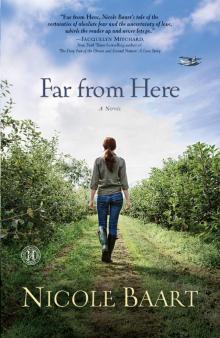
Where he left me, p.19
Where He Left Me, page 19


“Exactly,” he says, gesturing to the path between the trees. It’s barely discernible now, so snow-covered that I hadn’t even realized we were retracing our steps. I look at the stern set of Henry’s profile, and he must feel my gaze because he says: “If we don’t go back now, we might not be able to.”
He’s right, but that doesn’t stop the tears that spring to my eyes. I feel so hopeless. Like I’m tied to the tracks and a train is barreling down the line. I wish we would have never come across the antlers—we would’ve kept going.
And gotten stuck in a blizzard.
All at once I can picture it: the three of us stranded out here as the snow continues to ravage the mountain. It’s our bones I see, picked clean and bleached white come spring. An improbable tangle of limbs and stories that will never be told. I know we have to return, but Hemlock House doesn’t just feel haunted anymore, it feels like a tomb. And we’re going back to inter ourselves.
Every fiber of my being cries out for my husband. If only he were here. If only he had come home on Sunday like he was supposed to.
If only he had never left at all.
* * *
Henry stops more frequently on the way back and carefully examines the compass I’ve given him. He turns it this way and that, and a few times he even steps out of the side-by-side to examine the trail and squint off into the trees. There’s not much to see, and once, when an almighty gust tosses a powder keg of snow, he disappears completely. For just a moment, Finn and I are left behind. Trapped in a white, icy grave. Seconds later, when the dark silhouette of Henry reappears, I feel a surge of affection for him so strong it stings.
As he climbs back into the Ranger, his movements labored and heavy, I know we’re lost.
“How long?” I ask.
“Since we left the trail?”
I nod, and even though Henry doesn’t look at me, he must sense the movement. He says, “Only fifteen minutes or so. I think.”
Pressing Finn’s head to my chest, I swivel around trying to see where we came from and how we might retrace our steps.
“We can’t go back.” Henry puffs a frustrated breath. “And we can’t just head north—the homestead is a much smaller target than a highway.”
I think of the long stretch of road we were aiming for and then the little cluster of buildings that comprise Hemlock House. It’s just a tiny speck somewhere in the wilderness. Our chances of finding it without the benefit of David’s old trail system are beyond slim.
Panic thrums beneath my skin, a furious drumbeat that for the first time in hours makes me feel hot. I got Henry and Finn into this mess. It’s my job to get them out.
“Stay put,” I say, twisting out from underneath Finn.
“Where are you going?”
“We can’t be too far from the homestead. There must be a whole grid of trails nearby, and I know from riding a few of them with Felix that there are markings all along the way.” Not many, and David didn’t bother with reflective metal trail signs like he probably should have, but I’ve seen lengths of pale orange fabric tied on low-hanging branches at intersections or after a particularly long, uninterrupted stretch. Just a little token of civilization in the midst of this great unknown. “If I find one, we can get back on track.”
“So, we’ll drive slow and look for them,” Henry says, a note of desperation in his voice. “You can’t go running around out there.”
“You worried about me?”
Henry glares at me, which was exactly what I wanted. Better for him to feel incensed than defeated.
“You know we’ll never be able to see a ribbon from here,” I say, wrenching open the door before he can argue further. “It’s the only way.”
Finn looks straight at me as I ease the door shut, his eyes clear for just a moment. He doesn’t look scared, he looks trusting, as if he knows that even though we’re trapped in a precarious situation, I’ll keep him safe. It feels misplaced.
Outside of the protection of the cab, the wind howls like a banshee and whips snow in my face. Within seconds, my damp eyelashes are crusted in ice particles and my lips feel dry and cracked. I wish for a balaclava, a pair of snow goggles. But I comfort myself with thoughts of the fire that Henry let smolder in the inviolable cast-iron stove, and trudge forward through the deepening snow. Henry has no choice but to follow in the Ranger at a snail’s pace several feet behind me.
At first, I stumble from tree to tree, steadying myself against the thick trunks and searching for any evidence of human interference—one of the tattered ribbons, a nail, anything that might be a clue that we’re headed in the right direction. But when several minutes pass and I see nothing of the sort, I realize that this may be a doomed endeavor. Instead of focusing so narrowly on the individual trees, I start to scan the area, hoping for a glimpse of something—anything—that stands out against the unrelenting sea of white around me.
When a splash of red appears in the distance, I blink and then blink again, sure that my eyes are playing tricks on me. The world has become unyieldingly monochrome, and the interruption materializes like an oasis in the desert. A mirage, nothing more. But in moments when the snow parts like a veil, the color remains, a stain that only seems to intensify the more I stare at it.
Something breaks inside of me, a splintering that began when I first looked at the clock several nights ago and wondered why Felix wasn’t home from the airport yet. I remember the morning he left, his freshly shaven face, the weight in his eyes that suddenly seems like a crucial detail I missed. He was burdened the morning he left, preoccupied with something.
He was wearing his favorite red sweater.
I’m running before I have time to stop and think about what I’m doing. My whole body is pulsing with one thought: Felix. My husband, here all along. An apparition in a red sweater beneath a universe of falling snow.
It isn’t until I’ve nearly stumbled over the specter that I understand I’ve made a terrible mistake.
Yes, there is crimson amid the snow. A vibrant spill of it, as bright and garish as a sacrifice. But it’s not Felix’s sweater, or anything that might offer me comfort or hope. Instead, a carcass is split open on the ground.
Fur and hooves, a rib cage fanned open like a fragile, broken instrument. Snow wreaths the limbs but melts in the still-warm cavity that gapes open, stinking and ripe. It’s nearly empty, the tender organs devoured, the tough hide left for scavengers.
He grabs me from behind, and my scream is swallowed by the wind. But Henry is undeterred as he drags me backward, away from the carnage. “Come on!” he shouts, twisting me around and jerking me in the direction of the Ranger. At least, I think that’s where we’re headed; I can’t see it anymore. And then he’s taking me by the wrist and we’re running as best we can. Tripping and stumbling and holding each other up until the black shape of the UTV looms directly ahead and the kill is left behind for burial by snowstorm. We only stop when we can fling ourselves at the icy, unyielding side of the Ranger. I’m leaning against it, catching my breath when Henry whirls on me.
“What were you thinking?” he growls, biting off each word with such fury it would frighten me if I wasn’t so numb.
I can’t respond. Words seem just out of reach, a luxury I can’t afford when everything inside of me just wants to give up.
Henry must realize I’m in no shape to fight—that we’re all clinging on by a very thin thread—because as quickly as his anger flares, it fades. He drags one gloved hand across his face and sighs. “You shouldn’t have done that. We have to stick together. We could’ve…”
He trails off, but there are a half dozen ways to finish that grim sentence. We could’ve gotten separated from each other. Or lost. If Henry and I didn’t find our way back to the Ranger, what would have happened to Finn? For a moment I feel like I’m going to throw up, but I swallow down the bile in my throat. Henry is right, I shouldn’t have run off. It was selfish and stupid.
“I’m sorry,” I say. “I thought I saw something.” Felix. I thought for just a moment that my husband was closer than I could have ever imagined. And I’d be lying if I didn’t say that the residue of his presence still clings to me now.
I feel him.
But maybe that’s just a cocktail of hypothermia and longing. Or trauma from the gruesome tableau laid out like an offering on the forest floor.
Henry doesn’t accept my apology, but he does offer an explanation. “The work of wolves,” he tells me simply. “There aren’t many, but they’re here. Sometimes they take what they want and leave the rest for scavengers.”
Somehow, this makes me feel marginally better. The natural way of things is a much more palatable explanation than poachers—or something even darker. My mind is playing tricks on me out here, and I wish, not for the first time, that we had never left Hemlock House.
“Let’s get out of here,” Henry says, shielding his face from a gust of wind that whirls a funnel of snow at his head. “I found a trail marker.”
It’s just enough hope to keep me going.
CHAPTER 12
WEDNESDAY
It takes us nearly two hours, but we somehow manage to find our way back. We lose the trail again and again, only to catch a glimpse of orange through the blizzard, as if something (someone?) is leading us through. With Henry setting a course for north-northeast, we crisscross our way through the forest and eventually stumble upon a landmark I recognize.
“Go left!” I blurt, reaching across Finn to grab Henry’s arm.
“But the path leads—”
“Trust me. Those boulders point the way to the creek, and if we take a left here, we’ll emerge between the stable and the greenhouse. It’s not far—maybe a quarter mile?”
Henry glances over at me, wavering, but he must see the certainty in my eyes because he does as I ask. Several minutes later the leaning stable of the homestead appears between the snarl of trees like a vision. Henry catches my eye over Finn’s head, and something powerful passes between us. Relief and gratitude after the stress of the last few hours, but it’s more than that. We’re connected now, bonded by this crazy ordeal and the knowledge that we could have died out on the mountain. I find I’m proud of us. Proud of Henry.
“You’re going to have to carry him,” I say when Henry has parked and shut off the Ranger. Finn is fully slumped against me, and his hot head pressed against my neck is damp with sweat. Now that we’re safe—or at least in a place where we can get warm—a new kind of fear slinks in. We survived our ill-advised attempt to off-road our way to Requiem, but our situation is still perilous, to say the least. And I’m so worried about Finn my chest aches.
Inside, protected from the wind and driving snow, it feels like a sauna. Henry and I kick off our ice-crusted boots and make a beeline for the living room. It’s warmer in here, the heat of this morning’s fire still radiating from the black belly of the cast-iron stove, and goose bumps race across my skin. Thawing will be painful, and I already know that my fingers and toes will burn as they come back to life.
But none of that matters now. Henry lays Finn down on the couch and goes to stoke the fire while I get the boy settled. We agree to this wordlessly, our actions quick and decisive, intended to be as efficient and productive as possible. We instinctively know what to do, and while Henry throws more logs on the still-smoldering coals, I help Finn out of his damp coat.
“Hey, Finn,” I say quietly, sliding down the coat zipper and then easing his arms out one by one. Finn’s eyes flutter, but he doesn’t respond. His limbs are limp and toneless, his wrists catching awkwardly in the sleeves of the heavy parka. I feel like I’m undressing a baby, and I have to repress the urge to kiss his pale forehead.
Behind me, Henry pokes at the fire and determinedly ignores my ministrations. He’s worried about Finn. It’s evident in the tight set of his shoulders, his quick, shallow breath. I want to assure him that everything is going to be just fine, but the words taste like dust on my tongue. Instead of offering insincere assurances, I say true things as I peel off Finn’s hat and gloves and settle the blankets over him.
“We made it back to Hemlock House,” I tell him. “Henry’s getting a fire going and we’ll be nice and toasty in no time. If we run out of wood, we’ll burn the coffee table. And the kitchen chairs and the boxes in the cellar!” I force a laugh, and it sounds manic even to my own ears. Finn stirs a little, his fingertips twitching. I don’t think he’s unconscious, just drifting in and out, sleepy and sick and probably in desperate need of IV fluids and some hard-hitting antibiotics. Neither of which I can offer him.
“We’ll get you some medicine,” I continue, thinking about what I can do. “And food and water. You’ll feel better soon.”
That last part seems like a bit of a white lie. Finn has definitely taken a turn for the worse. He’s pale and wheezy, and his cheeks are clammy against the back of my hand. When he breathes, the fine tendons in his neck stretch taut as violin strings. I know we’ve just clawed our way to shelter, but a part of me is already eager to try again. Finn needs help.
“We need some extra pillows,” I tell Henry. “Something to prop him up a bit. And it’s time to try an expectorant. Does Finn have any known allergies to medications?”
“What? What do you mean?” Henry turns from the fire, his expression at once anxious and defensive. After the heroics of his masterful navigation through the woods, he looks impossibly young and frightened. I get it. The fear of a blizzard can’t hold a candle to the dread that looking at Finn stirs up. And Henry doesn’t want to admit that he has no idea what an expectorant is. Or maybe even a medical allergy. It’s a big ask.
I give him a soft smile. “I just need to know if he has ever taken medication and had a bad reaction. A rash, trouble breathing, anything out of the ordinary.”
“I don’t know. I don’t think so.”
“Okay. With your permission, I would like to give Finn some cough syrup. It will help loosen up the mucus in his lungs. I’m afraid he’s having a hard time breathing.”
Henry wavers, but after a few seconds he stands a little straighter and says, “Let’s try it.”
“Good. I’ll get the medicine. Would you grab some pillows from upstairs?”
I think we’re both grateful to have a specific way to help Finn, because Henry all but bounds from the room. In the kitchen, I find the ibuprofen and cough syrup and fill a glass with orange juice from the nearly empty jug in the fridge. Even though the electricity has been out for hours, the interior of the refrigerator is still cold. I cast a glance at the freezer, knowing I should probably empty it before everything starts to melt. But that’s a problem for later.
Back in the living room, I wrap my arms around Finn and lift his torso so that Henry can slide a pair of pillows beneath him. “He’ll be able to breathe easier if he’s not lying flat on his back,” I tell Henry. Then I hand him the small cup of purple cough syrup. “Finn will take it better from you.”
I perch on the edge of the coffee table and watch as Henry sits beside his brother and touches his face.
“Finn,” he says, his voice uncharacteristically gentle. “Finny-Boy, Finnigan Begin-Again, Finn Thomas… Come on, Finn. Wake up.”
Whether it’s the sound of his brother’s voice or the brush of his calloused finger along his cheek, Finn does as he’s told.
“Oh, hey.” Henry smiles. “There you are. Hi, bud.”
My heart pinches at the way Finn’s face lights up at the sight of his brother. For just a moment his rich golden-brown eyes sparkle, and then they drift closed again.
“Stay with me, Finn.” Henry lightly taps his brother’s cheek with his fingers. “You gotta take this stuff. It’ll make you feel better.”
“It tastes gross,” I tell him. “But there’s some juice here to chase it.”
“Aw, man.” Henry sniffs it and pulls a face. “It’s disgusting. You can’t take it, Finn. It’ll make you throw up. Projectile vomit all over the place—all over me. And that’s a no-go. I’ve changed my mind. No medicine.”
The corner of Finn’s mouth quirks as he struggles to open his eyes and keep them open. Henry is gagging now, smelling the cough syrup and then pulling exaggerated faces that elicit a breathy little half laugh from Finn. I’m elated—until the laugh ends in a coughing fit.
I lean forward to prop Finn up even more, lifting his head so that the weight of gravity on his own chest doesn’t make matters worse. With my hand on his back as he rasps and hacks, I can feel the deep, unsettling rumble of his lungs. It’s terrifying.
When the fit passes, Finn has been roused enough to swallow the cough medicine, a couple ibuprofen, and a few sips of orange juice. I keep encouraging Henry to tip just a bit more juice into his brother’s mouth, because I’m not sure when we’ll get another chance to hydrate Finn, but the boy slumps back after barely an inch is gone. I try to reassure myself it’s better than nothing.
Henry hands me the glass as he pulls the blankets back up over Finn. Then he glances at me, and I find myself raising one hand for a high five. It’s a bizarre, instinctual move—a remnant from my middle school teaching days, no doubt—and for a second, I’m mortified. But then Henry’s mouth pulls into a tight line that could be interpreted as a smile, and he gives my hand a soft slap. I can’t stop the grin that blooms. True, our situation couldn’t possibly get much worse, but we survived the storm and managed to dose Finn.
I’ll take whatever wins I can get.
* * *
When I was a little girl, I attended the church in our Milwaukee neighborhood. My mother had once been a devout Lutheran, but after my dad and brother died, she said God had abandoned her. I wasn’t old enough to know anything at all about religion, but when our next-door neighbors offered to take me off her hands on Sunday mornings, she gratefully accepted—any beef she had with the Almighty did not extend to me.
I loved church. It was a small, nondenominational Bible church with red Kool-Aid and watery coffee on a table near the entrance, and a Sunday school teacher who smelled of roses. She used to draw me close when she read the Bible story, letting me look at the pictures before she turned the book around for the rest of the circle to see. Looking back, I realize that she must have felt sorry for me, a pint-size charity case with unbrushed hair.
He’s right, but that doesn’t stop the tears that spring to my eyes. I feel so hopeless. Like I’m tied to the tracks and a train is barreling down the line. I wish we would have never come across the antlers—we would’ve kept going.
And gotten stuck in a blizzard.
All at once I can picture it: the three of us stranded out here as the snow continues to ravage the mountain. It’s our bones I see, picked clean and bleached white come spring. An improbable tangle of limbs and stories that will never be told. I know we have to return, but Hemlock House doesn’t just feel haunted anymore, it feels like a tomb. And we’re going back to inter ourselves.
Every fiber of my being cries out for my husband. If only he were here. If only he had come home on Sunday like he was supposed to.
If only he had never left at all.
* * *
Henry stops more frequently on the way back and carefully examines the compass I’ve given him. He turns it this way and that, and a few times he even steps out of the side-by-side to examine the trail and squint off into the trees. There’s not much to see, and once, when an almighty gust tosses a powder keg of snow, he disappears completely. For just a moment, Finn and I are left behind. Trapped in a white, icy grave. Seconds later, when the dark silhouette of Henry reappears, I feel a surge of affection for him so strong it stings.
As he climbs back into the Ranger, his movements labored and heavy, I know we’re lost.
“How long?” I ask.
“Since we left the trail?”
I nod, and even though Henry doesn’t look at me, he must sense the movement. He says, “Only fifteen minutes or so. I think.”
Pressing Finn’s head to my chest, I swivel around trying to see where we came from and how we might retrace our steps.
“We can’t go back.” Henry puffs a frustrated breath. “And we can’t just head north—the homestead is a much smaller target than a highway.”
I think of the long stretch of road we were aiming for and then the little cluster of buildings that comprise Hemlock House. It’s just a tiny speck somewhere in the wilderness. Our chances of finding it without the benefit of David’s old trail system are beyond slim.
Panic thrums beneath my skin, a furious drumbeat that for the first time in hours makes me feel hot. I got Henry and Finn into this mess. It’s my job to get them out.
“Stay put,” I say, twisting out from underneath Finn.
“Where are you going?”
“We can’t be too far from the homestead. There must be a whole grid of trails nearby, and I know from riding a few of them with Felix that there are markings all along the way.” Not many, and David didn’t bother with reflective metal trail signs like he probably should have, but I’ve seen lengths of pale orange fabric tied on low-hanging branches at intersections or after a particularly long, uninterrupted stretch. Just a little token of civilization in the midst of this great unknown. “If I find one, we can get back on track.”
“So, we’ll drive slow and look for them,” Henry says, a note of desperation in his voice. “You can’t go running around out there.”
“You worried about me?”
Henry glares at me, which was exactly what I wanted. Better for him to feel incensed than defeated.
“You know we’ll never be able to see a ribbon from here,” I say, wrenching open the door before he can argue further. “It’s the only way.”
Finn looks straight at me as I ease the door shut, his eyes clear for just a moment. He doesn’t look scared, he looks trusting, as if he knows that even though we’re trapped in a precarious situation, I’ll keep him safe. It feels misplaced.
Outside of the protection of the cab, the wind howls like a banshee and whips snow in my face. Within seconds, my damp eyelashes are crusted in ice particles and my lips feel dry and cracked. I wish for a balaclava, a pair of snow goggles. But I comfort myself with thoughts of the fire that Henry let smolder in the inviolable cast-iron stove, and trudge forward through the deepening snow. Henry has no choice but to follow in the Ranger at a snail’s pace several feet behind me.
At first, I stumble from tree to tree, steadying myself against the thick trunks and searching for any evidence of human interference—one of the tattered ribbons, a nail, anything that might be a clue that we’re headed in the right direction. But when several minutes pass and I see nothing of the sort, I realize that this may be a doomed endeavor. Instead of focusing so narrowly on the individual trees, I start to scan the area, hoping for a glimpse of something—anything—that stands out against the unrelenting sea of white around me.
When a splash of red appears in the distance, I blink and then blink again, sure that my eyes are playing tricks on me. The world has become unyieldingly monochrome, and the interruption materializes like an oasis in the desert. A mirage, nothing more. But in moments when the snow parts like a veil, the color remains, a stain that only seems to intensify the more I stare at it.
Something breaks inside of me, a splintering that began when I first looked at the clock several nights ago and wondered why Felix wasn’t home from the airport yet. I remember the morning he left, his freshly shaven face, the weight in his eyes that suddenly seems like a crucial detail I missed. He was burdened the morning he left, preoccupied with something.
He was wearing his favorite red sweater.
I’m running before I have time to stop and think about what I’m doing. My whole body is pulsing with one thought: Felix. My husband, here all along. An apparition in a red sweater beneath a universe of falling snow.
It isn’t until I’ve nearly stumbled over the specter that I understand I’ve made a terrible mistake.
Yes, there is crimson amid the snow. A vibrant spill of it, as bright and garish as a sacrifice. But it’s not Felix’s sweater, or anything that might offer me comfort or hope. Instead, a carcass is split open on the ground.
Fur and hooves, a rib cage fanned open like a fragile, broken instrument. Snow wreaths the limbs but melts in the still-warm cavity that gapes open, stinking and ripe. It’s nearly empty, the tender organs devoured, the tough hide left for scavengers.
He grabs me from behind, and my scream is swallowed by the wind. But Henry is undeterred as he drags me backward, away from the carnage. “Come on!” he shouts, twisting me around and jerking me in the direction of the Ranger. At least, I think that’s where we’re headed; I can’t see it anymore. And then he’s taking me by the wrist and we’re running as best we can. Tripping and stumbling and holding each other up until the black shape of the UTV looms directly ahead and the kill is left behind for burial by snowstorm. We only stop when we can fling ourselves at the icy, unyielding side of the Ranger. I’m leaning against it, catching my breath when Henry whirls on me.
“What were you thinking?” he growls, biting off each word with such fury it would frighten me if I wasn’t so numb.
I can’t respond. Words seem just out of reach, a luxury I can’t afford when everything inside of me just wants to give up.
Henry must realize I’m in no shape to fight—that we’re all clinging on by a very thin thread—because as quickly as his anger flares, it fades. He drags one gloved hand across his face and sighs. “You shouldn’t have done that. We have to stick together. We could’ve…”
He trails off, but there are a half dozen ways to finish that grim sentence. We could’ve gotten separated from each other. Or lost. If Henry and I didn’t find our way back to the Ranger, what would have happened to Finn? For a moment I feel like I’m going to throw up, but I swallow down the bile in my throat. Henry is right, I shouldn’t have run off. It was selfish and stupid.
“I’m sorry,” I say. “I thought I saw something.” Felix. I thought for just a moment that my husband was closer than I could have ever imagined. And I’d be lying if I didn’t say that the residue of his presence still clings to me now.
I feel him.
But maybe that’s just a cocktail of hypothermia and longing. Or trauma from the gruesome tableau laid out like an offering on the forest floor.
Henry doesn’t accept my apology, but he does offer an explanation. “The work of wolves,” he tells me simply. “There aren’t many, but they’re here. Sometimes they take what they want and leave the rest for scavengers.”
Somehow, this makes me feel marginally better. The natural way of things is a much more palatable explanation than poachers—or something even darker. My mind is playing tricks on me out here, and I wish, not for the first time, that we had never left Hemlock House.
“Let’s get out of here,” Henry says, shielding his face from a gust of wind that whirls a funnel of snow at his head. “I found a trail marker.”
It’s just enough hope to keep me going.
CHAPTER 12
WEDNESDAY
It takes us nearly two hours, but we somehow manage to find our way back. We lose the trail again and again, only to catch a glimpse of orange through the blizzard, as if something (someone?) is leading us through. With Henry setting a course for north-northeast, we crisscross our way through the forest and eventually stumble upon a landmark I recognize.
“Go left!” I blurt, reaching across Finn to grab Henry’s arm.
“But the path leads—”
“Trust me. Those boulders point the way to the creek, and if we take a left here, we’ll emerge between the stable and the greenhouse. It’s not far—maybe a quarter mile?”
Henry glances over at me, wavering, but he must see the certainty in my eyes because he does as I ask. Several minutes later the leaning stable of the homestead appears between the snarl of trees like a vision. Henry catches my eye over Finn’s head, and something powerful passes between us. Relief and gratitude after the stress of the last few hours, but it’s more than that. We’re connected now, bonded by this crazy ordeal and the knowledge that we could have died out on the mountain. I find I’m proud of us. Proud of Henry.
“You’re going to have to carry him,” I say when Henry has parked and shut off the Ranger. Finn is fully slumped against me, and his hot head pressed against my neck is damp with sweat. Now that we’re safe—or at least in a place where we can get warm—a new kind of fear slinks in. We survived our ill-advised attempt to off-road our way to Requiem, but our situation is still perilous, to say the least. And I’m so worried about Finn my chest aches.
Inside, protected from the wind and driving snow, it feels like a sauna. Henry and I kick off our ice-crusted boots and make a beeline for the living room. It’s warmer in here, the heat of this morning’s fire still radiating from the black belly of the cast-iron stove, and goose bumps race across my skin. Thawing will be painful, and I already know that my fingers and toes will burn as they come back to life.
But none of that matters now. Henry lays Finn down on the couch and goes to stoke the fire while I get the boy settled. We agree to this wordlessly, our actions quick and decisive, intended to be as efficient and productive as possible. We instinctively know what to do, and while Henry throws more logs on the still-smoldering coals, I help Finn out of his damp coat.
“Hey, Finn,” I say quietly, sliding down the coat zipper and then easing his arms out one by one. Finn’s eyes flutter, but he doesn’t respond. His limbs are limp and toneless, his wrists catching awkwardly in the sleeves of the heavy parka. I feel like I’m undressing a baby, and I have to repress the urge to kiss his pale forehead.
Behind me, Henry pokes at the fire and determinedly ignores my ministrations. He’s worried about Finn. It’s evident in the tight set of his shoulders, his quick, shallow breath. I want to assure him that everything is going to be just fine, but the words taste like dust on my tongue. Instead of offering insincere assurances, I say true things as I peel off Finn’s hat and gloves and settle the blankets over him.
“We made it back to Hemlock House,” I tell him. “Henry’s getting a fire going and we’ll be nice and toasty in no time. If we run out of wood, we’ll burn the coffee table. And the kitchen chairs and the boxes in the cellar!” I force a laugh, and it sounds manic even to my own ears. Finn stirs a little, his fingertips twitching. I don’t think he’s unconscious, just drifting in and out, sleepy and sick and probably in desperate need of IV fluids and some hard-hitting antibiotics. Neither of which I can offer him.
“We’ll get you some medicine,” I continue, thinking about what I can do. “And food and water. You’ll feel better soon.”
That last part seems like a bit of a white lie. Finn has definitely taken a turn for the worse. He’s pale and wheezy, and his cheeks are clammy against the back of my hand. When he breathes, the fine tendons in his neck stretch taut as violin strings. I know we’ve just clawed our way to shelter, but a part of me is already eager to try again. Finn needs help.
“We need some extra pillows,” I tell Henry. “Something to prop him up a bit. And it’s time to try an expectorant. Does Finn have any known allergies to medications?”
“What? What do you mean?” Henry turns from the fire, his expression at once anxious and defensive. After the heroics of his masterful navigation through the woods, he looks impossibly young and frightened. I get it. The fear of a blizzard can’t hold a candle to the dread that looking at Finn stirs up. And Henry doesn’t want to admit that he has no idea what an expectorant is. Or maybe even a medical allergy. It’s a big ask.
I give him a soft smile. “I just need to know if he has ever taken medication and had a bad reaction. A rash, trouble breathing, anything out of the ordinary.”
“I don’t know. I don’t think so.”
“Okay. With your permission, I would like to give Finn some cough syrup. It will help loosen up the mucus in his lungs. I’m afraid he’s having a hard time breathing.”
Henry wavers, but after a few seconds he stands a little straighter and says, “Let’s try it.”
“Good. I’ll get the medicine. Would you grab some pillows from upstairs?”
I think we’re both grateful to have a specific way to help Finn, because Henry all but bounds from the room. In the kitchen, I find the ibuprofen and cough syrup and fill a glass with orange juice from the nearly empty jug in the fridge. Even though the electricity has been out for hours, the interior of the refrigerator is still cold. I cast a glance at the freezer, knowing I should probably empty it before everything starts to melt. But that’s a problem for later.
Back in the living room, I wrap my arms around Finn and lift his torso so that Henry can slide a pair of pillows beneath him. “He’ll be able to breathe easier if he’s not lying flat on his back,” I tell Henry. Then I hand him the small cup of purple cough syrup. “Finn will take it better from you.”
I perch on the edge of the coffee table and watch as Henry sits beside his brother and touches his face.
“Finn,” he says, his voice uncharacteristically gentle. “Finny-Boy, Finnigan Begin-Again, Finn Thomas… Come on, Finn. Wake up.”
Whether it’s the sound of his brother’s voice or the brush of his calloused finger along his cheek, Finn does as he’s told.
“Oh, hey.” Henry smiles. “There you are. Hi, bud.”
My heart pinches at the way Finn’s face lights up at the sight of his brother. For just a moment his rich golden-brown eyes sparkle, and then they drift closed again.
“Stay with me, Finn.” Henry lightly taps his brother’s cheek with his fingers. “You gotta take this stuff. It’ll make you feel better.”
“It tastes gross,” I tell him. “But there’s some juice here to chase it.”
“Aw, man.” Henry sniffs it and pulls a face. “It’s disgusting. You can’t take it, Finn. It’ll make you throw up. Projectile vomit all over the place—all over me. And that’s a no-go. I’ve changed my mind. No medicine.”
The corner of Finn’s mouth quirks as he struggles to open his eyes and keep them open. Henry is gagging now, smelling the cough syrup and then pulling exaggerated faces that elicit a breathy little half laugh from Finn. I’m elated—until the laugh ends in a coughing fit.
I lean forward to prop Finn up even more, lifting his head so that the weight of gravity on his own chest doesn’t make matters worse. With my hand on his back as he rasps and hacks, I can feel the deep, unsettling rumble of his lungs. It’s terrifying.
When the fit passes, Finn has been roused enough to swallow the cough medicine, a couple ibuprofen, and a few sips of orange juice. I keep encouraging Henry to tip just a bit more juice into his brother’s mouth, because I’m not sure when we’ll get another chance to hydrate Finn, but the boy slumps back after barely an inch is gone. I try to reassure myself it’s better than nothing.
Henry hands me the glass as he pulls the blankets back up over Finn. Then he glances at me, and I find myself raising one hand for a high five. It’s a bizarre, instinctual move—a remnant from my middle school teaching days, no doubt—and for a second, I’m mortified. But then Henry’s mouth pulls into a tight line that could be interpreted as a smile, and he gives my hand a soft slap. I can’t stop the grin that blooms. True, our situation couldn’t possibly get much worse, but we survived the storm and managed to dose Finn.
I’ll take whatever wins I can get.
* * *
When I was a little girl, I attended the church in our Milwaukee neighborhood. My mother had once been a devout Lutheran, but after my dad and brother died, she said God had abandoned her. I wasn’t old enough to know anything at all about religion, but when our next-door neighbors offered to take me off her hands on Sunday mornings, she gratefully accepted—any beef she had with the Almighty did not extend to me.
I loved church. It was a small, nondenominational Bible church with red Kool-Aid and watery coffee on a table near the entrance, and a Sunday school teacher who smelled of roses. She used to draw me close when she read the Bible story, letting me look at the pictures before she turned the book around for the rest of the circle to see. Looking back, I realize that she must have felt sorry for me, a pint-size charity case with unbrushed hair.