

Dances, p.1
Dances, page 1


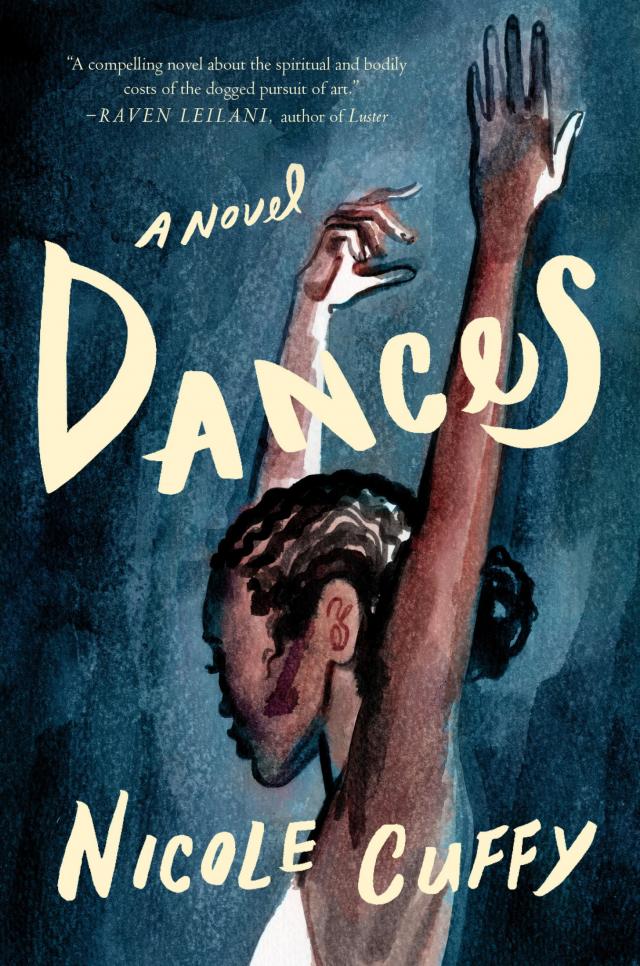
Dances is a work of fiction. Names, characters, places, and incidents are the products of the author’s imagination or are used fictitiously. Any resemblance to actual events, locales, or persons, living or dead, is entirely coincidental.
Copyright © 2023 by Nicole Cuffy LLC
All rights reserved.
Published in the United States by One World, an imprint of Random House, a division of Penguin Random House LLC, New York.
One World and colophon are registered trademarks of Penguin Random House LLC.
Hardback ISBN 9780593498156
Ebook ISBN 9780593498163
oneworldlit.com
randomhousebooks.com
Book design by Dana Leigh Blanchette, adapted for ebook
Cover design: Michael Morris
Cover illustration: Lauren Tamaki
ep_prh_6.1_143455484_c0_r0
Contents
Cover
Title Page
Copyright
Part I: Entrée
[barre]
Préparation
[center]
[adage]
[allegro]
Coda
[révérence]
Intermezzo
Part II: Adagio
Intermezzo
Part III: Ballabile
Part IV: Variations
[A]
[A1]
[A2]
[A3]
Intermezzo
Part V: La Danseuse
[pas de caractère]
Part VI: Le Danseur
Part VII: Coda
[apothéose]
Dedication
Acknowledgments
About the Author
_143455484_
I
ENTRÉE
[barre]
The princess has shed some of her earlier shyness and learned to trust her suitors. Her smile is as confident and bright as a new coin; gone is her earlier hesitation. There is plain, fresh-faced gratitude as she accepts a rose from each of her suitors. The roses are bright, white, scentless. She throws them, not cruelly but joyfully, almost ecstatically. It has been some fresh miracle, learning to trust these four princes, a dawning. No one has hurt her yet. She has not been hurt a day in her life, in fact, never so much as pricked her finger. She suspects that there is no such thing as suffering. She understands suffering in the abstract—it is what made her shy of her suitors at first, but that they have not caused her pain makes its possibility even more remote. No one has let her down yet. She can almost believe there is no such thing.
I am the princess.
My reality is dual: I am Aurora, the white princess, just turned sixteen, who knows no suffering, and I am also Cece, the Black dancer of twenty-two, whose toes are screaming from being en pointe for so long, who is sweating like a slave, and whose ankle is throbbing distantly from a slow-healing sprain. I am counting as I dance—there is little room in my head for much else, though for a flash I do wonder if I feel up to holding that last balance for a couple of extra beats. I step forward, taking my suitor’s hand as I rise en pointe in attitude derrière, ready for the first promenade. I am turned 360 degrees like a figurine, pivoting on the toes of my pointed foot, ankle protesting just outside the gates of my attention. I won’t hold the balance too long, but I’ll make sure to get my leg up nice and high in the arabesque to make up for it.
My second suitor approaches, and I steady myself, signaling the first suitor with a quick squeeze when I am ready for him to let go of my hand. For a brief moment, I am unsupported—or rather, I support myself—balanced on one leg. I bring both arms overhead in fifth position, the space between them an imaginary crown, and then I bring my arm back down, give my hand to the second suitor. Second promenade. I do this four times in total, ending with my high, unsupported arabesque. The music is swelling, the orchestra creating a big inhale. I tease the conductor a little bit by making the last supported pirouette a triple—he controls the music to match me. I smile mischievously at an audience I can’t see beyond the lights. The music thuds to its dramatic conclusion as I flourish my arms in third position. Oh Tchaikovsky, I think.
* * *
—
At the barre, I drown out the clunky, repetitive accompaniment by playing Tchaikovsky’s violin concerto in my mind. Tchaikovsky and Shostakovich—those were Paul’s favorites. Demi-plié and then grand plié, butt low to the ground, knees reaching over the second toes. Tendus, foot caressing the floor and then pointing: front, front, front fifth, front fifth, side, side, side fifth, side fifth, back, back, back fourth, back fourth, temps liés. And then dégagés, slow and fast, the foot caresses and then flies—front, side, back, side, side, back, side, front. Rond de jambe, the foot sweeping graceful half circles into the floor, and fondus and développés, the legs growing long now, delicious bloom in the hips and the inner thighs. Frappes, the legs loose at the knees, the feet playful. And finally, grand battements, lifting high, throwing the leg front, side, back, side. Company class is both repetitive and vital.
Alison is one of my favorite ballet mistresses at the company. She is perpetually in a good mood, her combinations are thoughtful, her corrections precise and gentle. She is in the middle of the room now, humming to herself and doing a kind of half dancing, sketching. I barely have to listen as she sets the next steps. I have been taking class with Alison since my student days at the School of American Ballet. The New York City Ballet does not hold open auditions; it pulls its dancers from SAB. Every class was a battle raged against imperfection. I remember the desperate thrill of it, the hunger. I stood out because of my Blackness, and I was determined then to obliterate it, to render my Blackness irrelevant with perfection.
Kaz, NYCB’s artistic director, took an interest in me early. He would slip into a class of young dancers, study us with his trademark stare. And he’d stop in front of me, watching me up close, very rarely offering a correction—only looking. To have Kaz’s eye on you was like an anointment, his very gaze material, an investiture. His fascination with me was unnerving, terrifying. His visits to classes were unpredictable. I never knew when he would be watching me, and so I had to constantly be perfect, beautiful. I was the only Black face in a sea of white and tan; I could not be anything but visible.
The pressure was enormous. I couldn’t have a bad turn day, or a fat day, when, no matter which clothes I wore, which mirror I checked, which angle I viewed myself from, all I saw was my body taking up too much space. When my knee started to ache, I couldn’t sit out for the big jumps at the end of class. I was a brick-brown kid from Brooklyn. There were people around me—students and faculty alike—waiting for proof that I couldn’t be graceful, that I was too heavy, too muscular, that my feet were too big, too flat, that I wasn’t classical. Ballet has always been about the body. The white body, specifically. So they watched my Black body, waited for it to confirm their prejudices, grew ever more anxious as it failed to do so, again and again.
I mark the little flourishes, the movement phases with my hands and feet, and then my body knows what to do. This has always been a skill of mine, remembering. I have been doing this routine—or variations thereof—every day for seventeen years. It is as ingrained in me as the movements required for tying my ribbons. I don’t have to think about it. Instead, I return to a favorite daydream of mine: I see the curtains rising, and the violin concerto is inflating, an orchestral bubble, and I can never work out whether it is I who appears first or my brother. Dwelling on Paul is a precious and carefully rationed indulgence. I just want him to see me now.
Préparation
Paul’s arrival in the world came ten years before my own. I remember the bony press of my brother’s lanky thigh against my knobby knee. There was, as there so often was, a record playing—Paganini, I think. In my small lap, I held the book Paul had brought home for me—an illustrated book about a ballerina, which neither of us could read because it was in Italian, but the last page of the book was a large watercolor of a girl in the middle of a grand pirouette en arabesque, pink-satin-clothed foot perfectly pointed. That’ll be you one day, Paul told me. I ran a finger along the dancer’s slender leg, reverent.
I tried to picture myself in the sparkling pink costume from the picture, spinning en pointe. I could almost feel it in my little body—the weight of the sequins and tulle, the weightlessness of the dance, the hard floor underneath my toes.
The dancer in the book had skin the color of a cloud in sunrise and straight yellow hair. My mother straightened my hair with chemicals over our kitchen sink, but given the thick grease she moisturized my scalp with and my utter disinterest in keeping my hair dry at all costs, it did not swing sensuously from my head but rather hung stiffly, like our homemade taffeta curtains. I couldn’t picture that beautiful costume against my dark skin.
On the couch next to me, my brother was working with his charcoals. Over the music, we could both hear our mother speaking sharply into the phone, and then Paganini’s violin stuttered as she walked into the room. It was our mother’s habit to walk around the apartment so heavily that she’d make my brother’s records skip (Paul preferred the sound of vinyl to anything else).
That was your father, she told us. She spat the word father out li
ke an accusation, like poison. I could never tell how my mother was going to feel about my father on any given moment. Now, she seemed angry. But the night before, I’d heard her crying in her bath. I’d opened the door and crept in, kneeling beside the tub. Her body was wavy under the water, transformed, her head leaning against the back of the tub, her eyes slightly wary. She’d crossed her arms over her stomach.
What’s wrong, Mama? I’d asked.
She’d splashed water on her face, disguising the tears. Nothing. She’d sounded small. I’d noticed for the first time what a slight woman my mother was.
Now, she glanced down at my ballerina book and shook her head disapprovingly. That what you want to look like? Is that why you like that ballet so much? Trying to dance your way out of being Black?
Christ, Ma, said Paul. Don’t take you and Dad out on her.
Don’t encourage her. Celine, that is not what we Black women look like. And it’s not all we can do, dancing for the white folks.
She can do what she wants. Isn’t that the point? Let her be.
Who are you to reprimand me, boy? Can’t even see straight, can you?
I looked between them, confused. Neither of them was looking at the other anymore. Or me. Or anything.
I think your tummy is pretty, I said to my mother, trying to be helpful.
But she only laughed an unhappy laugh. You’re just like your father, the both of you. Only difference is you two still got a chance to grow up.
She left the room, the record punctured with staccato stutters.
She’ll take him back again, Paul said. They always do this.
I looked up at him, not quite knowing what he meant but not wanting to reveal my ignorance. I didn’t want him thinking I was a baby. Mama’s always mad at him, I said.
Paul scoffed. Can’t really blame her. He glanced at me and shook his head. But it’s never enough, is it? She just takes it out on us. He checked that our mother was really gone and then fished something out of his pocket. He turned away from me, first bending all the way forward and then tilting his head back. When he turned back around, his nostrils flared and he smiled at my curious face. You’ll understand when you’re older, he said. Hey, you haven’t drawn me a picture in a while.
Eagerly, I put my book away and got construction paper and crayons from my side of our room. When I came back, it looked like Paul had been crying, his eyes glassy and his hand absently rubbing his nose. I wanted to make something beautiful for him, but I kept stealing glances at him as he worked—the tip of his tongue kept peeking out at the corner of his mouth, there was a little crease between his eyebrows. His hands on the paper moved so beautifully, more graceful by far than my own clunky coloring. I tried to copy him. I saw him smile.
You trying to be like me?
I grinned and nodded.
He made some mistake I couldn’t discern and threw down his charcoal, brought a hand to his forehead, smearing black there. Shit, he said.
My mouth opened in shock.
Sorry, he told me. Whatever you do, Cece, do it pretty. They’re always watching.
I didn’t know what he meant until I fell in love with dance, until I became used to the constant visibility.
[center]
My mother’s birthday was Sunday, but I was busy dancing the matinee for The Sleeping Beauty, and I completely forgot to call her. For four days. We don’t do gifts or cards, but I try to at least call her and wish her a happy birthday if I can’t get out to Brooklyn to visit her. Sheepishly, I call her as I’m laid out on my back in the living room, doing my morning stretches. It’s early, but I know she has her criminal law class at Brooklyn College this morning, so she will be awake. Ryn is boiling eggs, and their sulfuric stink leaks from our kitchen.
My mother takes a long time to answer, and when she does, she sounds slightly out of breath, like she’s had to run to answer her phone.
“Happy belated birthday,” I say.
“Happy birthday!” Ryn calls from the kitchen.
“Well, thank you,” says my mother. “And thank you to Kathryn.”
Kathryn shortened her name to Ryn when we got our apprenticeships with the company to sound more intriguing, but my mother never calls her Ryn.
“How’s it going?” my mother asks. “What are you having for breakfast?”
“Ryn is making eggs,” I say.
My mother and I generally keep our conversations at the surface level, but she is convinced that I must be anorexic because I’m a dancer. Asking about my meals is her way of checking in. It’s not nearly as subtle as she seems to think it is, and I find it irritating. I pull my right knee into my chest, feel the sharp ridge of my patella against my palm. My ribs kiss my thigh as I take a deep breath.
“You know who I ran into the other day?” my mother asks.
“Who?”
“Señora Sandy.”
Señora Sandy—Señora Ochoa-Famosa y Sandoval—was a small, freckled woman with an unruly halo of unnaturally red hair. She was a defector from the Ballet Nacional de Cuba, a fact she was fond of mentioning frequently to her students. Beginning when I was five, I took ballet classes from her in what would have been the living room of her cluttered Fort Greene brownstone, which seemed unbelievably lavish to me compared to the small Bed-Stuy apartment I shared with my mother and my brother and, intermittently, my father. Paul used to walk me to classes. He paid for them himself when my mother decided she didn’t like how invested I was getting in ballet.
“I haven’t seen her in forever,” I say. “How is she?”
“She’s walking with a cane now.”
My mother says this in a faintly moralizing tone, as though this is what you get when you put your body through a career of ballet. I bite the inside of my cheek. I straighten my right leg, grabbing my heel and pushing my toes down somewhere above my head, a supine split. If my mother had ever had any use for dance, I believe her calling would have been African dance or contemporary—the two often bear a striking resemblance. She has the presence for it.
My mother is a latent Garveyite who keeps a framed map of Africa over the dining table, and who, for the past two years, has been enrolled at Brooklyn College majoring in sociology and minoring in criminal justice so she can quit her job as a home-health aide and work for the NAACP. This accounts for at least some of her apathy toward my career. She is heavy in every sense of the word but the physical. She does everything with the full force of herself. It can be unbearable—most of all, I suspect, for her. She would have made a brilliant dancer, a heavy-footed modernist, consuming Katherine Dunham. If she’d had any use for dance.
But I resist heaviness, my presence is soft. It is ballet that chose me. But I chose it back, and I sometimes wonder if it wasn’t, in part, a small act of rebellion. African dance is a pulse. It is thick, wise, and wild. Clamorous and uncanny. African dance says, I am here. Ballet says, I am there.
“She asked about you,” my mother says.
“Oh?” I say, trying to picture what Señora Sandy would look like now, after so many years.
Señora Sandy was the first person to tell me I was a dancer. She was also the first person to tell me I couldn’t dance with the New York City Ballet. The life of a dancer is difficult, she’d said. A classical ballerina—a Balanchine ballerina—must have a certain body type. Long limbs, long neck, a small head, big eyes. Very lean and feminine. You, Cece, are not going to be that. You are athletic—powerful, thick muscles, you understand? Your butt sticks out, your chest is already budding, your mouth is not small like a doll’s. There is a reason there have been very few Black ballerinas.
She’d told me to set my sights on Alvin Ailey or Philadanco instead.


