

The circus, p.1
The Circus, page 1


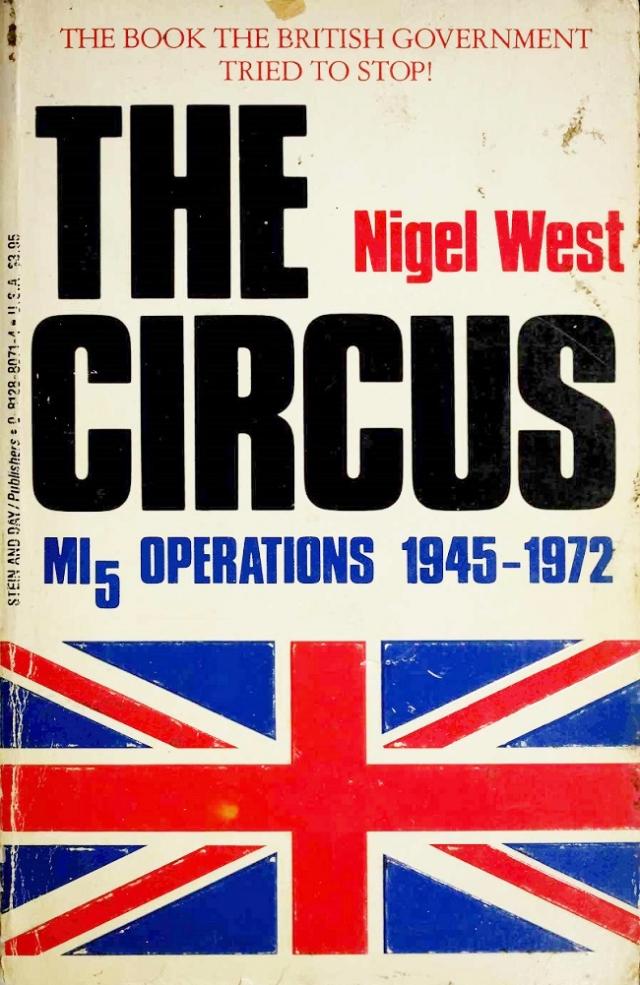
FIRST STEIN AND DAY PAPERBACK EDITION 1984
The Circus was first published in the United States of America hardcover in 1983 by Stein and Day/Publishers.
Copyright © 1982, 1983 by Westintel Limited
All rights reserved, Stein and Day, Incorporated
Printed in the United States of America
STEIN AND DAY/Publishers
Scarborough House
Briarcliff Manor, N.Y. 10510
ISBN 0-8128-8071-4
THE VERY PEOPLE WHO TRIED TO SUPPRESS THIS BOOK
HAVE ACKNOWLEDGED IN A COURT OF LAW THAT IT TELLS THE TRUTH!
Writes author Nigel West in his Introduction: “The Circus is the most detailed account of MI5’s work ever published, or ever likely to be. For those who find it closer to fiction than fact, they have MI5’s word for it that it is indeed all too terribly true.”
Contents
Abbreviations
Illustrations
Introduction to the American Edition
Tables of MI5’s Organization
1 - TRANSITION
2 - SIR PERCY SILLITOE
3 - SIR DICK WHITE
4 - SIR ROGER HOLLIS
5 - KAGO’S REVELATIONS
6 - ENTRAPMENT
7 - BETRAYAL
8 - PENETRATION
9 - SIR MARTIN FURNIVAL JONES
10 - A MATTER OF TRUST
APPENDIX I - Sir David Maxwell Fyfe’s 1952 Directive
APPENDIX II - Telephone and Mail Interception Warrants Issued 1945-72
Index
Abbreviations
ASIO - Australian Security Intelligence Organization
BND - West German Security Service
BOSS - South African Bureau of State Security
BSC - British Security Co-ordination
CIA - Central Intelligence Agency
CID - Criminal Investigation Department
CIFE - Combined Intelligence Far East
CPGB - Communist Party of Great Britain
D-G - Director-General of the Security Service
DNI - Director of Naval Intelligence
DSO - Defense Security Officer
DST - French Security Service
FBI - Federal Bureau of Investigation
GRU - Soviet Military Intelligence
KGB - Soviet Intelligence Service
MI5 - British Security Service
MI6 - British Secret Intelligence Service
NATO - North Atlantic Treaty Organization
NKVD - Soviet Security Service
NSA - National Security Agency
OSS - Office of Strategic Services
PROD - Office of Production, National Security Agency
RCMP - Royal Canadian Mounted Police
RSLO - Regional Security Liaison Officer
SDECE - French Secret Intelligence Service
SIME - Security Intelligence Middle East
SUS - Security Intelligence Service (MI6)
SLO - Security Liaison Officer
SOE - Special Operations Executive
UN - United Nations
Illustrations
1 Sir David Petrie, the wartime Director-General of the Security Service.
2 Captain Guy Liddell MC {Daily Express).
3 Klaus Fuchs, the atom bomb spy {Poppeifoto).
4 Jim Skardon and Henry Arnold during Klaus Fuchs’s trial {Keystone Press).
5 A unique newspaper story. The Daily Express catch the Director-General, Sir Percy Sillitoe, and Arthur Martin flying to Washington {Daily Express).
6 The KGB in action. Karpinsky and Zharkov hustle Mrs Petrov aboard an aeroplane bound for the Soviet Union after the defection of her husband.
7 Conon Molody, alias Gordon Lonsdale, the only Soviet ‘illegal’ caught by MI5 {Camera Press).
8 George Blake {Central Press).
9 John Vassall in his Dolphin Square flat {Poppeifoto).
10 Colonel Oleg Penkovsky, the senior GRU officer who spied for MI6 and the CIA, at his trial in Moscow with Greville Wynne {Press Association).
11 Chief Technician Douglas Britten, the RAF Signals
Intelligence officer who spied for Russia for six years from 1962 (Popperfoto).
12 The Soviet spy camera disguised as a wallet that the KGB supplied to Chief Technician Douglas Britten (Popperfoto).
13 Stephen Ward (Poppeifoto).
14 Captain Eugene Ivanov (Keystone Press).
15 Frank Bossard, the Ministry of Aviation official from the Guided Weapons Research and Development Division, who was caught red-handed photographing classified documents in his lunch-break (Popperfoto).
16 Joseph Frolik, the Czech intelligence officer who defected to the CIA in July 1969.
17 Sir Roger Hollis, Director-General of the Security Service from 1956-65 (Press Association).
18 Oleg Lyalin, the Soviet trade official (and KGB officer) whose affair with his secretary caused him to spy for MI5 (London Express).
19 David Bingham, the Royal Navy officer who volunteered a confession to the Director of Naval Security soon after the defection of Oleg Lyalin in 1971 (Press Association).
20 Sir Martin Furnival Jones, the Director-General of the Security Service from 1965-72 (Syndication International).
Introduction to the American Edition
On 12 October 1982, Her Majesty’s Attorney-General, The Rt Hon Sir Michael Havers QC MP applied to Mr Justice Russell for an ex parte injunction in the High Court of Justice to prevent the publication of this book. The judge, sitting in private and without any representation from the defence, heard evidence in support of an application that made British legal history. One part of the evidence included an affidavit sworn by the Home Office’s Principal Legal Adviser who explained that he had been fully briefed by MI5. He stated that the book
contains previously unpublished information classified as SECRET and identifies, inter alios, present members of the Security Service who have not previously been identified in any publication.
He went on to confirm that
there are many references in the manuscript to incidents, operations and investigations which are said to have taken place since the end of the Second World War, and which can only have been related to the Defendant by past (or present) members of the Security Service. Some of these references relate to incidents, operations, investigations and other matters which have not previously been made public.
The applicant concluded that
should the said 'manuscript be published either in the United Kingdom or elsewhere, the conduct of investigations and operations may be prejudiced and put at risk.
The judge agreed, and he granted the injunction. The delivery of the Court’s Order was the first time that either the author or the British publisher were even aware that legal proceedings had been taken! Some weeks later, after intensive negotiations had taken place, and after MI5 had ascertained that a copy of the manuscript had reached the United States before the Court Order had been applied for, the Order was discharged, and The Circus was allowed to be published. The Security Service’s clandestine intervention had been almost exactly a month too late.
Why the court action? Why the change of heart? Only a handful of people know the full story, and only a smaller number know the details of how a senior MI5 officer stole and copied an unauthorized copy of the author’s draft manuscript. The details behind this extraordinary episode would read like a thriller but to describe them would also jeopardize the liberty of many who believe that the public has a right to make up its own mind about the postwar record of Britain’s premier counterespionage organization. But that is not to say that the motive behind this book is a desire for total disclosure. It is instead the combination of a desire to safeguard secrets of real importance, and a determination to possess a yardstick by which the performance of our intelligence bureaucrats can be assessed.
In the weeks of discussion following the ban on the book it was agreed that certain names would be deleted from the version published in England. The reader will notice that there are now half a dozen blank spaces in the organizational charts that immediately follow this introduction. It was conceded by the Defence that it would not be in the public interest to identify these officers, who had all undertaken dangerous missions abroad and whose identification might compromise them.
The release of the original version in England has in part been overtaken by events. The MI5 officer who recruited Stephen Ward as an agent was traced by the London Sunday Times, and he confirmed this account of his entrapment operation that went so badly wrong and helped bring down the Macmillan government in one of the most notorious political scandals ever seen in the West. Identified by his MI5 cover-name of Mr K Woods, he commented that he and his colleagues “felt very sorry for Ward. We were very cut up when we heard he was dead." Ward had played a central part in what was to become known as the Profumo Affair, and subsequently committed suicide when MI5 failed to acknowledge his work and save him from a jail sentence. In another development it has been conceded that Sir Michael Hanley, Director-General of MI5 from 1972-79, was himself once the subject of a molehunt that sought to identify a Soviet spy inside the Security Service. The secret inquiry, which eventually cleared Hanley, was code-named HARRIET. His subsequent promotion was to create a storm of controversy within the British intelligence community. Details of this sensitive investigation were deleted from the British edition of The Circus.
This final version of The Circus is the most detailed account of MI5's work ever published, or ever likel y to be. For those who find it closer to fiction than fact, they have MI5’s word for it that it is indeed all too terribly true.
Nigel West
February 1983
Tables of MI5’s Organization
1
TRANSITION
‘The Security Service is, after all, a secret service . . . this is part of its essence. Its cost is borne on the Secret Vote and one must bear in mind therefore that the number of parliamentary questions which could be put to me with any hope of an answer being properly answered is very limited.’
Henry Brooke mp,
Secretary of State for the Home Department, 1963
When the war ended in Europe in May 1945 the British Security Service was in the process of winding down its activities and returning a large number of its personnel to civilian life. The reduction in the organization’s size had actually begun in the summer of the previous year, as the Allies had advanced towards the Rhine. The need for a large home Security Service had diminished, and many of the counter-intelligence staff had been attached to regular military units to supervise the liberation of the occupied areas.
Although counter-intelligence is a somewhat broad term, it does describe MI5’s responsibilities which, since 1909, have been specifically counter-espionage, counter-sabotage and counter-subversion in all British territory. Counter-intelligence in other geographical areas has always been dealt with by the Secret Intelligence Service (MI6).
Since November 1940 MI5 had been headed by a distinguished former Indian police officer, Sir David Petrie. He had been brought out of retirement in Egypt, at the age of sixty-one, to give the Security Service the strong leadership it had lacked since the previous June, when Churchill had sacked the original Director-General, Major-General Sir Vernon Kell, and his Deputy D-G, Brigadier Sir Eric Holt-Wilson. The organization had undergone a series of internal changes during that period, but its fundamental structure of six Divisions had remained the same.
‘A’ Division, headed by Colonel Charles Butler, was the administrative department, and included such subsections as legal, transport, personnel and policy. A2 also provided experienced administrators for the supporting agencies, such as the GPO’s telephone and letter interception units. The staff engaged on these duties had been drafted into the Services during wartime, so as to reduce union and other complications, but once the European war was over the responsibility for the interception of civil communications reverted back to the GPO’s Special Investigation Branch. However A3, the transcription service, remained a direct Security Service section. Also nominally in ‘A’ Division was the all-important Registry
which, by the end of hostilities, accounted for fully one third of MI5’s strength. The department was traditionally female and labour-intensive in spite of the use of Hollerith punch-card sorters, an innovation of the Head of Registry, Reginald Horrocks. Horrocks had first joined MI5 in 1940 from Roneo, the business efficiency firm, but had stayed on after the war, ably assisted by his future successor, Harold Potter. Registry was generally an unpopular posting as the work was appallingly dull, even if it was of . national importance. Registry girls were divided into three groups: filing clerks who operated the Nominal Indices, a card-index system linked to ‘open’ personal files and subject files which were available for any MI5 officer to request and examine; specially trusted girls who dealt with the top-secret Y Box Files; and the most exalted of all, the girls seconded to individual sections who kept guard over the ‘Held Files’, those considered too sensitive to leave lying around in Registry. Many members of this latter group showed considerable initiative and were rewarded by promotion to officer rank.
As we will see, ‘A’ Division was later to become highly technical and to acquire the services of a Scientific Adviser (A2) and to retain control over many ‘technical sources’.
‘B’ Division, the principal counter-espionage department, was headed by Captain Guy Liddell. It included the famous Bl(a) section, run by Colonel T.A. (Tar) Robertson, which had orchestrated the numerous double agents being used to deceive the enemy. Other ‘B’ Division sections included Bl(b), an analysis unit interpreting intercepted Abwehr wireless signals, and several other important operational branches.
‘C’ Division, headed by Major Herbert Bacon, took charge of vetting and other defensive security work, whilst ‘D’, headed by Brigadier Harry Allen, maintained liaison with the regular military forces and appointed liaison officers to the other Services.
'E' Division, the province of Major Kenneth Younger,1 oversaw the activities of all aliens, both neutral, friendly and otherwise. El was headed by a veteran anticommunist, Millicent Bagot, and her section dealt with international communism. E2 maintained contact with the overseas representatives (called Defence Security Officers where there were British garrisons and Security Liaison Officers elsewhere). E3 under Courtney Young retained the Far East as a single geographical interest.
'F' kept surveillance on the two political extremes in the United Kingdom: FI concentrating on the Communist Party of Great Britain (CPGB), F2 on the fascists. Both sections had operations and research sub-divisions, with F4 under John Bingham2 running the deep-cover penetration agents.
Each Division was headed by a Director, a senior MI5 officer who had pre-war intelligence experience. These men, together with the Director-General, Sir David Petrie, and his Deputy D-G, Brigadier A.W.A. (Jasper) Harker, sat as the ‘Directorate of the Security Service'. The exception to this was the head of ‘F’ Division, Roger Hollis, who only had the rank of Assistant Director. Hollis had joined MI5 in 1938 and therefore had little pre-war service. The Communist Party of Great Britain was his special concern, whilst the fascists were monitored by the other senior ‘F’ officer, Graham Mitchell, a former member of the Conservative Party’s research department, who had also been a journalist on the Illustrated London News.
This, then, was the order of battle of MI5 in 1945. It maintained a headquarters in St James’s Street, Mayfair, and used Blenheim Palace, in Oxfordshire, to house some of its administrative offices. It also ran a number of other smaller offices in London—in Regent Street, Piccadilly and Dolphin Square—where individual case officers could meet their agents.
During the war ‘B’ Division had also operated a small network of Regional Security Liaison Officers (RSLOs) attached to military districts in England, Wales and Scotland. It was their responsibility to discuss security matters with the Chief Constables in their area and build up good relations with the police forces in the provinces. The RSLOs, of which there were generally a total of eight, were disbanded in 1945 leaving background enquiries in the counties to the local Assistant Chief Constables and the Metropolitan Police’s Special Branch. When the county forces developed their own Special Branches security enquiries were handled by them, except in Scotland where a single Regional Coordinator was established.
Surprisingly the greatest number of MI5 officers (aside from headquarters’ clerical staff) were overseas, as liaison officers with the Dominion or Colonial intelligence services, or posted to semi-independent organizations, such as Security Intelligence Middle East (SIME), which was based in Cairo, or Combined Intelligence Far East (CIFE) in Singapore. Many other MI5 staff were seconded for duty with MI6, and in particular the Special Counter-Intelligence units, which were formed after the invasion of France to scoop up and ‘turn’ the German stay-behind agents.
These Special Counter-Intelligence operations gained increasing importance during the latter months of the war, when the code-breakers at Bletchley received less operational information from the now famous ULTRA intercepts, as the Wehrmacht and the SS fell back towards Germany and home territory, and made heavier use of land-lines. As a result wireless-orientated intelligence diminished and the Allied commanders at the front, particularly the 21st Army Group, were obliged to rely on the techniques of strategic deception which had been so successfully executed in the months leading up to D-Day.


