

To hell and back, p.1
To Hell and Back, page 1


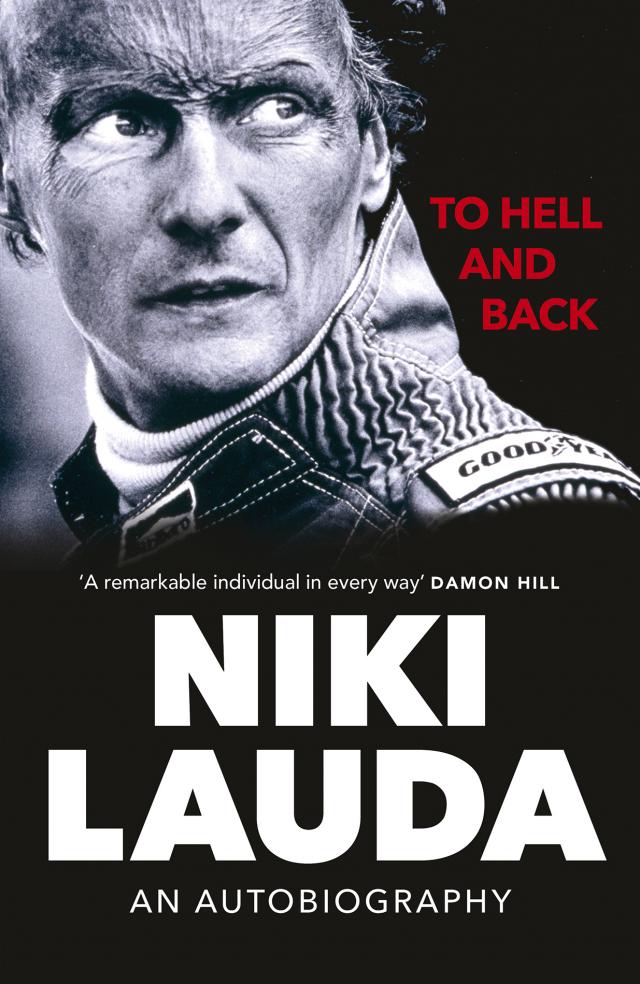
Niki Lauda
* * *
TO HELL AND BACK
An Autobiography
Written in collaboration with Herbert Völker
Translated from the German by E.J. Crockett
Introduction and Postscript by Kevin Eason
CONTENTS
Introduction: The Legend
1 Early Days
2 Deals and Wheels
3 Ferrari
4 Nürburgring
5 Life Goes On
6 Brabham
7 Comeback
8 Enter the Turbos
9 The Toughest Year
10 Estoril
11 Getting Nowhere Fast
12 From 400 to 1,000 Horsepower: Formula 1 1972–1985
13 Colleagues and Competitors
14 The Lauda System
15 Flying
16 Ibiza
17 The Last Lap
Postscript By Kevin Eason
18 ‘The Worst Time of My Life’
19 Breaking the Rules
20 The Final Victory: Sunday, 3 November 2019
Epilogue
Appendix: For the Record
Index
ABOUT THE AUTHOR
Andreas Nikolaus Lauda (22 February 1949 – 20 May 2019) was an Austrian Formula One driver and three-time F1 World Champion, winning in 1975, 1977 and 1984. A year later, he retired to pursue his love of flying, starting Lauda Air, among a series of aviation ventures, but Formula One always called. He was back in the sport in 1993 as a consultant for Ferrari before moving on to Jaguar and achieveing unparalleled success in the McLaren team with Lewis Hamilton and Nico Rosberg.
INTRODUCTION
THE LEGEND
Kevin Eason
HIGH ABOVE THE phalanx of fans clad in their red caps and shirts was a banner with a haunting picture in stark monochrome of a pair of eyes, scarred by heat and flame, staring down at the bare racetrack below. After the picture was a simple yet heartfelt message: ‘Ciao, Niki.’
The occasion was the 2019 Italian Grand Prix, a race steeped in memories and the history of a team that dates back to the very start of the modern era of Formula 1. Ferrari arrived at the fabled Monza circuit celebrating ninety years since Enzo Ferrari founded his eponymous team, the most famous and successful in the world.
This theatre of speed, carved between the trees of the royal park and the sporting home to Ferrari, has provided the stage for some of the team’s greatest acts, from Alberto Ascari’s first victory at Monza for Ferrari in 1951, the second world championship year, to Michael Schumacher’s tearful (first) retirement in 2006, just minutes after winning his final race for a Scuderia that he had helped transform into a powerful and dominant force.
This time, victory belonged to the freshest of Ferrari faces, Charles Leclerc, a stripling of just twenty-one years, who provided the champagne toast for the ninetieth birthday celebrations. The man whose eyes adorned that poster – and was missing from the Italian Grand Prix for the first time in more than forty years – would have grinned and revelled in one of the greatest sights in all of sport as Leclerc clambered onto the elevated podium to see the faithful Ferrari fans, the tifosi, turn the main straight into a river of red with their flags to cheer their new hero.
The memories of many of those teeming fans would have turned to the past, though, and appreciation of the man who looked down on their revelry: Niki Lauda, who died on 20 May 2019, as preparations for the September celebrations reached their climax.
Niki Lauda would have been central to the anniversary party as a key character in the Ferrari story. But he was more than a racing driver, more than a Ferrari driver and more than a man who presided over a team dominating Formula 1 in his final years. He was a symbol of extraordinary courage and determination, whose story was so shocking that even the scions of Hollywood were taken aback when it was committed to celluloid.
The word ‘legend’ is bandied about too easily in sport: a footballer scores a goal and is instantly crowned a ‘legend’, or a boxer knocks out an opponent and becomes a ‘legend’ because of just one fight. The quote attributed to Ernest Hemingway perhaps comes closest to an explanation of Lauda’s elevation beyond these lesser legends, beyond even the greatest. ‘There are only three sports – bullfighting, mountaineering and motor racing. The rest are merely games,’ Hemingway said. The intent of his analysis was to show that kicking or hitting a ball or running 100 metres might well be a worthy test of strength or skill, but it is not a contest of mortality.
Niki Lauda drove a car for sport, but crossed the line between life and death and fought back to even greater glory. Lauda really was a legend.
Even people who know nothing of Formula 1 have heard of his crash at the Nürburgring in 1976 when he was dragged from the inferno of his Ferrari so badly injured that he was given the last rites. It was here at Monza before the astonished tifosi that he came back from the dead, racing barely forty-two days after a priest attempted to usher him into the afterlife. His wounds bled, he had no eyelids and couldn’t blink, so he could hardly see the track … and he was terrified. Enzo Ferrari was horrified by the publicity that surrounded a comeback that seemed beyond human endurance, but the fans descended on Monza in hordes, encouraged by an hysterical Italian press heaping superlatives on this astonishing hero.
There was no heroic return in Lauda’s mind, though. For him, there was simply no alternative. He disguised his fear behind the fireproof balaclava through which blood seeped, and clamped his red helmet firmly onto his raw skull. Now no one could see the fear, trace the trembling and realise that Lauda was not just pitting his skill against the best, but probing the recesses of his mind where the darkest dread waited. A year later, he reclaimed his world championship for Ferrari.
Lauda’s first stab at an autobiography came in 1978 with For the Record – My Years with Ferrari, translated from the German into English by Diana Mosley, the mother of Max, who provided Lauda’s first Formula 1 cars from his March factory and later became the controversial president of the Fédération Internationale de l’Automobile (FIA), which governed Formula 1.
His second and last autobiography, To Hell and Back, was published in 1986 after his final retirement, and it was typically Niki – to the point with no frills and fancies, no doubt dictated at breakneck speed. It covers the years from his childhood to his accident and the battle for the 1976 title with the charismatic James Hunt, and then his departure from Formula 1 and motor racing as a three-times world champion and one of the most successful drivers in the sport, starting at the bottom with BRM and March, then Ferrari, before moving to the Brabham team run by Bernie Ecclestone, and finally McLaren. But Lauda never updated the book, nor told the story of life after Formula 1 as an airline magnate and then his extraordinary return to the track as chairman of the all-conquering Mercedes team that brought an astonishing five world championships for Lewis Hamilton, plus one more for Nico Rosberg, in successive years.
That was to be my job, and I have attempted to focus on the stories, events and anecdotes that would have been in his mind, which means that this book is part-autobiography, part-portrait of the man behind the mask of scars that became a trademark thanks to the Nürburgring.
I had the privilege as motor-racing correspondent for The Times to meet Lauda on many occasions at racetracks around the world, and there was one thing a journalist could rely on – that Niki would have an opinion on almost anything to do with motor racing. His opinions carried unique weight, though, because he had been there, done that and got the scars to prove it. Lauda’s image was of a bombastic, curt, driven, even impolite man, and he was all and none of those things, but the measure is that he was adored around the world, could charm even the grumpiest of associates and became one of the most revered of countrymen in his homeland of Austria. John Hogan was the mastermind behind the Philip Morris Marlboro sponsorship that invested hundreds of millions of pounds in Formula 1, including backing Lauda. According to him, Lauda was incredibly well-mannered, ‘particularly to women’, Hogan said. ‘He was always interested in people and put them at their ease. Women of all ages adored him. I think it was his upbringing because, despite his image, he was always courteous and polite.’
Lauda loved pranks and jokes, and would be a fascinating dinner companion with anecdotes that ranged through a life that refused to bow to rules and regulations or respect for authority. Lauda simply did not do rules – unless he could break them. He was his own man, struggling from the suffocating correctness of his privileged childhood to defy his family, who thought motor racing beneath their status in society; standing up to the fearsome Enzo Ferrari, who dominated Formula 1; and then taking on an airline cartel. It was as if he needed life to be a battle against authority and convention.
Hogan, who knew every driver and senior figure in Formula 1 from the early 1970s, including sponsoring and becoming close friends with James Hunt, put it simply: ‘You would have to call Niki a maverick. That’s the best description.’
Lauda loved a deal and could wring cash from even the tightest of fists to finance his motor-racing career and airline businesses. He started life in Formula 1 with massive debts as he inveigled cash from sponsors persuaded by his assurances of instant success, and ended his life with a fortune estimated by some of almost 500 million euros. He was never driven by money, though, only the deal, the battle and the victory.
‘Niki was always restless, always looking for the next thing,’ according to Bernie Ecclestone, who lured Lauda from Ferrari to his B
And he knew his worth. Before his second season with Brabham, Lauda demanded a pay rise to $2 million from Ecclestone, who blanched and refused point blank – until they had to attend a meeting with Parmalat, the team’s main sponsor. Ecclestone made the introductions and told executives that the team was prepared for the new 1979 season and that Lauda would be his Number One driver again. ‘No, I won’t,’ Lauda said, stunning the room into silence. Ecclestone and Lauda retreated to a backroom to argue over the $2 million, but Ecclestone was over a barrel: no pay rise, no lead driver. He paid up.
‘Niki didn’t stand on ceremony. He just got to the point,’ Ecclestone told me. ‘He couldn’t understand why people made a fuss. If something went wrong, he just got on with it and did something else. He didn’t have time for emotion and looking back. He learned a lesson and moved on. People understood that when Niki said good morning, it was before twelve o’clock. They felt comfortable that they could talk and what they got back was just how it is. That’s where he captured a lot of people to support him, because he was straightforward. He didn’t mind criticism.’
Ecclestone had already got his payback after the Nürburgring and from a man who could easily have claimed to have kick-started Formula 1 as a global television event. Grand Prix racing on television was a hit-and-miss affair with broadcasts in Europe controlled by the European Broadcasting Union. But Lauda’s crash and spectacular comeback had turned Formula 1 into must-see television and broadcasters were lining up for deals. Ecclestone, who also negotiated for the F1 teams, took on the European Broadcasting Union and started signing contracts with individual broadcasters for the first time – with the proviso that they came back to show the entire 1977 season, not just a pick-and-mix of whatever they fancied. It was the start of Formula 1’s drive to becoming a $1 billion-a-year sporting and entertainment giant – and made Ecclestone a billionaire.
‘In the old days, the broadcasters would just show Monaco and something else and that was it,’ Ecclestone said. ‘But Niki was suddenly a massive star and everyone wanted to know how the 1976 season would end. It was a breakthrough for Formula 1, otherwise we would still be stuck in Europe with very little coverage. I suppose it was all down to Niki and that crash.’
Lauda wasn’t remotely interested in stardom and hated being noticed in restaurants or in the street. He had no time for gushing tributes or emotional moments. There was, perhaps, no better demonstration of his lack of sentimentality than his attitude towards his many trophies. Some found their way straight to the bin, but the man who ran his local garage showed some interest, so they struck a deal: he could have a trophy in return for free carwashes.
‘That’s what I did,’ Lauda told the Reuters news agency. There was, however, a downside to this deal. ‘The guy died, unfortunately, and his son was running the petrol station, so a friend of mine took them away, polished them and then my kids put them on eBay. Now I have to pay for the carwash.’
That lack of sentimentality reached every part of his working day, even for those closest to him. Paddy Lowe, Lauda’s chief technical officer for three years at Mercedes, remembered: ‘One Christmas, I had a Christmas card from Lewis [Hamilton] for him, a personally written card expressing his thanks to Niki for all he had done and wishing him all the best. Niki read it and threw it in the bin. I thought he could at least have taken it home. It was just like everything in his life – it was bullshit, and he didn’t have time for bullshit.’
Even the scars that covered his head became an emblem to be exploited. Lauda had no vanity, no desire to look like James Hunt, the tall, blond Englishman he had competed against for the 1976 world championship. He accepted his scars and, apart from some work to replace his eyelids, he never bothered with plastic surgery, simply putting on a red baseball cap to cover the burn marks on his bald head, which he then turned into a $1 million-a-year advertising hoarding. Every setback could become a deal. He was matter-of-fact about his scars where others, such as Ian Wooldridge, were filled with horror. The celebrated Daily Mail sportswriter, who had witnessed the Nürburgring accident, wondered whether Lauda’s return at Monza was an act of extraordinary courage or of stupendous folly. ‘Is one man, aged 27, so unwilling to concede an earthly title that he is prepared to wager life against death when most men would be hiding their desperate injuries in a darkened room?’ he wrote. Lauda was simply phlegmatic. ‘I have reason to look ugly,’ he told one interviewer. ‘Most people don’t. The cap is my protection from stupid people looking at me stupidly.’
The lack of an ear was also a source of both amusement and simple reality: ‘People ask me, “Why did you never have an operation?” to which I would say, “Where the fuck do I find an ear?” It’s a very simple answer,’ he told Reuters.
His favourite story was of trying to recruit someone with acute observational skills. According to his narrative, he has each candidate come into the room to face the first question. ‘What’s the first thing you notice about me?’ Most of the candidates fail, immediately pointing out his burnt ears, but one says: ‘You are wearing contact lenses.’ Lauda is surprised and pleased, but wants to know how the prospective employee figured it out. The answer came: ‘If you had ears, you would be wearing glasses.’
Actually, there was one attempt to find Lauda’s missing ear. After a fashion. Years after the 1976 crash, Bernie Ecclestone decided his old friend Lauda should return to the scene. They took along Karl-Heinz Zimmermann, Lauda’s fellow Austrian who ran Ecclestone’s motorhome at Grands Prix. Like Ecclestone, Zimmermann was an inveterate prankster and he guided the three of them around the old circuit – known as the Nordschleife and closed to Formula 1 after the 1976 accident – until they arrived at the Bergwerk turn where Lauda crashed and his Ferrari burst into flames.
The three stopped and wandered around the grass verge as if searching for something until a group of German passers-by spotted them and recognised Lauda. ‘Hey, Niki Lauda,’ one said. ‘What are you doing?’ Zimmermann was already prepared and shouted over: ‘Looking for his ear, of course.’ The Germans thought that Lauda and his friends were taking the mickey, but Zimmermann nudged Lauda and pointed at the ground in front of them. ‘Look there,’ he hissed. A quick scour of the verge uncovered a fresh, pink ear. Lauda emerged triumphant, waving it in the air at the Germans like a Formula 1 winner’s trophy. It was, in fact, a pig’s ear, which had been secreted in Zimmermann’s pocket. The laughter was long and hearty, though the memories for Lauda must have been raw.
That fiery crash in 1976 deep in the forest of the Nordschleife could never leave him. It could have claimed his life in seconds there and then; instead, it took forty-three years to snuff out the irrepressible and undaunted Niki Lauda. This is the account of a life lived at speed, a life that went to hell, but came back to glory and fulfilment.
CHAPTER ONE
EARLY DAYS
COMING FROM A ‘good’ family has its advantages, although I question this at times when I think back to how angry I used to feel at being thrashed so often. In Austria, the Laudas are a ‘good’ family. At any rate they were. These days, Laudas of the captain-of-industry variety are something of a dying breed.
The most striking personality in the family was my grandfather, ‘Old Lauda’. Even now, after his death, the ‘old’ sets him apart from all the other Laudas (who, I imagine, also have hopes of living to a ripe old age). What I particularly liked about him was his physical presence, his sumptuous Vienna town house complete with liveried manservant, his sprawling estate in Lower Austria, his fabulous place in St Moritz.


