

Lady macbeth of mtsensk, p.1
Lady Macbeth of Mtsensk, page 1


NIKOLAI LESKOV (1831–1895) was one of four children. His father had a clerical background and legal career; his mother was a gentlewoman. After a rudimentary education in the central Russian town of Oriol, Leskov moved to Kiev and worked for his English uncle whose firm transported serfs, livestock, and deadstock all over Russia. Leskov spent three years among the varied geography, peoples, and dialects of Russia; his reports to his uncle were so colorful that they were published as sketches. After moving to St. Petersburg, Leskov became a journalist and published stories and a novel, No Exit (1864), which infuriated radicals and the government alike. Success came in the mid-1870s with his novel The Cathedral and Its Clergy (1872) and long stories such as “The Enchanted Wanderer.” He acquired a reputation as “the most Russian” of writers. Still, he earned so little that he became a government censor for a time. His personal life was a disaster: an early marriage ended with his wife’s committal to a psychiatric hospital; his longtime companion bore him a son, but left him; a liaison with his servant resulted in a daughter whom he brought up but would not acknowledge. His work of the 1890s was often rejected by editors and censors. Only posthumously did his critical reputation become unassailable.
DONALD RAYFIELD is Emeritus Professor of Russian and Georgian at Queen Mary University of London. As well as books and articles on Russian literature (notably Anton Chekhov: A Life), he is the author of many articles on Georgian writers and of a history of Georgian literature. In 2012, he published Edge of Empires: A History of Georgia, which has recently come out in an expanded Russian edition, as have his Life of Chekhov and Stalin and His Hangmen. He was the chief editor of A Comprehensive Georgian-English Dictionary. He has translated several novels, including Hamid Ismailov’s The Devils’ Dance from the Uzbek and Nikolai Gogol’s Dead Souls (an NYRB Classic), as well as Varlam Shalamov’s Kolyma Stories and Sketches of the Criminal World (both NYRB Classics).
LADY MACBETH OF MTSENSK
Selected Stories of Nikolai Leskov
NIKOLAI LESKOV
Translated from the Russian by
DONALD RAYFIELD and others
Introduction by
DONALD RAYFIELD
NEW YORK REVIEW BOOKS
New York
THIS IS A NEW YORK REVIEW BOOK
PUBLISHED BY THE NEW YORK REVIEW OF BOOKS
435 Hudson Street, New York, NY 10014
www.nyrb.com
Introduction copyright © 2020 by Donald Rayfield
Translation copyright © 2003 by Robert Chandler for “Lady Macbeth of Mtsensk”
Translation copyright © 1969 by William Edgerton for “The Steel Flea”
Translation copyright © 2020 by Donald Rayfield for “The Sealed Angel,” “The Enchanted Wanderer,” “The Unmercenary Engineers,” and “The Innocent Prudentius”
All rights reserved.
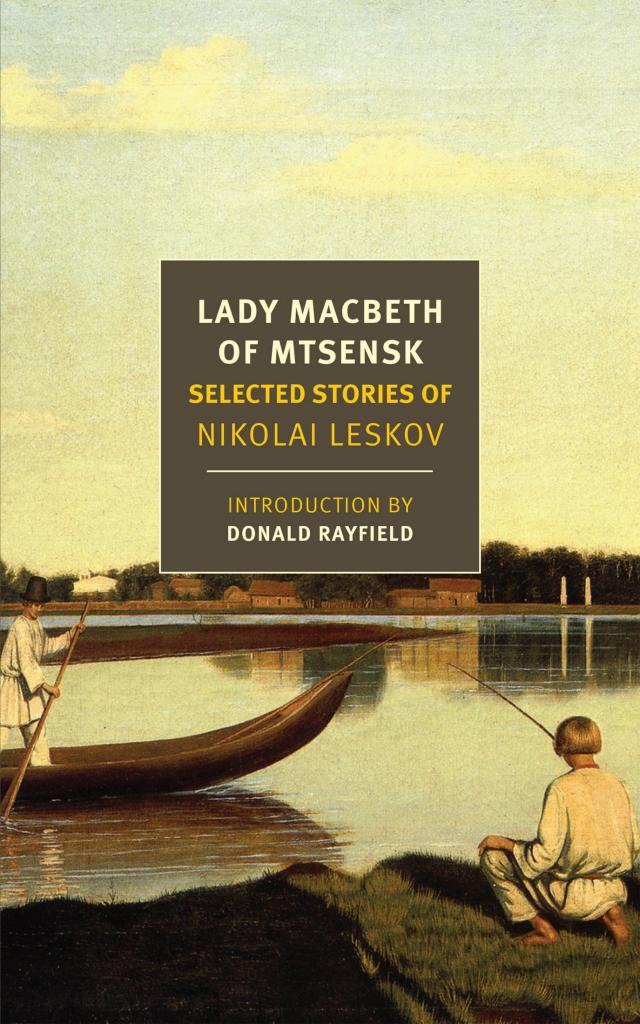
Cover image: Grigory Soroka, Fishermen, 1843–44; the State Russian Museum, St. Petersberg
Cover design: Katy Homans
Published with the support of the Institute for Literary Translation (Russia)
Library of Congress Cataloging-in-Publication Data
Names: Leskov, N.S. (Nikolaĭ Semenovich), 1831–1895, author. | Chandler, Robert, 1953– translator. | Rayfield, Donald, 1942– translator, writer of introduction.
Title: Lady Macbeth of Mtsensk / by Nikolai Leskov; translated by Robert Chandler and Donald Rayfield; introduction by Donald Rayfield.
Description: New York: New York Review Books, [2020] | Series: New york review books classics
Identifiers: LCCN 2020004672 (print) | LCCN 2020004673 (ebook) | ISBN 9781681374901 (paperback) | ISBN 9781681374918 (ebook)
Classification: LCC PG3337.L5 A2 2020 (print) | LCC PG3337.L5 (ebook) | DDC 891.73/3—dc23
LC record available at https://lccn.loc.gov/2020004672
LC ebook record available at https://lccn.loc.gov/2020004673
ISBN 978-1-68137-491-8
v1.0
For a complete list of titles, visit www.nyrb.com or write to:
Catalog Requests, NYRB, 435 Hudson Street, New York, NY 10014
CONTENTS
Cover
Biographical Notes
Title Page
Copyright and More Information
Introduction
Lady Macbeth of Mtsensk
A Sketch
The Sealed Angel
A Christmas Story
The Enchanted Wanderer
The Steel Flea
The Tale of the Cross-Eyed, Left-Handed Gunsmith from Tula and the Steel Flea
The Unmercenary Engineers
From the Stories of Three Righteous Men
The Innocent Prudentius
A Legend
Notes
INTRODUCTION
FEW RUSSIAN writers had a background like Nikolai Leskov’s. His paternal grandfather was a priest, and his father, Semion, worked his way into the gentry as a magistrate in the courts of the town of Oriol. But the family fortunes disintegrated: Semion’s temper, as prickly as his son’s, led to his early retirement; he ceded Nikolai’s upbringing to one brother-in-law after another: first, to a man so jealous that at night he tied his wife’s leg to the bedstead, but who did provide Nikolai with French and German tutors. Then the uncle died, and the widowed aunt married a Hercules, reputed in the Napoleonic Wars to have pulled two French cavalrymen off their horses and killed them by banging their heads together. This uncle sent Nikolai to a Dickensian local school, which he attended for two years before being expelled for misbehavior.
At sixteen, Leskov began working as a court clerk. A year later his father died of cholera, and the family’s estate burned to the ground. He and his brother (later to become a doctor) moved to Kiev, staying with another maternal uncle, who housed them in an attic and barred them from the dinner table, but let Nikolai finish his education. Here Nikolai took an interest in Poles and Polish language, in Old Believers (the Orthodox dissenters), and in Jews, while earning a living as a civil servant. In 1857, another maternal uncle, an Englishman named Scott, began a new career: Scott and Wilkins was a firm that transported estates—peasants, livestock, and dead stock—from overpopulated central Russia to lands on the Volga and in the south. Nikolai spent three years traveling in Russia, sleeping in the open among the serfs he escorted, exposed to Russia’s peasantry and ethnic minorities, their customs, religions, and languages, as no other writer was. Scott recommended Leskov publish his colorful business reports in the press.
When serfdom ended in the 1860s, peasants were no longer chattel: Scott and Wilkins went broke. Leskov became a journalist in an era of relative freedom. He was controversial, attacking corrupt police, doctors, and distilleries. Consequently, he was hounded out of the civil service. He settled in St. Petersburg, writing as Stebnitsky, a provocatively Polish pseudonym, given the anti-Polish feeling in Russia. He annoyed both the tsar and the new radicals by writing about fires that had plagued St. Petersburg: Leskov did not deny the government’s accusation that revolutionaries had lit the fires, yet he accused the authorities of deliberately not extinguishing them. Leskov fled his critics for a year, touring western Russia and Europe.
In 1864, undeterred by hostility, Leskov returned and published an anti-revolutionary novel, No Exit, and, six years later, another caricature of socialists, Daggers Drawn. He soon realized that these novels made him hateful to the new generation and suspect to the older one. A decade passed before a series of superb novellas, three about dominant women, were hailed by readers and critics.
The most powerful of these novellas and Leskov’s first claim to fame, “Lady Macbeth of Mtsensk” (1864), follows a device initiated by Turgenev in his stories “The Hamlet of Shchigry” and “King Lear of the Steppes”: reenacting Shakespeare in contemporary Russia. The story owes nothing to Leskov’s experience in Oriol’s criminal court, although the eight-year-old Leskov did see there a woman publicly flogged before she was sent to Siberia for murdering her father-in-law with Shakespearean brutality by pouring hot sealing wax into his ear.
“Lady Macbeth of Mtsensk” is Shakespearean in its linguistic vitality and emotional intensity. Leskov makes the story as harrowing as Dostoyevsky’s Crime and Punishment. Although Leskov allows her no redemption, his murderess is driven by a sexual obsession, just as Dostoyevsky’s murderer is motivated by an intellectual one. Leskov reportedly said, “While I was writing my ‘Lady Macbeth,’ the effect of overstrained nerves and isolation almost drove me to delirium. At times the horror became unbearable; my hair stood on end.”
Like Macbeth itself, Leskov’s story is closely knit. The plot is effectively propelled by a sequence of physical embraces and grapplings, which soon lead to Katerina’s murderous embrace of her husband: “In a single movement she pushed Sergey out of the way, jumped at Zinovy Borisovich from behind, and, before he could reach the window, grabbed him by the throat with her slender fingers and threw him to the ground like a sheaf of newly cut hemp.” A subsequent murder, this time of a small child—“in one movement, [she] covered the child’s face with a large feather pillow and threw herself across it, her firm resilient bosom pressing down on the pillow”—leads to the work’s tragic denouement. Found guilty of murder, Katerina Lvovna and Sergey are crossing the Volga with a detachment of convicts on their way to forced labor in Siberia. Katerina, abandoned by Sergey for a younger woman, twice flings herself on her rival: “without taking her eyes off the dark waves, she seized Sonetka by the legs and, in a single mo
In a single trajectory the work moves from the initial portrayal of Katerina Lvovna living a life of overwhelming boredom (skuka) to her final transformation into a pike (shchuka). Moved either by exalted love or by the basest of animal instincts, Katerina seems to know none of the contradictions and hesitations that are central to our humanity; everything she does, she does “in a single movement.” The importance of the theme of animal instinct is further emphasized by the parallels and contrasts Leskov repeatedly draws between the behavior of his protagonists and that of a variety of animals: an imaginary pig, both real and imaginary cats, real dogs, a mouse, a nightingale, a quail, and crickets—as well as the perch and roach of the final paragraph.
In the words of David McDuff, one of the story’s previous translators, “The narrative means, almost operatic in their simplicity and dramatic intensity (it is not hard to see why Shostakovich selected the tale for musical development in his Katerina Izmailova), are entirely merged with the stormy, passionate nature of the heroine.”
On January 26, 1936, Stalin famously walked out of the Moscow production of Shostakovich’s opera, which until then had been highly praised. On January 28, the article “Muddle Instead of Music” was published in Pravda, initiating a vicious campaign against Shostakovich and other artists. It is usually believed that Stalin disliked the opera because of its abrasive, dissonant modernism. One wonders whether Stalin might not have been equally alarmed by Leskov’s and Shostakovich’s evocation of the heroine’s terrifying single-mindedness or, after the recent suicide of Stalin’s second wife, by the desperate hatred she felt for her husband.
•
“Lady Macbeth” was one of twelve stories Leskov planned to write about Russian women in the provinces, “from the Oka to the Volga.” Most remained unwritten, but female characters are often as strongly delineated as the male protagonists in Leskov’s fiction in the late 1860s. Women and children loomed large in the author’s life. Leskov, against his late father’s advice, married in 1854: his wife, Olga, suffered from psychotic episodes (Leskov probably exacerbated them, not least by caricaturing Olga in his novel No Exit as a moronic socialist fanatic who “lied and wheedled and raged”), and from 1878 to her death in 1909 she was incarcerated at St. Nicholas, a psychiatric hospital, leaving Leskov to care for a daughter, Vera. In 1865 he took as a partner Ekaterina Bubnova, a mother of three boys. She lived with Leskov for ten years, gave birth to his son, Andrei, in 1866, and, after she was widowed, used the need to look after her children’s inheritance as a pretext to leave Leskov and return to Kiev. Her eldest son, Nikolai Bubnov, stayed with Leskov in St. Petersburg, along with Andrei and Vera. Despite Leskov’s protestations of undying love, Ekaterina Bubnova never returned. In 1879 he had a liaison with his Estonian housemaid, Ketti Kukk; a daughter, Varia, was born. Leskov insisted that Varia was an unrelated orphan and gave her the surname Dolina. Ketti Kukk left Leskov and was barred from seeing her daughter, so that Leskov became the sole charge of four children by three different women. The children suffered terribly from his rages: he flogged Andrei for the slightest misdemeanor at school, struck Varia for having her hair curled (she reacted with the words, “All you need are horns, then you’ll be a total devil”), and tested Bubnov by buying him a coveted potted palm tree and then making him destroy it to prove his love for his stepfather. Nevertheless, Bubnov eventually became a professor and Andrei a Soviet army general, while Varia lived to nearly ninety.
After the failures of No Exit and Daggers Drawn, Leskov changed not only his subjects but his technique. He abandoned the city and its intellectuals and bureaucrats and turned to the clergy, the dissenters, the monks, the peasants and landowners of provincial Russia. Instead of a strongly plotted story told in the third person, he followed Turgenev’s device of a storyteller entertaining a party of travelers with his life story. But Leskov went further, devising what would later be called skaz, a technique where the whole narrative is imbued with the speech habits, the “idiolect,” of the narrator and his milieu, as exemplified in his greatest novel, one of the most memorable and original works of Russian literature, The Cathedral and Its Clergy, about the life of Father Tuberozov and his fellow clerics as they battle for the faith against cynical authorities and fashionable freethinkers. Like Anthony Trollope in Barchester Towers or The Warden, the novelist gives an insight deeper than any historian’s into the workings of the national church; furthermore it shows Leskov to be as radical as he is conservative: priest and village atheist become allies in resisting the authoritarian machinations of St. Petersburg’s bureaucrats. But Leskov reveals another unsuspected side: a lyrical, mystical interaction of man and nature. Here, Leskov anticipates Thomas Hardy. The novel breathes tolerance and understanding, in contrast to the cantankerous personality of the author.
Even more compassionate, this time toward both Orthodox clergy and dissenting believers, was the novella “The Sealed Angel.” Subtitled “A Christmas Story,” it came as a bolt from the blue in January 1873: composed over six months, largely in the workshop of a friendly icon painter, it deals with a cooperative of Old Believer craftsmen, working for a foreign contractor, building an iron suspension bridge to connect Kiev across the Dnieper. Old Believers were sometimes tolerated, sometimes persecuted, exploited, even forcibly converted to the established church: once again, Leskov is radical in defending them and conservative in constructing a story, showing how miracles (again an encounter in a forest, and then a magical intervention as the hero crosses the half-built bridge in a snowstorm) bring reconciliation. The story is full of intriguing detail—how Russian craftsmen shorten English bolts that no hacksaw can cut, how icons are painted and how they can be forged, the network of Old Believers across the Russian provinces. Typically Leskovian are the benign English engineer and his wife, who support the Old Believers when their icon of the angel is confiscated and help them surreptitiously substitute a replica for the “sealed” genuine icon, without which the men cannot pray or work. Few Russian writers ever resisted mocking Germans, but Leskov, at least, was well-disposed to every other minority: Jews, Poles, Tatars, Gypsies, Bashkirs. He felt that “The Sealed Angel” was his best work, but he blamed conservative editors for pressing him to end the story “politically correctly” (which Dostoyevsky, too, found regrettable), making the Old Believers abjure their heresies. Left-wing critics were adamantly hostile, while Slavophiles and nationalists were delighted; the story was popular among all classes, right up to the Empress, who sent her adjutant to attend a reading at Leskov’s apartment.
Leskov now had a coterie of admirers, many influential. The tycoon Aleksei Suvorin was for the rest of Leskov’s life a supporter1 and publisher, as he would be for Anton Chekhov and Vasili Rozanov. (Ironically, Suvorin had sarcastically reviewed “The Sealed Angel” as the “first work by this literary muckraker and fully qualified sycophant in which he forgets about the existence of evil-tongued nihilists.”) Now Leskov’s work had a wide readership, including those who considered all other lay literature immoral and those who never read book reviews. Meanwhile critics grumbled that “Leskov has the sort of literary reputation that makes praising him an act of boldness.”
The following year Leskov wrote and published “The Enchanted Wanderer,” a story that is his most original and impressive. This time, talking to a group of travelers, the hero relates his entire life, from tearaway serf boy to a wandering monk, a staggering variety of careers—postilion, horse trainer and selector, soldier, actor, monk, and prophet—taking in almost all Russia and its people, from the Arctic to the Black Sea, the enchanted warrior personifies the complex Russian ethnogenesis. The story begins with a discussion of suicides, if their souls can be prayed for and by whom: a subject that quietly brews through the rest of the narrative. This initial chapter caused an uproar: How dare Leskov denounce Archbishop Filaret’s insensitive refusal to pray for suicides, while a drunken parish priest persists in doing so? For at least fifteen years, “The Enchanted Wanderer” was better understood by Leskov’s ordinary readers than by his critics. The hero that emerges often seems callous and intolerant in his militant Christianity: the ghost of a monk whom he carelessly kills dooms him to survive every danger and eventually become a monk himself. He is incapable of love for a woman, or for his unbaptized children; he flogs a cat and rides wild horses to their death. Yet he shows self-sacrificial heroism when he protects a Gypsy girl from his employer or when he fights Caucasian tribesmen. But the tone of “The Enchanted Wanderer” is as variable as its geographical range. One episode was too much for the censor: a Russian woman abducted by the Nogai Tatars converts to Islam and reinterprets their faith—they believed that a husband may not approach his wife unless she first cuts all his nails. Ksana-Khanum tells her husband that the rule does not state “all your nails,” that two will do, and the tribe’s conjugal life is reinvigorated. Both Tsarist and Soviet censors suppressed this passage. (It reappeared only in this century, and this translation reintegrates it into the text for the first time.)


