In this ravishing world, p.1
In This Ravishing World, page 1


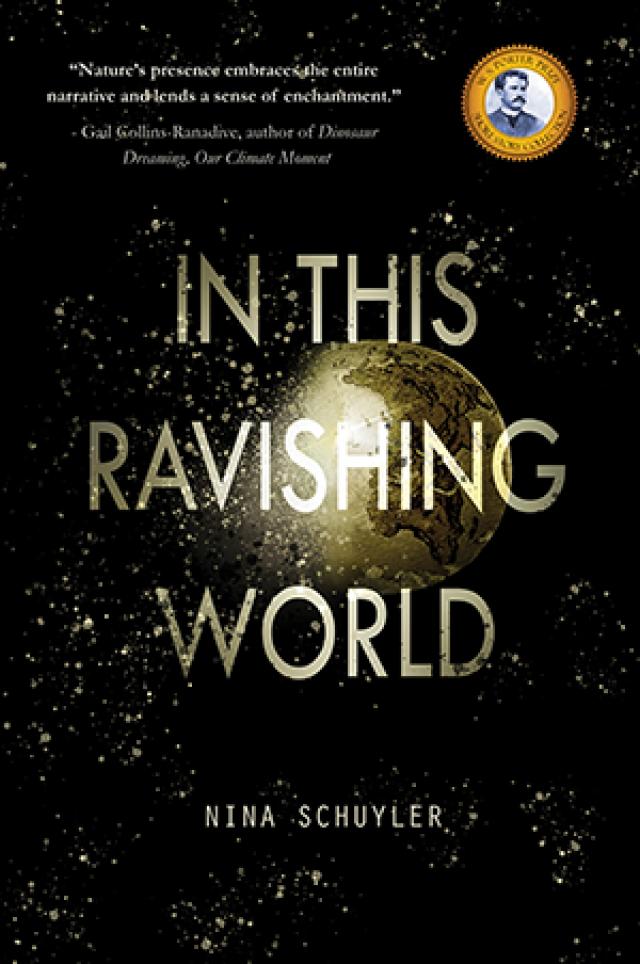
Contents
Praise for This Ravishing World
In this Ravishing World
Copyright © 2024 Nina Schuyler. All rights reserved.
Dedication
Quote
Introduction
On the Brink
Free
Belonging
The Object of Dancing
Paradise
Muscular Activity
A Living Soul
Our Days of Grace
Brethren and Sistren
The Big Picture
Acknowledgments
Praise for This Ravishing World
“In this Ravishing World also won The Prism Prize for Climate Literature. The judge for that contest wrote: three pages into reading this fascinating book, I knew it was the clear winner of the third annual Prism Prize for Climate Literature that I sponsor through Homebound Publications. Not only does it cover every facet of the climate issue and the ongoing efforts at dealing with or denying/undermining what needs to be done, Nature’s presence embraces the entire narrative and lends a sense of enchantment. Riveted, I could barely put it down for the three days it took to read the compelling stories of a diverse cast of characters: there is someone in these pages for every reader to relate to. Hooked by the older woman in the opening pages who was exhausted and discouraged after years of climate effort, and eagerly following her through to the final pages’ plausible outcome, I applaud and admire Nina’s skill at creating characters and plot that pull readers into climate awareness, while simultaneously acknowledging those of us who have tried to move the needle through non-fiction offerings. This book made me laugh and cry, and gave me a ray of hope.”
—Gail Collins-Ranadive, author of Dinosaur Dreaming, Our Climate Moment
“A wildly inventive plot that keeps you turning pages, characters who steal your heart, big ideas that engage your mind, and gorgeous prose that delights your senses.”
—Ellen Sussman, New York Times bestselling author
“With a surgeon’s precision, Ms. Schuyler has written another exemplary story.”
—Devi S. Laskar, The Atlas of Reds and Blues and Circa
“With astonishing dexterity and deep empathy, Schuyler takes the readers on a capacious journey with people from all walks of life: environmentalists, families, children, dancers, workers, hackers, and many more. Her spellbinding prose and unflinching vision overwhelms me with contrition for our prodigal past, trepidation for our fraught present, and hope for our perilous future on Mother Earth.”
—Yang Huang, author of My Good Son and My Old Faithful
In this Ravishing World
Nina Schuyler
Regal House Publishing
Copyright © 2024 Nina Schuyler. All rights reserved.
Published by
Regal House Publishing, LLC
Raleigh, NC 27605
All rights reserved
ISBN -13 (paperback): 9781646034420
ISBN -13 (epub): 9781646034437
Library of Congress Control Number: 2023943434
All efforts were made to determine the copyright holders and obtain their permissions in any circumstance where copyrighted material was used. The publisher apologizes if any errors were made during this process, or if any omissions occurred. If noted, please contact the publisher and all efforts will be made to incorporate permissions in future editions.
Cover images and design by © C. B. Royal
Regal House Publishing, LLC
https://regalhousepublishing.com
The following is a work of fiction created by the author. All names, individuals, characters, places, items, brands, events, etc. were either the product of the author or were used fictitiously. Any name, place, event, person, brand, or item, current or past, is entirely coincidental.
All rights reserved. No part of this publication may be reproduced, stored in a retrieval system, or transmitted, in any form or by any means, electronic, mechanical, photocopying, recording, or otherwise, without the prior permission of Regal House Publishing.
Printed in the United States of America
Dedication
For Peter, Fynn, and Yohann
Quote
So much is unfolding that must
complete its gesture,
so much is in bud.
- Denise Levertov
Introduction
The human ear can hear a sound wave as low as 20 hertz, the lowest pedal on a pipe organ, or pick up a pitch as high as 20,000 hertz, a soprano singer’s C7. This might be the problem: I don’t speak in your range.
If I say: the world can give you more than it should, do you hear me?
Or: the air will become so sluggish, so hot and heavy, clogged with pollution, eyes watering, burning, a constant cough, constant sickness, malaria, dengue, cholera.
Or: the sunlight filters through a green oak leaf on a hot June day, revealing an inner map of light green veins that lead to another shade of green, one that speaks to something deep inside, something that only green soothes.
Or: in the west, the land is so dry, the cracks scribbled in dirt spell the word “desperation.”
Or ask: what do you care about?
Or: you will miss everything, always, painfully.
Or: what do you owe an egret? A jaguar?
Do any of those words spring up and flame? Maybe I need to say something comforting so you relax, and the words slip in like beautiful music. I’ve heard humans can’t stare directly at it; it’s like looking at the sun. How about, Once upon a time, a man and a woman had a child. They lived in a little house with a stone fireplace and a yard filled with Queen Anne’s lace. Then one day, something terrible happened.
I’ve been trying to speak to you for years, and despite wildfires, droughts, and floods, I haven’t gotten through. I know it’s enormous and terrifying, and I wish I could think about dirt and new leaves sprouting, horses galloping in open fields, and spiderwebs woven in a rickety fence. Such fragility in all this wonder. For you, there are infinite ways to fill your ears, with melody and money, loneliness and love and envy. Stories, so many stories, you stuff your ears with romance, affairs, falsehoods, jokes, trivia, and mysterious struggles between humans. Amazing what the human ear attends to—and what the ear is flush with swims through the brain like a fish, or so I imagine.
The other day, I heard someone say Nature will have the last laugh, but I don’t want it. We’re enmeshed, we always have been, tightly knitted together whether you like it or not. Our lots are cast together, and as things have become more urgent, we’ve become even more entangled, fine threads connecting us, billions of them. I’m not sure what to do because the alarm bell is ringing. Do you hear it? I know the sound waves are in your frequency.
What you listen to matters because each sound creates a visible pattern. Note A’s pattern, for instance, is distinct from D minor’s, which is different from C’s. Like matchless snowflakes. And, most astonishingly, sound waves can change matter, water, blood, salt, oil, and fire. Like wind blowing waves in sand.
Maybe other voices are needed: human voices, a chorus, a concerto of joy and terror, hope and despair and pleasure. Someone honey-mouthed and persistent, someone full of sorrow, uttering the words “catastrophe” and “cataclysmic”; a voice angst-ridden and hopeful. Others scrambling to escape the despair of being human, another self-absorbed and, surprisingly, attuned to others, someone who loves freely and deeply anything that isn’t human. Maybe these other voices will have sound waves you can hear; maybe they’ll rearrange you.
Hello? Hello? Tell me, can you hear me?
Please, climb down the stairs and open the door.
On the Brink
I’ve been thinking about Eleanor for many years because she’s someone I think I understand. She’s sunk into the mood I’m in. There she is, standing at her mailbox, looking through her stack of mail, not seeing anything worthwhile, only bills and flimsy fliers, until at the bottom of the pile her fingers find an envelope of high-quality paper. She’s in her front yard, and at this time of day the neighborhood is quiet, with those who had to head to work leaving long ago and only older people and women with small children in strollers passing by. At least she lives in a place with beautiful trees, so when she steps outside her mood lifts slightly, with the trees and green opening her up.
When she sees who the letter is from, she’s sure it’s a plea for money, and she’ll gladly give as she does for every environmental group. Over the years, as the government has cut back on environmental protections, their requests have become more desperate, and her motivation to give has intensified. She recently revised her will, allocating the proceeds from her house to five such organizations.
But it isn’t an appeal for money. As she reads the letter, her heart flutters like a bird spreading its wings, preparing to soar, and it does soar, flying high to the tops of the trees, reaching the puffy clouds, darting, diving, spiraling, but then, as if it’s been shot, it falls to the ground with a thud. It takes a moment to realize her phone is ringing in her pocket. She glances at the screen—her daughter.
There is a confusion of noise and static. Ava is probably rushing from her office to the classroom, crossing the crowded university plaza. “Mom! I just saw the news. Congratulations!”
Of course Ava knows. In this age of inform ation, everything is instantly known; it is an intoxication, this insatiable desire to know. If Eleanor checks her computer, she’ll most likely find an email about this, and perhaps a press release has already been sent to the newspapers.
“It’s probably the first time they’ve honored an environmental economist,” says Ava.
Eleanor folds the letter and shoves it back into the envelope.
“It’s such an incredible honor,” says Ava.
The wind picks up and knocks down a handful of Japanese maple leaves, a flurry of red in the air. She’ll have to rake soon, she thinks. A baby cries, followed by a mother’s soothing voice, and Eleanor closes her tired eyes.
“Sure,” says Eleanor.
“You don’t sound very excited.”
Eleanor used to fantasize about this moment, this very letter, and even imagined what she’d wear to the awards ceremony: a forest-green dress, sleeveless, with a scooped neck. But Arthur died, and her work unraveled, with fewer companies interested in her views on sustainability, and the earth tipped closer to the point of no return, and she slid into a different vantage point where the collective mind is deranged. Gloom has crowded into her being and made itself at home. Amidst the rubble is her dream, which the letter now hands her, the Goldman Environmental Prize.
“I guess I’m not excited,” says Eleanor.
“What are you talking about?” Ava’s voice pitches high with incredulity.
Eleanor heads down the stone path to her front door, where her dog, Blue, is waiting for her, tail wagging. She pauses and watches an egret pass over the neighbor’s roof, white and enormous. She once saw a pair of egrets fight in midair. Inside, her house looks like it’s fallen into a torpor, with the deep shadows from the oak and birch trees and her realization that life is not what you dream.
“Empty. There’s an emptiness to it.”
“No, it’s something,” says Ava. “It’s the Green Nobel Prize. I called Ed and told him that I’m calling everyone I know.”
Despite her fifty years of work trying to convince corporations that so-called external costs are, in fact, not external at all, despite endless meetings with CEOs and government officials explaining if they don’t move to zero-carbon emissions operations, their company will go bankrupt, despite it all, her work has not averted what she most feared. She’s seventy years old, and the world is precisely positioned where she worked all those years to avoid. Growing old has brought the inevitable, the body working furiously at demolition; she knew she would not escape that. But she wasn’t prepared to experience it at the same time as the planet’s demise. It was never her future because in her future, in her imagination, her work counted. Her life—what she devoted herself to endlessly—counted.
“We’re on the brink, love,” says Eleanor. She closes the front door and sets the mail on the front hall table.
“You just need to let this sink in,” says Ava. “You used to say if you won this, you’d have more access to the corporate bigwigs. You’d get more done.”
Ava, with her photographic memory. When she was a little girl, she suffered a series of frightening seizures, limbs shaking uncontrollably, eyelids fluttering rapidly, eyes rolling back. The doctor said she’d outgrow the episodes, and she did, but Eleanor always suspected it changed her brain somehow. Ava has the uncanny ability to remember the most minute, mundane detail. No one else in the family has such a skill. The things she remembers—what gifts she received for her birthday five years ago, seven years ago, ten; what her brother promised he’d do and never did; and what they did for July Fourth when she was thirteen.
Eleanor sighs, and Blue flops to the floor, picking up her mood. The house smells of coffee and toast, a hint of dust. On the front table is a catalog of colorful, expensive clothes. If she opened the kitchen window, she might coax the scent of honeysuckle to come inside. “That was a long time ago,” she says, “and now everything is in bad shape.”
She will not mention the bad shape of her mind, the ever-present sense of dread. How it makes her feel older than her age. And she doesn’t need to tell Ava, a professor of microbiology, the kind of shape the Earth is in, though Eleanor finds herself mentally ticking off the horrific details—150 to 200 species lost per day; with global temperatures rising about 1.8 degrees Fahrenheit, the global sea level rising six to eight inches in the last century. Enough. No need to speak of it because everyone has heard it too often and tunes it out. Or goes numb or scrambles for a distraction. The litany of the catastrophic has turned into a tired old story, the meaning dried out, moth-eaten. But she can’t help thinking—here’s the punch to her gut—all of it could have been avoided.
“No one declines this award,” says Ava in a deadpan voice. “It would be a slap in their face.”
“You’re right,” says Eleanor. She sits on the floor and puts her head in her hands. Blue comes over and rests his chin on her thigh. Her pants hike up, and she sees pale blue veins stretched taut over her bony ankles, a map of old. “But I can’t in good conscience accept it.”
A stunned silence. “The prize comes with significant money.”
Eleanor pets Blue’s squarish head. “I don’t want the money.”
In the long awkward silence that follows, Eleanor wonders if Ava was counting on the money, at least a fraction of it. If so, Ava must be recalibrating all the things she will not be able to do or buy, the places she was planning to travel to—probably Berlin, which she loves, or Russia, where her husband was born—because there won’t be any award money.
If she thought Ava truly needed money, Eleanor would take out a second mortgage, or she’d sell her house and move to something smaller. Ava, her brilliant daughter with her wispy blond ringlets, thanks to Arthur, and thanks to Eleanor her tall, wiry, boyish frame, and sharp points of cheekbones and chin, her soft, loose-lipped mouth; Ava, her firstborn, who, like a bloodhound, sniffs out inconsistencies in logic. But Ava doesn’t need money. She’s a professor at Stanford, and her husband teaches Russian literature. They earn enough to have a very comfortable life. Her son, too, is doing well as a professional dancer with the San Francisco Ballet. It’s what he always wanted. And Eleanor’s wants and needs are slim and becoming slimmer by the day.
“You’re not thinking straight,” Ava says flatly.
It’s probably true. Her sluggish thoughts made so by despair. Did she even make coffee yet? Eat anything? Eleanor is aware of her heart beating fast like a trapped, anxious animal clawing to escape. Her daughter lately seems to view Eleanor as not so quick. Ava’s concern about Eleanor traveling to Vietnam last summer, that pointed question: are you sure you can handle such a long flight? Followed by a flurry of other nervous inquiries: Where will you stay? You’re going alone? Is that wise? As if Eleanor had never flown before, as if she’d never flown for her work to Vietnam, or Cambodia, Indonesia, Japan, Botswana, or South Africa, alone. As if all of that has vanished; and in some ways, it has.
Eleanor gets up and begins to walk the halls of her house, with Blue, her loyal black lab tapping the floorboards behind her, passing through the threshold of her study, back down the hall to the sunlit living room, the kitchen, and the front entrance. Their house, hers and Arthur’s, where they spent their long marriage. She stops and looks out the window. The light shines brightly on the rhododendron leaves and an empty plastic cup sits in the gutter. It’s true: some have a wonderful dream that they never accomplish. “But see, if I accept it, I’ll have to give a speech.”
“It’s usually the way these things work.”
“But I don’t have anything to say. At least nothing anyone wants to hear.”
There are days she can barely speak, her voice wheezy and faint. Where did she go wrong? What approach should she have taken? How come her work has come to nothing? Her throat tightens, clamping down her next words because she refuses—a rule she gave herself long ago—to burden her children with her inner angst, her vulnerabilities and fears. Lately, the slightest thing—the squawk of a scrub jay with the faint pink of its beak; the air all over Fort Funston, heavy with the sea’s brine and seaweed; the morning glories, the lovely light in their center like a slow secret—makes her weepy. A mix of deep pleasure and deep sorrow. Somehow, to receive this prize now feels like a cruel joke. Absurd. The letter seems to have loosened something inside because before she can stop herself, she says, “I feel like a failure.”