

California dreaming, p.1
California Dreaming, page 1


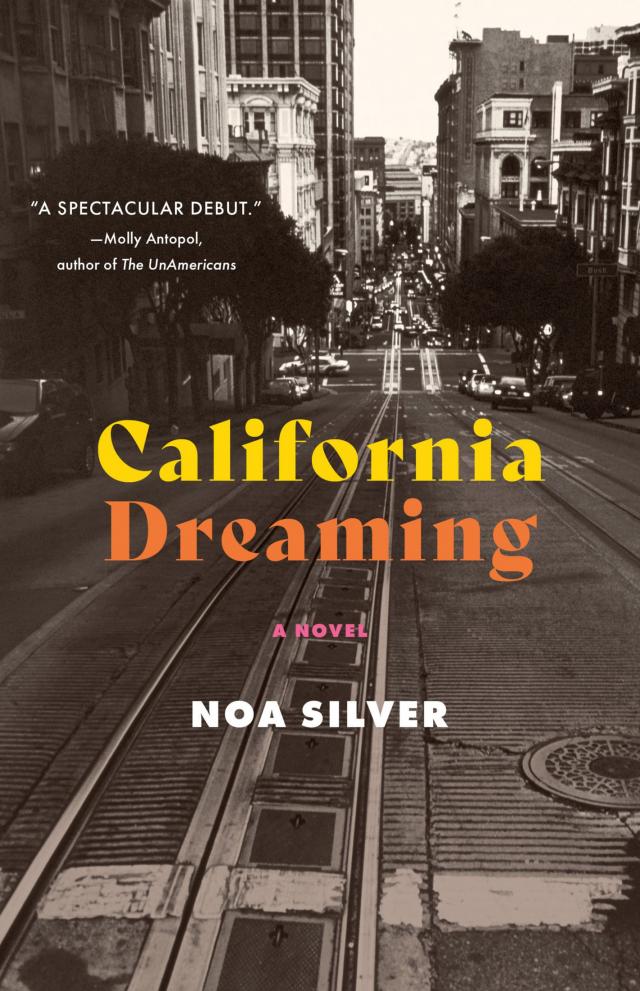
Praise for California Dreaming
“A splendid debut novel—confessional, engaging, honest. I very much look forward to reading more from this writer.”
—Lynn Freed, author of The Romance of Elsewhere
“In this tender debut novel, Noa Silver takes the reader back in time to one of those magical eras in Berkeley when young people, powered by their own idealism and multigenerational dreams, believed they could change the world. Fast-moving and unflaggingly engaging, California Dreaming tells a coming-of-age story that we need more than ever to hold close to our hearts.”
—Barbara Quick, author of What Disappears
“California Dreaming is a spectacular debut, shot through with wit, pathos, and wisdom and teeming with sentences so alive they seem to be reaching out to grab the reader by the lapel. At once a page-turning bildungsroman and an insightful commentary on the Bay Area in the twenty-first century, this book heralds the arrival of a talented writer whose work we’re bound to see on our shelves again and again. To read this book is to love it.”
—Molly Antopol, author of The UnAmericans
“A rich, insightful story about an East Coast transplant attempting to make a life within her own personal myth of California. Full of bittersweet longing, hard-won wisdom, and a pursuit for connection amidst personal and social change, California Dreaming is a pitch-perfect portrait of the Bay Area in the midst of the last tech boom.”
—Michael David Lukas, author of The Last Watchman of Old Cairo
Copyright © 2024 Noa Silver
All rights reserved. No part of this publication may be reproduced, distributed, or transmitted in any form or by any means, including photocopying, recording, digital scanning, or other electronic or mechanical methods, without the prior written permission of the publisher, except in the case of brief quotations embodied in critical reviews and certain other noncommercial uses permitted by copyright law. For permission requests, please address She Writes Press.
Published 2024
Printed in the United States of America
Print ISBN: 978-1-64742-660-6
E-ISBN: 978-1-64742-661-3
Library of Congress Control Number: 2023919355
For information, address:
She Writes Press
1569 Solano Ave #546
Berkeley, CA 94707
Interior Design by Kiran Spees
She Writes Press is a division of SparkPoint Studio, LLC.
Company and/or product names that are trade names, logos, trademarks, and/or registered trademarks of third parties are the property of their respective owners and are used in this book for purposes of identification and information only under the Fair Use Doctrine.
This is a work of fiction. Names, characters, places, and incidents either are the product of the author’s imagination or are used fictitiously. Any resemblance to actual persons, living or dead, is entirely coincidental.
NO AI TRAINING: Without in any way limiting the author’s [and publisher’s] exclusive rights under copyright, any use of this publication to “train” generative artificial intelligence (AI) technologies to generate text is expressly prohibited. The author reserves all rights to license uses of this work for generative AI training and development of machine learning language models.
For my parents
And for Jack
PART 1
Chapter 1
I always imagined the Bay Area as a gathering place for dreamers. Free speech and free love, long hair and long skirts, that place on the map where all those who were running and all those who were searching would stop—one last holdout for those of us who believed that even though the universe was random and moving ever closer toward chaos, something like meaning might still exist. I grew up on the words of Ginsberg and Ferlinghetti, on the tie-dyed memories of tripping acid on Mount Tam, on the aging and graying nostalgia of generations before.
When I got to the Bay in 2011, my mom’s copy of Kahlil Gibran’s The Prophet in my backpack, I started taking the bus around the East Bay. As I rode around Berkeley, I saw signs advertising quick routes to nirvana: LEARN TO MEDITATE! WANT INNER PEACE? JOIN THIS 10-SESSION COURSE. ONLY $1,425. There were yoga studios a dime a dozen, with drop-in prices that ranged from $18 to $25, and countless little shops that all seemed to be named some rendition of “Little Tibet.” Buddha statues and prayer flags hung in the windows; batik-patterned dresses sold for $45 each; volumes published by Shambhala Publications stood on the bookshelves. Singing bowls and meditation cushions were on offer everywhere—all the accoutrements needed for your very own meditation room.
Near the university, I’d sit in People’s Café, sip Mexican hot chocolate, and read the slogans on the bumper stickers they sold by the counter: SAVE TIBET, FREE PALESTINE, IF YOUR HEART IS IN THE RIGHT PLACE, IT’S ON THE LEFT, I ♥ AHIMSA, and ABOLISH CORPORATE PERSONHOOD. In and out of the café swished Cal students in yoga pants and big, round glasses (the kind I suffered through middle school wearing until my mom finally let me get contact lenses), interviewing for tutoring jobs and grabbing a vegan, gluten-free, cacao nut bar after their most recent donation-based Yoga to the People class.
Early on, I spent one blustery weekend morning going on a walking tour in San Francisco. The tour had a literary bent and began at City Lights Bookstore, mecca for the Beats-inclined. We paused in front of the apartment where Allen Ginsberg had lived, and my fellow tourists and I snapped photos of quotes by Maya Angelou and John Steinbeck painted on the wall outside Vesuvio Café.
Our tour guide pointed out that San Francisco was the perfect place for the literary and cultural revolution inspired by the Beat poets—the San Francisco Poetry Renaissance. The same buildings in which Howl was composed and Jack Kerouac and Neal Cassady drank and dreamed up a new vision of literary America, a hundred years earlier had housed brothels and speakeasies to entertain the gold rushers, traders, and merchants from across the seas. There was a certain lawlessness that characterized San Francisco, a lawlessness that was connected to vision, to imagination, to the desire—and the tenacity—to live outside the constraints of the times.
“Think of this city in terms of layers,” said our guide, “of one generation after another living and dreaming and drinking on top of the other in these same apartments, these same cafés, these same streets. Each layer sets the stage for the next. The current example of San Francisco’s revolutionary vision is Silicon Valley,” he said. “Aren’t we in a kind of modern-day gold rush? A technological renaissance? Our generation’s attempts to refashion, remodel, re-envision what is possible?”
At the time, I mostly paid attention to the points about the Beat generation. I roamed through City Lights at the end of the tour, flipping open Kerouac’s On the Road and Frank O’Hara’s Lunch Poems; I copied down inspirational quotes in my notebook, circling and starring my favorites from Kerouac a dozen times.
Chapter 2
I came to the Bay as a Teach for America (TFA) teacher, and in those last days of summer after the TFA boot camp had ended and before the first day of school, I’d hole up in the back of People’s and read Audre Lorde and think about biomythography, about the ways that writers blend myth and history in narrative. In between chapters, I’d flip through the book of Adrienne Rich poems I’d bought (A Wild Patience Has Taken Me This Far) and dream up lesson plans for English language arts that would help students understand the way words could mimic the sound of a bell chiming. Words like “certainty,” or “lovingly,” where the emphasis is on the first syllable, and the second two syllables reverberate, and then drift off into quiet.
My TFA placement was at a middle school in Fruitvale. Bright pastels painted the sidewalks; street vendors stood at the corners selling fruit and vegetables, little bags of popcorn, and spice-crusted nuts. The houses seemed to shrink into themselves: the roofs and walls sagged slightly, as though there had been too much rain and the houses had started to slouch over. Although, when I started teaching in 2011, California was in the midst of a drought that has continued for most of the years I’ve lived here. Signs were in Spanish and English, or just in Spanish, and at the middle school where I taught for two years—Bright Star Academy (BSA)—96 percent of the student body was Latino, many of them first-generation American, and others immigrants themselves. The other 4 percent was either Black or from the Pacific Islands. The only white people were among the teachers—a fact that took me years to recognize as problematic.
BSA is a charter school with a mission to prepare first-generation and immigrant students, most of whom did not speak English at home, to succeed, and even excel, in high school and beyond. The year I started teaching, the first professional development training scheduled was on how to incorporate the principles of restorative justice into the classroom. I had a feeling of Yes, this was why I came to the Bay. To be around vegetarians and teachers, yoga practitioners and abortion advocates; to be where people built their careers around mission statements rather than bank statements; to get to teach poetry in the way that I believed in it—as a lifeline.
A couple of weeks before school started, the teachers went on an overnight trip together. We drove up to Ukiah, a few hours north of Berkeley, into the golden grasses of the California hills, and bunked down in a rented farmhouse. On the drive, the principal, Jay, asked me what books I’d been reading to prepare for my first year of teaching, and I told him about Parker Palmer’s The Courage to Teach, and Frank McCourt’s Teacher Man, and Paulo Freire’s Pedagogy of the Oppressed. They were book
Jay nodded and someone in the back of the car coughed, and then he said, “Write this down. These are the things you need to read: Teach Like a Champion, Understanding by Design, and Why Are All the Black Kids Sitting Together in the Cafeteria? Got it? These books will teach you how to make lesson plans, how to structure your classroom, how to set expectations. They’ll make you think about the realities of the day-to-day, and how to understand your own positionality.”
I wrote the names of the books down, but I got lost somewhere between setting expectations and positionality—a concept I had never heard of before.
We all gathered around the campfire that evening, holding plates piled high with spaghetti and tomato sauce seasoned heavily with garlic. There were maybe twenty of us, not counting a few others who hadn’t been able to come on the trip. We crouched together on haystacks that had been haphazardly thrown together in a circle around the firepit. While we had spent the afternoon setting up the space, assigning teams to cook and clean—I was on dish duty that evening—and meeting in small groups based on the subjects we’d be teaching, this was the first time we were all gathered together. I imagine this was why Jay asked us to take a few minutes to introduce ourselves. The prompt, though, was unlike any name game I’d ever played, and I was caught off guard when Jay asked us, “Which of your tattoos is your favorite, and why?”
Nobody else seemed fazed by this, though there were a few titters around the fire, and I saw at least one of my fellow teachers pull her shirt away from her chest and look down with a smile. It didn’t seem like there was even an option to be sans tattoo, but after the snickers had subsided, Jay offered, as an afterthought, “And if you don’t have a tattoo, why not?”
We started going around the circle, each one saying their name and where they were from, what subject they taught, how long they’d been teaching, and then, of course, their favorite tattoo. I had been sure that someone else would also be tattoo-free, but by the time the metaphoric conch shell arrived at me, there hadn’t been a single one.
“I’m Elena, Elena Berg,” I said, and wondered if there was any tomato sauce on my chin or around my lips. “Uh, so I’m a TFA teacher, and I’ll be teaching seventh- and eighth-grade ELA. Um, I’m from the East Coast, from New England. And this’ll be my first year teaching.”
It was time to disclose both the fact of and the reason for my being tattoo-less, and as I looked around the circle at the faces glowing gold in the firelight, I thought about my grandparents back in Brooklyn. My grandfather, Nathan, and my grandmother, Sadie, both tiny in stature, with white curls haloing their crinkled red faces, sometimes looked more like brother and sister than husband and wife. They, apart from my mom, were my only family. They’d had no other children besides my mom and each of them was the only surviving member of their immediate families. I wanted them to do one of those genetic testing programs like 23andMe to find out if there were cousins or second cousins or second cousins once removed who had survived, maybe emigrated. I had visions of an entire shtetl’s worth of family waiting for us out there, but my grandparents would just chuck me under the chin and say, “You and your mama are all we need, bubbeleh.”
I thought about the blue numbers tattooed onto their arms, on the underside of their wrists, and how even as the years had brought on new wrinkles and folds of fat, the numbers themselves had not faded or disappeared. I thought about telling these glowing faces—my new teacher colleagues—about the weight that tattoos have in my family, how not even my mom, in her rebellious years of getting high and having threesomes, had ventured to mark her skin. I thought about adding that cremation was also out of the question for me, even though I thought it was more ecologically sound than being buried in the ground. I thought about saying that I wasn’t religious, never had been, that my grandparents weren’t either, but that we had turned our trauma into something sacred, and to go against it would feel sacrilegious.
But I didn’t say any of that. Instead, I said, while staring down at my plate of spaghetti growing cold, “Yeah, so I don’t have a tattoo. I guess just because I haven’t found the right one yet, you know?”
Later that evening, while washing dishes alongside Henrietta, a social studies teacher with fifteen years of experience under her belt, I started talking about my mother, how she had come out to California in the sixties and was now a professor of history.
“When did your mom start teaching?” Henrietta asked.
“After she left California,” I said. “She was political, protesting, but left when things got a little . . . hot. She was disillusioned; things weren’t working out here.”
“She went back to school?”
“Yeah. Studied history. She had some revelation about the fact that only certain stories get taught, that whole other narratives are silenced.”
“Is that why you want to teach, too?”
I slid a soap-sudded plate into a plastic basin of warm, gray water, rinsing off the remnants of spaghetti sauce.
“I guess so,” I said. “I want to teach kids that their voices—and stories—are important.”
Henrietta nodded.
“What about you?” I asked.
She laughed. “Well, some days it can feel like you spend most of the time telling them to take out their headphones and actually open their books.”
“I remember this one time in kindergarten I got in trouble for using the wrong color crayon,” I said.
“What do you mean, the wrong color?”
“We were supposed to make ‘realistic art,’ or something like that,” I said. “So, I drew a family—you know, parents, kids, the sun in the corner.”
“House in the background with the chimney poking up?”
“Probably a flower or two, as well.”
“Weird. How did your drawing get on my refrigerator?” Henrietta said with a smile, sponging the last remaining camping mugs.
“So, I pulled out a crayon that I thought was black and started coloring in the people’s faces.”
“You got in trouble for using a black crayon?”
“No, no,” I said, “it turned out that the crayon wasn’t black at all; it was purple.”
“No purple people allowed.”
“Exactly. I got in trouble.”
“Oh dear.”
“When I went home that day and told my mom, though, she was livid. She wrote a letter to the school.”
“What did it say?”
“She went on and on about how we use color in expressions to describe our emotions—you know, ‘tickled pink’ and ‘green with envy’ and ‘seeing red.’”
“Nice.”
“She said realism was overrated.”
“She sounds like a force to be reckoned with.”
“And she said it was a teacher’s job to encourage creativity in students, not to criticize them for artistic exploration.”
“And is that what you’re hoping to achieve?” Henrietta asked. “You want them to be creative? To explore?”
“I want them to be transformed, you know? The way I feel when I read great poetry.”
“And do you have a sense of how you want to create your classroom norms? How to set up a dynamic between you and the students to really allow for transformation?”
“You mean like what rules I want to establish? Needing to ask to go the bathroom or whatever? I’m not really into that. I believe that if they think that the rules are wrong, for example, then they shouldn’t follow them.”
My fellow TFAers and I had spent the summer repeating these ideas over cheap cups of coffee late at night, as we scrambled to write lesson plans for the following day’s mock classroom run.
Henrietta nodded and looked at me, her hands red from dishwashing. “Here’s the question, though,” she said. “How do you expect to actually get through to them, to encourage transformation and exploration, if they don’t, for example, want to read the poems you choose? How are you going to get them to buy in to your vision?”


