

A botanical daughter, p.1
A Botanical Daughter, page 1


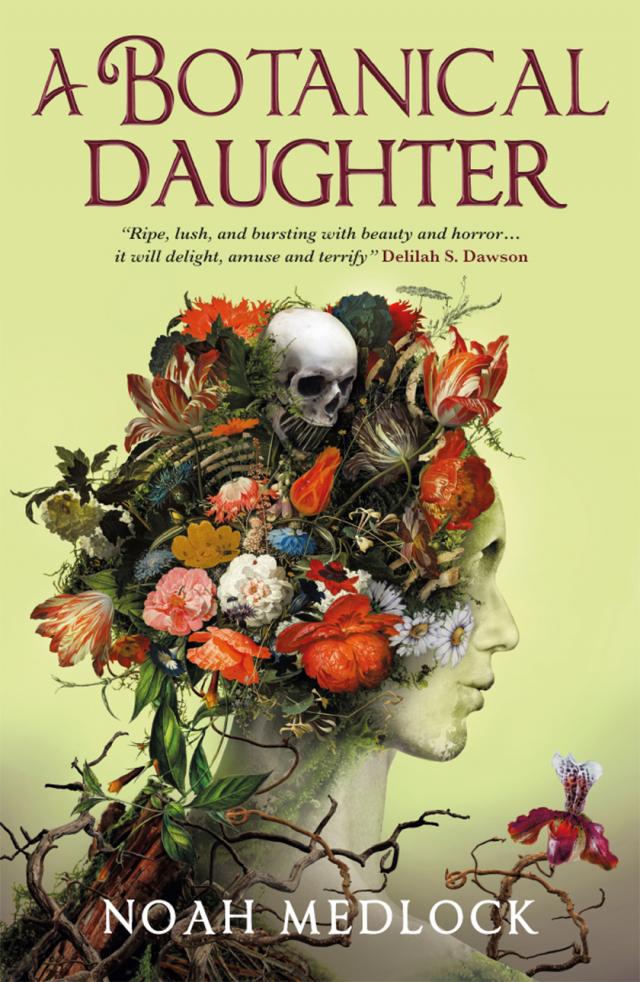
Contents
Cover
Title Page
Leave us a Review
Copyright
Dedication
Part I Germination
One
Two
Three
Four
Five
Six
Seven
Eight
Nine
Ten
Part II Cultivation
Eleven
Twelve
Thirteen
Fourteen
Fifteen
Sixteen
Seventeen
Eighteen
Nineteen
Twenty
Twenty-One
Twenty-Two
Twenty-Three
Twenty-Four
Twenty-Five
Twenty-Six
Twenty-Seven
Twenty-Eight
Twenty-Nine
Thirty
Thirty-One
Thirty-Two
Thirty-Three
Part III Propagation
Thirty-Four
Thirty-Five
Thirty-Six
Thirty-Seven
Thirty-Eight
Acknowledgements
About the Author
Praise for A Botanical Daughter:
“This book is the most fun a reader can have while still gritting their teeth in fear! Enchantingly eerie and upsettingly lovely, A Botanical Daughter is an intoxicating hybrid of blood, botany, and old-timey charm.”
Andrew Joseph White, New York Times bestselling author of Hell Followed with Us
“Ripe, lush, and bursting with beauty and horror, A Botanical Daughter will delight, amuse and terrify, all while breaking your heart. Perfect for readers who can imagine Frankenstein as created by the characters of Good Omens in the Garden of Eden.”
Delilah S. Dawson, New York Times bestselling author of Bloom
“Macabre and magnificent. Horrifying and hilarious. Oddly and unquestionably heart-warming. A delightfully gruesome and rather brilliant debut from Noah Medlock. A viciously violent Victorian romp that would have Mary Shelley saying ‘Damn!’”
Angela (A.G.) Slatter, award-winning author of The Path of Thorns
“Medlock invites readers into a rich and sumptuous world in a dark and charming novel full of macabre delights. The perfect blend of classic science fiction and horror, wrapped around a core of found family, love, and heartbreak – this story hits all the right notes.”
A.C. Wise, award-winning author of Wendy, Darling
“Deliciously arch and bursting with eccentricity, A Botanical Daughter starts its uncanny life as a cosy-yet-macabre look at found family. Soon, however, it grows, steadily and with skill, into a vegetal monstrosity, forcing us to look – not without a shiver – at the horrifying ‘other’ and the boundaries of personhood. An extraordinary debut.”
Ally Wilkes, author of All the White Spaces
“This flourishing horticultural horror could only be the monstrous byproduct of a mad phytologist, Mary Shelley grafted onto Jeff VanderMeer, a gothic greenhouse of sporror that reaches down deep into the substrata of the reader’s subconscious and eternally takes root. I absolutely loved it.”
Clay McLeod Chapman, author of What Kind of Mother and Ghost Eaters
“A dreamlike green Frankenstein. Medlock’s debut is full of uncertainty and charm, where wonder and suspense grow entangled with each other in a book that grips you tight. A captivating weird gothic.”
Hailey Piper, Bram Stoker Award®-winning author of Queen of Teeth
“Medlock’s fertile imagination has given rise to a neo-gothic novel that twines ideas of life, death, and humanity together in an inexorable, fecund embrace. Beautifully macabre and monstrously, joyously queer, A Botanical Daughter wrapped its tendrils around my heart and slowly squeezed until I was quite short of breath. Expect it to grow on – and in – you.”
Trip Galey, author of A Market of Dreams and Destiny
LEAVE US A REVIEW
We hope you enjoy this book – if you did we would really appreciate it if you can write a short review. Your ratings really make a difference for the authors, helping the books you love reach more people.
You can rate this book, or leave a short review here:
Amazon.com,
Amazon.co.uk,
Goodreads,
Barnes & Noble,
Waterstones,
or your preferred retailer.
A Botanical Daughter
Print edition ISBN: 9781803365909
E-book edition ISBN: 9781803365923
Published by Titan Books
A division of Titan Publishing Group Ltd
144 Southwark Street, London SE1 0UP
www.titanbooks.com
First edition: March 2024
10 9 8 7 6 5 4 3 2 1
This is a work of fiction. All of the characters, organizations, and events portrayed in this novel are either products of the author’s imagination or are used fictitiously. Any resemblance to actual persons, living or dead (except for satirical purposes), is entirely coincidental.
Copyright © 2024 Noah Medlock. All Rights Reserved.
Noah Medlock asserts the moral right to be identified as the author of this work.
No part of this publication may be reproduced, stored in a retrieval system, or transmitted, in any form or by any means without the prior written permission of the publisher, nor be otherwise circulated in any form of binding or cover other than that in which it is published and without a similar condition being imposed on the subsequent purchaser.
A CIP catalogue record for this title is available from the British Library.
For James
part i
germination
One
It is an unusual thing, to live in a botanical garden. But then again, Simon and Gregor were an unusual pair of gentlemen.
You might imagine that the vast greenhouse at Grimfern would be too stuffy for human habitation. You would be more or less right, though Gregor Sandys—that notorious botanist—had become accustomed to the garden’s balmy climate. Grimfern’s many brilliant glass surfaces were always covered in a sheen of condensation, so he developed a habit of carrying a handkerchief in every pocket for the sole purpose of wiping his spectacles. His sumptuous fruit trees and exquisite orchids required such moisture and heat that by the end of a hard day’s gardening he could practically wring out his cummerbund. Gregor would swelter at any temperature though, cooking slowly like a steamed ham, for his precious collection of botanical curiosities.
In a house made of glass, the dazzling sun was a constant worry. An embellished wrought-iron frame held up countless artisanal panes, and if a denizen of the garden were caught off-guard by a passing sunbeam—or even by a particularly flamboyant candle flicker—he would be quite incapacitated by the light’s furious beauty. Simon Rievaulx, the other resident at Grimfern, had set up his taxidermy workstation in the cool, dark basement of the glasshouse precisely to avoid this problem. Down there, beneath even the boiler, he could make sure that his compositions did not spontaneously de-compose by keeping his cadaverous creations, and himself, pleasantly chilled.
The immense roof of the central dome was a masterpiece of levity through structural integrity—a hallmark of Victorian engineering. The Grimfern Botanical Garden was a prismatic Hagia Sophia—a fountain of jewelled rafters. Even the great Crystal Palace in London would be jealous of its bespoke glasswork. Gregor had taken care to fill his glass mosque not only with greenery, but also with music; he had his mother’s piano placed carefully under the great dome to achieve maximum acoustic effect. There he would sit of an evening and swoon to the excesses of French and Bohemian composers. Of course, the great glass roof made a great damn clatter when the storms hit, so even under its shelter Gregor’s rhapsodies could be rained off. In addition, the heat and damp played havoc with the beast’s temperament. Even the simplest étude became savage with its barbarous tuning.
The final complaint to be discussed here about living in a rococo conservatory is the sheer lack of privacy. Simon and Gregor, being confirmed bachelors, had no qualms about keeping each other’s company. Well, they shared one qualm—that they should guard their own workspaces as sacred to themselves. Simon never visited the west wing where Gregor conducted his research, and Gregor never descended the stone steps to Simon’s refrigerated taxidermy practice. They slept, washed, and cooked in the east wing of the gardens, which was split up with luscious ferns and vines into smaller rooms. A playful device allowed for a bath or shower in amongst tropical foliage, with the jungle flora appreciating this steamy atmosphere.
An odd thing about this notionally see-through house was that barely anyone, except for the two gentlemen inhabitants, ever actually saw inside. It was set upon a commanding hill with a long, sweeping lane, stone steps, and terraces. It was ringed by a thick hedge and guarded by sentinel poplar trees. The wider grounds were kept by a squadron of villagers, handpicked for their discretion, or for their un-inquisitiveness. They trimmed the lawns, spruced the bushes, mucked out the horses, and so on, enjoying generous pay and limited oversight from Mr Sandys. But they were never to set foot, or even peer, within the topiary fortress where the masters lived.
The only villagers who even came close to the greenhouse were the post lad and the girl who dealt with the laundry. They would meet Gregor at the top of all those steps, where the privet reared up into an arch over a
The story starts here at one such exchange, in part because the boy—Will—carried with him a long-awaited delivery: a crate marked with angry customs notices in both Dutch and Malay. But we also start here because the girl—Jenny—was entirely absent.
* * *
“Package for you, sir. Straight from Araby, by the looks of it!”
Gregor eyed the crate with ill-concealed glee.
“It is a specimen from Indonesia, in fact.” He dropped his canvas sack of laundry and hefted the rough-hewn box from Will. “And it took more than a few well-chosen words in the ears of powerful people to get it back here.”
The young man just smiled and shrugged, making the most of his time near the greenhouse to nosy around the patio. Gregor tolerated this indiscretion, as all he could spy on would be the meticulously spherical rose bushes. The view inside the greenhouse was blocked by emerald, sun-hungry leaves, thick and waxy against the steamed glass.
“I guess Johnny Foreigner doesn’t like you nicking his plants.”
“I didn’t steal this, I discovered it. And it’s not a plant. It is a fungus.”
“Finding or robbing, flowers or fungus. Can’t tell the difference, myself!” Will said with his cock-eyed smile. The corners of Gregor’s eyes creased behind his spectacles, but he held his tongue. Now there was only the matter of the laundry bag, slumped on the floor between them. Both men stood there, just blinking at it.
“The girl—she isn’t here?”
“No, sir,” said Will, “Jennifer’s not turned up today.”
“Whyever not?”
The lad shifted his weight, his countenance darkening. “It’s a sorry business, Mr Sandys. It seems—”
“Question withdrawn. She can pick up the laundry next time. Good man. Off you pop.”
Gregor turned sharply and rushed his acquisition to the laboratory, dragging the laundry behind him. He dumped the linen sack in the entryway, with shirts and smalls spilling out onto the stonework. The post he cast carelessly near enough to a sideboard near the door. He had better things to do—there was botany afoot.
* * *
Simon emerged from his underground workshop, blinking in the full light of morning. His jaw was pale and sharp, and scrupulously shaven. He stopped briefly at the pile of clothes on the stonework floor, looked this way and that, then stepped clean over it with his gangly legs.
“Was there any post for me, Gregor?” he called into the west wing.
“Probably,” might have been the muttered response.
The sideboard was empty. The sideboard which was placed there for the express purpose of receiving the mail. Simon tapped it. That was where the post was supposed to be. There was laundry on the floor and no post on the sideboard. The whole world was out of alignment. Such things irked Simon in a way that he had learned never to show.
“Where is it?” he asked back, in a practised, even tone.
“By the door!” came the distant, disinterested response.
By the door. But not on the sideboard. Simon turned a full circle before his doleful eyes fell upon a pile of envelopes, sticking out of a large terracotta pot. Barely a foot away from their proper place, on the sideboard, the sideboard put there to receive the post. He retrieved them stiffly (he wore his pinstripe trousers slightly on the too-tight side) and brushed off the potting soil.
One letter, addressed to him personally, displayed such lavish penmanship that he opened it hurriedly with a grin.
* * *
[Letter from Rosalinda Smeralda-Bland, dated Saturday 8th June 1889]
Dearest Simon,
A curse upon the botanist! Has he no love for me, the greatest (and presumed last) of his admirers (other than your own, dashing self)? The letters I have written to him, so carefully crafted, so stuffed with adulation, I fear have languished unopened upon his potting shed bench. So much love—so much stationery—wasted!
I implore you, darling Simon, when you next see the elusive gardener, to strangle him with his own watering hose. And after that, give him the news that I intend to visit Grimfern on Whitsun to see what botanical wonders he has in stock. I have been badgering him for weeks about it, and in the absence of a response, I shall take no ‘no’ as an invitation.
See you tomorrow, Simon.
Love to you both,
Rosalinda S-B
P.S. Fair warning—I shall have to bring Mr Bland, I’m afraid…
“Rosalinda’s coming, Gregor, to buy some plants. On Whitsun—that’s today!”
Gregor was finally interested enough to emerge from his laboratory, dressed in an apron and carrying a crowbar which he had used to open his Indonesian crate.
“Today? She can’t come today. She didn’t tell me!”
“From the tone of her letter, I think she rather did, in fact.”
Gregor took the letter and skimmed it, squinting in the absence of his spectacles which were perched, forgotten, above his auburn hairline. “Shame about Mr Bland. It will be nice to see Rosie, though.”
“But, Gregor!” Simon’s large eyes were even wider than usual. “The greenhouse is in disarray! Plates and glasses here and there, post in the plant pots, clothes all over the atrium—”
“Oh yes, the girl didn’t come to fetch the laundry.”
The clothes sack could, of course, have been moved anywhere other than the middle of the floor, directly by the greenhouse entrance. It would be a chore of a matter of mere moments to place it elsewhere, but Gregor had not the drive and Simon had not the grace to do it now, themselves. As far as these stubborn fellows were concerned, the clothes would have to remain there for the rest of eternity.
“The girl—Jennifer Finch, isn’t it?” asked Simon.
“Possibly. I—”
Just then, there came a thud from Gregor’s laboratory in the west wing. There was nobody except for the two of them in the greenhouse. Gregor frowned, growled something about the wind, and disappeared behind screening vines to find out what must have fallen.
Simon chewed his lip and put on his black silk gloves. He happened to be planning a visit to Jennifer’s father, who sold him animals of dubious provenance for use in his taxidermy works. He would go there today and ask after his wayward daughter. There was little-to-no hope that Gregor would do anything about the laundry issue, and perhaps by speaking to the Finch girl, Simon could resolve it without actually having to do any housework himself, either.
* * *
Gregor bounded back into his laboratory, the straps of his apron flapping behind him. It was a bracing, bright day, and there were cloud-shadows scudding along the brick floor.
Gregor’s workshop was messy, but it was a human’s mess rather than Nature’s. In the great central atrium, he had meticulously planned and maintained Nature’s chaos to resemble itself. Tropical plants were laid out in a riot of colour and shape—it was Gregor’s scrupulous organisation and upkeep which kept it looking spontaneous. In his laboratory, however, careful filing systems and square trays of seedlings, which should have spoken of humankind’s impulse towards systematisation, lay scattered and chaotic in Gregor’s tempest of genius.
Gregor stalked around the various workstations, trying to spot a stray animal or a broken pane—the potential source of a bluster. But there was no sign of a further disturbance, nor even of anything having fallen to make the noise.
Until he looked back at his newly arrived crate.
No sooner had he prised the lid open, Simon had called him back to the atrium. Gregor had reluctantly left the crate slightly open, its lid just off-kilter. Now though, it was squarely shut.
“Who…” Gregor began, before holding his tongue. There was no one in the garden besides himself and Simon.
He pulled at the lid, but it gave more resistance than he expected. He finally wrenched it open and the contents released a puff of mildew, before shaggy tendrils of grey broke between the contents and the lid.
This was the precious specimen Gregor had imported, at no insignificant cost, from the Isle of Sumatra to his greenhouse in sleepy Buckinghamshire. Out there in Indonesia he had discovered this mycelium with miraculous properties. But had it… closed its own crate?




