

Simple pasta, p.1
Simple Pasta, page 1


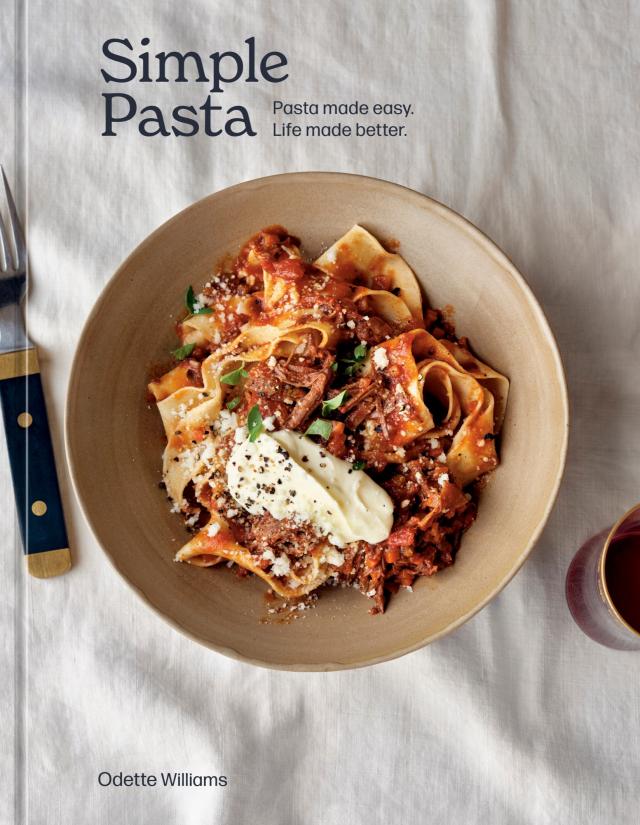
Text copyright © 2022 by Odette Williams.
Photographs copyright © 2022 by Graydon Herriott.
All rights reserved.
Published in the United States by Ten Speed Press, an imprint of Random House, a division of Penguin Random House LLC, New York.
TenSpeed.com
RandomHouseBooks.com
Ten Speed Press and the Ten Speed Press colophon are registered trademarks of Penguin Random House LLC.
Print typeface(s): DJR’s Forma DJR Mircro, ITC’s Souvenir, and Newlyn’s New Spirit
Library of Congress Control Number: 2022934786
Hardcover ISBN 9781984859921
Ebook ISBN 9781984859938
This page: Garlic bread styled by Christopher St. Onge.
Acquiring editor: Kelly Snowden | Developmental editor: Kim Keller
Production editor: Sohayla Farman
Print designer: Rachel Tervenski
Design manager: Emma Campion
Print production designers: Mari Gill and Faith Hague
Print production manager: Serena Sigona
Print prepress color manager: Jane Chinn
Food stylist: Rebecca Jurkevich | Food stylist assistant: Cybelle Tondu
Prop stylist: Amy Elise Wilson
Copyeditor: Dolores York | Proofreader: Adaobi Obi Tulton
Indexer: Amy Hall
Publicist: Kristin Casemore | Marketer: Andrea Portanova
rhid_prh_6.0_140822100_c0_r0
Simple Pasta is a book of appetite and desire; of unpreened, simple, tasty recipes that you’ll happily return to again and again. Along with the classics that we all crave (I’m talking to you, Cacio e Pepe and Carbonara), I’ll also share new favorites to add to your repertoire. Consider these as seasonal blackboard menus. Pasta is the star, but I’ve also got the supporting acts: starters, salads, booze—and, of course, dessert—so you can put a killer meal together. There’s nothing a home cook can’t successfully pull off, and, yes, I’m going to convince you to make your own pasta. If you don’t have the energy for the fresh stuff (I get it), you can always use dried pasta. Either way, pasta is primal. It’s flour, water, and joy. Everyone loves it. So, put the music on, call your people, and let’s roll.
Contents
Introduction: Channeling la Dolce Vita
Pasta Techniques
Serving Sizes
Tips for Cooking Pasta
Let’s Roll: The Only Pasta Doughs You’ll Ever Really Need
Egg Dough
Gnocchi
Semolina Dough
The Pasta Playground
Flat Egg Dough Pasta
Shaped Egg Dough Pasta
Filled Egg Dough Pasta
Shapes for Filled Egg-Dough Pasta
Laminating Dough with Herbs & Flowers: Peter Rabbit Pasta
Shaped Semolina Dough Pasta
Everyday Sauces & Crunchy Bits
Tomato Sauces
Nonna’s Homemade Passata
Mama Sordo’s Red Sauce
Luxurious Pomodoro in a Flash
Pestos
Classic Genovese Pesto with a Twist of Opal Basil
Charred Broccoli, Cashew & Pecorino Pesto
Cavolo Nero, Parmigiano & Pistachio Pesto
Artichoke, Almond & Asiago Pesto
Nana’s Nasturtium & Macadamia Pesto
Walnut, Anchovy & Parsley Pesto
Crunchy Bits
Basic Bread Crumbs
“GB in the House” Garlic Bread
Spring
Crispy Shrimp with Lemon Aioli
Super-Dirty Preserved-Lemon Martini
Butter Lettuce with Celery, Pistachio & Pecorino Toscano
Good Pasta, Good Butter, End of Story
Potato Gnocchi with Baby Asparagus & Miso Butter
Wicked White Bolognese
Artichoke, Pea & French Feta Farfalle
Roasted Salmon & Fregola in a Zingy Dressing
Peppery Pappardelle, Pancetta & Mushrooms
Weeknight Wonder Rigatoni with Tuna, Fennel, Lemon & Olives
Creamy Potato, Caramelized Leeks & Gruyère Pansotti
Prosciutto & Ricotta Ravioli
Mighty Fine Skillet-Roasted Chicken
Rhubarb & Raspberry Crisp with Vanilla Bean–Tangerine Ice Cream
Summer
Nectarine & Cucumber Salsa with Burrata
Classic Summertime Spritz
Heirloom Tomato, Basil & Olive Croutons
Beachy Alfresco Linguine alle Vongole
Spaghetti with Sun-Kissed Tomatoes, Ricotta & Crispy Prosciutto
Fried Zucchini & Basil Casarecce
Chopped Salad Pasta
Garlic Shrimp Mafaldine
Cacio e Pepe
Cavatelli with Sausage, Peppers & Oregano
Sweet Corn & Jalapeño Ravioli
Lobster Ravioli
Grilled Lemon, Garlic Butter & Herbed Orzo
Fabulous 15-Minute Branzino
Salted Caramel Ice Cream with Chiacchiere
Autumn
Marinated Peppers, Gruyère & Hazelnut Dip
Sanpellegrino 75
All about Arugula Salad
Garganelli with Vodka Sauce
Beet & Carrot Agnolotti with Sage-Hazelnut Butter
Umbrian Lentil & Porcini Ragù
Midnight Fettuccine with Seared Scallops
Seafood Marinara (Frutti di Mare)
Meatballs with Mama’s Red Sauce & Spaghetti
Luxe Mac & Cheese
Tagliatelle with Lamb, Fennel & Olives
“Yum, You’re Lovely!” Classic Bolognese Lasagna
Superior Schnitzel
Sesame & Honey Panna Cotta
Winter
Oysters with Peppercorn & Fennel Mignonette
A Bone-Dry Prosecco Tower
Winter Chicories with Date & Anchovy Dressing
Creamy Wild Mushroom & Potato Gnocchi
Carbonara
Gnocchi with Luxurious Pomodoro
Cannellini, Pancetta & Lemon Pasta e Fagioli
Crispy Italian Sausage & Broccolini Orecchiette
Classic Tortellini en Brodo
Cannelloni—Let’s Bring It Back!
Beef Short Rib Pappardelle
“Damn, That’s a Keeper” Winter Vegetable Lasagna
Skirt Steak with Olive Gremolata & Fried Gnocchi
Gianduja Crème Brûlée
The Pasta Toolkit
In My Grocery Basket
Types of Flour
Pasta Tools
Acknowledgments
About the Author
Index
Introduction: Channeling la Dolce Vita
The summer when I started working in earnest on this manuscript, I had planned to take the kids to Italy. The pandemic put an end to that; so instead, my good friend Amy and I hunkered down with our collective five kids and two dogs on Fire Island. We decided we’d manifest our own La Dolce Vita. Each night we rolled a lot of pasta as I jotted down recipe notes and the kids waited patiently for yet another 10:00 p.m. dinner. We filled our days with saltwater and aperitivo. We listened to music, dressed up for each other, and put on lipstick, even though it was going to be slurped off by linguine. After we put the kids to bed, Amy and I would sit down with a bottle of red, google “Italian villas,” and daydream about travel, touch, and socializing again. The next day, we headed back into the kitchen and made pasta, yet again.
This book could have been called Pasta, I Love You So Much It Hurts. It’s been a long-standing affair. My love of homemade pasta can be traced to a specific time and restaurant. I was a young kid growing up in a coastal steel town two hours north of Sydney, Australia. On Friday nights, my parents would take my brother and me to our local Italian restaurant, The Trieste, for dinner. They’d bundle us up in our pajamas (yes, we went in our robes and slippers) because by the end of the night, driving home with our bellies full, my brother and I would fall asleep in the back of the Kombi van and have to be carried to bed. Take me back! As kids, we picked up on our parents’ relief and relaxation that only Friday evenings can bring about.
Going to the Trieste for dinner was an affordable treat that we all loved. It was a family-run restaurant with about ten Formica tables and a carpeted floor. It was BYOB. To get to the bathroom you had to walk through the kitchen, past the cook. There was a Chupa Chups lollipop stand on the bar that loomed over us, keeping children in check. We knew that if we played our cards right and behaved throughout dinner, we’d each get to choose one at the end of the night.
Those Italians knew a thing or two about parenting. My mom always appreciated how welcoming the owners were to children. This was back when there were no iPads and kids weren’t always welcome at restaurants. Kids could be, well, kids: unpredictable, cranky, loving, annoying, curious, and excited all in a hot minute. I might be making this up, but I have memories of the owner allowing my brother and me behind the bar at the end of the night to help ring up the bill on the cash register.
Each week, we ordered the same thing: sizzling garlic prawns that came in a flaming-hot black skillet, spaghetti Bolognese that my brother and I split, and schnitzel for my parents. The laminated dessert menu sho wcased garish premade gelato that arrived rock-hard and never tasted as good as the pictures looked. Dessert was Trieste’s weakest link, something I’ve remedied in Simple Pasta (and in my previous book, Simple Cake, come to think of it).
Dessert aside, everything in life felt right during those meals. I think such a happy childhood experience is why I adore twirling pasta and eating simple Italian food so much. I will never tire of the feeling it gives me. It’s my comfort food. My escape. My indulgence. My way back to a time when life felt uncomplicated.
Sadly, a restaurant like the Trieste is almost impossible to find these days. But that doesn’t mean you can’t re-create the feeling of contentment (and pasta!) at home. In these pages, Italian is the starting point, but you’ll also see influences from places I have lived in and traveled to. I’ve also been inspired by chefs and cooks who make homemade pasta exceptionally well. Their restaurants are places at which I’d happily eat every night, if I could. They don’t just consistently cook delicious homemade pasta but they also fill my soul in a similar way as the Trieste.
There was Dolomiti’s, the Italian restaurant where I worked in my early twenties, and I loved Old Papa’s Cafe in Fremantle, too many trattorias around Sydney to name, and Frankies in Brooklyn (my local for over a decade). I could happily eat at Ignacio Mattos, Altro Paradiso any night of the week. I’m crazy for Missy Robbins’s Lilia and Misi in Williamsburg. It’s dreamy to sit at the bar at Via Carota in the West Village, and Flour + Water in San Francisco is our new haunt, when we can get a table. Il Corvo Pasta in Seattle was absolutely worth the hour-long wait that I made my kids suffer. Rolf and Daughters blew my mind with their seasonal pasta when we visited Nashville. These favorites have inspired me to imbue Simple Pasta with seasonal creativity and the feeling of making everyone welcome.
But here’s the skinny, and why I had to write this book. How was it that someone who worshipped pasta had never made her own fresh pasta until she was forty? Now, I religiously make it for my family. Yes, it really is that easy! I’m guessing I’m not alone. Well, this is the cookbook that’s going to be your gateway. Yes, you are going to make homemade pasta. And you are going to love it.
As well as giving you the tried-and-true classics that we all crave, I’ve made sure the recipes are focused, with an emphasis on produce that’s either growing in the garden or available at the market. There’s a wonderful improvisational nature to pasta; it’s essentially a blank canvas for seasonal produce. I love that pasta can be a quick meal for one or a feast. Once you get to know these basic doughs, you will really be able to play. And for those nights when you just don’t have the wherewithal for homemade pasta in you, reaching for store-bought dried pasta is just A-OK. In fact, for some recipes, it’s preferred. For convenience, each ingredient list starts with the amount of pasta needed, whether fresh or store-bought.
In the end, I did make it to Italy. My daughter Opal told me, “You can’t make a pasta book and not go.” We photographed half the book on Fire Island, where it all began, and then took off to a villa in Marsala, Sicily, for a week. It was exhilarating to travel again. Opal was right, and so was the gelato. Collaborating and creating something from nothing, both on a barrier island and in a foreign country was magical. I hope Simple Pasta ignites your own wanderlust and that one of my recipes, menus, or personal anecdotes sparks an idea that you can run with and make your own. I’d do anything for a great meal and a belly laugh. It’s pure pleasure and joy. My wish is for you to find this feeling within these pages.
Pasta Techniques
Kneading, resting, rolling…repeat after me.
Kneading
Kneading is essential to develop the gluten in flour and to create elasticity so a dough can be rolled thinly without tearing. You’ll have a craggy ball of dough at the start, but you’ll end up with a silky-smooth, soft ball of dough after kneading.
Start by lightly flouring a clean, wooden work surface and knead using a wave-like motion. Drive the heel of your palm into the dough, pick it up and fold it onto itself, rotate 45 degrees, and then drive your heel back over the dough again. Repeat this for the recommended time or until the dough is smooth and supple and springs back when lightly pressed. After kneading, the dough should feel similar to fresh Play-Doh. If it feels wet and sticky, add a little more flour to your work surface and knead to incorporate. If it feels dry, spritz the dough with water from a spray bottle or drip very small amounts, a little at a time, and work it into the dough.
Resting the Dough
After kneading, shape the dough into a ball and wrap it well with plastic wrap to rest. Resting the dough, covered, allows for a more even hydration and gives the gluten time to relax before being rolled and shaped. Under a time crunch, I’ve been known to not let egg dough sit for the stated 30 to 60 minutes. Nothing bad will happen to the dough if you let it rest for longer than directed but always keep it in the refrigerator; well covered with plastic wrap during this step so it doesn’t dry out.
Some folks like to rest semolina dough, but I haven’t found it essential and usually start shaping immediately or within 10 to 15 minutes after kneading. Just make sure to keep the dough covered as you work.
Rolling Out the Dough
Rolling out the dough creates a thin, silky sheet of pasta that can then be cut, shaped, or filled. Depending on what shape or cut of pasta you are making, the thickness of the dough will vary slightly, but the overall goal is to end up with a large sheet that is uniformly even.
By Machine
For all intents and purposes, an electric pasta-rolling machine, such as a KitchenAid mixer with pasta attachments, is a godsend. The machine makes rolling pasta easy and fast. Make sure to keep the machine at a slow speed while rolling the dough. Alternatively, a hand-cranked machine does the trick. A novice might find it easier and more manageable to feed smaller pieces of dough through a hand-cranked machine.
By Hand
The simplest way for a novice to roll pasta is to use a standard rolling pin and a lightly floured surface, preferably wooden. Roll the dough as you would a pie dough, only the end product will be much thinner. When you start out, don’t go for a spectacularly large sheet, your goal is an evenly rolled, thin sheet. Whether using Basic or Large-Batch Egg Dough (see this page), start by dividing the dough into four equal pieces to make the rolling more manageable. With this quantity, you’ll end up with a sheet that’s a similar size to a pizza. Don’t worry too much about the shape of the sheet as you roll; its translucency and evenness are key. So, grab your rolling pin, and go for it. Sure, it’s a cruder version than the method that I describe following but, at the end of the day, you hand rolled your pasta!
Using a Mattarello and Tagliere
I do want to share a traditional method using a mattarello and tagliere, that I learned from Sfoglina Julia Ficara of Grano & Farina cooking school in Rome. She earned the title of sfoglina for her expertise in rolling fresh sheets of pasta (sfoglia) by hand. Like any skill, rolling dough by hand takes time and practice to master. I’m still a work in progress but can now roll out a respectable sfoglia. Julia is ergonomically efficient and all about getting food on the table to feed hungry mouths, no faffing or fiddling. Her speed prevents the pasta from drying out.
If you’re wanting to roll out an ambitious, large sheet of dough, you will need two specific tools: a mattarello, an untreated wooden rolling pin that’s about 40 inches long and thinner than a standard rolling pin (you can find beautiful vintage ones online), and a tagliere, a large untreated board, about 4 by 3 feet and roughly 1 inch thick, made of porous wood (like poplar, linden, birch, maple, or pine). Both the wooden surfaces of the mattarello and tagliere add a wonderful texture to finished pasta. Once you have these tools, it’s time to master the technique. It’s a challenge, and I’m no sfoglina but here’s my version of how I do it.
To hold a mattarello, cup your hands so that your palms are resting on the top side of each end of the mattarello and your fingers are wrapped over it. (I pretend to have LEGO-shaped hands that snap around the roller.) This grip will allow your hands to move easily along the length of the mattarello and distribute pressure evenly. Use your palms to push the pin away from you and your fingers to guide it back. Think of pushing forward, rather than pressing down.


