

A nurses tale, p.1
A Nurse's Tale, page 1


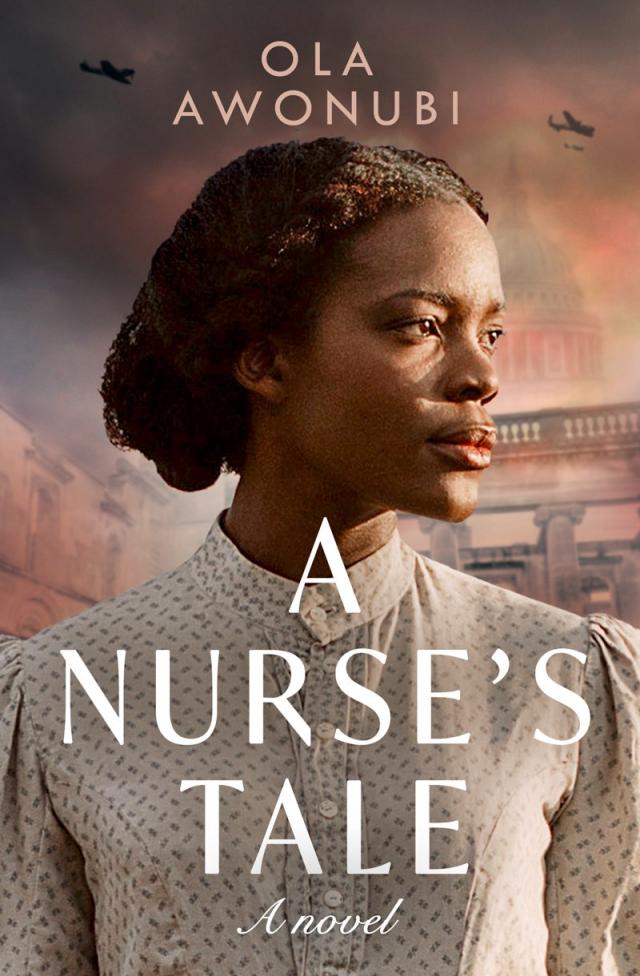
A NURSE’S TALE
OLA AWONUBI
One More Chapter
a division of HarperCollinsPublishers Ltd
1 London Bridge Street
London SE1 9GF
www.harpercollins.co.uk
* * *
First published in Great Britain by HarperCollinsPublishers 2023
* * *
Copyright © Ola Awonubi 2023
* * *
Cover design © Lucy Bennett / HarperCollinsPublishers Ltd 2023
Cover photographs © Shelley Richmond / Trevillion Images (woman); © Stephen Mulcahey / Arcangel Images (background)
* * *
Ola Awonubi asserts the moral right to be identified as the author of this work
* * *
A catalogue record of this book is available from the British Library
* * *
This novel is entirely a work of fiction. The names, characters and incidents portrayed in it are the work of the author’s imagination. Any resemblance to actual persons, living or dead, events or localities is entirely coincidental.
* * *
All rights reserved under International and Pan-American Copyright Conventions. By payment of the required fees, you have been granted the non-exclusive, non-transferable right to access and read the text of this e-book on screen. No part of this text may be reproduced, transmitted, down-loaded, decompiled, reverse engineered, or stored in or introduced into any information storage and retrieval system, in any form or by any means, whether electronic or mechanical, now known or hereinafter invented, without the express written permission of HarperCollins.
* * *
Source ISBN: 9780008492335
Ebook Edition © July 2023 ISBN: 9780008492328
Version: 2023-06-06
To my parents, Deborah Iyabode Awonubi and Robert Oladipupo Awonubi, who came to England and braved cold weather and cold hearts to make it home for us and taught us to aim high and achieve destiny.
* * *
Thanks for showing us the richness of culture, literature and everything that makes Nigeria so special.
* * *
I dedicate this book to every parent who has ever had dreams for their children that were greater than the struggles they faced.
Contents
Prologue
Chapter 1
Chapter 2
Chapter 3
Chapter 4
Chapter 5
Chapter 6
Chapter 7
Chapter 8
Chapter 9
Chapter 10
Chapter 11
Chapter 12
Chapter 13
Chapter 14
Chapter 15
Chapter 16
Chapter 17
Chapter 18
Chapter 19
Chapter 20
Chapter 21
Chapter 22
Chapter 23
Chapter 24
Chapter 25
Chapter 26
Chapter 27
Chapter 28
Chapter 29
Chapter 30
Chapter 31
Chapter 32
Chapter 33
Woman of Nigeria 100
Bibliography
Acknowledgments
Thank you for reading…
You will also love…
About the Author
About the Publisher
One More Chapter...
Prologue
ADE
London, May 1948
The sweet scent of daffodils and primroses excites my nostrils.
In those dark days, it seemed as if such tranquil and simple joys were buried beneath the death and the destruction of war.
I do not know whether I will have the time to pen my thoughts when I get back to Nigeria, as I have done during my time here.
Maybe I will pick up these muddled and untidy letters – held together with a piece of string I found at the back of my cupboard and the residue of all the hope I could muster up during the war – and remember what it was like to live each day as if it was all I had left.
This is a new England now and I pray that my grandchildren will come back here and enjoy a day in a park like this.
There is a part of my heart that is wedded to this place.
I love the friends I have made. The kind old ladies who want to touch my hair and ask me, ‘Where you from, love?’ I love apple pie and custard and Lord Woolton pie (it is so tasty that you could swear there is actual meat in it and not Marmite because of the rationing).
I love walking in Hyde Park with my husband Timothy, holding hands and imagining that I am Princess Elizabeth and he is Prince Philip.
I love listening to the latest music from the States, the softness of silk tights against my legs and the scent of rain-drenched gardens of lilies and roses as I run to catch the bus.
Growing up in Nigeria, I read the words of Dickens and Austen and imagined fine gentlemen like Mr Darcy, tiny twisted streets and tall spires of churches, stately homes with big fireplaces and lots of crimson-cheeked happy children running around with dogs.
I got the dog bit right but everything else is just the England of my books and of my dreams. The dreams our colonialists made up for us.
My eyes have seen another England.
The one my father had warned me about when he first sent me to finishing school. The one that meant I had to stay up at night and study longer and harder because I would never be seen as being equal to my classmates or colleagues. The one where, because of the colour of my skin, I would always be seen as mentally inferior to my peers.
An England where there were places that I had been advised were not good for me to venture into because they did not want any of my ‘kind’ in the area. The England where people could ask me whether my black – my beautiful brown skin – could be washed off, as if it was a stain against their pristine whiteness. Then there were those who wanted to know if I had a tail under my crisp white apron and blue uniform. In this England, Black people were forced out of Anderson air shelters by members of the public – and sometimes even the police – to run the risk of being blown to pieces by German Luftwaffe bombing.
An England where I carry the memory of the time when a young woman in labour preferred to suffer her pains and scream alone, rather than allow ‘that bloody darkie’ to put ‘her filthy black hands’ on her. Another nurse came to assist her later.
I was calm because that was what they taught in nursing school.
Always smile. Always be professional. Always think about what’s best for the patient.
So, I learned how to make sure my face was a blank canvas, which I kept in place till the end of my shift. It was only when my roommates were fast asleep that I allowed myself the luxury of hot tears of anger, self-pity and homesickness for Afin Ake.
Forget that you are a Princess of Egbaland and that you have servants at your beck and call in Ake Palace. Forget about the fact that you attended the kind of private school that the woman having the baby might never be able to afford. Forget that this woman – who couldn’t even string a sentence of the King’s English together, with correct tenses and grammar, without swearing – thought she was superior to you just because of the colour of her skin.
Yet as the waves of pain increase, the nurse requests that I help her with the woman and when I grip her hand as her son begins to make his way into the world, our eyes meet, and the colour of my skin disappears and we are just three women working hard in the age-old battle to coax new life out into the world.
‘Jenny,’ I announce. ‘It will not be long now. I need you to push…’
After the birth, we make sure mother and baby are comfortable, and then Nurse Peters and I deal with the afterbirth and clean up. The new mother turns to Nurse Peters and asks for my name.
‘Nurse Ademola.’
Jenny is looking more herself now. The colour is slowly ebbing back into her cheeks and we have got her out of her stained nightwear into a clean nightdress and have lain down clean linen. ‘I’m sorry I was being a bit silly back there. I’ve never really met a darkie before. I mean, look at you – all smart and in a nurse’s uniform and all…’
Nurse Peters gives me a wink as we neaten the bedclothes and pick up the soiled items. ‘Yes, Nurse Ademola is quite famous, you know. One day you can tell your son that a princess helped bring him into the world.’
‘You what?’ Her lips tremble with incredulity.
Nurse Peters straightens up and folds her arms across her chest. ‘She is a princess of a kingdom in Africa but she went to school here and all…’
I wince at the qualifier even though I know Veronica’s being kind.
She is one of us now…not some savage from the wilds of Africa. She even went to school here, so she’s OK…
The patient stares at me as if I have acquired two extra heads. I do not know which response I find more depressing.
‘Ooh…Henry.’ She bends her head to look at her son, who is staring sightlessly in her direction. ‘Lookie hear. A darkie nurse and a princess as well. Whatever is this world coming to?’
I take a deep breath of air and stretch my lips into my trademark professional smile, especially reserved for some of the natives of England. ‘Congratulations, Mrs Johnson.’
I have noted that there is no doting husband waiting outside. There has also been no mention of him fighting any war or being buried on some forsaken field somewhere. I am aware that many women lie, though, and add the ‘Mrs ’ to keep a veneer of respectability.
Not that we care. We are not here to judge in any way, but today I feel slightly mischievous – maybe the whole situation we are facing is seeping into my self-imposed reinforced exterior – and I hear myself asking whether she needs us to contact her husband or any other member of her family.
She straightens up in the bed and holds her baby close as if I might be about to take him away. ‘My husband is away, fighting in France.’
By this time, we have been at war with Germany for the past two years and our boys aren’t exactly allowed home on holidays unless they’ve been badly injured or have mental-health issues. I give her the tight smile I reserve for people who get on my nerves. ‘Of course.’
We leave the room and Veronica shakes her head at me. ‘Not our place to judge.’
I shrug. ‘Not her place to call me a “darkie”.’
‘Matron said—’
‘I know what Matron said.’
‘You need a cuppa.’
I smile then because, in this messed-up world, my colleagues believe a cup of unsweetened hot tea – with a spoonful of powdered milk, if our rations stretch to it – is all that is needed to put the disjointed pieces of our world in place again.
Chapter One
YEMI
Lagos, 12 November 2018
Yemi shut her laptop and started packing her stuff away. Her director gave her the thumbs-up and she smiled to herself, satisfied that he was happy with her presentation to our clients – a large engineering firm.
As the clients filtered out of the room, one of her colleagues stopped to say hello.
‘That was absolutely on point. You could see their comms team loved it.’
Yemi’s face brightened. ‘Thanks, Chika. I’ve spent so many late nights working on this.’
Her colleague fixed her with a mock-stern look. ‘So, now that it’s done, you can stop making excuses because of ‘I have to work late’ and come out for a drink with us. The ladies are going to this great club in Ikoyi after work. They serve the most fantastic cocktails with tapas, you know. Not oyibo people’s tapas, the Naija ones – puff-puff, akara, peppered suya and yam fritters – all bite-size.’ She ran a hand over her hips, which were encased in a snug grey tailored dress with a white collar. ‘You know we have to keep it looking good…Bae could be just around the corner.’
Yemi’s lips formed into a slight grimace. ‘I’m really not in the mood for clubbing…I’ve got another project queued up behind this one. Besides, I was going to watch trashy TV and eat lots of ice cream.’
Chika opened her bag, pulled out a little mirror and pursed her lips in her best Kardashian pout before she applied a thin coat of vivid-red lipstick. ‘You are not going to find Bae while sitting at home eating ice cream! You better look sharp before your mother starts dragging you off to church service to pray for a husband. Thirty isn’t so far away, you know.’
‘Thanks for the reminder.’
‘As a good friend and colleague, I have to tell you the truth. How many men have I introduced you to in the past few months? But it’s always one thing or the other – this one is too short, that one is too boring…Girl, I’m concerned here. You need an intervention.’
Yemi sighed, picked up her laptop and left Chika standing there, shaking her head.
Yemi’s brow was furrowed as she sat in traffic, watching the sun bearing down on the yellow trail of public transport – danfos, Maruwa cars and Keke Napes intermingled with cars, motorbikes and lorries on the Third Mainland Bridge.
She felt envious of those perched on okadas – motorbikes or bicycles that weaved through the gaps in traffic – and watched as they defied space and basic traffic rules for a quicker but less-safe journey.
Lagos was basically two cities split between the mainland where most people lived, and the islands, which were connected by the Third Mainland Bridge. Like millions of others, Yemi had to battle to get into work every morning and she’d learned to avoid travelling back home after 3:30 p.m. because a journey of thirty minutes could take you three hours or more as traffic fossilised into a total standstill.
She turned up the radio to listen to FM 2000, her favourite radio station, and let Asa’s evocative Afro-folk, reggae-pop, nu-soul jazz drown out the hooting of the driver next to her.
‘Bamidele’ was one of her particular favourites. Play that at a party and you could be sure it was going to be lit…Come home with me, it said…
Wa ba mi dele…
Suddenly the car in front of her moved and she accelerated as fast as she could, ignoring the cars from the other lanes trying to force their way into the only line that seemed to be making any progress, but a cheeky danfo drove into her line of vision and she had to brake. She swallowed back the choice words that sprang so easily to her lips. This was the third time this had happened this week and, the previous time, her windows down, she’d heard the other driver’s derisive request that she beg her lover to get her a chauffeur if she was having problems driving properly.
Right now, she had no time for this. She put a finger to her head and turned it clockwise to show what she thought of him. His response was a placatory salute.
She grinned to herself and thought about home.
She had a small one-bed apartment on the fourth floor in a vibrant waterside district on Lagos Island, smack in the middle of a cluster of two- and three-bedroom apartments, shops, office spaces and churches.
The flat suited her Bohemian streak. It consisted of a substantial sitting room with large windows that she had furnished with love, care and large pot plants in ceramic containers from local artisans. She’d also hung traditional Egba artwork on the white walls and spoilt herself with a sofa made out of Adire pattern printworks that had come from the renowned dyeing pits of her mother’s hometown, Abeokuta. She had found a mahogany bookshelf from her dad’s study for her books.
Apart from nosy neighbours and the occasional amorous married man who thought she was an easy target because she was single, she kept to herself and enjoyed living on the estate.
The next morning, Yemi popped into the Ladies’ to freshen up and eyed herself in the long mirror, running a hand over the plaits that rested on her shoulders. She liked this particular style because she could wear her hair away from her face when she liked. Her cream shirt and brown-and-mustard-patterned Ankara culottes emphasized her slim figure. She opened her make-up bag and rummaged around for her favourite shade – a bright-coral lipstick that favoured her smooth copper-brown complexion – and then dabbed some powder on her face to take away the shine.
It was said if you could live in Lagos, you could live anywhere in the world. Sometimes she wondered if she could face another day in the traffic, but the next day she would find herself back on the commute because she loved her job – according to Chika, a little too much.
Chika had lots to say about Yemi’s choices when she wasn’t busy trying to fix her up with any eligible guy who happened to be around. Thank God her mother wasn’t on a perpetual Bae watch like her friend. Having the girl in her head for eight hours a day was bad enough – she was so extra.


