

The devil and mrs gooch, p.1
The Devil and Mrs. Gooch, page 1


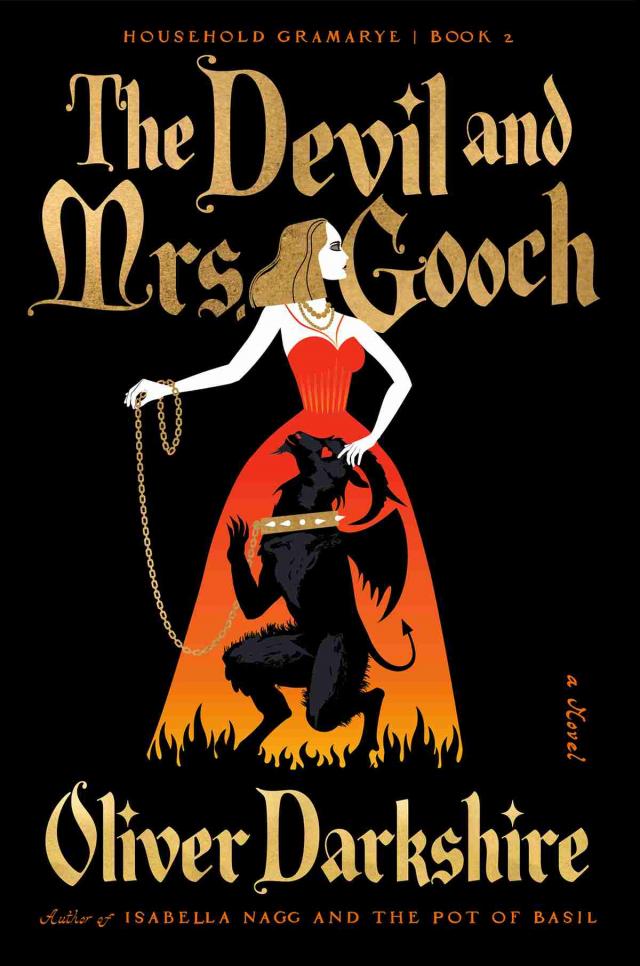
The Devil and MRS. Gooch
A Novel
HOUSEHOLD GRAMARYE
BOOK 2
Oliver Darkshire
For Tenser
When we’re all dead, I want strangers to know
you had a good soul, but a fantastic arse
For Porthos
I am glad we met at that terrible game
because it gave us the gift of time together
and how princely a gift
Contents
Reader’s Note
1.Concerning Hobs
2.The Monastery at Mount Pelican
3.The Household Gramayre
4.The Devil by the Wayside
5.Gwendolyn
6.The Hotel Paramort
7.The Internecine Express
8.Drinking Alone
9.The Devil Through the Window
10.Another Fateful Collision
11.The Hob Assembly/Tantarrabobs
12.The Molar Seat
13.The Devil Gets a Job
14.Mrs. Bobkins
15.The Gwendolynian Museum
16.Green, Interrupted
17.A Brush with Mortality
18.Foldable Is Cheap
19.Lessons in Parenting
20.The Discovery of House Rot
21.Gonorilla in the Cellar
Interlude: Truth Leaves Her Well
22.Spring Cleaning
23.The Fate of Jean-Claude 562
24.Gwendolyn on the Balcony
25.Hob in the Box
26.The Hobs Are on Strike
27.The Seven-League Boots
28.The Shadow Parliament
29.Gonorilla, Again
30.The Devil Steals a Moment
31.Riddles in the Backways
32.Tantarrabobs, Heroic
33.Elegy for Tantarrabobs
33 (again).The Reaper Comes for Tantarrabobs
34.Ring for Service
35.The Hob Assembly, Once More
36.Gonorilla, Thrice
37.She Lived in a Boot
38.To Ponder an Orb
39.A Very Good Knife
40.Death Without Measure
41.Inevitable Betrayal
42.The Greater Consensus
43.Gwendolyn Victorious
44.Back Home, but Much Too Late
45.Bagrat’s Choice
46.A Stolen Moment
47.Unfinished Business
48.The Devil and Mrs. Gooch
49.I Speak for the Trees
50.Flight Through the Backways
51.Gwendolyn Still Victorious
52.Gonorilla, Resilient
53.Gonorilla Brings Down the House
54.Loose Ends
55.Epilogues
Acknowledgements
Reader’s Note
The foremost inconsistency amongst all copies of the Household Gramarye is the spelling of the word Gramarye itself, a word which has no fewer than seven hundred and eleven recorded spellings, localizations, and regional bastardizations. Amongst folk of letters, the two variants most frequently pitted against each other are Gramayre and Gramarye. Blood has been spilled on this account. Other less common spellings include Graham, Greem, and Glob. All are pronounced “Grammar.”
1
Concerning Hobs
Every house has a hob in its cupboard. You might not be aware of it because hobs are reclusive, and they are very proficient at hiding, but it’s true nonetheless. The Household Gramayre, that repository of indispensable and practical sorcerous advice for the layman and academic alike, frequently depicts the hob with numerous long and hairy arms that drag on the floor, which is broadly accurate excepting that a hob is rarely seen without a basket of laundry, a handful of plates, or some other sundry chore clutched in its furry paws.
You see, a hob likes to clean. That’s what all the stories say.* They are proud creatures, bound to the hearth itself, and they take joy in the kind of day-to-day maintenance which humans and other larger (more careless) creatures find so onerous. A household that maintains a good relationship with its hobhoulard will find that their strange lodger busies itself around the place in the quiet hours, unfolding from impossibly small places to clean dishes or hang out laundry before vanishing back into the crannies from whence they came. If you have a bad relationship with your hob, which is easy to accomplish if you break one of the many peculiar customs to which they are attached, then it may refuse to clean for you at all, or even actively sabotage you by moving your things around when you aren’t looking. If you’ve ever put your keys down by the door only to find them an hour later in the waste bin, then you might have an angry hob on your hands.
Truthfully, people rarely pay their hobs any mind at all, which is how the Gooseander House hob knew he was doing his job correctly. Amongst hobs, when they saw each other at all (which was rarely), it was customary for them to refer to one another by the name of the household they maintained, and thus he was called Gooseander. He’d been the hob of Gooseander House for fifty years, since the foundations were laid by a young man looking to start a new life in the city. The hob had formed from the dark, sodden earth when the idea for the house had entered the young man’s mind, and had spent weeks patiently waiting in the shadows for the construction to be completed, all the while growing more real. When the foundations were laid, he found he could walk on solid ground. When the walls were erected, his long arms could touch them. When the nameplate was finally attached to the door, he knew what his name would be. And so, he was the house’s hob, and would be for as long as it stood. This is how life begins for a hobhoulard.
If judged in direct comparison to all houses ever built, Gooseander House was modest in its ambitions. The best that could be said for it was that it was unremarkable, and thus unlikely to draw the attentions of the usual dangers that plague the inhabitants of a world such as its own, namely wizards looking for prophesied heroes, diabolical events of a political nature, and extraplanar realtors. To Gooseander, however, it was the most special place in the whole wide world, and not a day went by in the cupboards of his little house when he did not look up at the low ceilings and think how lucky he was.
The walls of the house were rough stone, haphazardly placed with loving hands by the young man who made it. Free space in which to build a house in Verdigris was uncommon, and the lower city was already a sprawling slum of cramped domiciles and crooked towers, but he’d inherited the plot from a distant relative, and he was determined to build a place of his own. It took him many years, as he was a cobbler, not a builder, and it showed in the holes between the bricks where the wind whistled through, and in the way the water leaked through the traditional copper roofing.
The cobbler was a retiring man, and he spent the long days of his craft in quiet seclusion, until one day he met a windworker with a bad temper who brought a smile to his face, and could make all the clouds go away. Before long, the windworker moved into the cottage, which was more crowded and untidy than it had been before, but Goose would come out of the cupboards each night and sort things back to where they should be, because he enjoyed listening to the burble of the two men from a room away. Time, as it is wont to do, passed before anyone thought to strap it down and give it a good talking-to, so in this comfortable manner the two men grew wrinkled and grey under the roof of the little cottage. The hob did not grow old. This is the nature of hobs, as buildings age more thoughtfully and in a much lonelier manner than people do.
All the while, Goose busied himself maintaining the cupboards and dark corners of the house. Good houses have shadowy crannies and sinister nooks where spiders might lurk, not only because spiders are wise and useful guardians, but because it’s polite to provide places in which your hob can relax away from prying eyes. The low ceilings of Gooseander House were decked with wisp-orbs, arranged with rope in weblike patterns, the twinkling lights inside occasionally bumping vainly against the glass whenever a living creature entered the room below them.†
Each night, as the residents of Gooseander House sank into slumber, the hob got to work. He would clean the floors, wash the dishes, scrub and mangle the clothes, and attend to a host of other unpleasant tasks that were important to him because he loved the house very much, and he did not like to see it in disrepair. You see, he was a hob, and a hob is for tidying. It was in his bones, the same way a flower knows how to bloom, or a cloud knows how to ruin a perfectly good picnic. If you are lucky enough to espy a hob at work, which is difficult because they are secretive and subtle entities, you might fancy the hob was moving to music, so graceful are their motions. Plates float to their cupboards, doorknobs are polished, and dust vanishes at the wave of a feather duster. No matter the shambles, by dawn a hob is ready to sit down and enjoy their reward—a morsel of food the house’s other inhabitants leave each night, by way of thanks for the hob’s labours. Some hobs are pickier than others, but you can’t go wrong with a saucer of milk, unless your hob is lactose intolerant (which is sometimes the cause of strange odours around the house that you can’t explain).
One night, which felt like any other night to Gooseander, he crept out of his favourite cupboard to clean, only to find that the kitchen was still occupied. Frightened of being seen, he darted back into the darkness and watched through a crack in the cupboard door. The elderly couple were up late, candles burning low on the table as they conferred in hushed voices. Gooseander wasn’t supposed to listen, but he sometimes did. He liked hearing about their lives. He considered hi mself their cohabitant,‡ and their lives were intertwined with his. But tonight was different. There was a murmur of change in the air, a tension between the couple that made Gooseander terribly uncomfortable, an itch he couldn’t scratch.
“Think about what she’s offering,” said the cobbler, crouched in one of the small chairs but leaning forward in earnest. “Security. We could get away from here, go somewhere nice.”
“I like it here,” pouted the windworker, hands clasped on the table in the way he did when he didn’t like what he was hearing. His face was set with a frown deep enough to be marked on an elevation map of the area.
“Well, that’s not true.” A pause lingered. “You don’t like it here, you never liked it here. You’re always saying how fickle the winds are in Verdigris.” He chuckled. “Besides, you’re getting too old.”
“I’m not.” The smaller man’s sulk visibly evolved into a glower. “And I like things. Sometimes. We’re fine here.”
“If we move,” wheedled the cobbler, “she’ll give us the money to live anywhere else. We could have a castle! A moat!”
“I don’t want a moat.”
“No, what you don’t want, Stefan, is to be a windworker into your old age. You can barely whistle up a breeze these days, and your back isn’t getting any better, is it?”
The windworker was stonily silent.
Sheepishly, as if knowing he’d stepped over a line, the cobbler tried again. “Oh, don’t be like that. I’m sorry. Look, just think about it, will you? Leave the winds to blow where they will, let’s go somewhere new. One more adventure, eh? Just you and me . . .”
The voices grew faint as the couple moved upstairs into the house.
Concealed in his cupboard, the hob called Gooseander was confused. Did they intend to leave the house? He didn’t much like the sound of that. Who knows what the new owners would want, or how messy they would be. Houses got new owners sometimes, he knew that. Humans in particular didn’t live very long, not compared to hobs or houses. You had to be prepared to let them go. The more he sat with the idea, the less he liked it. To try to distract himself, he stacked dishes and swept the floors, but unpleasant thoughts kept coming thick and fast.
If the cobbler wasn’t happy with the house, then clearly they weren’t happy with the hob. Was it the hob’s fault? It was his first house. His only house. Had he done something wrong? How hadn’t he noticed before now?
Creeping out of the shadow behind the umbrella stand in a silent tangle of furry legs, Goose snuck along the wooden floors without so much as a creak. Hobs can tread very softly when they choose, knowing exactly where to step, and which creaky boards to avoid. Scuttling and flitting, he retrieved a basket of damp laundry and headed outside to hang it on the dingy washing line in the backyard. It was a moonless night, just how Gooseander liked it,§ and the rain was gentle, nearly imperceptible. The cottage was on the very outskirts of Verdigris, so that in the summer you had a month or two where it didn’t rain every day. From here, if you looked out on a night like tonight, you could see the flashes of lightning from the eternal storm that hung over the city, harsh blue reflecting off the spires. As he pegged some underwear to the line, his mind began to tread in unexpected directions. If only he’d been quicker, tidier, more useful, then these two would still love the house as much as he. Could he change their minds? Tidy better? Faster? If only he could make them see it the way he did, then they would never leave, and they could go on day and night forever and ever.
He finished setting the last pair of trousers on the line and, while he was there, straightened out some lavender plants which had started to crowd in on each other. He wasn’t a garden hob, but he didn’t like to think of someone passing by the house and seeing the window boxes in disarray. He was about to head back inside when he stopped in his tracks. There was movement at the very edge of his vision, where the cottage fence bordered on the unknown. With no time to re-enter the house without being seen, he scampered into a rosebush near the house. The thorns were uncomfortable, but a hob is covered in a thick furry hide designed to protect them from cupboard splinters or needlepoint accidents, and so he was able to conceal himself amongst the flowers without being hurt.
Someone walked up the pathway towards the cottage. She was tall, very tall, and clad in a dark riding cloak that failed to conceal tousles of golden hair poking out from the side. The arrangement of it obscured her face from view, framing it like the wings of a helmet. Her shoes were colonnade heels which doubled as a kind of jackboot, the kind of shoes that colonized the land they stepped on. Whoever she was, she was carrying something close to her chest, perhaps several things, and she stopped a few feet from the cottage to busy herself with the items in her hands. He was folded up impossibly small in the bush, and though he strained his neck, he couldn’t quite see what she was doing.
“Scenic location.” The voice was vibrant and full of frenzied life, like a pool of piranhas. “Rustic. They don’t make them like this anymore. Oh, the profit potential . . .” The words oozed from her lips like a psalm. “It’s almost a shame.”
Gooseander looked around for whomever she was speaking to, but saw no one. She had the bearing of a woman who spoke to herself sometimes, who’d spent so long without an equal that she really had no choice but to keep her own counsel.
“Delightful,” the woman said, looking at the front of the cottage with an appraising eye. Raising one hand, she traced a long finger down a climbing plant so patiently cultivated by the cobbler.
She stepped back from the house and raised her arm. She was holding a bottle.
The realization settled on Goose in a lightning flash, and yet he felt rooted to the spot. A hob could not confront a stranger. A little voice in his head screamed at him to act. To move. But he remained in the bush, watching as the cloaked figure raised her hand and hurled the bottle through the window into the kitchen.
Flames blossomed inside the house, billowing out of the window in a surge that threatened to roast the arsonist in her tracks, the fire lashing out to within inches of her face. She remained still, unmoved by the explosion, drinking in the destruction.
Finally regaining control of his limbs, Gooseander leapt from the flowers with a yelp, hand out as if to touch the house. His house. The flickering fires confounded his vision, hurting his eyes. He could barely see a thing, and he fumbled his way forward anyway. There was a barrel of water behind the house. He could use it to. He could—
A hand grabbed him by the scruff of the neck, lifting him off the floor. He raised some of his hands to shield his eyes from the harsh light, to find himself face-to-face with this strange woman who wanted to destroy everything he’d ever loved. Up close, under the belligerently orchestrated tangle of golden hair, a pair of merciless eyes gazed upon him, and an unlikely smile touched the corners of her mouth. She watched him with curiosity, and perhaps a touch of breathless reverence.
“There you are,” she said, rapturously, “you delicious little thing. Don’t be afraid.”
Still half-blinded, he scrabbled for purchase, to free himself, but her outstretched arm was like iron. He might as well have been trying to uproot a tree from within its branches.
“Aren’t you an energetic one?” She was talking to him like you might talk to a baby, if you intended to put that baby to work in a coal mine. “You’ll love your new home. Lots to do there. Lots of cleaning, lots of work.” Her smile had all the friendliness of an alligator. “I suppose I needn’t have burned the house, it’s just much easier than the other ways.”


