

The golden generation, p.1
The Golden Generation, page 1


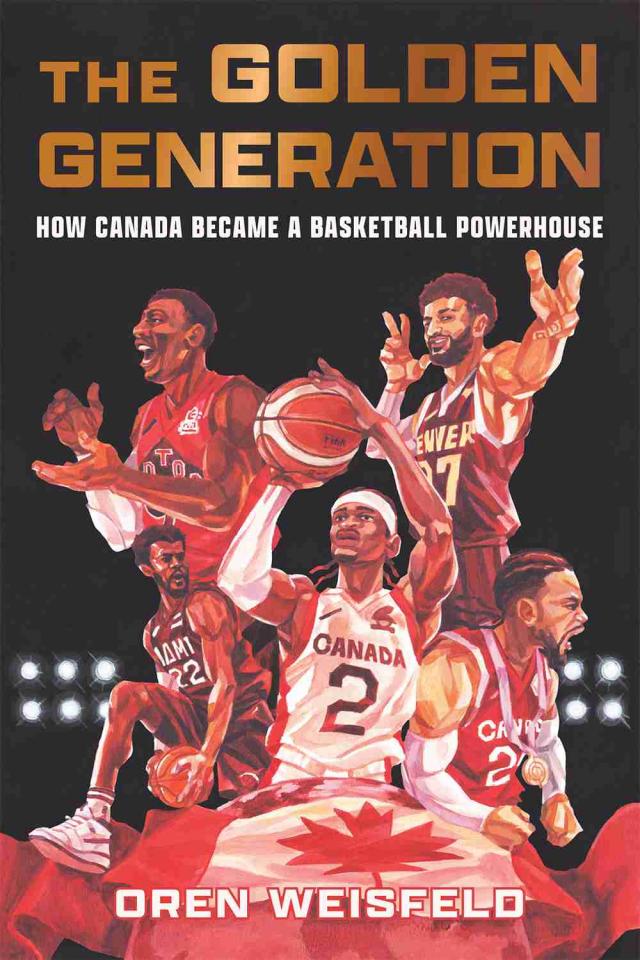
The Golden Generation How Canada Became a Basketball Powerhouse
Oren Weisfeld
Contents
Dedication
Epigraph
Note to Reader
Intro: Opening a Pandora’s Box
Part 1: Tribal Knowledge Chapter 1: Captain Canada
Chapter 2: The Dark Cloud, Part 1
Chapter 3: The Dark Cloud, Part 2
Chapter 4: The Sydney Olympics
Chapter 5: Reverend Ro Russell
Chapter 6: One-and-Done
Chapter 7: The Kid from Keele Street
Chapter 8: Captain Kelly
Chapter 9: A Changing of the Guard
Chapter 10: The Chosen One
Chapter 11: Heartbreak in Mexico City
Part 2: The Golden Generation Chapter 12: Batty and Bench
Chapter 13: The Gold Medal Boys
Chapter 14: Hometown Heartbreak
Chapter 15: The Summer Core
Chapter 16: The Winter Core
Chapter 17: History in the Making
Chapter 18: Dillon the Villain
Chapter 19: The Prep School Boom
Chapter 20: The Paris Olympics
Outro: O Canada!
Acknowledgements
Appendix Team Canada Men’s All-Time Records
Interviews and Sources
About the Author
Copyright
Dedication
vFor my parents,
Harvey and Ariela
Epigraph
vii“Not only is there more to life than basketball, there’s a lot more to basketball than basketball.”
— Thirteen-time NBA champion Phil Jackson
Note to Reader
viiiQuotes from individuals in this book come from a variety of news sources (past tense) as well as from the author’s own interviews (present tense). A detailed source section is provided on page 266.
The Golden Generation is in no way affiliated with Canada Basketball and is not an official biography of Team Canada or its players.
Intro Opening a Pandora’s Box
1Canada’s national basketball federation was desperate for help.
With a $1.3-million deficit that stemmed from a federal government that has historically been hesitant to fund team sports, costly mistakes made by previous regimes, and the banks no longer willing to lend it any more money, it was the summer of 2007 when Canada Basketball needed an injection of cash to survive. “Things were incredibly grim,” CEO Wayne Parrish said. “We didn’t know if we could meet payroll or pay rent. Every day was day-to-day.”
Parrish walked into the offices of Maple Leaf Sports and Entertainment (MLSE) on 50 Bay Street in downtown Toronto to meet with Bryan Colangelo, the president of basketball operations for the Toronto Raptors. MLSE and Canada Basketball had a relationship dating back to 1994, when the two organizations worked together to host the FIBA World Championship in Toronto. They understood that what was best for the long-term success of each business was to put their minds and resources together to help grow basketball across the country.
“You know, it’s a terrible way to start off a relationship” Parish recalls saying. “But is there any way you could provide some help?” And he walked out of the meeting with a cheque for $300,000. “My experience in those early months, in the first couple of years certainly, was that so many people just wanted to help make it work,” he says.
Halfway through the meeting, Colangelo asked if someone could join them, and in walked a short Italian man with a strong accent named Maurizio Gherardini — the assistant general manager of the Raptors who was better known for managing some of Europe’s best clubs since 1975. “I don’t think Maurizio said a word in the conversation,” Parrish says. “He just listened.” But at the end, Colangelo asked Gherardini if he wouldn’t mind working with Canada Basketball going forward, bringing his knowledge of international basketball and network of connections to 2the Canadian federation. Gherardini accepted, but not without giving the organization a healthy reality check.
During his first meeting with the board of directors a couple weeks later, Gherardini walked to the front of the board room, took out a black marker, and wrote one word on the whiteboard: Revolution.
After digging into the Canadian basketball landscape, Gherardini understood that Canada was bursting with potential. He saw the liberal immigration policy leading to an increasingly diverse population; he saw the passion and inspiration that the Raptors were beginning to have on young kids following Vince Carter’s tenure with the team; and he saw the school teachers and coaches working to develop the next generation of players at the grassroots level.
But he also knew that it was going to take nothing short of a revolution for Canada to reach its potential. Despite placing seventh at the Olympics a few years prior in 2000, Canada’s basketball scene appeared to be regressing, with a splintered infrastructure that included school, club, and provincial teams all playing under different rule sets and pulling kids in different directions. Meanwhile, the national program couldn’t even recruit its best players, let alone fund a top-tier program.
“Keep in mind, at that time Canada had in the NBA one icon named Steve Nash, and a guy named Joel Anthony,” Gherardini says. “That was it. There was no other Canadian talent; no other Canadian players in any European top competition.”
But thanks to the work of countless Canadian basketball players, coaches, parents, and businesspeople who invested time and resources into the expansion of grassroots basketball, Canada is now a basketball powerhouse.
During the 2024–25 season, Canada had a record 28 NBA players, the most of any country outside the United States for 11 straight seasons. Andrew Wiggins, Jamal Murray, and RJ Barrett are household names, while Shai Gilgeous-Alexander just cemented himself as the best player in the world after winning the NBA MVP award and leading the Oklahoma City Thunder to the 2025 Championship.
Meanwhile, the Canadian basketball passport had become one of the most attractive on Earth, with a record number of Canadians playing in top professional leagues across Asia, South America, and Europe, 3including in the EuroCup and EuroLeague. Team Canada is ranked fifth in the world after winning bronze at the 2023 FIBA World Cup and participating in its first Olympic Games since 2000 at Paris 2024.
Canada now has a comprehensive prep school ecosystem, some of the best club teams in the world, and a FIBA-sanctioned domestic league that is growing at an unprecedented rate. At the youth level, participation rates have doubled since 2010, with more than 700 officially registered clubs and 100,000 registered participants across the country (not including school, Amateur Athletic Union, or house league). In fact, basketball is among the fastest growing sports in Canada, especially among young people and immigrants, who make up 23 percent of the population.
“The system, the approach changed, and it looks like we opened up a Pandora’s box,” Gherardini says. “This is the game today. But we should go back and see the whole process.”
By now it is well-known that Vince Carter’s dunks inspired a generation of Canadians before Kyle Lowry, DeMar DeRozan, and Kawhi Leonard poured fuel on the fire by helping the Raptors win its first NBA Championship in 2019. But inspiration is one thing, and development is another. And for a long time, Canada lacked the resources and imagination to send its best players to the pros.
However, as one generation learned from their experiences and mistakes, they passed down tribal knowledge to their sons and daughters, nieces and nephews — former athletes who lacked the developmental tools to play professionally but taught their children how to shoot on Fisher-Price nets before driving them to practices all across the provinces; coaches who grew up in dangerous, impoverished neighbourhoods and volunteered countless hours in the gym to improve their communities by providing a refuge for inner-city kids; and club programs that learned from our neighbours to the south and understood that in order to be the best, you had to go down to America and beat them.
This book tells the story of the trailblazers that took their hits in order to lay the foundation for the current Golden Generation of Canadian players to thrive: coaches like Ro Russell and Mike George who helped countless kids get NCAA Division I basketball scholarships; parents like Charmaine Gilgeous and Roger Murray who passed down the lessons they learned growing up to their sons; and players like Junior Cadougan, 4Cory Joseph, and Andrew Wiggins who were guinea pigs for the wild world of American basketball, creating a pathway for the next generation to follow.
Of course, the role Canada Basketball has played in identifying and developing the nation’s best players and coaches cannot be overlooked. From players like Steve Nash inspiring a generation of kids to dream during his magical run at the 2000 Olympics to coaches like Jay Triano and Leo Rautins giving players the opportunity to wear the red and white to executives like Parrish and Michael Bartlett bringing money into the program to give the athletes the treatment they deserve, this growth would not have been possible without Canada’s national federation keeping the lights on despite the obstacles.
(While the Canadian women’s program has had more success than the men in recent years, going to four straight Olympics and producing a rec ord number of WNBA players, it’s clear that the best is yet to come. With the third-ranked girls’ program in the world, a pipeline of exciting young prospects currently entering college, and a WNBA team coming to Toronto in 2026, it didn’t feel right to include their stories at this time.)
After interviewing more than 100 of the most influential figures in the modern history of Canadian men’s basketball, this book aims to tell the never-before-told story of how Canada became a basketball powerhouse, going from the bottom of the international basketball rankings to the top. By jumping back and forth between developments within the Canadian men’s national team, innovations in the grassroots community, and profiles of Canada’s top players, the book aims to answer questions like: How did a cold-weather, hockey-crazed country of 40 million produce the best player in the world, and 28 NBA players in 2025? How did the Canadian national team, once a laughingstock of the international basketball community, win its first ever medal at the 2023 FIBA World Cup? And why does the developmental infrastructure in place suggest that what we are seeing now is just the beginning?
Sure, a “revolution” that opened up a “Pandora’s box” sounds extreme. But when it comes to the history of Canadian basketball, the truth really is stranger than fiction.
Part 1
5Tribal Knowledge
Chapter 1 Captain Canada
Steve Nash dribbles at Santa Clara University, the lone NCAA school to offer him a basketball scholarship.
John Nash
8“If every basketball player worked as hard as I did, I’d be out of a job.”
— Steve Nash
Steve Nash was born in Johannesburg, South Africa, in 1974 to John and Jean Nash, Brits who lived there briefly before fleeing the racial apartheid for sunnier pastures. The family settled in Victoria, the capital city of British Columbia, located on the southeastern tip of Vancouver Island on the Pacific coast.
“Really it was the best thing we could have done,” John says. “Wonderful place to bring up children.” The island was safe from crime, and as Canada’s lone snow-free capital, their three kids, Steve, Martin, and Joann, could bike around freely and play outdoor sports year-round.
John was a professional soccer player back in South Africa and England, where he met Jean. He wasn’t particularly big or physical, but he was skilled and known for his playmaking instincts, with a knack for setting up teammates from anywhere on the pitch. As soon as his kids were old enough to walk, he taught them the right, selfless way to play in the backyard of their home. “If they played a one-two around me, even if it was a bad one-two, and they passed the ball around me, I would let them get away with it,” he says. “If they tried to fake it and dribble, I’d tackle them.”
Steve took to soccer immediately, with his first word being “goal.” But he excelled in everything from baseball to hockey to box lacrosse to rugby to chess, making 10 of 10 place kicks in his first high school rugby match, scoring seven goals in a juvenile lacrosse game, and winning three elementary school chess titles. In high school, he became the only player in the history of British Columbia to win the province’s most valuable player in soccer, basketball, and rugby. “I think he would have been a pro in at least three, maybe four sports,” his college basketball coach, Dick Davey, says.
9And he might have been a professional soccer player like his younger brother, Martin, if it wasn’t for the fact that Victoria was going through a basketball renaissance in the 1980s, right when Nash was coming of age.
The best university team in the country, the University of Victoria Vikes, won seven straight national championships between 1980 and 1986 behind head coach Ken Shields and starting point guard Eli Pasquale. Shields grew up in Haida Gwaii, BC, and fell in love with the game playing with the local Indigenous kids before moving to the mainland and coaching at Laurentian University for six years. There, he met a local high schooler named Pasquale, who followed Shields to U Vic in 1980 and became the best player in the country, dominating Canadian university basketball (U Sports) alongside a group of local islanders — several of whom went on to play for Team Canada.
“I think for many of them it was an inspiration,” Nash’s high school coach, Ian Hyde-Lay, says of the Vikes’ impact on the teenagers he was coaching. “McKinnon Gym was packed every night. It was a big ticket . . . With no pro sports teams in the town, it was one of the events to go to.”
Nash was already a multi-sport athlete who spent his weekends taking a ferry back and forth from Metro Vancouver for rep soccer and hockey tournaments. He had a keen sense of footwork, hand-eye coordination, spacing and angle concepts, and problem-solving skills that turned out to be transferable to basketball, which he excelled in after discovering the sport in eighth grade.
In fact, after participating in his first pick up basketball game, Nash ran home to his father bursting with excitement. “Dad, it’s like cheating,” John recalls his son saying. “You can use your hands!”
* * *
Dave Thomson was the physical education teacher at Arbutus Junior High School, where Nash went from grades 8 to 10. He would open the gym for Nash and his friends to play at all hours, spending entire evenings and weekends there, only pausing briefly to run across the street to Mark Kennedy’s house for lunch.
“It was kind of crazy,” Thomson says. “But they loved it so much. And they loved being together so much that it seemed to work for them.”
10Nash fell in love with the game once he started playing regularly with his new friends Kennedy, Mike Schaeffer, Al Whitley, and Adam Miller at Arbutus. “I wanted to be with my friends playing basketball,” he says, getting tired of returning from Vancouver every weekend and hearing stories about how much fun they had. “I didn’t want to miss that. So, I stopped soccer and hockey after that season so that I could be with my friends playing basketball.”
Nash had developed such an elite feel for the game by grade 9 that the boys won the junior high school provincial championships. At the same time, basketball was becoming a more popular sport worldwide, as the red and white Air Jordan 1s hit the market with Spike Lee joining Michael Jordan in the commercials. And Nash took to it with a religious fervour, jumping over his backyard fence to practise his jump shot at the Hillcrest Elementary School playground, 50 metres away, whenever he had time to spare. “Steven would get out there and he would grind,” John says. “If he even thought about not shooting, say, 100 threes — if he got halfway through and saw that — he had the determination to say, ‘I’m gonna start again at zero to punish myself for thinking that I should give up on a project.’”
When he wasn’t shooting, Nash would carry a basketball around with him, distracting neighbours with the sound of him dribbling and practising crossovers, pass fakes, and shoulder shakes, visualizing moves that he would then use in a game. “I think the bottom line is, for whatever reason, however — nature, nurture — I can get obsessed,” Nash said. “I got obsessed with trying to be the best I could be.
“So, I put in that time. I constantly was trying to get better.”
Nash transferred to St. Michaels University School (SMUS) in November of grade 11 after having academic issues at his first high school, Mount Douglas Secondary. Unfortunately, because of Canada’s archaic high school transfer rules that disable mid-year transfers from playing sports during the same season, Nash became a “redshirt” basketball player who was only allowed to participate in practices and exhibition games — a tough pill to swallow for a kid who was beginning to set his sights on obtaining a scholarship to play Division I basketball in America’s National Collegiate Athletic Association (NCAA).
11Still, his new coach Hyde-Lay connected him with Ken Shields, who let him come to U Vic and play pickup ball with the university team. “It was a really amazing opportunity to kind of feel the level and feel what it’s like to play against men,” Nash says.


