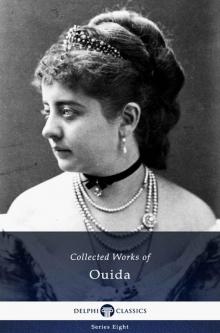
Delphi collected works o.., p.590
Delphi Collected Works of Ouida (Illustrated), page 590


He smiled.
‘Nay, love, I shall not move again. My spine is hurt, not broken, I believe — but hurt beyond help; paralysis has begun. My angel, grieve not for me, I shall die happy. You love me still! Ah, it is best thus; were I to live, my sin and shame might still torture you, still part us, but when I am dead you will forget them. You are so generous, you are so great, you will forget them. You will only remember that we were happy once, happy through many a long sweet year, and that I loved you; — loved you in all truth, though I betrayed you!’
The hunters bore him gently down in the cool pale noontide along the peaceful mountain side homeward to Hohenszalras, and there, after eleven days, he died.
The white marble in its carven semblance of him lies above his grave in the Silver Chapel; but in the heart of his wife he lives for ever, and with him lives a sleepless and an eternal remorse.
THE END
Princess Napraxine (1884)
Published in 1884 by Chatto and Windus and by Lippincott in America, this was one of Ouida’s most ambitious novels, yet it did not receive universal acclaim. The Spectator of 30 August 1884 did not find it to be any more than quintessential Ouida, with a typical cast of characters – princes and princesses, duels and opulent settings; the reviewer also notes “vice is taken for granted” in the narrative. The reviewer in the St James’s Gazette concurs: “Seldom or never has even ‘Ouida’ been more wicked-worldly, more cynical, more free-spoken, more sensual, more unblushing,” and describes the dialogue as “brilliant and admirable” (24 June 1884). Ouida was captivated by the themes she crafted for this novel and returned to them repeatedly for the rest of her novel writing career. The theme that Ouida experimented with repeatedly was the conflict between two types of women: the Angel of the Home and the New Woman, an independent career oriented female. Ouida states in the dedication that the story is about people who are “neither happy nor wise.”
Princess “Nadine” Napraxine is a stunningly beautiful woman in her early twenties, desired by all men she meets, which somewhat bores her whilst amusing her at the same time. Although someone with such beauty ought to really be sweet natured, there is another side to Nadine – she can be malicious. Also, as her friend Lady Brancepeth said, “It is her habit to condemn everything. She is a pessimist from sheer want of ever having had real disappointment.” Contentment is alien to her and she claims to dislike virtue. She had been only sixteen years old when the older Prince Platon Nicholaivitch, head of family of Napraxine, lost his heart to her; in contrast to her negative personality, he is loyal, loving and popular not just because of his wealth, but also because he is a decent person. It is a marriage of convenience from her point of view; she abhors its physical intimacy, but relishes the wealth and power it brings her and the ability to help her father financially; she refers to money as “the sunshine of life.” She has little interest in the two sons she has early in her marriage, who are being raised by their grandmother.
Despite her marriage, Nadine is still pursued by many men, who have fallen hopelessly in love with her, little realising that she has no interest whatsoever in sexual relationships, either with her husband or with a lover – an unusual decision for an aristocratic woman at that time. Otto Othmar is such a man: he is a millionaire who can buy anything he wants, but still desires the unattainable – the Princess Nadine. He falls hopelessly in love with her and tries to banish his feelings by travelling abroad, but as soon as he returns, these feelings are revived on meeting her again. She takes an intellectual view of emotions, regarding them as a form of performance and has the temerity to laugh at Othmar’s love. Spurned and hurt, Othmar marries a penniless, innocent girl, Yseulte de Valogne, also known as Cendrillon, who is distantly related to Nadine’s friend, the Duchesses de Vannes. In Othmar, Cendrillon has the chance to have a better life; but Nadine has other ideas. She realises she should not have let Othmar go and resolves to revive his feelings for her; the victim in this emotional triangle, Yseulte, falls into a deep depression and decides to take action to allow her husband and his first love to be together. In Nadine, despite the exotic and highly feminine interiors she surrounds herself with, we have an amoral, selfish, hedonistic character that exploits without conscience to achieve what she wants; many of her qualities are those of a classic male Gothic villain.
This is a strong story and one that reworks several of Ouida’s major themes, such as an exploration of the hedonistic lifestyle of the European aristocracy. Nadine is a truly dislikeable character, returning to Ouida’s earlier explorations of gender with her masculine hard-headedness over emotional display; she is as controlled and controlling as many of the men around her, if not more so. It is a pity Ouida did not delve deeper into the concept of female masculinity, to complement her portrayals of effeminate men in novels such as Under Two Flags. This is worth reading as a benchmark of what mainstream society regarded as deliciously risqué and public libraries regarded as unacceptably seedy and inappropriate.
The first edition’s title page
CONTENTS
VOLUME I.
CHAPTER I.
CHAPTER II.
CHAPTER III.
CHAPTER IV.
CHAPTER V.
CHAPTER VI.
CHAPTER VII.
CHAPTER VIII.
CHAPTER IX.
CHAPTER X.
CHAPTER XI.
CHAPTER XII.
CHAPTER XIII.
VOLUME II.
CHAPTER XIV.
CHAPTER XV.
CHAPTER XVI.
CHAPTER XVII.
CHAPTER XVIII.
CHAPTER XIX.
CHAPTER XX.
CHAPTER XXI.
CHAPTER XXII.
CHAPTER XXIII.
CHAPTER XXIV.
CHAPTER XXV.
CHAPTER XXVI.
CHAPTER XXVII.
CHAPTER XXVIII.
CHAPTER XXIX.
CHAPTER XXX.
CHAPTER XXXI.
CHAPTER XXXII.
CHAPTER XXXIII.
VOLUME III.
CHAPTER XXXIV.
CHAPTER XXXV.
CHAPTER XXXVI.
CHAPTER XXXVII.
CHAPTER XXXVIII.
CHAPTER XXXIX.
CHAPTER XL.
CHAPTER XLI.
CHAPTER XLII.
CHAPTER XLIII.
CHAPTER XLIV.
CHAPTER XLV.
CHAPTER XLVI.
CHAPTER XLVII.
CHAPTER XLVIII.
CHAPTER XLIX.
CHAPTER L.
CHAPTER LI.
CHAPTER LII.
CHAPTER LIII.
CHAPTER LIV.
CHAPTER LV.
L’ENVOI.
VOLUME I.
TO
TWO PERFECTLY WISE AND HAPPY PEOPLE
MY DEAR FRIENDS
PIERRE AND EMILIE DE TCHIHATCHEFF
THIS STORY
OF PEOPLE NEITHER HAPPY NOR WISE
IS
AFFECTIONATELY DEDICATED
CHAPTER I.
A BLUE SEA, some palms with their heads bound up, some hedges of cactus and aloes; some thickets of high rose-laurel, a long marble terrace shining in the sun, huge groups of geraniums not yet frost-bitten, a low white house with green shutters and wooden balconies, a châlet roof and a classical colonnade, these all — together with some entangled shrubberies, an orange orchard, and an olive wood — made up a place which was known on the French Riviera as La Jacquemerille.
What the name had meant originally nobody knew or everybody had forgotten. What La Jacquemerille had been in the beginning of time — whether a woman, a plant, a saint, a ship, a game, a shrine, or only a caprice — was not known even to tradition; but La Jacquemerille the villa was called, as, before it, had been the old windmill which had occupied the site, ere steam and fashion, revolutionising the seashores of Savoy, had caused the present pretty nonsensical, half-rustic, half-classical house to be erected on the tongue of land which ran sharply out into the midst of the blue waves, and commanded a sea view, west and east, as far as the Cape of Antibes on the one side and the Tête du Chien on the other.
It was one of the most coveted spots on the whole seaboard of our modern Capua, and brought a little fortune annually to its happy possessor, a respectable vendor of hams, cheese, and butter in the Cannebière at Marseilles, who for the coming season had pocketed now, from Prince Napraxine, the round little sum of two thousand napoleons.
And the Princess Nadège Napraxine, who had set her heart, or rather her fancy, upon it, was sitting in a bamboo rocking-chair and looking over the house front, and thinking that decidedly she did not like it. It had been an idiotcy to take it, just the sort of folly which her delegate in the affair always committed. They would have been a thousand times better off at the hotels in Nice; you had no kind of trouble at an hotel, and you could always have your own cooks if you insisted.
For three months it had been the reigning desire of her life to have La Jacquemerille for the winter; it had been let to an American millionnaire, and the apparent impossibility of getting it had naturally increased her anxiety. The American millionnaire had suddenly decided to go home; Jay Gould or Mr. Vanderbilt had done something that had disturbed his digestion, and La Jacquemerille, which she had never seen, but had fallen in love with from photographs, was granted to her wishes for the modest sum of forty thousand francs. She had travelled straight from the Krimea to it without stopping, had arrived by night, and now was looking at it for the first time in broad daylight with a sentiment very near akin to disgust. She did not find it the least like the photographs.
‘It is so horridly low!’ she exclaimed, after a long and thoughtful examination of the frontage, where an Ionic colonnade sheltered itself under a châlet roof from the Bernese Oberland. ‘I am sure it will be most dreadfully cold. And just look at the architecture — every style under heaven! Was there ever such an extraordinary jumble?’
‘If it be a jumble, my dear, it is very suitable to our generation; and you are very lucky if, when you buy a pig in a poke, you get nothing worse than a jumble,’ said another lady who was sitting opposite to her, with a book held upside down and a litter of newspapers, and who was known in society as Lady Brancepeth.
‘Pig in a poke! what is he?’ said the Princess Napraxine in her pretty English, which she spoke with scarcely any foreign accent. ‘The house is shocking! It is the Parthenon mixed up with a Gasthof. It is a nightmare; — and so small! I don’t believe there is room for one quarter of the servants. And just look at these palms with their heads tied up as if they had neuralgia; and I am sure they may well have it, standing still in that bise, day and night. I think the whole place utterly odious. I will tell the women to unpack nothing; I am sure I shall not stay a night; an Italian villino with a shingle roof and Grindenwald balconies! Can anything be so absurd?’
‘I suppose you will wait till the Prince comes downstairs?’ said Lady Brancepeth with a little yawn.
‘Oh, I don’t know; why? He can stay if he likes. Oh, dear! there is a Cairene lattice at that end and these other windows have been copied from the Ca d’Oro, and the roof is as Swiss as if it were a cuckoo clock or a St. Bernard dog. What is one to do?’
‘Stay,’ suggested Lady Brancepeth. ‘People do not die of a Swiss roof unless it tumbles in. The house is all wrong, no doubt, but it is picturesque; a horrible word, you will say, but it describes the place. It is picturesque.’
‘Wrong things usually are,’ said the Princess Napraxine with a sigh, as she surveyed the Greek peristyle, the Swiss shingles, and the slender Ionic colonnade. ‘Are all these oranges good for one’s complexion, I wonder? It is like sitting in a bright yellow room. I don’t like bright yellow rooms. Who said that granted wishes are self-sown curses? Whoever did must have wished to hire La Jacquemerille, and done it. Why do they tie up those palms?’
‘To blanch the leaves for Holy Week. Every blade of grass is turned into money on this poetic shore. If the gardens have been included in your agreement you can untie them; if not, you cannot.’
‘They will certainly be untied; as for agreement — your brother took the place for us, I daresay he blundered.’
‘What were your instructions to him, may I ask?’
‘Oh, instructions? I do not remember. I sent him the photographs, and wrote under them: “Take me the house at any price.”’
‘Curt as Cæsar!’
With a little yawn the Princess Napraxine looked down the long shining sea-wall of white marble, studded at intervals with vases of white marble filled with aloes; beyond the marble wall was the sea — blue, bright, quivering, and full of shifting lights as diamonds are. Then her gaze came inward, and returned to the outline of the house which was so daring and contradictory a jumble. The creepers which covered it glowed red in the December noon; its blue and white awnings were gay and fresh; its vanes were gilded, and pointed merrily to the south; a late rose was garlanding the Cairene lattice; some woodlarks were singing their pretty little roundelay on the boughs of a carob tree; it was all bright, lively, full of colour and of gaiety. Nevertheless, she hardened her heart to it and condemned it utterly, out of mere waywardness.
‘I shall go away after breakfast,’ she said, as she looked. ‘Platon can do as he likes. I shall dine at Nice, and you will come with me.’
‘I was sure that was what you would do,’ said her friend; ‘so was Ralph.’
‘Then I shall not do it,’ said Princess Napraxine.
She rocked herself soothingly in her chair.
‘What a dear little bird that is singing; it cannot be a nightingale in December. The sea looks very much like our Krimean one; and what a lovely air it is. Like an English June without the rain-clouds.’
‘Wait till Madame la Bise comes round.’
‘Oh, Madame la Bise comes round the corner everywhere. She is like ennui — ubiquitous. You have her in England, only you pretend she is good for your health, and your Kingsley wrote an ode to her; the rest of the world is not such a hypocrite.’
‘Kingsley? He was Tom Brown, was he not?’
‘You are Tom Brown! Really, Wilkes, you know nothing of your own literature.’
‘Well, I was never educated as you clever Russians are,’ said Lady Brancepeth, good-humouredly; she was sometimes called Socrates, and generally Wilkes by her intimates. She was the ugly member of a singularly handsome family, and the nickname had been given to her in the schoolroom. But her ugliness was a belle laideur; her face was charming in its own way; her eyes were brilliant, and her figure was matchless. She was an earl’s daughter and an earl’s wife, and when she put on the Brancepeth diamonds and showed herself at a State ball, if ugly she was magnificent, even as, if intellectually ignorant, she was a marvel of tact, humour, and discernment.
Her friend and hostess was as entirely unlike her as an orchid is unlike an aloe. She was exquisitely lovely, alike in face and form, and as cultured as a hothouse flower. She was just three-and-twenty years old, and was a woman of the world to her finger tips. She was very cosmopolitan, for though a Russian by birth and marriage her mother had been French, one of her grandmothers English, the other German, and she had been educated by a crowd of governesses of many different nationalities. All her people, whether Russian, English, French, or German, had been very great people, with innumerable and unimpeachable quarterings, for many generations, and to that fact she owed her slender feet, her tiny ears, and her general look of perfect distinction. She had a transparent, colourless skin, like the petals of a narcissus in its perfect mat whiteness; she had oriental eyes of a blue-black, which looked immensely large in her delicate face, and which could have great inquisitiveness, penetration, and sarcasm in them, but were usually only lustrous and languid; her mouth was most admirably shaped, and her teeth deserved the trite compliment of the old madrigals, for they were like pearls; she had a very ethereal and delicate appearance, but that delicacy of mould sheathed nerves of steel as a silken scabbard sheathes a damascene blade. She had an infinite grace and an intricate alternation of vivacity and languor which were irresistible. Men were madly in love with her, which sometimes diverted and sometimes bored her; many people were rather afraid of her, and this pleased her much more than anything. She had a capacity for malice.
She now held a sunshade above her head and surveyed the house, and tried to persuade herself it was charming, as her friend had been so sure she would find it detestable. She had wished for the place with an intensity that had almost disturbed her sleep for some weeks, and now she had got it and she hated it. But as they had expected her to do so she was determined to conquer her hatred and to find it much better than its photographs. The task was not difficult, for La Jacquemerille, if full of absurdities and incongruities, was decidedly pretty.
As she swung herself on her rocking-chair and began to see with the eyes of her mind a hundred improvements which she would instantly have effected whether the terms of the contract allowed of it or not, she saw coming within the range of her unassisted eyesight a large and stately schooner, with canvas white as snow bellying in the breeze. She drew on her long loose tan-coloured glove cheerfully, and said aloud:
‘After all, it is better than an hotel. There is no noise, and nobody to stare at one. I daresay we shall get through three months without cutting each other’s throats.’
Lady Brancepeth turned and looked out to sea, and saw the schooner, and smiled discreetly; she said as discreetly:
‘I am so glad, dear, you won’t fret yourself too much about the place; after all, you are not going to live in it for a lifetime; and though, no doubt, it is utterly wrong, and would give Oscar Wilde a sick headache, yet one must confess it is pretty and suits the sunshine.’
The trees had been cut, so that openings in their boughs allowed the sea to be seen from any point of the terrace. Princess Nadine from under her sunshade watched the stately yacht draw nearer and nearer over the shining path of the waters, and drop anchor some half mile off the shore; then she saw a gig lowered, with red-capped white-shirted sailors to man it, and a figure which she recognised descended over the schooner’s side into the stern of the boat, which thereupon left the vessel, and was pulled straight towards La Jacquemerille. Neither she nor Lady Brancepeth appeared to notice it; they talked chiffons, and read their newspapers; but the long boat came nearer and nearer, until the beat of the oars sounded directly under the walls of La Jacquemerille, and the rowers were too close at hand to be seen. But the Princess Nadine heard the rattle of the oars in the rowlocks, the shock of its keel against the sea stairs below, which she could not see for the tangle of pyracanthus and mahonia and many another evergreen shrub, covering the space between the terrace and the shore; she heard a step that she knew very well, the sound of which moved her to a slight sense of anticipated amusement, and a stronger sense of approaching weariness, and she turned her head a little, with a gracious if indifferent welcome in her eyes, as a man ran up the stairs at the end of the terrace, and came along the marble floor in the sunshine — a young man, tall, fair, athletic, with a high-bred look and handsome aquiline features.