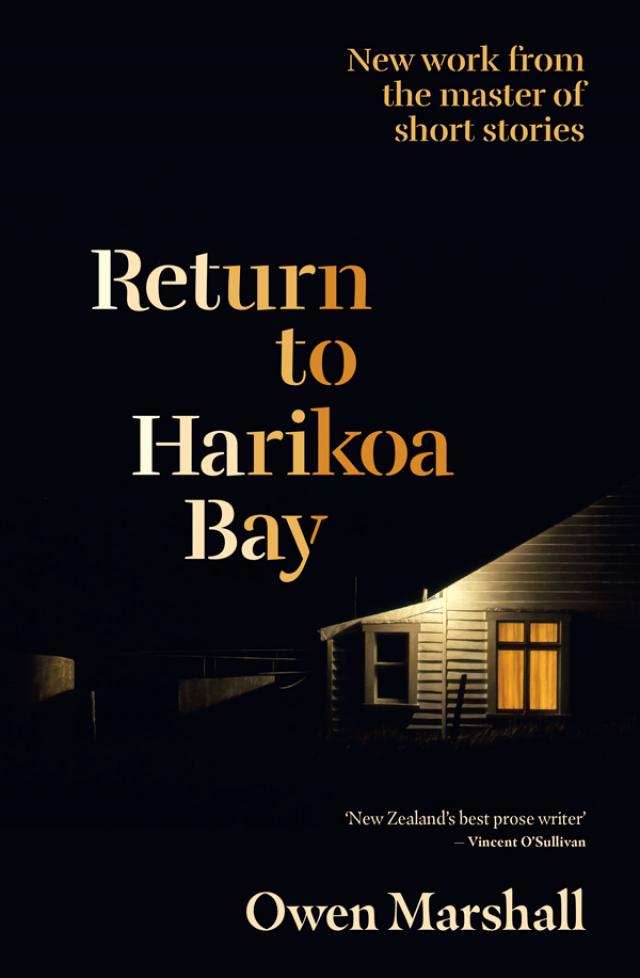
Return to harikoa bay, p.1
Return to Harikoa Bay, page 1


‘Whenever I think of coming to punish my father, it’s always in a strong wind, and that’s blowing now as I drive up the long, unsealed track to the house and sheds.’
So begins one of Owen Marshall’s superbly subversive stories. He offers up a wide range of subjects, from untimely deaths to unusual discoveries made about friends or neighbours, from burnishing an overseas trip to a tale about saving a business venture:
‘Just in time,’ said Paddy. ‘I thought I was going to have to resort to giving blow jobs in the office.’ It wasn’t quite as Jane A would have expressed relief, perhaps, but sincere in its own way …
With over ten years since his last collection of new stories, Marshall explores his fellow New Zealanders, bringing his wisdom and wry eye to vivid, insightful scenes:
‘Places bring back people, people bring back places, and both conjure the cinema of your past.’
Contents
1.
Resurrection of the Dolls
2.
Rue de Paradis
3.
The Drummer and the Stoat Killer
4.
Dancing on Another Planet
5.
Night Nurse
6.
Family Ties
7.
The Penguin Cap
8.
Hīkoi
9.
The English Visitor
10.
Living in the Moment
11.
Giving the Finger
12.
Cecily
13.
Taking the Fall
14.
Discovering Australia
15.
Double Bubble
16.
Other People
17.
Pīwakawaka
18.
Frost Flowers
19.
Running Bear
20.
Return to Harikoa Bay
21.
The Dreamer
22.
Koru Lounge
23.
The Light Fandango
24.
Thunderflash Days
25.
Three Women, One Morning
26.
Mr Prince
27.
Refuge in the Present
28.
Leaving Emptiness
29.
Third in the Back Row
30.
The Undertaker’s Story
31.
What Eddy Sees
32.
Behind the Scenes
33.
Being Frank
Acknowledgements
Follow Penguin Random House
For Jackie
1.
Resurrection of the Dolls
‘Fuck, and fuck again,’ said Emma with vehemence. She was alone and so could say it loudly without fear of reproof, yet she wished Mr Torres were there to hear her, or Hilary or Eddie. Impropriety in the presence of others would have given greater emotional release. The photocopier was in revolt again and she could hear the A4 sheets scrunching up within its innards, but nothing was coming out. It did this from time to time and always to her and not the others. The photocopier surely had a reptilian animosity at its core. Eventually it became so constipated that there was just a grating sound and the flickering of red, baleful eyes.
Emma was in the photocopying room of Hoffman, Utterlay and Smith. A room the size of a modern laundry, and although its purpose and location were quite obvious, there was formal designation on a green plastic tag above the entrance. Emma knew she should go and tell someone the copier had seized up again, but she went instead to the small window and watched the new person moving into the adjoining commercial space. A modest showroom, a poky back office and even smaller area for toilet and basin. Mr Torres, who was HUS office manager, called it the swamp of dreams. Eleven different enterprises had foundered there in his time, he said, and he took a bitter satisfaction in that. Transfixed in such a barren life himself, he had no pleasure in the success of other people.
Even within the four years of Emma’s time at HUS, three enterprises had begun with hope and trumpets and left in tears and disarray. The premises were occupied by Pooch Pamper when she first joined the firm: two middle-aged women who offered to wash and sanitise dogs, and exercise them safely in the municipal park. There was occasional barking to be heard for a few months and a variety of breeds to be observed, but after a malign mastiff killed a black swan in the reserve while nominally supervised by the taller of the Pooch Pamper owners, it was all over. The less tall woman, diminished even more by tragedy, moved to Australia to re-establish the business in a country unaware of the disaster.
After a two-month vacancy Pandora’s Box moved in, a speciality chocolate concept created by Vanessa Prendergast — handmade chocs in white, red and blue as well as the traditional colour. They were packaged in cellophane tied with striped ribbon, or in small cardboard boxes in pastel shades. The window display attracted the attention and admiration of many, but the prices were such that sales were insufficient to maintain a business. Mass-produced chocolate won, as mass-produced goods usually do. Emma had bought Vanessa’s chocolates and talked sometimes with her in the small shop, but that, of course, was not enough. Vanessa had resorted to offering individual elocution lessons among the chocolates, but nothing could prevent failure. Mr Torres sneered and said she hadn’t even understood what Pandora’s box really contained — afflictions from the ancient gods. Didn’t she know that? So Vanessa had finally surrendered and taken a job at the auction house in Glutt Street.
The Reverend Ewan Mosley was the next tenant, but even a divine connection was insufficient to ensure success. He set up the Modern Christian Bookshop, which he stocked not just with Bibles, New Testaments, Billy Graham speeches in three volumes, religious novels and biographies, but also with up-to-the-minute gospel music discs and even paintings with inspirational themes — robed figures caught in shafts of heavenly light and clustered children with beatific expressions. How few the customers — the only regular a homeless and toothless man seeking warmth in winter — and the Reverend Mosley reluctantly decided that philanthropic provision was not sufficient to justify the stock held and the rental for the premises.
And so Emma watched from the window the arrival of the latest lessee. An attractive young woman with short hair dyed red, who carried in sewing machines and other such apparatus, then cartons of material, and also boxes of dolls, some pinkly and smoothly naked, some elegantly clothed. When Emma went back into the offices she told her colleagues of the new neighbour and the nature of her enterprise. Most wished her better fortune than her predecessors, but when Mr Torres heard later, he assumed a hangman’s smile and said he gave her six months. Six months max and he’d bet on it. The HUS partners were not interested in such gossip. They passed through the open office and its undistinguished denizens as if it were a supermarket.
The next day, during her lunch break, Emma went next door to meet the red-haired woman and welcome her. She was good looking, as already said, and blithely untroubled by existential anxiety, as is conventional in such a story as this. The shop was not yet officially open, the door was locked, but Emma could see the woman working inside amid the cartons and new shelving. She came to the door in answer to Emma’s knock. ‘We’re not open yet,’ she said cheerfully. ‘I’m still setting up. Sorry.’
‘I’ve just come to wish you well. Success and all that. I work next door at HUS.’
‘HUS?’ the woman said.
‘Hoffman, Utterlay and Smith.’ Emma had forgotten that not all the world was aware of the acronym so customary for her. ‘I’m Emma.’
‘Just like in Jane Austen.’
‘In name only,’ said Emma. ‘I lack gentility.’ She was impressed a little, however, by the woman’s knowledge of the literary connection.
‘I’m Paddy.’
‘I won’t interrupt. I just wanted to say hi.’
‘You’re not. Come in,’ said Paddy, stepping back, so Emma went in and they chatted.
The shop had no name displayed, but Paddy said it was to be called Paddy’s Dolls. ‘I know,’ she said. ‘It’s not that great, but the good ones were taken — Dolled Up, Doll World, Dolls’ House. I couldn’t believe how many names turned up on Google.’ Paddy said she wouldn’t just sell dolls, but clothe them, to the owners’ specifications even, if so requested, and she was considering having a section for second-hand dolls that she’d buy in, refresh and hopefully make a useful profit from on resale. Infused with her enthusiasm, the project sounded like a winner, as had many of those in the same premises before her. But Emma said nothing of those, instead asking what Paddy had done before. ‘Oh, I had this job at the hospital laundry and hated it. I’ve always wanted to have a business of my own. I’ve actually got a polytech qualification in media and entertainment studies, but it didn’t lead to anything. I had heaps of dolls as a kid and I’ve always been keen on sewing and dressmaking. I knit too. Most people aren’t interested now, are they?’
‘I suppose not.’ Emma wasn’t interested herself. They seemed skills like blacksmithing, or candle-making.
‘At last I’m my own boss,’ and Paddy stood among the boxes of fabrics and dolls, the partly assembled shelving, the brooms and mop, and she smiled, gave a shiver of delight at her own accomplishment.
‘Good on you, and good luck,’ said Emma, and she meant it, yet even then, even befo
Emma and Paddy became friends. Emma would wave as she passed the shop, go in often at lunchtimes and after work. In the first few months, when Paddy was still optimistic of sufficient patronage, Emma even went in to help on the odd Saturday morning. Customers were scarce, but she could fit the garments on the dolls, covering their asexual pink bodies with beautiful clothes that bestowed femininity. They became confidantes, Emma and Paddy, sharing expectations and grievances and their views on all the world. Paddy had hoped her qualification would lead to a career as wardrobe mistress in the film or television industry, but instead ended up in the hospital laundry. Emma had gone teaching after gaining her degree, but had been so buffeted by indifference and insolence that she’d accepted the hierarchy and boredom of HUS clerical work, where she found herself in a so-called open office, but cubicled, with partitions chest high around her. Mainly women fellow workers, their heads questing from cells like despairing battery hens.
Both Emma and Paddy had lives beyond their work. Unlike Georgian heroines they were not past their use-by date at twenty-eight and thirty. Both had a boyfriend whom they dominated, and could easily have had others. Relationships were conducted on their terms, and their satisfaction in independence was far greater than any wish to live with a man. What they sought in addition, however, was achievement and pleasure within a career.
Emma envied Paddy. She envied her despite the private conviction that Paddy’s Dolls would fail as its predecessors had failed. Paddy would surely go down with the ship, but at least she was its captain. When she was photocopying at work, Emma would go to the window and look out to see the frontage of the adjoining shop, with ‘Paddy’s Dolls’ painted there in bold gold letters and she would wish herself there, rather than in the useless bustle of HUS. In truth, she felt herself demeaned in her job, surrounded by petty and materialistic concerns, subject to people of inferior nature and talent — Mr Torres especially.
Mr Torres knew of her friendship with Paddy and took pleasure in snide references to the inevitable fate of the shop. Open derision too. ‘Dolls. Jesus Christ,’ he said. ‘What sort of person thinks you can make a living selling and dressing dolls. Some folk just have no understanding of the realities of business. I’d put a burger joint in there, or a betting shop. People have to eat and they’re suckers for a chance to win big.’
Mr Torres was an embittered man, as I’ve mentioned: the necessary counterweight to the more sympathetic characters in a story of this sort. He envied the partners above him and chafed at being no more than office manager when his ego demanded more. His wife had grown cold and his children had dispensed with him. His bitterness was such that it couldn’t be contained internally and manifested itself in his appearance. Sardonic lines were as sabre cuts on his cheddar cheeks, his upper lip curled from the teeth and his eyes had a restless dissatisfaction. ‘Oh yes, the signs are there, I’m afraid,’ he said. ‘The writing’s on the wall. It’s just a matter of time for your friend. The novelty wears off, you see, Emma. We’ve seen it all before.’
And yes, the signs were there. Emma had to admit that. Paddy’s dolls’ clothes were attractive and individual, but time-consuming to produce. Even at a modest mark-up, the prices were significantly higher than for the cursorily dressed dolls in the chain shops. ‘I’m working for peanuts,’ Paddy admitted. ‘In fact peanut singular. I don’t know what to do.’ She no longer opened the shop on Saturdays, or weekday mornings, and instead went to the homes of successful people to clean their showers and toilets. ‘It’s worse than the bloody laundry,’ she said, ‘and some stuck-up bitch accused me of stealing her Coco perfume.’
‘It’s not fair. Your dolls are fantastic: better than anything else I’ve seen.’
‘Yeah, people say they’re fantastic, come into the shop and drool over them, ask me about the fabrics and how I come up with the ideas. But do they buy them? Not bloody often. I always thought if you made something really nice, the best you could and better than other stuff, then you couldn’t miss. But people won’t pay.’
‘It’s just not fair,’ said Emma again. ‘Your dolls are the best.’
‘And I really love doing it. It’s the greatest feeling ever.’
They were sitting together in the small shop, close to Paddy’s embroidery machine, which she had still not fully paid off. Her natural mood was one of cheerful optimism, but she knew the place was failing. Even cleaning bathrooms and kitchens couldn’t save it. Emma hated to see her sitting there, sad faced, and crowded around her the multitude of dolls, all sizes, all ethnicities, all beautifully dressed, wide eyed and with fixed smiles that admitted of no misfortune in life.
There had to be an answer, and it came fortuitously after Emma had twice had sex with Reyansh in his apartment in a new block close to the university. Reyansh hasn’t been mentioned before because he isn’t as integral to the story as Emma, or Paddy, or even Mr Torres. Sex was very important to Reyansh, but less so to Emma, and that’s another reason why his role is secondary. A pleasant enough guy, ethnically distinctive and well toned, but inessential here except for his knowledge of marketing on the net. Selling online was his business, and when his lust had been sated for at least a few hours, he talked of his job. At the moment his work was preparing a programme for top-end running shoes. ‘There’s a vanity market for almost anything,’ he said. ‘People who want the most expensive product just because it’s the most expensive and exotic. Not many people, okay, but they’re there and with online selling you can cream them off from anywhere in the world.’ He was watching Emma preparing to leave and already aware of stirrings that made him reluctant to see her go. ‘Limitless possibilities if you pitch it right,’ he said. ‘Perception is everything.’
That’s what gave Emma the idea for the salvation of Paddy’s Dolls. ‘There’s something I want you to do for me and Paddy,’ she told him. ‘We need to go top end.’ Was Reyansh going to say no? And you need a happy ending in a story of this nature.
The three of them had meetings at Paddy’s small shop to discuss a new modus operandi. Even more design time and expensive costuming were to be lavished on the dolls, Indian silks and real jewels, complimentary perfumes in tiny crystal bottles, birth certificates with wax seals. The price was more than quadrupled and Reyansh devised his most scintillating online advertising in order to retain Emma’s favours. The enterprise was rechristened Petite Perfection as Paddy’s Dolls was too plebeian. How those dolls sparkled and smiled, some no taller than a pencil, some larger than human babies. They were an ageless perfection unattainable by anything organic, undemanding in upkeep and with no capability for disobedience, all of which made them the more desirable.
What a gamble it was, but Reyansh was right, for orders began to trickle in, and a trickle was more than enough to provide a generous profit. Paddy worked happily in the shop, troubled no longer that people came to stare and wonder at her skill and inspiration, yet almost all unable to make a purchase. Mr Torres couldn’t understand how the business survived. It hurt him to see apparent guilelessness win out. ‘I don’t see hardly anyone buying any friggin’ dolls at all,’ he said in exasperation. ‘It should have gone under by now.’
Nothing succeeds like success, as the adage tells us. Seven Sharp even came calling, and Paddy and her dolls were on early evening television. Emma was able to add to Mr Torres’s chagrin by informing him she was resigning from HUS to join Paddy in Petite Perfection. Even the HUS partners deigned to notice Emma’s resignation and presided in the firm’s tearoom over a modest cheese and chardonnay farewell. They had a nose for money. Emma’s last action was to secretly force-feed the photocopier with a wet serviette.
‘Your business is saved by the world’s preening vanity,’ Emma told Paddy the next day as they sat together in the shop admiring newly arrived Florentine leather, velvet from La Rochelle, tourmaline and topaz from Madagascar.
‘Just in time,’ said Paddy. ‘I thought I was going to have to resort to giving blow jobs in the office.’ It wasn’t quite as Jane A would have expressed relief, perhaps, but sincere in its own way, and sufficient closure to a gentle satire.