

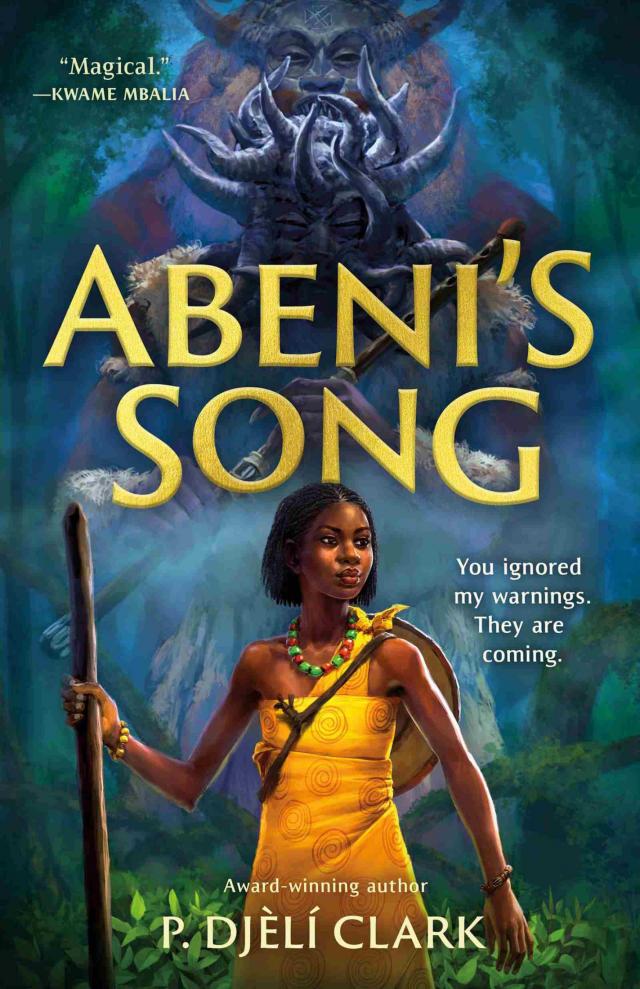
Abenis song, p.1
Abeni's Song, page 1


Begin Reading
Table of Contents
About the Author
Copyright Page
Thank you for buying this
Tom Doherty Associates ebook.
To receive special offers, bonus content,
and info on new releases and other great reads,
sign up for our newsletters.
Or visit us online at
us.macmillan.com/newslettersignup
For email updates on the author, click here.
The author and publisher have provided this e-book to you without Digital Rights Management software (DRM) applied so that you can enjoy reading it on your personal devices. This e-book is for your personal use only. You may not print or post this e-book, or make this e-book publicly available in any way. You may not copy, reproduce, or upload this e-book, other than to read it on one of your personal devices.
Copyright infringement is against the law. If you believe the copy of this e-book you are reading infringes on the author’s copyright, please notify the publisher at: us.macmillanusa.com/piracy.
For Nia & Nya, who have always liked my stories
PART I
CHAPTER ONE
THE SONG
Damju awoke to the song.
It was a beautiful song.
It danced in her head—coming from everywhere, all at once. She sat up, opening her eyes to a familiar world of light and shapes. It was the way she saw, which had always been different from others. It was still night. Night was dull. Not like daytime that glowed. And there were night’s sounds that lulled her to sleep—chirping crickets, night birds, and howling animals that shared their small valley.
She tilted her head to listen. Only there wasn’t any of that now. There was only quiet—like someone had told the world to hush. There was just the song. Beautiful and strange, filling up her thoughts.
But where was it coming from? Who would be playing music so late? Standing, she ran fingers along the cracked mud walls of her home, careful not to stumble over her mother—who lay sleeping. She reached down to put a hand to where her two brothers should have been, but there was only emptiness.
Not long ago Damju could walk easily under calabash bottles hanging from their ceiling. But she’d seen almost twelve harvests now and the bottles grazed her hair as she moved to the door. She pushed through it and outside.
The night air was warm and still strangely quiet. But she wasn’t alone. She could just make out the shapes of people moving along narrow moonlit streets. Some were small. Others her height. All children, she realized in surprise. She frowned. What could they be doing? She reached out, catching someone’s arm.
“Wait! What’s happening?”
A breathless reply came. “The song, Damju! Can’t you hear it? Can’t you see—Oh! I’m sorry!”
Damju recognized the voice. Ewa, who always seemed to forget Damju saw differently. “I hear it. But what do you see?” How did you see a song?
Ewa fumbled. Her voice was strange—like someone still half asleep. “I can’t explain. But the song shows you things. Beautiful things!”
Damju was confused. A song that showed you things?
“Where are all of you going?”
“To find the song, of course,” Ewa answered. “Just like you.”
“What? I’m not—” She stopped, realizing her feet were moving! But when had she started walking? The song! She could feel it pulling at her, urging her on. Ewa shrugged away, leaving Damju between other children, all marching forward like a flowing river.
Fighting, she made her feet stop, planting them firm in the middle of the street as others pushed past. “Kambo! Dawda!” she called to her brothers. They had to be out here. But how long ago had they left home? How far might they have gone? The thought made her panic, and she shouted their names over and over into the night.
“Damju!” Someone grabbed her. Her brother! She clutched on to him.
“Kambo! Where’s Dawda?”
“Right here,” her other brother answered.
Damju breathed in relief. “I thought you were gone.”
“We almost were,” Dawda snickered. “Came back when we heard you calling after us like a loud goat!”
Dawda was always the one to make jokes. For once, Damju didn’t laugh.
“This song, it isn’t right! We have to—”
“It’s okay, Damju,” Kambo said.
“The song’s showed us what’s out there,” Dawda added.
“What? What did it show you?”
“Baba!” Kambo said. “He’s waiting for us!”
Damju stared up at the shape of her brother’s face, too stunned to answer. Other children passed by, and they were now the only ones just standing. Baba? Their father was gone. He’d died when she was small. Her brothers remembered him better than she did, but he was gone all the same. Did ghosts walk this night?
“I know how it sounds,” Dawda said. “But we saw him, Damju. Calling us.”
Something Ewa said came back. The song showed you things—beautiful things.
She shook her head. “No! It’s not real! The song! It’s showing you what you want to see. It must want you to—!”
“It’s fine, Damju,” Kambo assured her, his voice like Ewa’s now—half asleep. “We’ll come back, with baba.”
“No, don’t go!” But they were already gone, and her hands clutched at other children who pushed forward. One by one, they marched past the village’s low stone walls, chasing what the song showed them, the things Damju couldn’t see.
Somewhere in the valley came another curious sound. A woman’s voice. Damju thought the woman might be crying, and she fought to hear the words above the song.
The children. He has taken the children. Taken them from me. The children, the Children of Night …
When everyone had gone, she stood alone, until the song and the voice faded away.
CHAPTER TWO
FESTIVAL
Somewhere very far away, Abeni woke up with a wide-mouthed yawn.
She’d been dreaming. Of a song, of all things.
But the dream was already getting fuzzy, the way dreams did. And the song and odd voice became distant echoes. Soon she couldn’t remember what they sounded like at all. Then she forgot entirely.
Today is my birthday.
Abeni smiled, taking a long stretch and wriggling her toes. Sunlight crept into her home through slight spaces in the straw roof, bringing the heat of the day to come with it. It was early, but already she could hear the familiar sounds of morning.
Chok-a-chok-chok-a-chok.
Her mother pounding yam outside. That meant her aunts were here. And that she’d overslept! Sitting up abruptly from her sleeping mat, she kissed the back of her teeth and shook her herself fully awake—so that her plaited hair swung from side to side. How could she oversleep on today of all days!
“Abeni!” her mother called from outside. “Are you really still sleeping?”
“Um, no!” she croaked. Swallowing, she found her voice. “I mean, no, mama!”
Her mother kissed the back of her teeth, the way she did when she didn’t quite believe you. “Well, I hope you’re dressed! It’s almost time to go!”
Dressed? Abeni looked down to her plain brown tunic and made a face. This wouldn’t do, not for today. She glanced at a pile of her clothes scattered in a corner. They wouldn’t do either. She jumped up, meaning to run, then slipped on her sleeping mat, and landed with a thud.
“Abeni?” her mother called. “What’s all that noise? What’s going on in there?”
“Nothing, mama!” she called back, hopping on one foot while nursing a stubbed toe—and glaring at the sleeping mat. This wasn’t how this morning was supposed to go!
Hurrying, she ran from her room. Her father had built their house before she was born, making it older than her. It had one long circular wall that was smooth to the touch and smelled of old earth. Smaller walls divided the house into separate parts. She passed through the cooking chamber where her mother’s planting tools hung beside her father’s hunting weapons. Reaching her parents’ chamber, she found a bundle of neatly folded cloths with colorful prints. Her mother’s best wrap skirts—which she was not supposed to touch. But she needed something nice for today. Rifling through them, she settled on a bright gold one, with spirals like little red snakes.
“Abeni!” Her mother’s voice had that tone in it now. “Do I have to come in there and get you?”
“No, mama! Just a moment!”
Finding a large jug of water, she checked her reflection. She’d thought that today, her twelfth birthday, her face would seem different—more grown. But it looked the same as the day before, and the one before that. Brown eyes and a dark brown face, with a fleshy nose above lips people claimed made it look like she was pouting. Her tight coils of black hair had been parted down the middle and plaited into thin hanging braids that she could swing back and forth. That had taken her aunts hours to finish yesterday. They hadn’t done it too tight, but it still hurt a bit if she raised her eyebrows.
Opening her mouth, she examined her teeth to see if they’d grown. Nope. Still the same size, even the same overbite. Altogether, she looked very much … the same. But it was her birthday. She was older. That was all that mattered.
“Abeni! Did you fall back asleep, girl?”
She broke away from her reflection. “I’m awake!” No time for a long bath. Wriggling out of her tunic, she scrubbed and dried quickly, wrapping the gold cloth about her. She tucked it in here and there—just right to make it stay on. She wasn’t any taller than any other girl her age in the village, but her mother and aunts fretted at her skinniness. Her father teased he’d have to tie rocks to her feet to make sure a strong breeze didn’t carry her away. She didn’t find that funny.
She looked down with a smile. The cloth was nice as a skirt on her mother, but as a dress it looked wonderful on her. Still, it was missing something. Rifling through more of her mother’s things, she found a set of necklaces—settling on one with sparkling green and red stones and snatching up the matching pieces nearby.
As she fitted on the jewelry her eyes caught sight of a small soapstone jar carved like a frog—where her mother kept her sweet oils. Opening the jar, she scooped out a handful and rubbed it everywhere. Satisfied, she slipped into her favorite red-brown sandals and stopped to admire herself. Or tried to.
“ABENI! If you’re not out here by the time I count to—!”
She was out the door before her mother even finished the sentence.
Her village was alive. Everywhere were other rounded houses like her own, their brown straw roofs today decorated with colorful flowers and strips of bright cloth. People moved about in the streets, some with arms full, others holding clay jars atop their heads—their voices louder than usual in the early morning.
“Eh! Look here. The princess has awakened to greet us!”
Abeni looked to see her father smiling at her. He wore a white kilt that fell to his feet, alongside strips of leather with black and red designs that hung from his waist. His shoulders and chest were bare, except for fresh spirals of white chalk.
“Akanyo, I didn’t know you were hosting the daughter of a chief,” the man who painted her father’s skin added.
“That must be it,” her father said as if surprised. “The daughter of a chief!”
The two men stopped to give her a deep bow.
Abeni rolled her eyes but smiled. Her Uncle Tawayo and her father loved to joke. The two were the strongest men in the village, and everyone respected them as great hunters. Today they were dressed almost exactly alike. Even their hair was the same, shaved on all sides except for a flat patch at the top.
“What do you say, Afayo?” Her father nudged her brother. “Doesn’t your sister look like a chief’s daughter?”
Her brother looked up from where he sat, decorating a long spear with bits of rope and beads. He wore his hair just like the two men, though he still looked like a boy. He gazed lazily at her dress before turning back with a shrug. “She looks okay.”
Abeni frowned. Okay? She simply looked okay? Her brother had seen three more harvests than her, but they’d always been close. Now he was all puffed up with himself, keeping to other older boys who soon would be counted as men. Well not today!
She ran over and tackled him, seeking the tickle spots she knew all too well. He cried out but it was too late. Between his protests, he laughed, until finally managing to twist away.
“Ayiee! You crazy little monster! Okay! Okay! You look nice!”
“How nice?” she asked, wriggling her fingers in threat.
“Very nice! Very nice!” He held up hands to ward her off. Pausing, he sniffed the air and wrinkled his nose, smelling the sweet oil. “But the chief’s daughter stinks!”
She stuck out her tongue. He made a face back.
“It certainly took the chief’s daughter long enough to come out here! And it seems the two of us have the same tastes.”
Abeni turned at her mother’s voice. She was using a long wooden pestle-stick to pound the contents of a wide wooden bowl. A green skirt with leaf patterns stretched to her ankles and a bright white fabric wrapped about her chest. At the moment, she eyed her daughter’s dress with interest.
“I thought you might like it?” Abeni asked sheepishly.
Her mother raised an eyebrow, never stopping her pounding. It was hard to tell what she was thinking when she made that face. It always made Abeni squirm. She had tried to perfect it herself, but never seemed to get it quite right.
“Let the girl be, Yayawi,” a short plump woman beside her mother chided. “How can the branch of a tree not resemble its roots?”
“Eh yes, Yayawi,” another chimed in. “She’s growing more into your face each day. Might as well grow into some of your clothes too.”
Both women laughed. Her mother’s older sisters—Aunt Awami and Aunt Awomi. They were twins. Not only did they look alike, down to their round moon faces and dimples, they thought alike and sometimes finished each other’s sentences. They were her favorite aunts. They each gave her knowing winks, and she returned them back.
Everyone claimed she looked just like her mother—the same nose, high cheeks, round eyes, and those lips made for pouting. But where Abeni was gangly her mother was solid, with strong arms and legs. Not as stout as her sisters, whose wide hips swayed when they walked. But she certainly wasn’t in danger of being carried away by a strong wind.
“Well can she help her mother pound yam? I was calling you awake to get you to help us. Or is the princess too good for that?”
Abeni beamed, matching her mother’s growing smile. She bounded over to the large bowl that stood to her waist, peering down at the orange half mashed bits.
“Here, have mine.” Her Aunt Awami handed over a pestle, showing Abeni how to grasp the long wooden stick properly. She’d often watched her mother pound yam, but they’d never asked her to take part. “Hold it with both hands, strong.”
Abeni nodded, excited. When her mother brought down her pestle, she waited to hear her Aunt Awomi’s fall before letting her own drop in rhythm.
Chok-a-chok-a-chok.
Behind her, Aunt Awami sang about a woman who stole her neighbor’s yam. Only it was magic and would jump when she struck it. Aunt Awami called out, and they answered like the frustrated woman, “Yam stop jumping in my bowl! Yam stop jumping in my bowl!” When they finished, the yams were an orangey mush. Abeni let out a breath. Her arms were tired!
“Wearing my clothes and now pounding yam,” her mother remarked. “My little rain bringer is soon going to outgrow me.” There was a sadness in her voice, though Abeni couldn’t imagine why.
“Eh!” her mother cried, wrinkling her nose. “Abeni! Did you take a swim in my sweet oil?” Her brother barked a laugh. Abeni quickly changed subjects.
“Today is my birthday!” she reminded.
Her mother frowned, but her voice softened. “Yes, it is. Have I ever told you about the day you were born?”
Abeni groaned. Just about a hundred times.
“Don’t be like that. It used to be your favorite story.”
When she was little. She was twelve now!
“I’d like to hear it!” her brother called with a grin.
Abeni turned and crossed her eyes at him. He made a sillier face back.
“Yes,” her mother murmured, as if just remembering. “It had been a very dry season right before you were born, and the village saw little rain.”
“I remember that time,” Uncle Tawayo added. “There were fires in the forest because it was so hot. All the animals ran off and we had little to hunt. Even the river began to dry up.”
“The whole village worried,” Aunt Awami said, scooping mashed yam out of the pounding bowl and into a large clay pot. “Every day we asked the spirits for rain.”
“And you were in my belly,” her mother added, smiling.
“That is because you knew how hot it was!” her father said. Everyone laughed and Abeni winced. Please let this story be over.
“Your mother’s belly was big like a melon with you,” Aunt Awomi said, helping scoop yam. “We took her to the healer to see if he could find a way to make you come out. But he didn’t know what to do, so he sent your father to see the old woman.”
She said the last words almost as a whisper. The old woman. Abeni didn’t know her real name because that was all anyone called her. The other children said she was a witch, and grown-ups whispered the same. Whoever she was, she lived by herself in the forest and hadn’t come to the village since before Abeni was born.
“What was it the old woman told you to do, Akanyo?” Uncle Tawayo teased.


