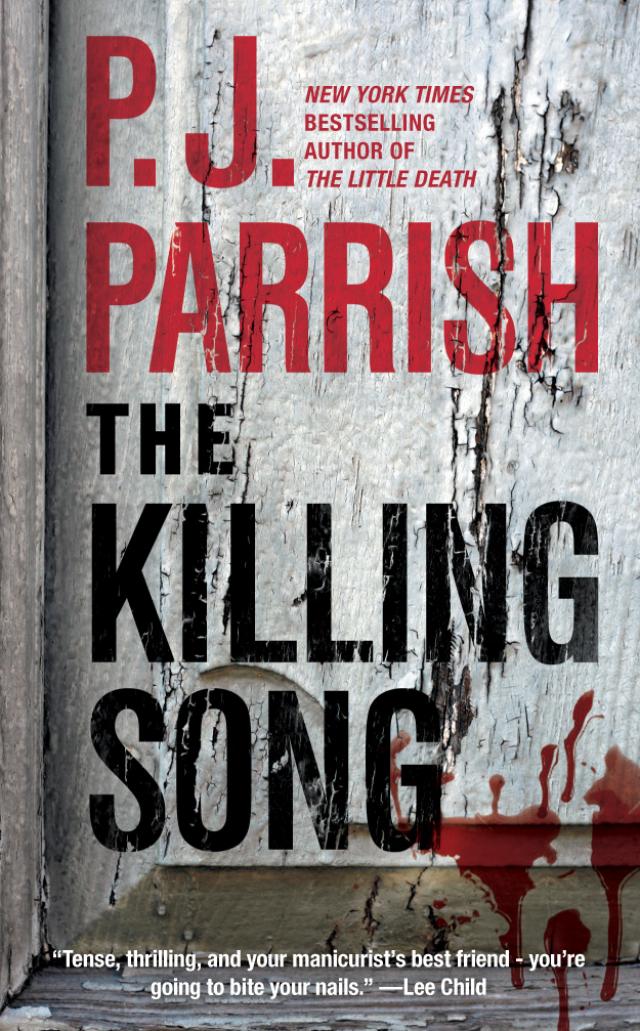
The killing song, p.1
The Killing Song, page 1


Praise for the work of
Edgar Award finalist P. J. Parrish
THE KILLING SONG
“I love THE KILLING SONG, in which the best sister act in crime fiction, known as P. J. Parrish, has crafted one of the best criminals ever. Their serial killer is as brilliant as he is ruthless, but he makes a critical mistake when he murders the baby sister of reporter Matt Owens. Heartbroken and driven, Matt tracks the villain from Miami’s South Beach to the catacombs of Paris, in a story so riveting you won’t be able to stop turning the pages.”
—Lisa Scottoline, New York Times bestselling author of Save Me
THE LITTLE DEATH
“Louis Kincaid is the detective I would want on the case if it was someone I knew on the slab. The Little Death is P. J. Parrish’s best work yet!”
—Michael Connelly
“Sex, murder, and money, all set in the insanity that is Palm Beach society.”
—Brad Meltzer
“Louis Kincaid and P. J. Parrish get better with every book.”
—Orlando Sentinel (FL)
“THE NOVELS OF P. J. PARRISH [ARE] AS SUSPENSEFUL AND SHARPLY WRITTEN AS ANY OF THOSE BY MICHAEL CONNELLY AND JAMES PATTERSON.”
—Chicago Tribune
A THOUSAND BONES
A Cosmopolitan magazine “Sizzling Summer Read”!
“Stunningly crafted page after page, on the way to a thrilling climax.”
—Linda Fairstein, New York Times bestselling author of Killer Heat
“Sizzle[s] with taut suspense and the promise of a tumultuous conclusion… . Another top-notch whodunit.”
—Publishers Weekly
More praise for the spellbinding crime fiction of P. J. Parrish
“If you haven’t discovered the fast-paced action, terrifying suspense, and hair-pin twists of P. J. Parrish yet, now’s the time.”
—Mystery Guild
“I’m hooked on P. J. Parrish. Nobody else creates such a compelling mix of real characters, genuine emotion, and fast-paced suspense.”
—Barbara Parker, author of Suspicion of Madness
“A pretzel-like plot … an ambitious and engrossing tale.”
—Orlando Sentinel (FL)
“A stand-out thriller … intriguing and atmospheric… . Suspense of the highest order.”
—Chicago Sun-Times
“An invigorating ride.”
—Baltimore Sun
“P. J. Parrish is a superb writer.”
—National Book Critics Circle
“HER ABILITY TO RAISE GOOSE BUMPS PUTS HER IN THE FRONT RANK OF THRILLER WRITERS.”
—Publishers Weekly (starred review)
“Wonderfully tense and atmospheric … keeps the reader guessing.”
—Miami Herald
“A good, fast read, satisfying plot, and characters you’ll want to meet again.”
—San Antonio Express-News (TX)
“A really fine writer.”
—John Sandford
“Parrish is an author to read, collect, and root for.”
—James W. Hall
“Opens like a hurricane and blows you away through the final page… . A major league thriller that is hard to stop reading.”
—Robert B. Parker
“A masterpiece of shock and surprise … from the startling opening to the stunning finale.”
—Ed Gorman, Mystery Scene
“A superb, highly atmospheric, thought-provoking thriller… . Tense, exciting scenes.”
—Lansing State Journal (MI)
Also by P. J. Parrish
The Little Death*
South of Hell*
A Thousand Bones*
An Unquiet Grave
A Killing Rain
Island of Bones
Thicker Than Water
Paint It Black
Dead of Winter
Dark of the Moon
*Available from POCKET BOOKS
Pocket Books
A Division of Simon & Schuster, Inc.
1230 Avenue of the Americas
New York, NY 10020
www.SimonandSchuster.com
This book is a work of fiction. Names, characters, places, and incidents either are products of the author’s imagination or are used fictitiously. Any resemblance to actual events or locales or persons, living or dead, is entirely coincidental.
Copyright © 2011 by P. J. Parrish
All rights reserved, including the right to reproduce this book or portions thereof in any form whatsoever. For information, address Pocket Books Subsidiary Rights Department, 1230 Avenue of the Americas, New York, NY 10020.
First Pocket Books paperback edition August 2011
POCKET and colophon are registered trademarks of Simon & Schuster, Inc.
The Simon & Schuster Speakers Bureau can bring authors to your live event. For more information or to book an event, contact the Simon & Schuster Speakers Bureau at 1-866-248-3049 or visit our website at www.simonspeakers.com.
Cover photo by Paolo Gadler/stock.xchng
Manufactured in the United States of America
10 9 8 7 6 5 4 3 2 1
ISBN 978-1-4391-8936-8
ISBN 978-1-4391-8938-2 (ebook)
Contents
Acknowledgments
Chapter 1
Chapter 2
Chapter 3
Chapter 4
Chapter 5
Chapter 6
Chapter 7
Chapter 8
Chapter 9
Chapter 10
Chapter 11
Chapter 12
Chapter 13
Chapter 14
Chapter 15
Chapter 16
Chapter 17
Chapter 18
Chapter 19
Chapter 20
Chapter 21
Chapter 22
Chapter 23
Chapter 24
Chapter 25
Chapter 26
Chapter 27
Chapter 28
Chapter 29
Chapter 30
Chapter 31
Chapter 32
Chapter 33
Chapter 34
Chapter 35
Chapter 36
Chapter 37
Chapter 38
Chapter 39
Chapter 40
Chapter 41
Chapter 42
Chapter 43
Chapter 44
Chapter 45
Chapter 46
Chapter 47
Chapter 48
Chapter 49
Chapter 50
To Daniel,
If I should fall behind, wait for me …
preferably in Paris
ACKNOWLEDGMENTS
Dear readers,
Most of you know by now that there are two of us. But we doubt you know how many stand behind us and beside us to make our books possible. Here are just a few:
Love to Daniel, who several years ago, in the Paris café Le Rostand, serenaded me with the lyrics to the Stones’ song “Too Much Blood,” drawing appalled looks from the matron sitting next to us but inspiring this story nonetheless.
Love to our agent Maria Carvainis for talking us off the ledges.
Special thanks to rock music aficionados Jim Fusilli and Cameron Cohick for plumbing the dark corners of their souls for morbid lyrics (I owe you a Burberry scarf, Roon); to Phillip and Davis Ward for the ephemera about Duke U and the modern newsroom; to Barbara Hijek, news researcher of the South Florida Sun-Sentinel; to Andy the computer geek; to Dr. Doug Lyle for his medical and forensic advice. And finally, to our French friend Cecile Gauert, who patiently corrected our French. Nous vous disons un grand merci.
To all our supporters at Pocket Books, a huge thanks. Many writers complain of copy editors bleeding all over their pages, but this book was improved greatly by Aja Pollack, who caught many errors and kept our tangled time line straight. Special mention must go, finally, to our talented editor Abby Zidle, who let us get our way but let us get away with nothing.
And lastly, we must thank our sister-in-law and cellist Ginger Gordon for answering our questions. To all the other cellists who helped us: We will honor your request to remain anonymous because, as one of you plaintively told us, “Cellists really are the nicest people in the orchestra.”
1
He couldn’t take his eyes off her.
The last rays of the setting sun slanted through the stained glass window over her head, bathing her in a rainbow. He knew it was a just a trick of light, that the ancient glassmakers added copper oxide to make the green, cobalt to make the blue, and real gold to make the red. He knew all of this. But still, she was beautiful.
His mother was there in his memories suddenly. He was watching her sitting before her mirror, remembering the way the lamplight turned her white skin gold. And he could remember what she said as she painted her lips. Every woman, for just one moment in her life, should be able to be the most beautiful woman in the room.
He stared at the girl. The sun had set and the glow had faded. Her moment was gone.
He looked away, focusing on the music before him. Vivaldi, The Four Seasons. He didn’t need to read it. He knew every note by heart. He had played it a thousand times, so much that any pleasure he had ever taken in it had long ago died. As he played, he watched the faces of the audience. Tourists, mostly, and easily amused.
A pause in the music. They had finally come to the last movement, “Winter.” Fifteen more minutes and he was free.
His eyes flicked to the violinist, then, on cue, he drew his bow across the strings in short little bursts, the notes sounding like the cold chattering of teeth. There was little for him to do now, just keep a steady background beat, so he let his mind wander, let his eyes wander.
Back to the girl. She was in the front row and though it was dim now, he could still see her clearly. She was staring right at him, her mouth moving rhythmically, as if she were trying to sing along. It took him a few seconds to realize that she was chewing gum. A surge of disgust moved through him. Why did all the American girls chew gum? Didn’t they know it made them look like cows?
He looked away. He hated it when people weren’t polite.
“So where are you taking me?”
He looked down at the girl. She laced her arm through his and snuggled closer. Her nose was red. The musicians had been warmed by the small space heaters at their feet, but there had been no such comforts for the audience in Sainte-Chapelle. And now they were scattering into the cold night, bound for their four-star hotels or the nearest bistros.
“Are you hungry?” he asked.
She shrugged. “I grabbed a sandwich before the concert. I’m not used to eating as late as people do here.”
“Then a drink?”
She smiled. “Never too late for that.”
He disentangled himself from her grasp and hoisted up his case. They started walking toward the bridge. As they crossed over to the Left Bank, a tour boat approached, its garish floodlights trained on the Seine’s stone embankments, seeking out lovers in the shadows for the tourists’ titillation. But it was too cold for anyone to be out tonight. The lights found only rats scurrying into their holes.
In a café on boulevard Saint-Michel, he steered her to a corner table. He carefully positioned the large black case out of the aisle. She pulled off her gloves and glanced around. “I guess they don’t have real booze here,” she said.
“Excuse me?”
She sighed. “It’s just that I’ve been here for two weeks and I am dying for a decent martini.”
“You should have said something. We could have gone to Le Fumoir.”
She shrugged. “That’s okay. It’s just that I don’t really like wine all that much, you know? And it’s so cold and I can’t seem to get warm. No one told me Paris was going to be freezing.”
“It’s January,” he said.
“Yeah, well, maybe I should have waited. April in Paris and all that stuff, right?”
He smiled, then caught the waiter’s eye. When the man came over, he ordered for both of them. When the waiter returned with the drinks, the girl stared down at hers.
“What’s this?”
“Vin chaud. Hot wine. Try it.”
She set aside the cinnamon stick and took a sip. She smiled. “Good.”
“They add spices to it. I’m glad you like it.”
For the next half hour, he just listened. She loved to talk—about her job as a computer-something; about her six-toed cat, Toby; about her boyfriend who had emptied their bank account and run off, which is why she had decided on impulse to come to Paris; about her dream to be a tennis pro at the Houston country club where her parents kept her on their membership so she’d meet a quality man and get her life in order.
“They never forgave me for divorcing Dean and not popping out four blond babies,” she said. This came after the third vin chaud.
He suspected she wanted him to ask her more about Dean, but he was tired of listening to her. He was even getting tired of looking at her, realizing now that whatever he had seen in her face before was gone. When he had spotted her this afternoon in the Tuileries, he had been immediately attracted to her. He had impulsively introduced himself and then invited her to be his guest at the concert.
But now, as he looked at her in the harsh light of the café, he realized she wasn’t beautiful at all. True, she was blond and blue-eyed, but whenever she opened her mouth she became plain. He looked away, out the window at the people hurrying through the cold.
“So, how old are you?”
Her voice drew him back. “Does it matter?” he asked.
“I guess not.” She finished the vin chaud and picked up the cinnamon stick. “I kind of like older guys. Especially when they look like you. Dean was blond. But I always had a thing for the tall, dark and handsome ones.” Her eyes lingered on his, then drifted toward the black case propped in the corner.
“You’ve got quite a big instrument there,” she said with a smile.
He didn’t answer.
“Is it heavy?”
“You get used to it,” he said.
She was sucking on the cinnamon stick. For a long time she just stared at him, then she said, “Take me home.”
He felt relieved. “Where are you staying?”
“No, I mean to your place.”
When he hesitated, she countered with a smile. “I mean, why the hell not? It’s my last night in Paris, right?” she said.
He knew that if he waited too long to answer, she would be insulted. A part of him didn’t care. A part of him wanted to put her in a taxi and be rid of her. But the other part, that part of him that slept just below his consciousness, was coming alive. He could feel it, a dull humming sound in his brain that soon would echo in a vibration in his groin. He could repress it. He had before.
He stared at the girl. But why?
He would not take her to his apartment on Île Saint-Louis, even though it was just across the bridge. He would take her to the other place. It was, after all, what she deserved.
She was talkative on the long ride. But as the car descended the steep hill behind Sacré-Coeur and slid into the darkness, she grew silent.
He saw her staring at the empty streets and crumbling buildings awaiting demolition, at the slashes of graffiti on the metal shutters of the Senegalese restaurant. And at the Arab men in skullcaps who sat hunched in white plastic chairs, their dark faces lit by the green fluorescent lights of the cafeteria. They were in a neighborhood called La Goutte d’Or, far from the cafés of the Left Bank, far from any notion of what the tourists believed the city to be. Goutte d’Or. Drop of gold. Centuries ago, the name referred to the wine grown in the local vineyards. Now it was slang for the yellow heroin sold in bars and the back rooms of luggage stores.
He parked the car. The girl didn’t move, so he got out and opened her door. She was staring at the battered steel door with the number forty-four above it.
“You live here?” she asked.
“It’s cheap,” he said.
He retrieved his black case from the backseat and held out his free hand. She hesitated, then slipped her hand in his.
He hit the switch just inside the entrance door, illuminating a sagging staircase and peeling walls. He motioned and she started up ahead of him. At the fifth floor, he set the case down to get his key. The lights went out and she gasped.
For a long moment, he didn’t move. He could hear her breathing hard next to him. In the close darkness, he could smell her, smell everything about her, the slightly sour wine on her breath, the vanilla shampoo she had used that morning, and the musky smell of her sweating body beneath the damp wool of her coat.
“Don’t worry,” he said. “It’s just the hall light. It’s on a timer.”
He unlocked the door and led her inside. He set the case aside and watched her face as she took in the details of the room. A sagging futon, a metal bookcase holding a CD player and discs, an archway leading to a kitchen and an open door revealing the edge of a toilet.
“What’s that smell?” she asked.
“What smell?”
“Like … somebody’s been cooking meat or something.”
“Oh, there’s a butcher shop downstairs,” he said, unwinding his scarf and taking off his coat. “Would you like a drink?”
“Yes … no. I mean, no, if it’s wine. And no water either. The water tastes weird here. You got any grass?”
“No, I’m afraid not.” On his way to the kitchen, he closed the door to the bathroom. He uncorked a bottle and poured himself a glass of Bordeaux. He took a drink and pulled off his tie, watching her as she walked slowly around the room. She leaned in to peer at the titles of the CDs, then moved toward an alcove behind the shelf.
“Hey, you have two of them,” she said as she reached into the alcove.
He was next to her in two quick strides, grabbing her arm. “Don’t touch it!”
She gave a small cry and wrenched her hand free. “Why not?”