

The patent, p.1
The Patent, page 1


Praise for The Patent
Opposite worlds and conflicting desires clash in this action-packed, page-turning suspense.
Richard Paul Evans
#1 New York Times Bestselling Author
The Christmas Box and The Walk
The Patent freakin’ rocks! Extremely well written, it is a can’t-put-it-down story. Awesome. There is a sequel, right?
Michael Enos
Chief Financial Officer
The Patent is sheer genius! It’s not only riveting and thought provoking, but has more twists and turns than a habit trail. An unapologetically modern man’s thriller.
Katie Leigh
Author of Adventures in Oddity
and Voice of Your Childhood
In The Patent, co-authors Max Garwood and P.S. Wells take the reader on wild ride full of intrigue, betrayal, and family turmoil to the brink of World War III. An edge-of-your-seat page-turner that will keep you enthralled to the very last page.
Henry McLaughlin
Award-winning Author
Journey to Riverbend
Technological espionage, the race for state-of-the-art weapons, gun smuggling, blackmail, kidnapping, and murder–The Patent has everything to keep you saying, “Just one more chapter… just one more.”
Debbie Wilson
Christy Award-winning author
Tiger in the Shadows
Civilization as we know it is at stake. If you are a reader who wants strong characters on a complex journey that has you asking “Why?” and “How?” over and over, here’s the story for you. Garwood and Wells know their craft. Well done!
David Pierce
Author of Don’t Let Me Go
and To Kill a Zombie
Just finished your new book, The Patent. Couldn’t put it down! Amazing!
Christine Sacco Williams
Educator and Activist
As an actor, I live for great stories and this is one! Nothing better than an intriguing spy story and The Patent has all the components of a great one. Great story, great characters, all put together by a great writing team!
Gary Moore
Actor
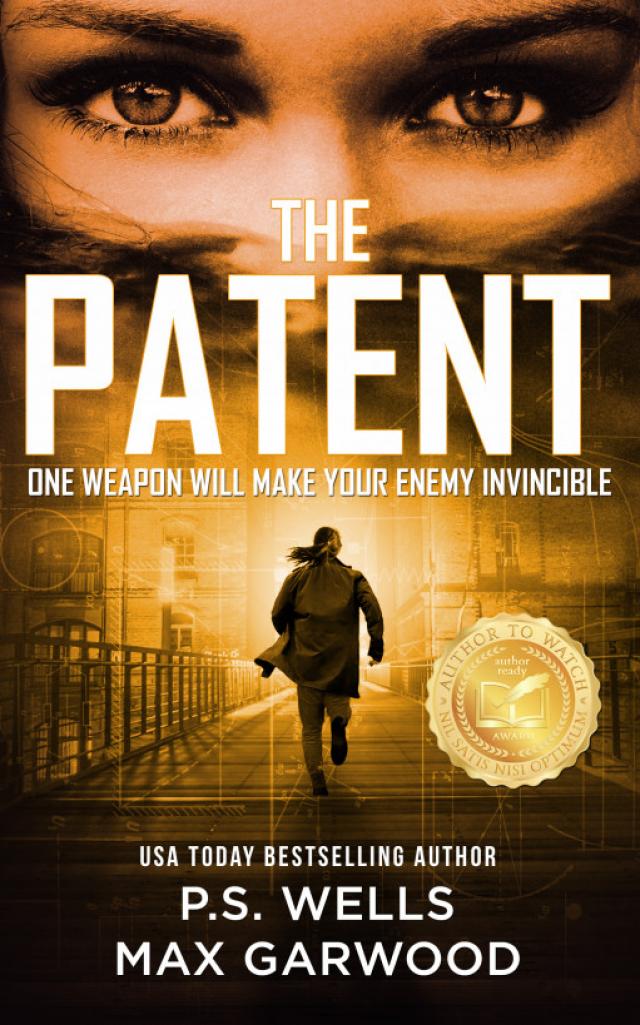
THE PATENT
One Weapon Will Make Your Enemy Invincible
P.S. Wells
Max Garwood
Pegwood Publishing
Copyright 2022 by P.S. Wells and Max Garwood
All rights reserved. No part of this publication may be reproduced, stored in a retrieval system, or transmitted in any form or by any means–for example, electronic, photocopy, recording–without the prior written permission of the publisher. The only exception is brief quotations in printed reviews.
Title: The Patent, Revised edition
By P.S. Wells and Max Garwood
ISBN: 978-1-7331060-2-3 (ebook)
978-1-7331060-1-6 (paperback)
Subjects: 1. Fiction/Action & Adventure
2. Fiction/Thrillers/Suspense
3. Fiction/Thrillers/Espionage
Cover photo: nOahKEaton, 99designs.com
Published by Pegwood Publishing
Roanoke IN 46783
Printed in the United States of America
Dedication
To our readers.
And to Max, Barbara,
Marquis, Sarah, and Evan
who have become family.
P.S. Wells
Chapter One
Shanghai. He hated the place.
Busy and overpopulated, the city offered plentiful opportunities to remain anonymous, a necessary convenience for Colonel Jai Yao’s business. China’s most populous city and one of the first to adopt the one-child population control policy, Shanghai presented the sadistic illusion of prosperity to countless peasants that immigrated from country villages. The place also bore cruel memories that haunted his sleep and confounded his waking hours.
The dirty military vehicle dropped him in front of a tired looking building. One of many religious structures confiscated by the government, the former temple now belonged to the people. The People’s Republic.
Most of these historic structures served as Custody and Repatriation Centers. In an effort to “clean up her cities,” China rounded up beggars, street children, garbage gatherers, prostitutes, the homeless, and any unregistered workers. Anyone authorities opted to bully.
Inside, Yao processed through a security checkpoint. Under vaulted ceilings, the place smelled of age and centuries of incense burned during religious ceremonies.
Passing an oversized room, sweat broke out on his top lip. Barely lit by narrow windows set far above a man’s head, he remembered a similar place, years ago. Reeking of sweat, that room had been jammed with prisoners, all charged with the unpardonable crime that they did not belong. Yao didn’t belong. Insufficient ventilation in the overcrowded space left the inhabitants lethargic, their eyes dulled by hopelessness. Some lay curled on the filthy floor, seeking relief from intestinal complaints. All were plagued by pest infestations and desperate for access to toilets and water for washing.
He shook his head to push away the memory, reminding himself that this building had an entirely different purpose.
In a concrete-walled corridor at the building’s center, two guards flanked oversized double doors.
Again, Yao flashed his identification, and the doors opened. What had served as the temple’s inner sanctuary currently resembled a laboratory not unlike the one where he had studied on the other side of the world. Like the lab at the Massachusetts Institute of Technology in the United States, the overhead lights were bright, and the controlled air circulated cool and dry. Wearing white lab coats, two-dozen Chinese scientists and technical personnel were busy at workstations.
“Colonel Yao.” From the center of the room, one man broke away from his task and came quickly to Yao’s side. “We are honored by your presence.”
The Colonel barely acknowledged the simpering department supervisor. “Walk with me.”
The two passed one workstation after another. Colonel Yao viewed each with a critical eye. “Tell me about your progress.”
Chapter Two
Marc Wayne grabbed a fire extinguisher and doused the greedy flames. His eyes stung, and fire erupted a second time. Emptying the contents of the canister, he ignored the chirp of his cell phone.
At last, Marc and the extinguisher prevailed, and the flames died. Just to be certain, he stood at the ready, poised to combat another fiery outburst. When nothing happened, he relaxed and set his weapon on the granite kitchen countertop next to the television. Movement on the screen caught his attention, and he turned to the news channel report.
“In a grab for military superiority, the Chinese leap-frogged the jet engine technology of the free world. This new Chinese engine powers a superior model fighter plane that, according to the National Security Adviser, ‘poses a serious threat to the safety of our borders.’”
While the news reporter narrated, the flat screen showed a video clip focused on an expanse of sky. As Marc watched, a jet appeared and sliced through the clouds as seamlessly as a dolphin cutting through surf. “Nice.”
The CNN report changed topics, and Marc threw open windows to vent the smoke and fumes. He swept the disappointing remains of his invention, dumped the ashes into the kitchen sink, and flushed the mess down the disposal.
Letting the faucet run, Marc mentally recalculated the inter-connecting ingredients and the sequence of steps that should have produced an adhesive. As he purged his flopped experiment down the drain, he kept one ear tuned to the TV. The morning news predicted overcast skies.
“Weather guessers.” He gathered his hair into a ponytail and switched off the television.
On the routine bicycle ride downtown, Marc cycled through the neighborhood where he’d grown up, past welcoming homes with front porches for sitting out. He peddled leisurely, hearing his bike wheels crackle over the early September leaves swirling along the sidewalks and pooling against the curb. He wheeled around a corner and biked down Main Street. Past the bank, funeral home, and the Veterans of Foreign Wars Post, he braked in front of a narrow brick building that once served as the post office but had been divided vertically into two narrower offices. The sign read Marcus Wayne, Patents.
Leaning the bike against the sign, he heard the phone inside. He fished his pocket for the key and unlocked the door. But the ringing had stopped. Recalling the year he was twelve and had worked his first paper route, he picked up the morning newspaper. Today’s front-page wire story asserted that rapid advancements in military superiority by governments hostile to the United States could be a precursor to World War III.
“Mornin’, Marc.” A gravelly voice called. “Did you see the news?”
Marc turned to see Dr. Thurmond Yoder peering over his glasses. As long as Marc could remember, Thurmond had been the local veterinarian. The building’s landlord, Dr. Thurmond, housed his practice in the west section and rented out the east side.
“How’s business, Dr. Thurmond?”
“Barking along.” The wizened old man appeared tall, thin, and angular, like the brick office they shared.
“Glad to hear that.”
“I’m glad to hear anything at my age.”
When Thurmond had an especially mouthy Chihuahua hospitalized for several days, Marc understood why this rental space had been available so often. “And just how old are you, Dr. Thurmond?” Marc welcomed their customary morning repartee.
“Old enough to remember when you used to come in to get your hair cut.”
Marc tossed the key inside where it landed on the receptionist’s desk. “I was five.”
“Business was slow, so I took up dog grooming. I was clipping your dog, and you asked if those clippers worked only on dog hair.”
“And you said, ‘Let’s see.’”
Thurmond wagged a finger at him. “Looks like you could use another trim.”
“Obviously, the experience traumatized me.” Marc shook his head. “Haven’t been able to face a set of clippers since.”
“I might have medication for that.”
“I’ll keep that in mind.” Marc threw a casual salute. He started into his office, but his neighbor called him back.
“About the news?”
Marc nodded. “I saw the new Chinese military jet engine.”
“Read today’s top news story.” Dr. Thurmond pointed to the newspaper in Marc’s hand. “During World War II, I served as crew chief aboard the aircraft carrier USS Monterey.”
Marc knew the story. Well. While a teenager, Dr. Thurmond lied about his age and enlisted, making him one of the younger veterans of that war. “Along with future president Gerald Ford who helped you fight a fire below decks.”
“Fire erupted from colliding aircraft when swells caused by Hurricane Halsey tipped the ship 70 degrees. During that December of 1944, we lost 147 planes and 490 men.” Dr. Thurmond removed his glasses and cleaned them with his vet smock. “Do you see the connection?”
Like when he got caught daydreaming in school and the teacher called on him, Marc felt unprepared for the question. “Connection?”
Dr. Thurmond held up his glasses and examined the lenses for smudges. “World War II stood as a clear case of good versus evil. Enslaving force against republic liberty.”
Unsure what to say, Marc shifted his weight.
“My generation fought fiercely with the technology we had.” Dr. Thurmond slipped the clean glasses back on and studied Marc. “What will you do about this new threat?”
“Me?” Marc felt like he wanted to loosen his tie, but he wasn’t wearing one. Didn’t even own one. “Or my generation?”
“Every generation needs leaders. Especially when the wolf growls at the door.” With a nod, Dr. Thurmond disappeared into his vet clinic.
Marc opened the morning paper and balanced the pages across his bicycle’s handlebars. Scanning the disturbing cover story, he pushed his bike inside and kicked the door closed behind him.
In this small Midwest town of Dixon, Indiana, Marc felt insulated from the world’s conflicts. These new political developments had nothing to do with him. Surely, someone else would handle the global situation. Someone else always did.
Chapter Three
Special Agent Mallory Wayne checked the time and mentally rehearsed her argument.
“Relax.” Her partner, Thomas Brenau, joined her at the conference table.
“I’m fine.”
“Then stop twirling your hair.” He tugged at his own short-cropped crown. “It makes you look like a novice.” He snapped his fingers. “Oh yeah, you are the newest member of the task force.”
Mallory shifted her twirling into a quick scratch behind her ear. “Welcome back from maternity leave. Have photos of that new baby?”
“Introducing the reason I was out of the office, so you got to be the lead on this project.” Thomas unfurled the photo section of his wallet like an accordion. “Meet the third Brenau production.”
“People keep albums on their computer.”
“I can show you those, too.” He opened his cell phone where a photo of his wife and children served as the screen wallpaper.
Already talking, Special Agent in Charge, Logan Deverell entered the FBI conference room. Early forties, he sported a deep tan and a perpetual cup of coffee. “Talk to me, people.”
Mallory opened her mouth to open the meeting, but nothing came out. Her carefully prepared introduction vanished from her mind.
Thomas cleared his throat and indicated the overhead screen. A wide-faced black man reared in Georgia’s historic Savannah, Thomas had just celebrated his thirty-fifth birthday. The counter-terrorism specialist took the remote from Mallory’s hand and pointed the device at the overhead screen. “Here’s the segment of the CNN special that started this parade.” The news clip described a specialized jet engine manufactured by an Asian company and marketed to governments hostile to the United States.
More than a decade younger than her supervisor, Hoosier native and Purdue graduate, Mallory specialized in research and analysis. She saw her moment to re-engage. To take charge. “According to Department of Defense analysts,” Mallory gestured toward the now silent screen, “that engine is an obvious copy of a General Electric engine under development for a new Boeing fighter/bomber.”
“That explains why the Defense Department has their underwear in a wad.” Deverell unwrapped a stick of cinnamon-flavored gum. “Our directive is to stop the flow of industrial and defense sensitive information to foreign entities.”
Mallory passed a file to Deverell. She opened her own copy and began to read. “Going back over the last two decades, Hsu Kai-lo and Chester H. Ho, naturalized citizens, were arrested by the FBI in June 1997 and charged with attempting to steal the process for culturing Taxol.”
Deverell raised an eyebrow. “Taxol?”
“Used to treat ovarian cancer.” Mallory leaned forward. “A trace element found in an endangered species of yew tree used in the formulation of the drug. Bristol-Myers Squibb invested millions to develop the process for culturing commercial quantities of the material from plant cells.”
Thomas added, “A federal grand jury returned indictments, eleven counts against Hsu, Ho, and a female accomplice, Jessica Chou.”
“Hsu, Ho, Chou?” Deverell waved at the stack of files in front of Mallory. “Sounds like verses from Old MacDonald Had a Farm. With a ho-ho here and a chou-chou there… What else you got?”
“In August 1997, Harold C. Worden pled guilty to felony interstate transportation of stolen property. A 30-year employee of the Eastern Kodak Corporation, Worden worked as project manager for a processing machine using a secret formula that determines the quality of the photographs.” She slid that file to the bottom of the pile and opened the next one. “Kuxuhe Huang sent US trade secrets worth $300 million to China and Germany. Charged under the 1996 Economic Espionage Act, which passed after the US realized China and other countries were spying on private businesses.”
Deverell held up his hands. “Okay. Got it. That stack holds how many such case examples?”
Thomas fanned his own stack with his thumb. “I make it to be the size of a DC phone book.”
“Heavy on the research and evidence, Mallory.” Deverell swept his hand in an exaggerated motion, indicating the number of files. “What’s your point?”
“The point is that we have agents doing a good job tracking down industrial espionage.” Mallory tapped the files with a manicured index finger. “The successful development of that jet engine by the Asian company is the result of vital information secured before the Air Force tested the engine. Before the theft ever became another case of industrial espionage.”
“Before?”
“General Electric worked on the design, using strict security precautions. The functionality of the GE engine showed up in foreign hands before GE made the design public.” Thomas emphasized the word ‘before.’ “The guts of this engine were disclosed in several patent applications that GE filed to protect the design for later commercial development.”
“Meaning?”
“Meaning.” The moment had arrived to press her leadership and display her analysis and deductive reasoning on this case. Mallory spoke each word with overstated slowness. “Somebody had access to the functional design before GE had the engine tested.”


