

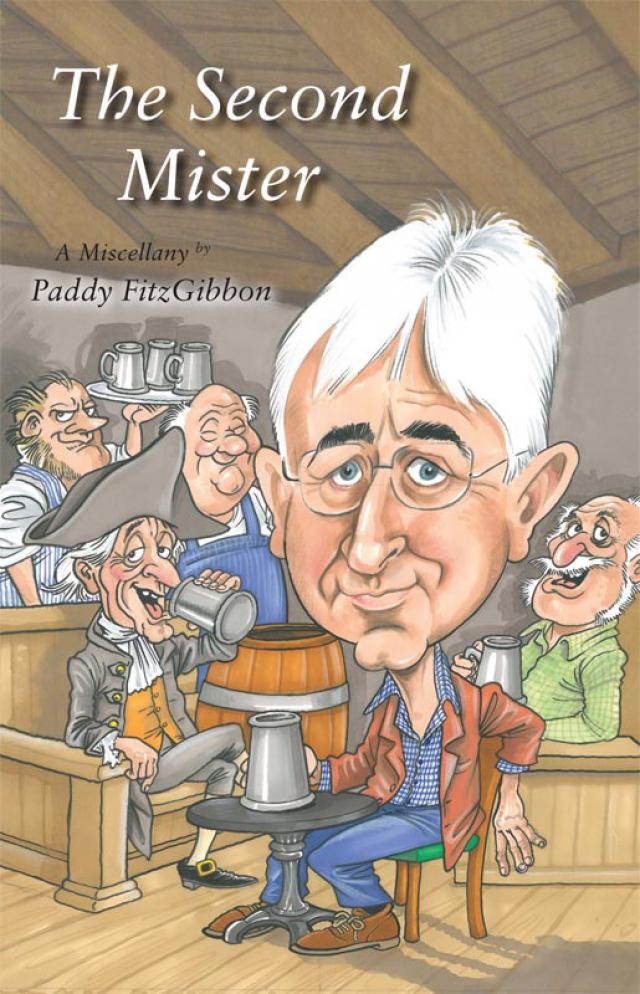
The second mister, p.1
The Second Mister, page 1


THE STRANGE TIMES OF FATHER
COLLIER AND MORDECAI HAM
Igrew up in Listowel in a house that was like a little island surrounded by a happy sea of licensed premises. One wet winter’s night in the Mid - Fifties I was standing at our hall door when a young woman rushed out from an adjoining pub. She was sobbing and the tears on her cheeks briefly reflected the light from a nearby streetlamp. A few seconds later a rather dishevelled figure followed her. She wheeled around to face him and said: “ You don’t love me, Tomeen, you only loves porter”. Tomeen hesitated for a moment and then turned and went back in to the love of his life. The unfortunate woman went on into the night and to loneliness, or to what else I do not know.
What I do know, is that her attitude to the unsanitary intoxi cant would have been warmly endorsed by Mordecai Ham.
Mordecai who ? I hear you ask.
Mordecai Fowler Ham was born in Scottsville, Kentucky on the 2 nd of April 1877. He was descended from no less than eight generations of Baptist preachers and he himself, at a relatively early age, also took on the burden of the service of the Lord. For the next forty years or so, he laid into the practitioners of every evil in sight: fornicators, atheists, Roman Catholics, drunkards, harlots, Evolutionists and modernistic theologians. When Al Smith, a Catholic, ran for the Democrats in the presidential election of 1928 Ham declared: “If you vote for Al Smith, you’re voting against Christ, and you will all be damned.” It is sad to reflect that the 15015464 Americans who voted for Smith are now, apparently, being lit and licked by flames eternal.
Ham himself claimed that during his career he produced 303387 conversions, a figure which seems somewhat precise. Professor James A. Borland, a onetime pastor of Grace Bible Church in Madison Heights , claimed that nearly one million souls “received Christ” as a result of Ham’s efforts, but it is not clear whether or not this figure includes “backsliders ”, so called. One of his most remarkable successes occurred in Macon, Georgia where his preaching resulted in the closing of thirteen brothels, all the whores having declared for Jesus. He was frequently assaulted while in full oratorical and holy flight and on one memorable occasion he dispatched a drunken assailant with a well aimed thump from his hefty Bible.
Oddly different were the attempts at redemption going on at much the same time on this side of the Atlantic.
Only fading memories now remain of the great mission conducted in Listowel by the formidable Father Collier of Limerick. He too had his list of favourite forms of sinfulness that he flayed with a vigour that would have been worthy of Ham himself. His standard stock of errors and horrors included Saturday night dancing, Friday morning sausages, Protestantism and Communism, “Pagan England ” and “Atheistic Russia,” “jazz music”, smoking outside the back door of the church and of course, again and again, anything related to “the flesh ” and its attendant and widespread occasions of sin. It is perhaps surprising that alcoholic beverages were mentioned in passing only, but then a great part of the mission’s success derived from the fact that large numbers of men took advantage of it to come to town and slake a thirst that had been building up for the previous year.
As the days, and more importantly the nights, of the mission went by the fervour, the excitement and the incidence of extraordinary happenings increased exponentially. Little slivers of Latin were heard in likely and unlikely places: Pater noster, Ave Maria, Exultemus, Delirium Tre-mens. Visions of a wide assortment of supernatural creatures became quite common as the drink and the sermons took their cumulative toll. Somebody took a photograph of Father Collier aloft in his pulpit . As the church was dark a flash had to be used. One credulous soul, who had not seen the photographer, declared the resulting wave of light to be “a bolt of celestial grace from Heaven itself.”
At least three times the missioner told the shocking but cautionary tale of a girl “from a very nearby parish” and who was innocent of the grave dangers posed by “company keeping.” It seems that she met a handsome stranger at a late-night dance. She was greatly taken by him and they both left the hall and went to an isolated place. It was only then that she looked down and saw that her companion had cloven hooves instead of feet !
The climax of the mission came on the last night when the faithful were asked the traditional question: “Do you renounce the Devil with all his works and pomps ?” This inevitably produced an enthusiastic but inebriated response from the rear of the church:
“ We do, th’oul hoor, we do.”
Uniquely, the following day Father Collier was escorted to the Railway Station by a small crowd led by a young man playing an accordion. As he was about to board the train a leading toper knelt before the priest and then took his hand and said: “ Father Collier, the people of Listowel will be forever in your debt. ”
Of course it did not last.
The town soon returned to its innocent and sinful ways, but not before a curious incident occurred. It seems that a middle aged citizen had continued the bibulous aspects of the mission for some days after the priest had left. His wife grew increasingly exasperated and at about nine o’clock one morning she stormed out of her house in a great rage and ready to devour anything that moved. Unfortunately, the first person she met was a neighbouring grocer who was in his place of business quietly reading the racing page of The Irish Press . She let loose a roar at him of seismic magnitude:
“ Your oul’ sausages are no good”.
The grocer yawned and then, perhaps thinking of the events of the previous week, replied:
“ They have one advantage mam, you can eat them of a Friday”.
THE RAJ DEPARTED
MY ROYAL CONNECTIONS
THE POET IN TOGHER CASTLE
THE BALLAD OF THE LAST IRISH PATRIOT
RECONSIDERING YEATS
“ … Na flatha fá raibh mo shean roimh éag do Chríost ” is the concluding line of Aodhagáin Ó’ Rathaille’s last great poem, said to have been written on his death bed. The poem shouts to the Universe Ó’Rathaille’s agonised admiration for the old gaelic aristocracy. The words quoted translate roughly as “ My fathers served their fathers before Christ died.” The line was greatly admired by William Butler Yeats.
You bet it was !
He admired it so much that he stole it and used it in his own play The Countess Cathleen, larceny being one of the cornerstones of literature.
The Countess Cathleen is not often seen nowadays on Broadway or in the West End. Hollywood has shown no interest in it at all ! How can this be ? What can possibly explain such neglect of our National Poet and erstwhile Nobel Laureate ?
Perhaps one can discern a hint of where the problem lies by looking at the play’s list of characters which includes inter alia:
“TWO DEMONS DISGUISED AS MERCHANTS,
PEASANTS, SERVANTS, ANGELICAL BEINGS, SPIRITS.”
The play opens with another character, Mary, asking the unforgettable question:
“ What can have made the grey hen flutter so ?”
Well it just goes downhill after that, in spite of mention being made of “a man with ears spread out ” that “moved up and down like a bat’s wing”. Then we are entertained by an image of “..a man who had no mouth, nor eyes nor ears; his face a wall of flesh ” and of course this is followed by further references to the aforesaid hen.
The play was apparently written in 1892 when Yeats was 28 years old.
He had published Crossways, his first collection of poems three years before. The book suffers from a kind of Pre-Raphaelite wishy- washiness but many of the poems hint of greatness to come, but not yet quite to hand.
He wrote many fine poems in the following years, but nonetheless managed to encumber the World with The Man who dreamed of Faeryland and the unspeakable tale of the doddery old priest Peter Gilligan.
As late as 1903 in Baile And Ailinn he could still fall prey to the well known, and usually fatal, poetic tendency to surrender all judgement, and abandon all taste, for the sake of a good noise.
Listen to this:
“ They know all wonders, for they pass
The towery gates of Gorias,
And Findrias and Falias,
And long-forgotten Murias.”
I do not suppose that modern science has yet extended the study of genetics to early twentieth century or medieval verse, but those lines of Yeats must have something in common with the following piece which has been battering the brain of man for half a millenium:
“ Aoibhinn bheith I mBinn Éadair,
Firbhinn bheith ós a bánmhuir,
Cnoc lánmhar, longmhar, líonmhar,
Beann fhíonmhar, fhonnmhar, ághmhar”.
These last two lines have always sounded to me like six fully armoured medieval knights falling off their horses in quick succession.
Then suddenly, around 1911, the poetry changes radically. It is said that the change occurred as a result of certain events in the poet’s love life, or the lack thereof. Gone are the hosts riding from Knocknarea, and Caoilte is no longer tossing his burning hair. Now Yeats has a colder but even more intense engagement with reality.
The man who once had dreamed of faeries at the fair of Dromahair had come a long way when he wrote in September 1913 :
“What need you, being come to sense,
But fumble in a greasy till,
And add the halfpence to the pence
And prayer to shivering prayer until
You have dried the marrow from the bone.”
He never looked back after that an d went on to pen some of the most powerful and moving poetry ever written: The Wild Swans at Coole, Colonos’ Praise, The Tower, the two Byzantiums…the list goes on and on.
So, what is to be said of the occasional howler to be found in his earlier work? Very little, in fact. Every writer takes a tumble from time to time (even James Joyce, perhaps the most careful writer of all). I think it is very much to Yeats’ credit that he managed to cast off the baggage of Faeryland and angelical beings. His closeness to the reality of his historical situation enabled him to create phrases that so accurately reflected his times that they became clichés ( “… the best lack all conviction,” or “…A terrible beauty is born “).
I have been reading Yeats for over 50 years. Yes, he was one of the World’s greatest poets. Yes, his works are one of civilisation’s finest adornments.
I still have no idea as to what can have made that wretched fowl flutter so.
A MAIDEN…
AN EPILOGUE TO
PATRICK KAVANAGH'S POEM
“ THE GREAT HUNGER ”
ALL POWER TO CROMWELL
OLYMPIC IDYLLS
MY WILL
PAY HEED…
DISCIPLINE
PLATYPUS
WISDOM
CARA MÓR *
During the distant days of my brathood, I greatly admired the songs of Elvis Aaron Presley. Elvis was born on the 8 th of January 1935, several years after Kruger Kavanagh had returned to Dunquin from his American exile. Is there a connection between these two great men ? Yes, but only a very minor one, as I will presently demonstrate.
Kruger emigrated firstly to Springfield, Massachusetts, I think shortly before the outbreak of the First World War. During his time abroad, according to his own telling, he got to know everyone of importance in the U.S., but scarcely anyone else. He had some connection with a theatre company in New York and is believed to have at least visited Hollywood. These facts provided him with an impressive corpus of reminiscences which he made good use of after his return home in the late Twenties.
He established a guest house in Dunquin where for forty or fifty years he played host to the great, the good and the not so good. As one of the latter, I first stayed with him in June 1961. On my second evening there, a Rolls Royce came over the hill from the direction of Ballyferriter. This was most unusual as the preferred mode of transport in West Kerry at that time was the Raleigh bike rather than the Rolls Royce. An elderly English couple got out and indicated to Kruger that they would like to stay the night. A tsunami of charm poured forth from our mutual host.
The way into the guesthouse was through the bar which had a plain concrete floor and two seats from a bus of great antiquity. These were provided for those who, as the night went on, were losing their struggle with the perpendicular. There was a large hole in one wall from which Kruger dispensed considerable quantities of wisdom and porter. When the English lady saw the condition of the bar she came back out and said:
“We can’t stay here Mr.Kavanagh, we’re used to staying in Grade A hotels ” .
Kruger’s face reddened as he planted his two strong hands firmly on his hips. He stayed silent for about ten seconds ( a record for Kruger ). He then looked his escaping guest straight in the eye and replied:
“Madam, I have been in every hotel from New York to San Francisco and my establishment is equal to any of them ….”.
Then came the bit of pure genius:
“…and when I say New York to San Francisco, I mean travelling by way of Suez”.
The guest house had doubled as a shebeen for many years. It was granted a liquor licence in the late Fifties, but only after a celebrated court case. Brendan Behan was a regular visitor to Kruger’s and he celebrated the event with a poem in the Irish Times. This began with the noted stanza:
“ ‘Tis a terrible thing to be breaking the law,
But ‘tis worse to be left with a thirst in your craw,
We’ll be decent and legal with pints in our paw
When we wet the new licence with Kruger”.
Kruger was the owner of a van which was known throughout West Kerry. It was very old but it did possess pneumatic tyres, although that might come as a great surprise to anyone who had travelled in it. It had to be driven with all the windows open as the exhaust came up through a hole in the floor, rather than being dispersed in a more conventional manner. There was also a small hole in the roof which had to be avoided in wet weather. Jokingly, I used to call the decrepit vehicle “ An Spéar Van”.* I think Kruger approved of the name, as I heard afterwards that he often used it himself. Needless to say, he claimed the sickly witticism as his own. I never did tell him that the first name that came into my mind was “ An Sean Van Bhocht”. **
Kruger started to drink glasses of port when he was in his early sixties, something which was then unknown to his wife.
The injunction “ Na h-abair faic le Cáit”* was generally issued as soon as we left Dingle for home . On one memorable afternoon he broke his journey back to Dunquin to visit the very elderly proprietor of small pub. The two men chatted amiably for about fifteen minutes. Unfortunately his host’s mind had started to fail him. Kruger stamped out of the bar with great indignation and little dignity after being asked:
“How are the people of Dunquin, and how is that old rascal Kruger Kavanagh?”
Kruger possessed a high intelligence and a truly enquiring mind. These qualities however never seemed to lead to anything other than a great charm which in turn never went anywhere else. He sometimes reminded me of the great Okavango river which instead of flowing to the sea goes inland and eventually evaporates without a trace. His great ego, like all great egos, invited puncturing. Kerry then, as now, had a thriving population of low types and it was inevitable that sooner later some of these would put Kruger in their sights.
Kruger had hung on the dining room walls several inscribed photographs of celebrities he had known. The was a photograph of the then President which carried the message “Do Kruger O’Caomhán , fear iontach. Eamon de Valera”. **
There was a signed photograph of a celebrated star of the silent screen and which described Kruger as “ My greatest lover”.
Kruger was not at all religious: he frequently referred to the newly de-canonized St.Philomena as “The Reactor” . His wife Cáit made up for him. No objection was raised when she came back one day from Dingle with a large picture of the Sacred Heart which she hung on the dining room wall. The holy icon was not remarked upon until one morning about a week later, when the guests came down to breakfast to find that during the night some impious hand had written on it:
“ To Kruger, with affection and respect.God.”
I must admit that I myself did not always forego opportunities to have fun at Kruger’s expense. One day, knowing exactly what the response was going to be, I asked Kruger:
“ Abair liom Kruger, an raibh aithne agat ar Elvis ?” *
His eyes glazed over for a fraction of a second, and then gathering himself, he replied gently:
“ Cara mór a Phádraig, cara mór.” **
Footnotes
* A Great Friend
* Literally “The Sky Woman” who in 18th Century poetry symbolized Ireland.
** Literally “The Poor Old Woman” another poetic image symbolising Ireland.
* “ Say nothing to Cáit”.


