

Like every form of love, p.1
Like Every Form of Love, page 1


also by padma viswanathan
The Toss of a Lemon
The Ever After of Ashwin Rao
published by random house canada
Copyright © 2023 Padma Viswanathan
All rights reserved under International and Pan-American Copyright Conventions. No part of this book may be reproduced in any form or by any electronic or mechanical means, including information storage and retrieval systems, without permission in writing from the publisher, except by a reviewer, who may quote brief passages in a review. Published in 2023 by Random House Canada, a division of Penguin Random House Canada Limited, Toronto. Distributed in Canada by Penguin Random House Canada Limited, Toronto.
www.penguinrandomhouse.ca
Random House Canada and colophon are registered trademarks.
library and archives canada cataloguing in publication
Title: Like every form of love : a memoir of friendship and true crime / Padma Viswanathan.
Names: Viswanathan, Padma, 1968- author.
Identifiers: Canadiana (print) 20230222188 | Canadiana (ebook) 20230222226 | ISBN 9781039006201 (hardcover) | ISBN 9781039006218 (EPUB)
Subjects: LCSH: Viswanathan, Padma, 1968-—Friends and associates. | LCGFT: Autobiographies.
Classification: LCC PS8643.I89 Z46 2023 | DDC C818/.609—dc23
ISBN 9781039006201
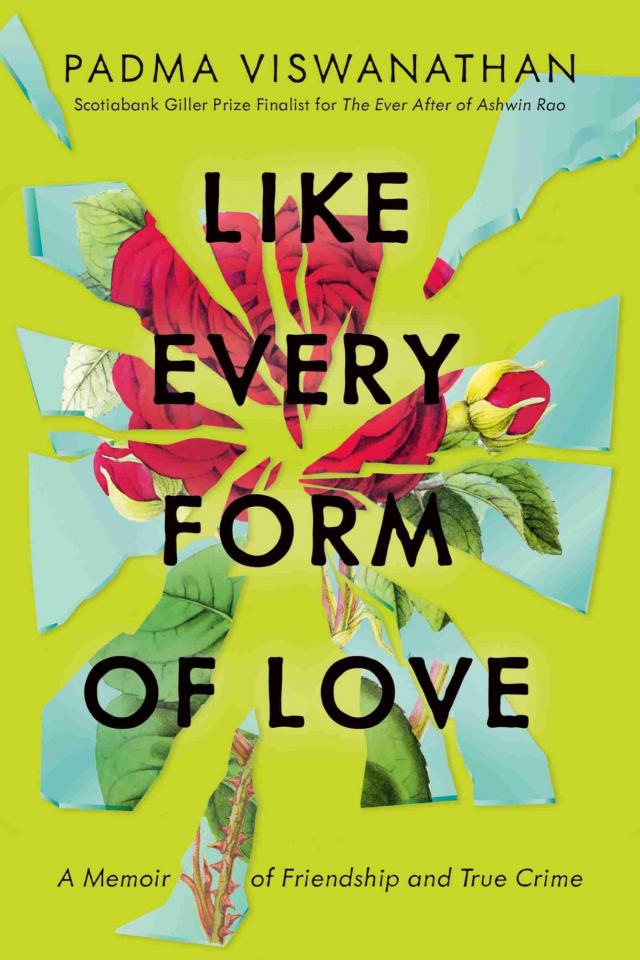
Cover design: Kelly Hill
Image credits: (rose) ArtVee; (glass) susaro / Getty Images
a_prh_6.0_145846060_c0_r1
For C.L.
All right! Let’s start the story. When we come to the end, we’ll know more than we do now.
—hans christian andersen, “The Snow Queen”
The art of writing stories lies in being able to draw, from what little you’ve understood of life, all the rest, but at the end of the page life resumes and you realize that what you knew was nothing at all.
—italo calvino, The Nonexistent Knight
Contents
1. A Complicated Business
2. Taking Notes
3. Of Ducklings and Swans
4. Tonal Resonance
5. The Snow Queen
6. Bullshit Artist
7. The Riddle of the Sphinx
8. Advancing the Drift
9. A Trail of Roses
10. Stones Unturned
11. Cuba Return
12. Like Every Form of Love
13. Ghosted
Acknowledgements
Notes and Credits
1. A Complicated Business
In September 1997, I went to stay on a chunky decommissioned tugboat moored in Genoa Bay, a tiny marina on Vancouver Island. My plan was to spend a couple of weeks writing, alone.
Instead, I made a friend.
On arrival, I’d quickly drawn the attention of my neighbours, people who lived on their boats and spent any spare time or money grooming them, who made their living restoring antique wooden boats, even a woman who had sailed the entire southern hemisphere with her young kids. When I mentioned that my husband was coming out from Edmonton to Victoria for a visit, and that I needed to go see him, they introduced me to Phillip, a fellow landlubber, who was occupying a friend’s boathouse for a few months. He was going to the city for a haircut and could take a passenger.
The marina’s permanent residents gave off some snide energy when they mentioned Phillip, but the Genoa Bayers were all characters of towering eccentricity and outsized opinions. Rumours and slights darted between the piers like schools of tiny fish; cliques formed and exploded with the predictability of a lava lamp. Innuendo wasn’t to be taken too seriously. My own membership in Genoa Bay society was practically affirmed by a couple of snarky comments about the derelict condition of my tugboat, property of my husband’s family.
Phillip was buff, with hollow cheeks and expressive blue eyes: flinty or inquisitive or fonts of loving kindness by turns. There was nothing femmy or camp about him, yet he affected a performative masculinity in public, brusquely calling security guards and checkout clerks “man” and “bud.” In private, he unloosed throaty, symphonic laughs, blasts from a rogue angel’s trumpet. (God, I loved his laugh.) He’d locked that hard body around a tender heart.
His defences dropped quickly; after that trip to the city, he pursued my friendship. My other project in this time, though, was a three-day fast (either confronting or avoiding my then-life’s most urgent subject, my disastrous marriage—I’m still not sure). And as my mother had told me, a food fast is traditionally done with a social fast. She used a Sanskrit word for it, maunam, silence.
Phillip didn’t believe in it, not like the fast conflicted with his beliefs, but like he couldn’t absorb the fact of its existence. He wanted me to come thrifting with him; he wanted me to taste a delicious cookie he’d bought. I caved on all counts. I had only a few days left in Genoa Bay and was charmed and intrigued. He was so different from my other friends. His courtly manners, opening doors for me and making me walk on the side of the street away from the curb; the way he spoke, in a thick BC lilt, his speech peppered with “fuck” the way others use “like” or “um,” using colourful, unfamiliar idioms I’d repeat to myself and write down later. I heard the stern, brass-knuckled poetry of the dangerous classes in his waxings-on about his main topic, the pursuit of rough sex, “the game, the gay game,” as he put it.
After his haircut in Victoria on our first time out together, he ran a hand along his new fade and mused, “Maybe I’ll find me a long-haired motorcycle dude, with my soldier’s buzz cut.”
He told me he hadn’t been sure how I would “take the whole homosexuality thing, being straight…”
“And Indian?” I guessed.
“Well, yeah,” he admitted, “of the culture. But I used to work at a pulp mill, and all the guys there”—Sikhs, I supposed, since they’d been stalwarts in BC’s lumber industry for generations—“they’d be having sex with women, men, everyone. I’d get to know these guys and get to know their dads and go to bed with them.”
Stories: he had a million of ’em.
On my last afternoon, he invited me for tea at the boathouse where he was living, a floating bungalow with walls of some honey-coloured wood, maybe pine. To one side, its windows showed a low black cliff like a side-hugging arm around the bay; to the front, open water. I’d recorded in my journal that week a series of seal sightings over successive dawns, and also birds: black oystercatcher, mountain bluebird, mute swan, hairy woodpecker, belted kingfisher, and a great blue heron I saw daily from my writing desk, the tugboat’s helm. Once, I took my seat to find my eyes level with its scaly feet on the pier beside me.
As Phillip fixed our tea, we chatted idly about desserts. He mentioned a delicious coconut pudding he’d sampled in Cuba and never forgotten.
Cuba? What was he doing there?
It turned out to be the only topic that day: a single story, it took up the entire afternoon.
* * *
When Phillip was eleven, his father, Harvey Totten, a single parent in Chilliwack, BC, placed an ad: Help wanted, three boys. Two women came and left, third time was the charm: Delia Pilon, petite and sassy, with a narrow, calculating face and an air of glamour. Glossy light-brown hair; blouses tied at the waist. Later, when they lived up north for a time, she liked to smoke a cigar while browsing the aisles at Safeway, “just to shock the shit out of everybody,” as Phillip put it. It was her way.
“I told everyone at school that we had a new housekeeper.” It still made him dreamy to recall it. Del integrated quickly, into the Totten household and into Harvey’s bed. Phillip was enraptured.
His mother had been in and out of hospital when he was tiny and gone back east when he was about six. Harvey kept the boys; they’d moved every year since, the main constant being Harvey’s severe regimen of chores (corporal punishment always available as an alternative).
In fairy tales the coming of a stepmother is never regarded as anything but a misfortune, but picture Phillip: a tender boy, living in a house of men, when in waltzes this wisecracking lady, smelling good and with soft arms open. What he called the “negative pressure” of the years before, of all his life, really, or all he could remember, he could feel it releasing. When he came home from school, he’d find Del at the kitchen table; he’d natter on about his day as she poured him a glass of milk and filed her nails, a ribbon of smoke fraying from her cigarette.
And after school let out for the year (the Fraser Valley brimming with scents of mud, manure, wild rose, and yarrow), he came home one afternoon to find Del and Harvey packing the car. A holiday. They’d never taken a holiday.
His eldest brother Ben, who was eighteen, was AWOL by then—he’d been running away from home for a few years and eventually did a stint in prison—but Phillip, his brother Rob, Del and Harvey headed south, taking the coastal route into California. Occasionally, Harvey would pull over so he and Del could consult maps; sometimes, they would leave the car and walk into a field or send the boys out of earshot while they had mysterious, intense discussions.
L.A., San Diego, Tijuana. When they attempted to cross the border into Mexico, they were stopped: Del had no ID. They backed up, conferred. Del took the wheel and “stuck a fifty in her tits.” Phillip heard her speaking Spanish with the border guard, but as she extracted the money from her cleavage, the guar d shook his head. They tried one last time, with Harvey tucking another fifty-dollar bill into his passport along with her warmly creased one.
“No. They turned us around.”
Back in San Diego, Del and Harvey explained that the boys would take a Greyhound with him, while Del would take “the midnight express, what criminals took to get to Mexico. The driver would bribe the guards—no stops, no questions.”
Once they were reunited in Mexico City, Del had a talk with the kids. “So, listen, guys,” she said, as matter-of-fact and maternal as a mother in a TV show, “you have to know something.” The boys cocked their heads. “I’m not ‘Delia Pilon.’ My name is Mary Lloyd and I’m a bank robber. I was paroled, but the conditions stipulated I was supposed to stay in Prince George, ass end of nowhere, nothing and no one. So I broke parole and came down south to be closer to my mum. I’m on the lam.”
* * *
The afternoon light must have been shifting around Phillip as he talked. There are things we can’t remember but whose truth we take for granted.
I remember the boathouse as having many windows.
I remember that the tea—regular black tea with milk, probably Red Rose (only in Canada)—tasted salty to me, but that when I asked Phillip, he said his tasted fine. (In a nostalgic conversation a couple of years later, I mentioned that strange detail and he confessed he’d mistakenly used water he’d salted for pasta. Why did I still remember it? Because it was strange. Why did he? Because he lied.)
I don’t remember that we got on to his family story out of idle chit-chat about desserts: that was in my journal.
I don’t remember exactly how Phillip told the story. I typed it into my computer when I got back to my boat that night, but I’ve since lost the file. I don’t even remember which computer it was. It doesn’t matter, because Phillip repeated it many times over the years and because it’s not important how he said it but how I heard it, which was how most people hear it: they hear “woman bank robber travelling under an alias,” and they’re hooked.
* * *
In the course of their developing intimacy, Harvey and Del had learned that they had shared political convictions: Harvey was a long-committed leftist, insisting his kids read Marx and sing along to old union songs; Del had gotten to know Fidel Castro and Che Guevara back when those compañeros were planning the Cuban Revolution. She and her late husband, Lew, her former partner in crime, had donated some ill-gotten proceeds to the cause.
“Harvey was a pipefitter,” Phillip said, “had his steam ticket, knew carpentry. It was my understanding that we were going down to Cuba to help them rebuild.” Del, meantime, was looking forward to a reunion with Fidel.
Now they were stuck in Mexico City because she had no passport. Fortunately, she and Harvey had a “concoction”—Phillip’s term—inspired by her having fainted in the crowded exit corridor of a bullfighting arena. They would go to the Canadian embassy and say that in the confusion, her purse, containing her passport, had been stolen.
As the boys tried to keep up with what was genuine and what invented, Del explained what they needed to do to help make sure their fledgling family stayed together. Harvey, with great foresight, had brought along various papers related to the boys’ biological mother, Lucille, including their marriage certificate. The idea was that Del would pretend to be her.
“And so,” Del asked, all business, “can you guys make it look like I’m your mum?”
Sure, said the boys. No problem. Lucille had been gone almost half their life; Del was the closest thing they had to a mother. It wouldn’t even really be pretending.
Del went out the next day and bought new clothes—a mid-calf-length dress and jacket, and a hat with a veil that swooped down over one eye. “She looked beautiful, very elegant,” Phillip recalled. “Just before we went inside the embassy, she stops, does a look around, to see if anyone’s watching.” I thought this was vanity, but Phillip clarified: she was “a bit on the paranoid side.”
And then, “In the embassy, we boys were all Mum this and Mum that. We played it to the hilt. Harvey filled out the application, with my real mum’s maiden name, her sister’s name, her brothers’ names, the whole deal. And Del walked out of there with a passport.”
* * *
“A book should be written.”
At some point, Phillip said this. I know he did because I wrote it down in my journal. It’s not actually attributed, but it’s on a page with other quotes from Phillip. Unless I said it? Unlikely: I’m not inclined to the passive voice. Anyway, I’ve thought about it so many times now that I can hear him saying it, just as if he did.
Was it a throwaway phrase, a cliché to underline the story’s outrageousness?
Or was it calculated to plant a seed, because he knew I was a writer?
It doesn’t matter unless we need to decide who to credit or blame for starting this whole mess.
It doesn’t matter because as soon as I heard the story, I wanted to write a book, a book about Del—ballsy, beguiling Del.
* * *
They landed in Cuba on July 26, 1965. “The Cuban national holiday—we just happened to arrive that day. There was music and gaiety.” The streets thronged with people dancing, vibrated with sounds, a güiro, a tres, hips shaking, heads thrown back, an atmosphere—gaiety, that was the word. “We spent two weeks in a fancy hotel—maybe a Hilton pre-revolution?”
Yes: the Habana Libre, formerly the Habana Hilton. It opened in 1958, with five days of celebrity-studded festivities, as the tallest hotel in Latin America. Then the revolution hit and, in 1959, Castro made it his headquarters. By 1964, it was a place to accommodate official visitors, sympathizers, Harvey and Del.
As Del tried to make contact with Fidel, Phillip and Rob cannonballed into the pool and ate that coconut pudding whose taste Phillip was to recall his entire life. The family toured Havana and, eventually, the island, courtesy of the Cuban government, which provided them with a car, driver and translator. “We were taken around in an old Cadillac. They took us to a refrigeration plant, a sugar cane mill, industry places—the government was apparently seriously considering hiring Harvey.
“At one point, we were in a ballroom all lit by chandeliers—an old Mafia hotel—and our driver asked for the lights to be turned down. He asked again, pointing his finger like it was a gun, but they didn’t do it, so he took out a real gun and pointed with that. That’s when it clicked for me: This guy’s a little more than a driver. Anyway, they turned down the lights.”
Within a month, they learned they wouldn’t be staying after all. Del told Phillip that Harvey was “rejected because the authorities read him as racist. They said he treated the Black people differently from the light-skinned people, with disrespect. Uppity white person? No, we don’t want you here to help. They told Del that they didn’t like his kind of communism.”
Back in Canada, Harvey could only find a job way up north, in Kitamat, so that’s where they ended up.
“We didn’t have a lot of money and we’d sold everything, so Del got all our furniture from the dump. And she had a gambling den, poker. She was good—real good. The mayor would be over and the chief of police and everybody, and everybody would compliment her on the place and she’d brag, ‘It’s all from the dump! Every piece!’ ”
A few months later, Harvey got a job that let them move back to the Fraser Valley, a place locals called Strawberry Mountain, adjacent to the Peters Reserve, where they acquired forty-four acres for $8,000, the proceeds from Del’s poker game.
They terraced and planted and started building a beautiful A-frame house from timber they harvested from nearby public lands (everyone did it, apparently). Harvey really did have practical skills and know-how.
“Harvey harnessed the creek that ran down through the property and ran irrigation hoses off it. He also jerry-rigged a pipe that ran into the house and through the stove, to heat it, so we had lukewarm running water.” His skills also came in useful for other less legitimate enterprises, such as rustling a cow that wandered over one too many times from the neighbours’ farm, or distilling moonshine from cider the kids made by running apples through an oak press. They made do, got along to get along.


