

Come rain or shine, p.1
Come Rain or Shine, page 1


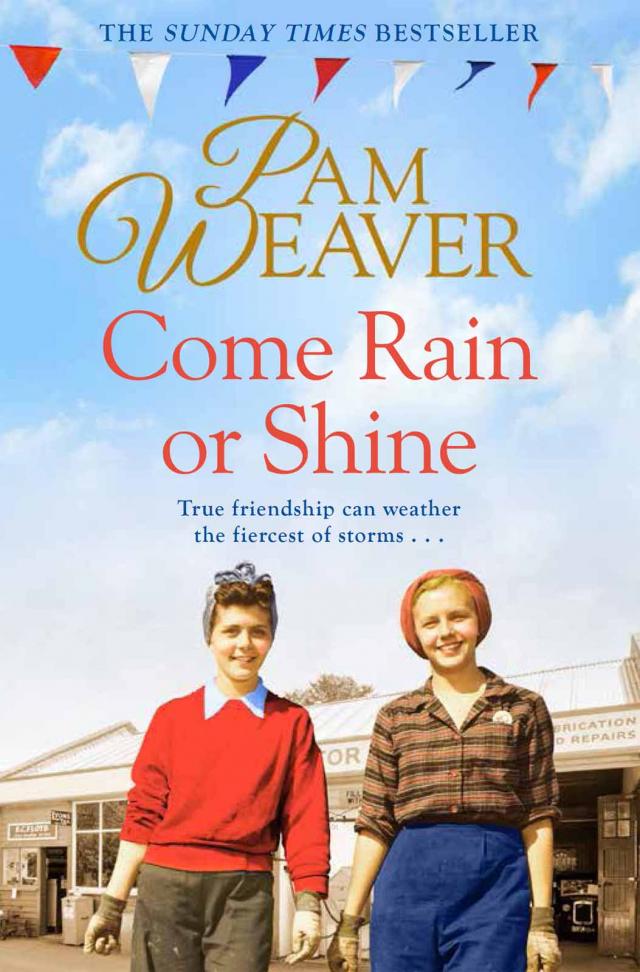
Come Rain or Shine
PAM WEAVER
CONTENTS
CHAPTER 1
CHAPTER 2
CHAPTER 3
CHAPTER 4
CHAPTER 5
CHAPTER 6
CHAPTER 7
CHAPTER 8
CHAPTER 9
CHAPTER 10
CHAPTER 11
CHAPTER 12
CHAPTER 13
CHAPTER 14
CHAPTER 15
CHAPTER 16
CHAPTER 17
CHAPTER 18
CHAPTER 19
CHAPTER 20
CHAPTER 21
CHAPTER 22
CHAPTER 23
CHAPTER 24
CHAPTER 25
CHAPTER 26
CHAPTER 27
CHAPTER 28
CHAPTER 29
CHAPTER 30
CHAPTER 31
CHAPTER 32
CHAPTER 33
CHAPTER 34
CHAPTER 35
CHAPTER 36
CHAPTER 37
CHAPTER 38
CHAPTER 39
CHAPTER 40
AUTHOR’S NOTE
ACKNOWLEDGEMENTS
This book is dedicated to four wonderful people who have always been there to encourage me: Eric and Pat Harvey, Nikki Sheeran and Penny Cheal. Thanks guys and hope you enjoy reading this one . . .
CHAPTER 1
Findon, near Worthing, 1915
The light level was changing over Cissbury Ring. In another half-hour the first rays of April sunshine would bathe the prehistoric hilltop fort, highlighting the ring of trees planted in a previous century. In the dull silence of early morning, Amos McCabe was sitting on the steps of his shepherd’s hut enjoying his first pipe of the day. Before long, his flock would stir from their sleep to feed on the chalky downland pastures. They had grazed in the same area on the South Downs close to the villages of Wiston, Washington and Findon for years, and because the land was not naturally fertile, they had played their part in keeping it well manured. If the soil was well prepared by his flock, the following year the land could be turned over to wheat.
Bess, his sheepdog, came out from under the hut and shook herself. Amos lowered his arm and she came to his side. He didn’t speak. He didn’t need to. The bond between them was strong. She sat under his right hand and he fondled one of her ears.
As soon as the first rays of sunlight streamed across the trees on the hill, Amos rose to his feet. He’d count his sheep to make sure they were all there and then he’d return home. Lambing was over and he’d stayed long enough to make sure every animal was sturdy. After six weeks out on the hills and living in his shepherd’s hut, he was looking forward to sitting by his own fireplace and listening to Molly singing as she prepared their meal in the kitchen. Of course, he’d still have to come out twice a day to check on the flock, but he could enjoy a little free time at last.
In years gone by, his father and grandfather before him would have had the occasional company of other shepherds, but that was in the days when the Sussex Downs were home to more than three hundred flocks. The Great War was changing everything. Once farm workers and shepherds had been sent to the front, the countryside was denuded of labourers and the huge flocks disappeared. These days, Amos would be lucky to find two hundred flocks on the whole of the Sussex Downs, which stretched from the Itchen Valley in Hampshire to Beachy Head, near Eastbourne.
To the sound of the dawn chorus and the tuneless song of a distant cuckoo, Amos and Bess rounded up the sheep and pushed them through a small gate. This enabled him not only to count the sheep but also to do a quick check for any signs of sickness or injury. Occasionally he’d stop to smear a little tar on a scratch or a superficial cut to stop the flies attacking the animal and to give the wound a chance to heal. The whole exercise didn’t take long, but by the end of it, he’d noticed one ewe was missing.
He knew exactly which one it was. He’d nicknamed her Slippery Sybil because whenever she found a gap in the hedge or a weakness in a fence, she’d push her way through to the other side. It didn’t seem to matter to her that she’d left behind good pasture and now she only had barren woodland or weed-covered soil, she made a habit of wandering away from the others all the time. Under normal circumstances he would have got rid of her, but she was a delight to the eye with her beautifully proportioned body and an exceptional coat of wool. Amos sighed. Now, instead of going home, he would have to scour the hillside for Slippery Sybil.
He found her high up on a large patch of scrubland. She had walked across a platform of last year’s brambles, which spanned a small ditch, become stuck and rolled to one side. She remained forlornly waiting to be rescued, two of her legs dangling between the branches, the others in the air. If he hadn’t found her, she would have died. Once she had been ‘cast’ she couldn’t have righted herself and the gases building up in her rumen would have eventually cut off the blood supply, firstly to her legs and then to other parts of her body. For all that, she wasn’t completely stupid. Sybil trusted him absolutely and stayed perfectly still while he leaned over her to release her fleece and lift her out. Once she was freed, Amos stood astride the animal, talking softly to her as he rubbed her limbs to bring the sensation back. When he finally let her go, she walked unsteadily at first, but then broke into a trot which quickly became a run to join the rest of the flock.
Bess had wandered away as Amos set about his rescue. A minute or two later she began to bark. With Slippery Sybil on her way back to the rest of the flock, Amos set off down the hill. Bess was still barking. He shouted a command and although the dog stopped for a second or two, she refused to obey. Instead, she cocked her head on one side and began barking again. It was then that he noticed the magpies. There were several on the ground and a couple in the branches of a tree looking on. What did you call a gathering of magpies? He’d read it somewhere but he couldn’t quite recall . . . a congregation of magpies or was it a murder of magpies? The thought of murder made him feel uneasy. Bess seemed to be keeping them away from something. She was an intelligent animal, and Amos felt obliged to return and see what was troubling her.
As he drew near, Amos heard a reedy cry. It made the hairs on the back of his neck stand up. He’d been working on Sussex sheep country for years. He knew the Downs like the back of his hand. He was familiar with the sights and sounds of animals in the night, like a hen harrier swooping down on a foraging field mouse, the call of a vixen, the smell of a fox’s lair or the cry of an owl. Pathetic as it was, this wasn’t the usual cry of any animal that he’d come across, whether in distress or otherwise.
Bess was still staring into the thicket, her flanks shivering, when Amos crouched down and, looking under the hedge, spotted a tiny arm.
‘Dear Lord alive,’ he murmured. ‘It’s a baby.’
He parted the foliage to get a better look. She was naked but she lay on a dirty piece of yellow-edged blanket. Her skin was blue with the cold and she still had her umbilical cord. The placenta was beside her. Tugging at the blanket, Amos got her into a better position, and whipping off his shepherd’s waterproof cape, he wrapped it around her tiny body. Her cry was getting weaker all the time, as feeble as a kitten’s meow. He knew he had to get her to a place of safety and quickly.
Because he often had days on his own, Amos had become a man who loved reading. Years ago he’d read in a book how the eastern shepherd who lived at the time of Christ had a pocket on the inside of his cloak. At lambing time, he would put any sickly or orphan lamb inside that pocket where the warmth of his own body would help it survive until he could tend to it properly. Amos had been so impressed with the idea that he’d persuaded his wife to make just such a pocket on the inside of his own coat. He’d had little opportunity to use it, but now he gently pushed the baby, still wrapped in her blanket, into its folds and tied his belt underneath her so that she wouldn’t be swung about as he walked. As he hurried down the hill, the birds descended on the bloody placenta, greedy and fighting.
His mind was in a whirl. Who could have done such a terrible thing? It was obvious the perpetrator didn’t want the child to survive, else he or she would have put her somewhere where she was bound to be found. Amos felt sure it couldn’t have been the mother. For starters, it was highly unlikely that she could have climbed the steep hill so soon after giving birth, so who was responsible? The father? The midwife? He felt his eyes smarting. What should he do? When he reached the village of Findon he planned to bang on somebody’s door in the hope they would know what to do, but judging by the poor little mite’s colour, she needed expert help and quickly. There was a hospital in Worthing. Somehow or other, he had to get her there.
As luck would have it, as he came off the hill he saw Jack Ward getting into his builder’s lorry. Jack was startled by Amos’s request, but moments later they were speeding along the Findon Valley towards Worthing with Bess sitting in the back of the flatbed. By instinct, Amos spent the time gently rubbing the baby’s back. He’d do it for a lamb after a difficult birth and for some reason it seemed natural to do the same for this little girl.
They didn’t say much. Each man was left to his own thoughts. Being so early in the morning, the roads were clear and they made good time before Jack pulled into the area at the front of the hospital. Having told Bess to wait by the door, Amos hurried inside. The nurses sprang into action as soon as they saw the baby and she was hurried away.
Someone brought Amos a cup of tea while the police were conta
‘Don’t suppose we’ll catch the blighter what did it,’ said the policeman bleakly, ‘but if we ever do catch him or her, it’ll be attempted murder.’
They let Amos see her before he left. A nurse accompanied him and he stood over the tiny crib. The room smelled of disinfectant and carbolic soap. She was all alone in the room and she was wrapped up in warm blankets. There were two hot-water bottles in the crib, one on either side of her. She stirred slightly as he spoke to her as if she recognized the sound of his voice. Amos laid a hand across her precious little body and said a silent prayer. A minute or two later, he sensed the nurse fidgeting behind him, anxious to get back to her other duties.
‘Thank God I got there in time,’ he mumbled gruffly as he turned to go.
The nurse gave him a sympathetic smile. ‘She’s very small,’ she said softly, ‘and she’s had such a terrible start.’
Amos stared at her with a blank expression as she shook her head and added, ‘Despite your prayers, I’m afraid there’s not much hope.’
CHAPTER 2
Worthing, 1946
‘Just go to the end of Station Approach and head down Chapel Road. You can’t miss it. It’s right opposite the new town hall.’
Sheila Hodges thanked the woman who had given her directions, and hurried off. It was a beautiful day, warm and sunny, perfect beach weather, which was a welcome change. So far the beginning of summer had been wet. Sheila had only just arrived in Worthing, but she hadn’t brought her bathing suit. She was on her way to a funeral, which was why she’d asked directions to the Tab.
When she’d got the letter from her cousin Ronnie telling her that their grandfather had died, Sheila had hardly given it a second thought. Over the years, she’d had very little contact with family and in fact she’d struggled for a moment to remember what cousin Ronnie looked like. She remembered that her full name was Veronica Jackson but she preferred to be known as Ronnie and that she had short dark hair. Ronnie’s older brother, Leslie, had been a bit of a wimp. They’d all met up a couple of times when Sheila was very young and she and her parents had come to Worthing on holiday. That was long before the war, maybe 1929 or 1930. Their week’s holiday was all right, but the weather hadn’t been all that great and the beach was knee-deep in rancid seaweed. The second time had been in the following year. She and Ronnie, who were roughly the same age, got on well, but her mother and grandfather had a terrible row about something and the holiday was cut short. Sheila’s mother said little about the past, but there was obviously some unpleasant history between her and Granddad. Sheila knew her mother and Granny exchanged Christmas cards, but that was about it.
A few days before, Ronnie had written to say that the funeral was to be at eleven thirty at Worthing Tabernacle, Chapel Road, with the wake at their grandmother’s house afterwards. The invitation would have stayed where she’d put it on her chest of drawers had she not had such a dreadful day at work the day before.
Sheila caught the train from Victoria, arriving at five minutes past eleven, in plenty of time to walk to the church. After weeks and weeks in stuffy London it was absolute bliss to breathe in fresh air and not to have to walk by bombed-out buildings, a constant reminder of such awful memories.
She was a pretty girl who had not long had her twenty-second birthday. She didn’t have anything black so she hoped her grandmother would forgive her grey pinstriped dress with a white Peter Pan collar under her navy coat. She’d been lucky enough to stumble across them in a Red Cross charity shop and she’d used her vouchers to get them. The coat was slightly too big but having taken the belt and the belt loops off, at a quick glance it might have passed for one of those swagger coats which were becoming fashionable. Her hat was a jaunty little pixie, which she wore at an angle over the left side of her head.
The town bore few battle scars until she reached the church. There the shops next door had been damaged, but work was well underway to repair and rebuild them. Worthing Tabernacle was an attractive building with a pale Bath-stone exterior and a large rose window gracing the upper part of the building. With a quick glance up at the town hall clock on the opposite side of the road, she mounted the steps and walked in. An usher gave her a slight nod as she went from the vestibule into the church itself.
There were few people waiting inside; five, maybe six. They sat on the semi-circular pews below the double-deck pulpit. The door slammed behind her and they all turned round. Sheila made to sit at the back until a woman dressed in a shabby brown coat stood up and walked towards her. As she drew closer, Sheila recognized her. It was her grandmother. She was older than Sheila remembered, but of course she would be. She was smaller too. Her hat had seen better days. The flowers on the band were tired-looking and faded. Her shoes were highly polished, but creased with age.
‘Granny.’
It must have been easily sixteen years since she’d seen her. The old lady put out her arms and Sheila walked into her embrace. She smelled of lavender and moth balls. When she stepped back, Sheila was struck by her deep-set eyes and sad expression. The frizzy hair peeping out from under the hat was speckled with grey and badly in need of a decent cut and the attentions of a hairdresser. Granny reached up and stroked her face gently. Her fingers were rough. Hard-working hands, Sheila thought to herself.
‘I was so sorry to hear about your mum and dad,’ Granny said softly.
Sheila nodded. ‘I’m sorry you couldn’t get to the funeral.’
Granny’s gaze dropped to the floor. ‘I would have come, but your granddad . . .’ Her voice trailed.
‘I know,’ said Sheila. She smiled.
Her grandmother linked her arm through hers and led her down to the front and the rest of the mourners. Sheila recognized cousin Ronnie at once. She had grown into what her mother would have called a handsome woman rather than being pretty. She still had the same twinkling eyes and a smile which lit up her whole face.
‘So good of you to come,’ she said, giving Sheila’s arm a slight squeeze.
The couple sitting beside her were Ronnie’s parents, Auntie Jean and Uncle Bill, from Warminster. Auntie Jean hadn’t changed a bit, although she had gathered a few grey hairs over the years. Uncle Bill was like a different man. Sheila remembered him as robust and with a mop of ginger hair. Now he wore rimless glasses and he was almost bald. They were dressed entirely in black. There was a man sitting next to Uncle Bill, but he didn’t stand up as she approached. It was her cousin Leslie. He looked every inch the spiv with his flashy checked suit – hardly the thing to wear at a funeral, she thought – and imitation brogues. His hair was slicked down and he had a Ronald Colman moustache. As Sheila squeezed into the pew beside them, there was no time for chit-chat. A voice behind them said, ‘Would you all rise,’ and a moment later the vicar preceded the funeral director and his pall-bearers as they brought in the coffin.
By the time they were on their way to the house, everyone was exhausted. The service had been brief, but then they’d had to accompany the coffin up to Durrington cemetery for the burial. There was only one car so it was a bit of a tight squeeze.
‘Did he make a will?’ Leslie asked as they were being driven to the house. He was wiping his hands with his handkerchief, having made a big fuss when getting some sort of smudge on them as he opened the door.
His mother frowned. ‘Not now, dear.’
Leslie glanced at Sheila. ‘Why not? No need for secrets. We’re all family here.’
Sheila saw the colour rise in her grandmother’s cheeks. ‘It all comes to me,’ she said quietly.
Leslie looked out of the window and everybody shifted awkwardly. Then, turning back, he said, ‘Well, I’ll take over the garage if you like.’
Uncle Bill harrumphed.
Auntie Jean, wedged between them both, nudged her son in the ribs.
‘What?’ he demanded. ‘It’s obvious, isn’t it? I’m the only one here that’s suitable.’
‘She knows you’d never make a go of it,’ said Uncle Bill, leaning forward. ‘I doubt that you’ve ever done an honest day’s work in your life.’
Leslie glared at his father with a malevolent look in his eye. ‘Don’t start that again,’ he retorted. ‘You can’t tell me what to do any more.’


